
Brooklyn Blackout Cake

Medically reviewed by Christiana George Updated Date: June 8, 2023
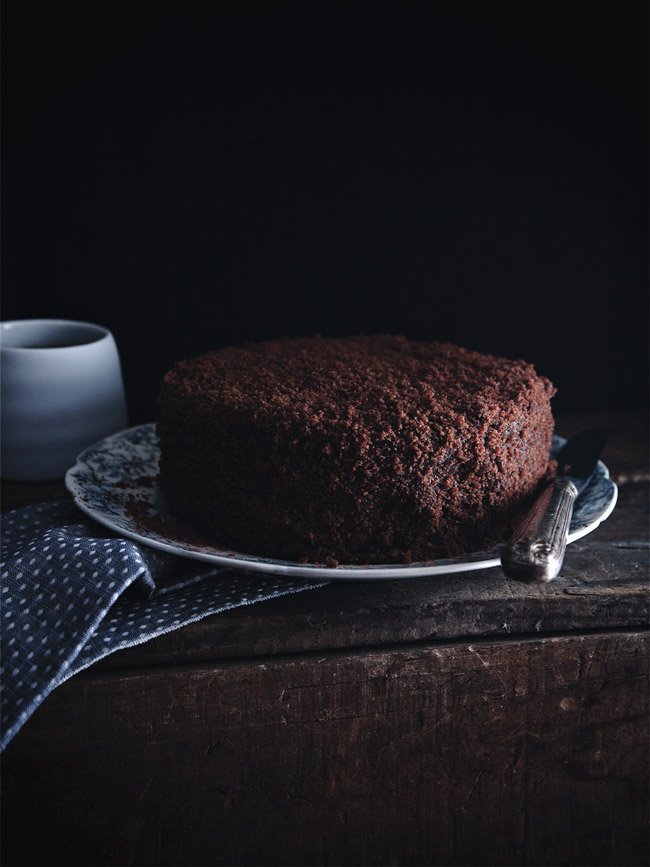
A proper celebratory cake should consist of at LEAST three layers, am I right? Unless the two layers are really thick, or the one layer is a flourless chocolate cake, or an olive oil cake, or something else rustic (and probably foreign). That being said, this cake features three teeny-tiny layers, so maybe it’s only technically a one-and-a-half layers tall. But that’s neither here nor there. The official story is, I made a three-layer cake, and that’s that.
The occasion? My birthday! (I know, I know, who makes their own birthday cake? Hello, a food blogger, duh!) We celebrated on Saturday, therefore the cake was consumed that day. I had to hustle to complete it because my original idea for a twenty-something-layer crepe cake flopped (also, I discovered that Trader Joes’s powdered sugar is slightly gray-colored. Ever seen a gray glaze on a cake? Probably not, because it’s gross-looking.)
For those unfamiliar with the Brooklyn blackout cake, it’s Americana at its finest. Its name was coined during World War II—the most patriotic name possible for a chocolate cake with chocolate pudding frosting and a chocolate crumb exterior, right?—and for a few decades, it reigned as one of the most delicious, iconic food items in the New York area. Unfortunately, the bakery that invented the cake went out of business, and it vanished. Well, not quite. It’s still plenty nostalgia- and saliva-inducing, but the original recipe is, like all good things, cloaked in secrecy.
You’ll find versions of it here and there, back-engineered attempts at recapturing the chocolate on chocolate on chocolate magic. Strangely, my favorite rendition isn’t from a bakery in the borough in which its name was clinched, but rather, from a tiny Upper East Side bakery called Two Little Red Hens, which turns out such a DENSE and MOIST slice, that I can only eat half of it (granted, Chris and I always order a slice of cheesecake along with it).
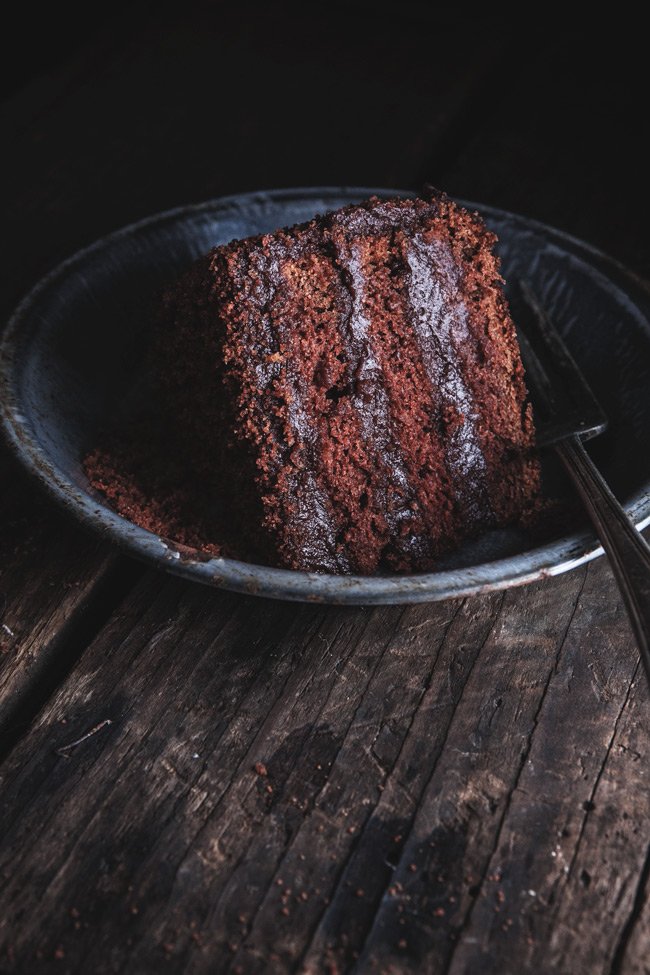
While the cake was consumed in its entirety, I did manage to save a slice so you could see the layers within. For what it’s worth, I found it a bit flat-tasting, lacking in depth, the frosting especially. I was surprised, since it’s from the Hummingbird Bakery cookbook, but then again, I did learn recently that there is such thing as too much chocolate. If you make it, let me know what you think. I may have to adjust my chocolate expectations.

BROOKLYN BLACKOUT CAKE
Makes one 3-layer 6-inch cake
Adapted from the Hummingbird Bakery Cookbook, via Hummingbird High
Note: This recipe was created by Hummingbird Bakery, a London bakery. Michelle wrote that she found the chocolate pudding difficult to make, but I used an immersion blender to mix the corn starch with the water and had no problems with the pudding coming together whatsoever. (A lot of Chinese dishes involve slurries, corn starch with water mixes used to thicken sauces, so maybe I’m just used to the weird properties of corn starch.)
Ingredients:
- For the frosting:
- 1-3/4 cups water plus 1/4 cup water, separated
- 1-3/4 cups granulated sugar
- 1/2 Tbsp light corn syrup
- 1/2 cup unsweetened cocoa powder
- scant 1/3 cup cornstarch
- 3 Tbsp unsalted butter, cold and cut into 1-inch cubes
- 1/4 tsp pure vanilla extract
For the cake:
- 3-1/2 Tbsp unsalted butter, at room temperature
- 10 Tbsp granulated sugar
- 1 egg, room temperature
- 1/4 tsp vanilla extract
- 1/6 cup unsweetened cocoa powder
- scant 1/2 tsp baking powder
- scant 1/2 tsp baking soda
- a pinch of salt
- 1 1/3 cups all-purpose flour
- 2/3 cup whole milk
Directions:
For the frosting: Ideally start on this the day before to give it time to cool fully. Combine 1-3/4 cups water, sugar, light corn syrup, and cocoa powder into a small sauce pan and bring to a boil over medium heat, whisking occasionally. In the meantime, combine the remaining 1/4 cup water with corn starch in a cup and mix with an immersion blender until dissolved. It’ll be relatively thin and uniformly opaque.
Slowly pour the corn starch mix into the sauce pan, whisking vigorously. Let the mix come back to a boil, whisking still. Continue whisking as the pudding thickens. It shouldn’t take more than a few minutes for it to reach a thick chocolate pudding-like consistency. Turn off the heat and stir in the butter, incorporating it completely. The pudding should be shiny and thick.

Pour the pudding into a receptacle, cover the surface with plastic wrap, and place it in the fridge until completely cool.
For the cake: Preheat the oven to 325 degrees F. Butter a 6-inch round pan, and lay a circular parchment paper round on the bottom.
In a stand mixer bowl, cream the butter and sugar until light and fluffy, about 5 minutes. On low speed, mix in the egg until it’s completely incorporated. Scrape down the sides of the bowl, then, on low speed, beat in the vanilla extract, cocoa powder, baking powder, baking soda, and salt. Continue mixing until just combined, then add about half the flour as well as the milk. When just combined, add the remainder of the flour, mixing until just combined.
Pour the batter into the prepared pan, and place it in the oven. Bake for about 30 minutes, until a skewer inserted in the middle comes out clean and the top bounces back a little when you push it. Let the pan cool for a minutes, then empty the cake onto a cooling rack to completely cool. Remove the parchment paper round.
Assembling: Slice off the domed top of the cake. Save it for the crumb topping. Carefully, slice the cake into three even-sized layers (they’ll be quite thin, so be careful). Proceed the way you’d normally assemble a layer cake, adding about 1/4 of the chocolate pudding frosting between layers. (When you take the pudding out of the fridge, it’ll be kind of hard to work with initially, but will become more malleable once it’s been worked with a spatula for a bit.) Cover the exterior of the cake with the rest of the chocolate pudding.
Finally, take that saved dome and process it in a food processor until it turns into fine crumbs. Using a sieve, spread the crumbs evenly across the top of the cake. With the remaining crumbs, cover the sides. I found this easiest to do by taking a handful and patting them onto the sides, first covering the bottom, then moving onto the top.
Related Posts

Subscribe for New Racipies
Get mental health tips, updates, and resources delivered to your inbox.
Dulce de Leche and White Chocolate M&M; Cookies

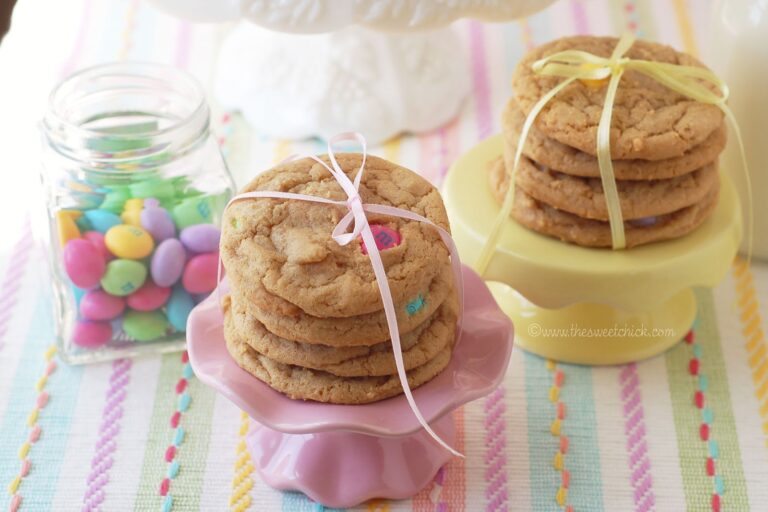
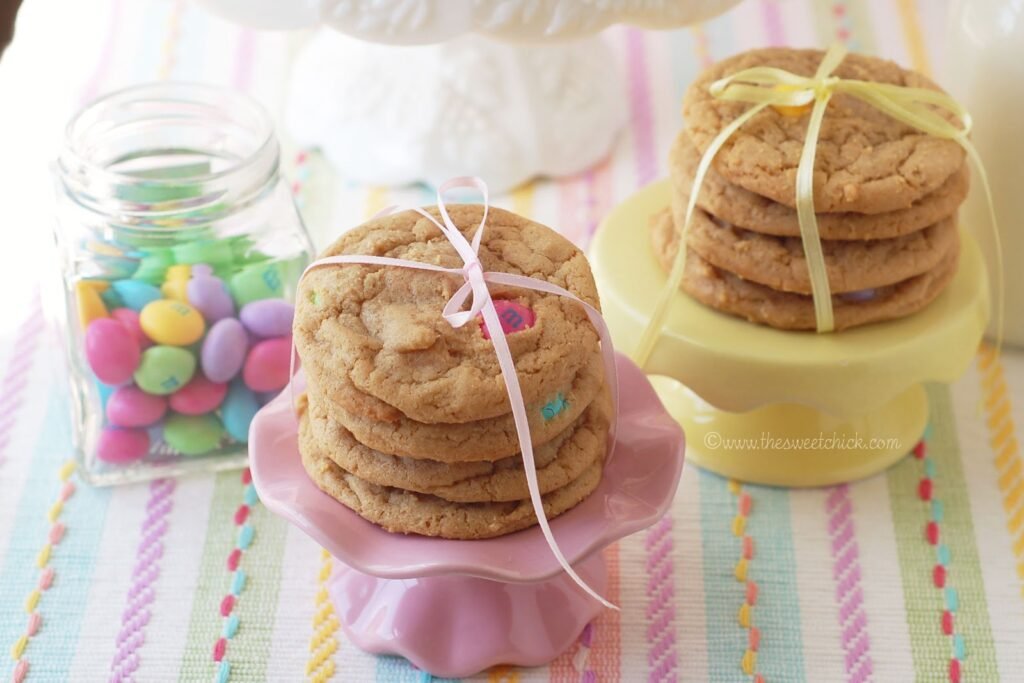
Well, if you are looking for something to make with your leftover Easter candy or leftover dulce de leche, you have come to the right place. Target sold white chocolate M&M’s this year at Easter time. I don’t remember seeing these before. I had to try them. They taste phenomenal. And I don’t usually like white chocolate. I am more of a dark chocolate or milk chocolate kinda gal.
Before I ate the whole bag by myself, I decided I had to make some treats with them. I really liked the taste of white chocolate and dulce de leche in my Dulce de Leche Rice Krispie Treats so I thought I give it a try with some cookies. I took inspiration for my cookies from How Sweet It Is Puffy Peanut Butter Cookies with Chocolate Chips.

I am finding all sorts of new uses for dulce de leche. If it wasn’t for my Argentinian in-laws, I wouldn’t even know it existed. Now that would be a shame.
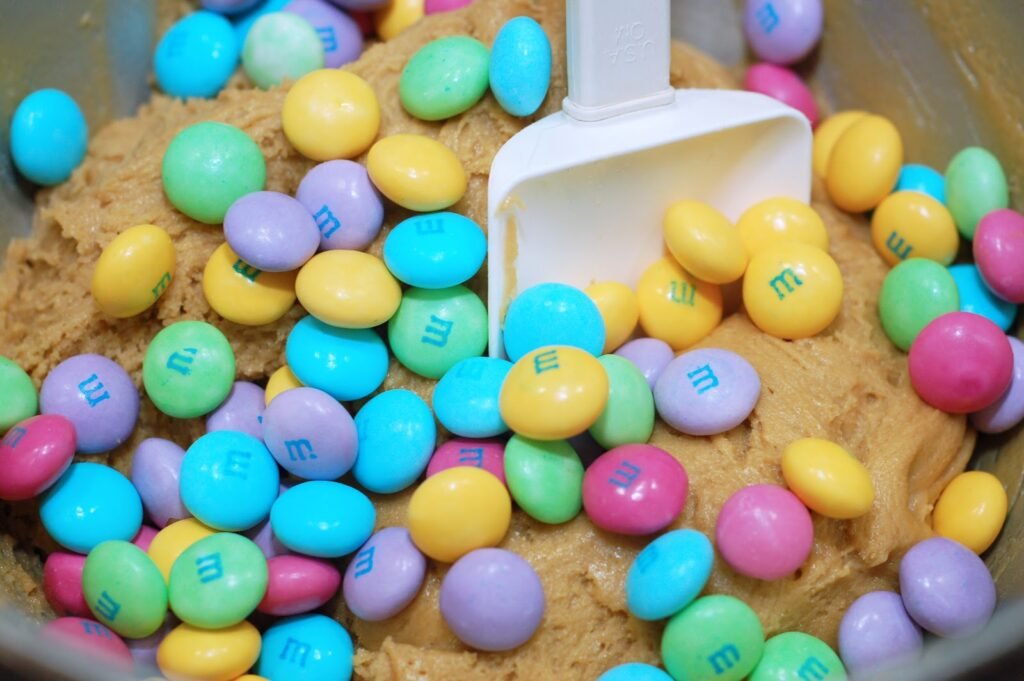
I love the colors of these M&M’s. So pretty!

I could have just eaten the batter like this, but I was good and baked it. Although I did have to battle my daughter to lick the bowl afterwards.
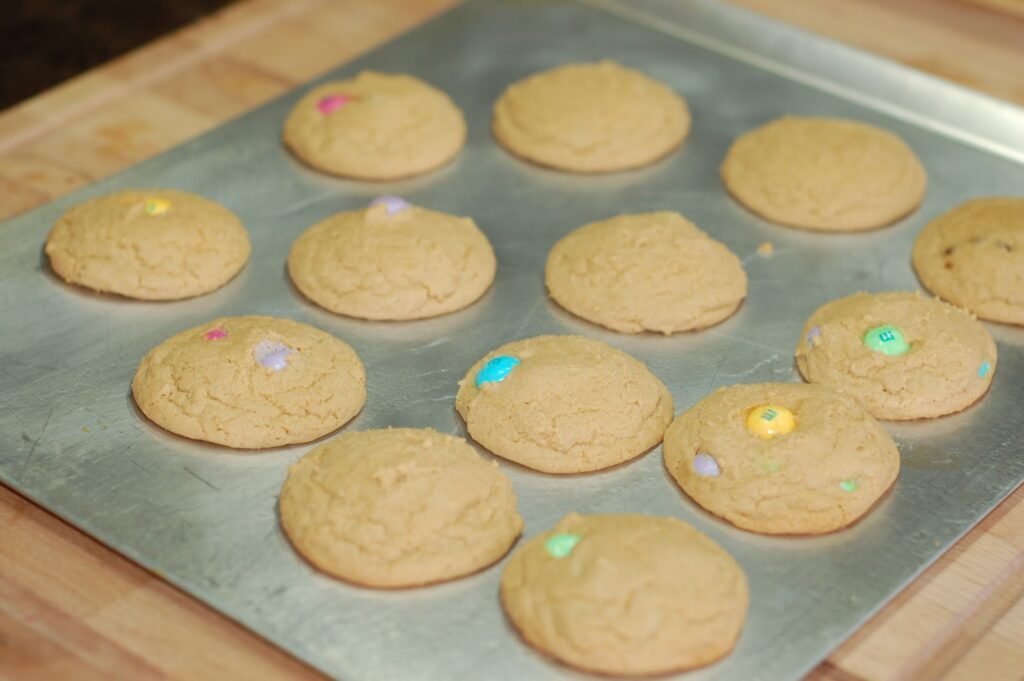
The cookies started out puffy, but then flattened out. I was a little disappointed, but the flavor combo was right on. Just the right amount of dulce de leche and white chocolate M&M’s. Heaven! The cookies came out soft on the outside and chewy on the inside.
Dulce de Leche and White Chocolate M&M Cookies
by The Sweet Chick
Prep Time: 15-10min.
Cook Time: 10-12min.
Keywords: bake dessert dulce de leche white chocolate m&m’s cookie
Ingredients (about 24 cookies)
- 2 cups all-purpose flour
- 1/2 teaspoons baking soda
- 8 tablespoons of salted butter, melted and cooled
- 6 tablespoons of dulce de leche
- 1 cup brown sugar
- 1/2 cup sugar
- 1 egg + 1 egg yolk, at room temperature
- 1 teaspoons vanilla extract
- 1 cup white chocolate M&M’s
Instructions
Preheat oven to 325 degrees F. Place butter in microwave safe bowl and heat in 30 second increments until melted. Let cool completely. Then mix the melted butter and the dulce de leche.
Mix the flour and baking soda in a bowl and set aside. In another bowl, mix the cooled butter/dulce de leche mixture and sugars until they are combined. I used my stand up mixer.
Add the egg, egg yolk, and vanilla and stir until mixed. Gradually add flour and mix until a dough forms. Fold in the M&M’s. I did this part by hand because the white chocolate M&M’s are so big.
Shape the dough into a ball about 1 inch in diameter. I used a cookie scoop. Place on a baking sheet two inches apart and bake for about 10-12 minutes or until the edges are slightly brown. The centers should be soft and puffy. Do not over bake.
Let cool for a few minutes, then transfer to a cooling rack. Make sure you get your glass of milk ready to dunk those beauties!
Related Posts


Subscribe for New Racipies
Get mental health tips, updates, and resources delivered to your inbox.