
Homemade Yeasted Apple Cider Doughnuts (Fluffy & Fried)

Medically reviewed by Christiana George Updated Date: January 5, 2026
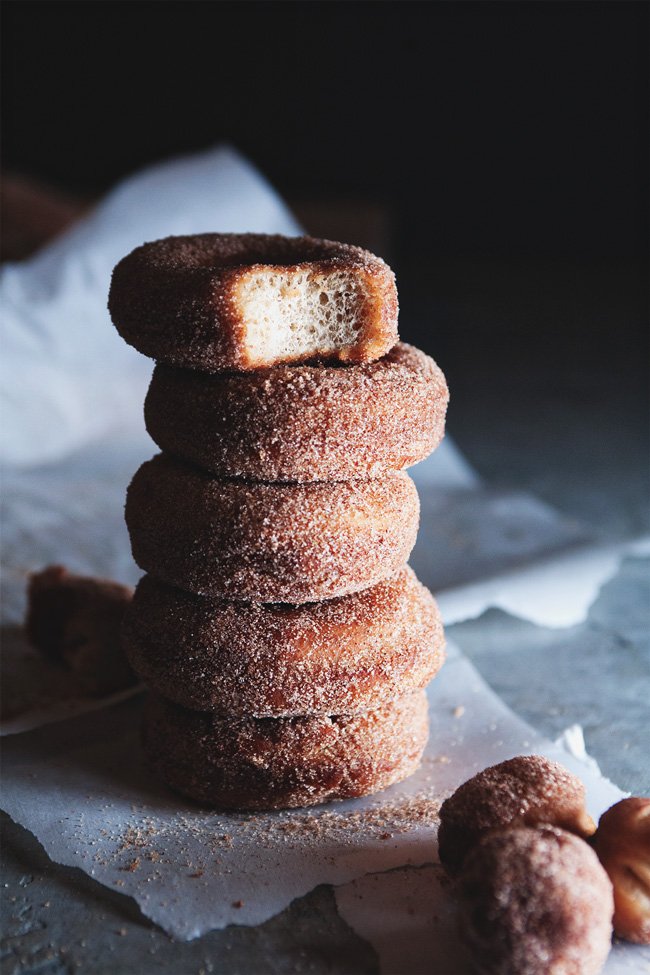
These soft, fluffy yeasted apple cider doughnuts are the perfect autumn treat. Infused with fresh apple cider and rolled in cinnamon sugar, this recipe brings the best of the farmers’ market right to your kitchen.
Capturing the Flavors of Fall
The last couple of weeks: Full of visitors, mostly conversation, and good food too. The three always happen to coincide, don’t they?
Earnest walks, feet pounding pavement to the tune of miles of city blocks, great big swathes of condensation disappearing into the air as we talk, scarves up to our ears, gloved hands stuffed into pockets. The cold is omnipotent and inescapable.
The couch served double-duty as a bed, throws unfolded and refolded, and finally heaped together over the rip in the couch. Towels bunched up on the rack, foreign toothbrushes and contacts, and creams on the counter.
Squished together like sardines around the table. Plates and bowls cycled over and over. Coffee and coffee and coffee and coffee. The twice-daily sauna turns us into captives of the heat, shedding layers as if on cue as the radiator whistles on.

And then there was Thanksgiving…
And then there was Thanksgiving. I can’t even think about it. So much food. My role as the preparer of brussels sprouts, though, thankfully, not much else. Watching as the guys prepared the turkey, standing on tiptoes with my cameraphone poised above the headless carcass.
It was salted, backbone cut out, pushed down hard until its breastbone cracked. Piercing it with a meat thermometer a million and one times, unsure why its internal body temperature kept vacillating. As a result, dry white meat but done in 90 minutes.
For dessert, a pumpkin pie. There was also homemade cinnamon ice cream—thanks, Alanna, for implanting the idea in my mind! It tasted just like Cinnamon Toast Crunch.
Discovering the Perfect Apple Cider Doughnut
The return to normalcy. Decompression. Time once again ours. Sleeping in and in and in. Leftovers. Sitting on the couch, which was once again a couch, and streaming Breaking Bad until Walt started getting annoying.
Christmas tree shops set up on street corners, and wreaths, big ones and decorated ones and plain ones too. I cracked open my computer for the first time in what felt like weeks. Black Friday emails are days late, but overflowing my inbox nonetheless. I also ate my first apple cider doughnut.
And then I had to make them.
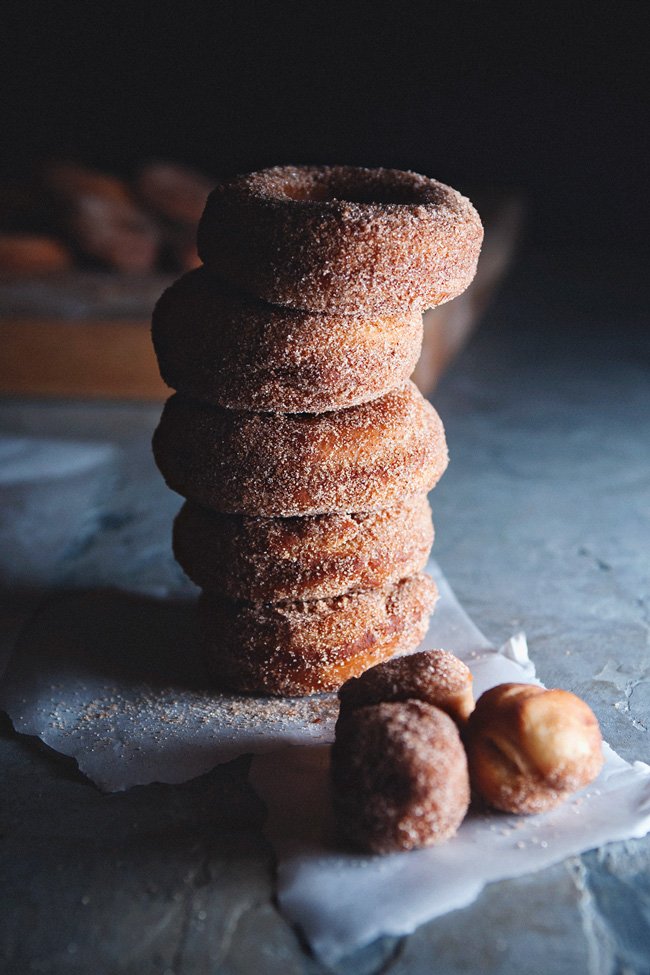
Because what I ate was cushiony and soft, full of air pockets, a real treat for gluten-vores. It was also heady with autumn spices and dusted with coarse sugar, really underscoring the apple cider flavor just like they should. In short, it was completely unlike anything I’d expected, and it was amazing.
Yeast vs. Cake Doughnuts: Why Yeast Wins
I’m not usually a fan of cake doughnuts. In fact, I’m not sure the doughnut I had on Saturday was a cake doughnut – it was far too luscious and fluffy. But I love anything apple cider flavored, so I decided to make my own version with yeast.
This recipe is close. It’s not fluffy enough in my opinion, but then again, I wonder if the doughnut of my dreams is exactly that: not real. Nevertheless, there’s something really exciting about making doughnuts at home (another one of those look-what-I-made! foods), and these taste delicious when they’re fresh out of the, um, fryer?
Is that what you call your pot when you’re using it for deep-frying? Not every person is ready to spend a lot of money at an online casino, and it is okay. For those of you who want to play slot machines with a small deposit, our friends from Fancasinos.com have created a rating of minimum deposit casinos in 2023. People are able to play there with $10 and get a bonus.
Tips for Frying Homemade Doughnuts
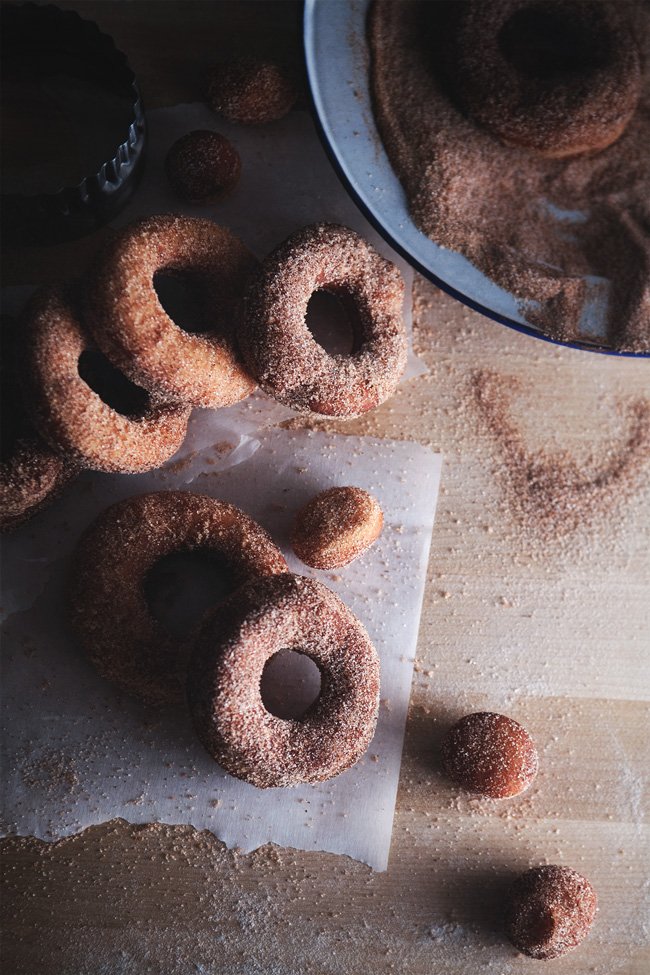
Monitor the Heat: Use a candy thermometer to keep oil at 360°F.
Don’t Overcrowd: Fry 2-3 doughnuts at a time to maintain oil temperature.
The Flip: Use chopsticks for an easy, gentle flip.
YEASTED APPLE CIDER DOUGHNUTS
Makes 12 doughnuts plus 12+ doughnut holes
Adapted from Chow
Ingredients:
- 2-1/2 cups all-purpose flour, plus extra for rolling out
- 1-1/2 tsp ground cinnamon
- 1/2 tsp freshly grated nutmeg
- 1/2 tsp fine salt
- 2-1/4 tsp active dry yeast
- 1/4 cup plus 1 tsp granulated sugar
- 3/4 cup apple cider
- 2 large egg yolks
- 1 Tsp vegetable oil
- 1 tsp vanilla extract
- 1 Tsp unsalted butter, room temperature
Neutral oil for frying
1/2 cup sugar (optional)
1 Tbsp ground cinnamon (optional)
Directions:
Whisk the flour, cinnamon, nutmeg, and salt in a large bowl to combine, and set aside.
In a medium bowl, mix the yeast and 1 tsp of sugar. Heat 1/2 cup of the apple cider until it’s warm but not hot, and add it to the yeast mixture. Stir to combine. Let it sit until it’s foamy, about 5 minutes.
Then, add the remaining 1/4 cup sugar, remaining 1/4 cup apple cider, egg yolks, oil, and vanilla and whisk to combine. Add this mixture to the flour mixture and stir with a wooden spoon until the dough comes together and begins to form a ball.
Transfer the dough to a lightly floured work surface. Scatter the butter pieces over the dough and knead until the butter is fully incorporated and the dough is smooth and elastic, about 6 to 8 minutes. You might need to add up to 1/4 cup of additional flour to keep the dough from being too sticky.
Oil the sides of a large bowl. Form the dough into a ball, and place it in, turning to coat. Cover the bowl and let the dough rise in a warm place until doubled in size, about 2 hours.
Line a baking sheet with parchment paper. Punch down the dough, transfer it to a lightly floured work surface, and roll it out until it’s about 1/2 inch thick. Using a 3-inch round cutter, stamp out as many dough rounds as you can.
Use a 1-inch round cutter to make the inner hole (or, in my case, an icing tip that was about 1.5″ in diameter) and place the doughnuts and doughnut holes on the prepared baking sheet. Gather the dough scraps and repeat.
Discard any remaining dough scraps. Cover the doughnuts and let them proof until they’re about 3/4 inches in height, 30 minutes to an hour.
Fill a heavy-bottomed pot with about 2 inches of neutral oil. Clap a candy thermometer on the side. Heat the oil on medium heat until it reaches 360°F.
It should take a little while, so in the meantime, prepare a rack where the doughnuts will drain by laying over it a few sheets of paper towels. If you’re planning on topping the doughnuts, prepare the cinnamon sugar in a large plate and set it close by.
Once the oil is ready, add the first doughnut. Fry until golden brown, about 30 seconds, then flip it over (I used chopsticks). Add the second doughnut and repeat. Move the first one to the rack when it’s ready, and continue frying the rest.
I was able to balance frying three at a time. Once the doughnut has cooled a little, dip it in the cinnamon sugar until it’s generously covered. Move on to the doughnut holes.
Related Posts



Subscribe for New Racipies
Get mental health tips, updates, and resources delivered to your inbox.
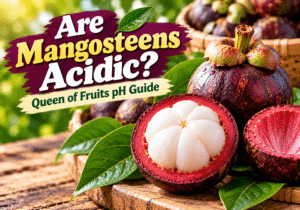
Are Mangosteens Acidic? Queen of Fruits pH

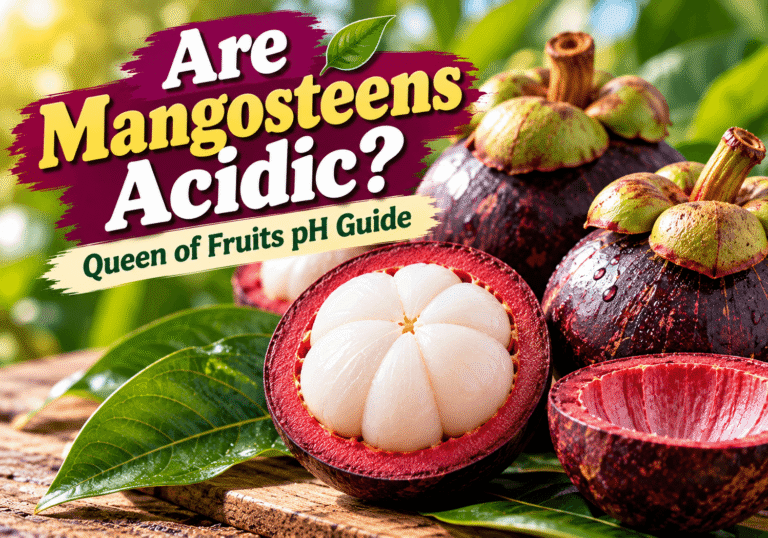
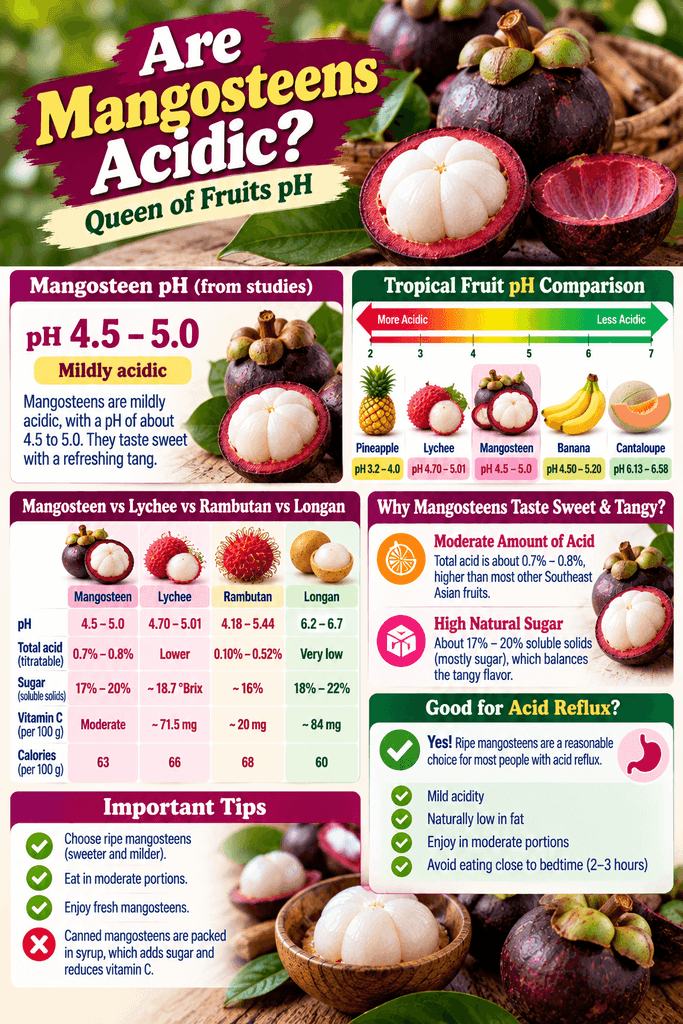
Mangosteens are mildly acidic. UC Davis postharvest experts report that ripe mangosteen flesh has a pH of about 4.5 to 5.0, with titratable acidity of 0.7% to 0.8% and soluble solids (mostly sugar) of 17% to 20% (Kader, UC Davis). That pH is in the same gentle range as bananas and lychees. But mangosteens carry more total acid than most other Southeast Asian fruits, which is why the “queen of fruits” tastes sweet with a noticeable, refreshing tang.
If you have acid reflux or sensitive teeth, mangosteens are usually a reasonable choice in moderate amounts. This guide explains how acidic mangosteens really are, how they compare with lychees, rambutans, and longans, what canned mangosteens mean for your diet, and how to enjoy them.
Key Takeaways
- Mangosteens are mildly acidic, with a pH of about 4.5 to 5.0 per UC Davis.
- They carry more total acid than their sweet cousins, about 0.7% to 0.8%, similar to a tart apple.
- They’re also very sweet, with 17% to 20% soluble solids, which balances the tang.
- Acidity drops as mangosteens ripen and during storage.
- For most people with acid reflux, ripe mangosteens are a reasonable fruit in moderate portions.
- Canned mangosteens come in syrup, which adds sugar and cuts vitamin C.
Are Mangosteens Acidic? The Short Answer
Yes, mildly. Anything below pH 7 is acidic, and mangosteens sit at about pH 4.5 to 5.0. The FDA’s widely used pH table doesn’t list mangosteen (FDA), so here’s what other sources report:
| Mangosteen measure | Value | Source |
| pH | 4.5–5.0 | Kader, UC Davis |
| Titratable acidity (total acid) | 0.7%–0.8% | Kader, UC Davis |
| Soluble solids (mostly sugar) | 17%–20% | Kader, UC Davis |
| Total titratable acid at harvest (Indonesia) | About 0.60%–0.74% | Sumiasih et al., 2019 |
Values vary with cultivar, ripeness, and storage time.
So mangosteens have a mild pH, but a moderate amount of total acid. Both numbers matter, and we’ll explain why next.
Why Are Mangosteens Acidic and Sweet at the Same Time?
pH and total acid measure two different things:
- pH tells you how strong the acidity is in the fruit’s juice. Lower numbers mean stronger acidity.
- Titratable acidity tells you how much acid the fruit contains overall.
Mangosteens have a mild pH (4.5 to 5.0) but more total acid (0.7% to 0.8%) than many similar fruits. Fruits contain natural buffers that keep pH from dropping as much as the total acid might suggest. Mangosteens also have a lot of sugar, 17% to 20% soluble solids (Kader, UC Davis). The result is a fruit that tastes sweet first, with a bright, tangy finish.
We couldn’t find a published breakdown of which organic acids dominate in mangosteen flesh.
How Acidic Are Mangosteens Compared With Apples?
Here’s how mangosteen’s total acid compares with some fruits we’ve covered:
| Fruit | Titratable acidity | Source |
| Rambutan | About 0.10%–0.52% | Chai et al., 2018 |
| Mangosteen | About 0.7%–0.8% | Kader, UC Davis |
| Granny Smith apple | About 0.7%–1.0% | Good Fruit Grower |
| Passion fruit | About 3%–6% | Dantas et al., 2018 |
Different studies and methods; use as a general comparison.
Mangosteens carry about as much total acid as a tart Granny Smith apple, more than rambutans, and far less than passion fruit. But mangosteen’s pH (4.5 to 5.0) is milder than an eating apple’s (3.30 to 4.00 per the FDA).
Do Mangosteens Get Less Acidic as They Ripen?
Yes, overall. A Thai study following mangosteens through maturation found that titratable acidity rose early in development, then decreased until full maturity, while soluble solids in the aril kept increasing (Ratanamarno et al., 1999).
Acidity also falls during storage. In an Indonesian study, total titratable acid was about 0.60% to 0.74% right after harvest and dropped to about 0.14% to 0.20% after 30 days of storage (Sumiasih et al., 2019).
What this means: Fully ripe mangosteens taste sweeter and less tangy than underripe ones.
Are Mangosteens More Acidic Than Lychees and Rambutans?
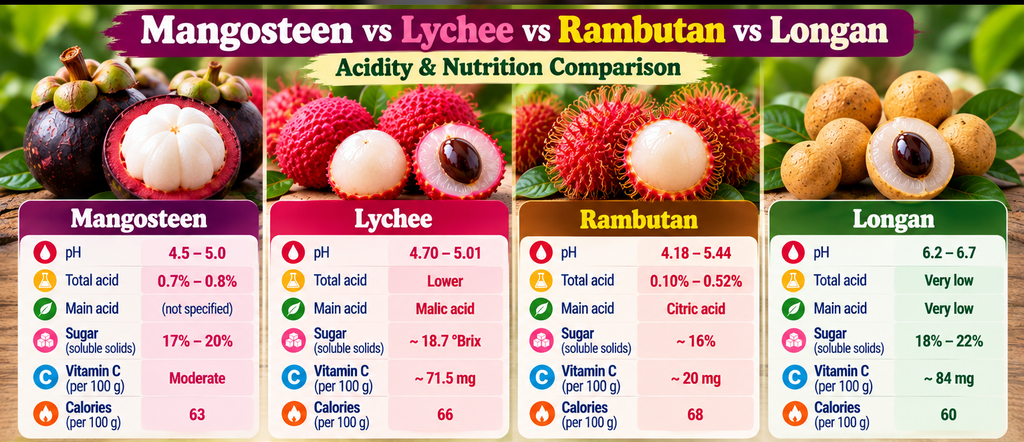
Mangosteens are often grouped with lychees, rambutans, and longans as Southeast Asian specialty fruits. Here’s how their acidity compares:
| Mangosteen | Rambutan | Lychee | Longan | |
| pH | 4.5–5.0 | About 4.18–5.44 | 4.70–5.01 | About 6.2–6.7 |
| Total acid | 0.7%–0.8% | 0.10%–0.52% | Low (not quantified in our sources) | Low |
| Sweetness | 17%–20% soluble solids | About 16% sugars | High | 18%–22% soluble solids |
Sources: mangosteen and longan from UC Davis (mangosteen, longan); rambutan from Chai et al., 2018 and UC Davis; lychee pH from the FDA.
The takeaway:
- By pH, mangosteens, rambutans, and lychees are about the same. All three sit around pH 4.5 to 5.
- By total acid, mangosteens are the tangiest of the group. That’s why they have a more noticeable sweet-tart flavor than lychees or rambutans.
- Longans are the least acidic, close to neutral.
How Acidic Are Mangosteens Compared to Other Fruits?
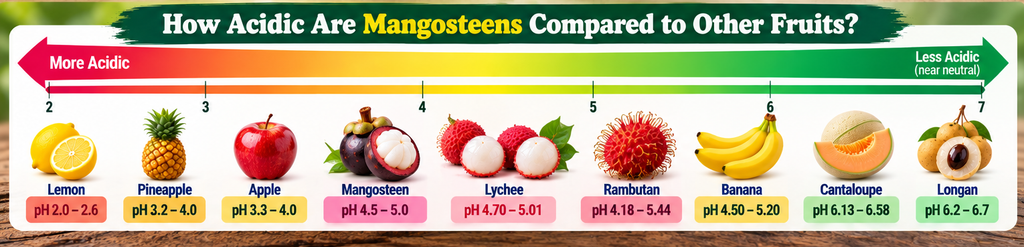
Here’s where mangosteens fall next to other fruits in the FDA’s pH table (FDA):
| Fruit | Approximate pH |
| Lemon juice | 2.00–2.60 |
| Passion fruit pulp (studies) | About 2.4–3.2 |
| Pineapple | 3.20–4.00 |
| Apples, eating | 3.30–4.00 |
| Mangoes, ripe | 3.40–4.80 |
| Guava, fresh (studies) | About 3.7–4.2 |
| Persimmons | 4.42–4.70 |
| Mangosteen (UC Davis) | 4.5–5.0 |
| Bananas | 4.50–5.20 |
| Lychee | 4.70–5.01 |
| Papaya | 5.20–6.00 |
| Longan (UC Davis) | About 6.2–6.7 |
Source: FDA, Approximate pH of Foods and Food Products; mangosteen and longan from UC Davis; passion fruit and guava from published studies.
A few takeaways:
- Mangosteens are less acidic by pH than citrus and tangy tropical fruits like pineapple, mangoes, guava, starfruit, and passion fruit.
- They sit alongside low-acid fruits like bananas, persimmons, and dragon fruit.
- Papaya, longans, and melons like cantaloupe are even milder.
For the full list, see our complete guide to acidic foods.
Are Canned Mangosteens Acidic?
Fresh mangosteens can be expensive and hard to find, so many people buy them canned. We couldn’t find a published pH for canned mangosteens, and the FDA table doesn’t list them. USDA’s only mangosteen entry is canned in syrup (USDA FDC 169090):
| Nutrient | Canned mangosteen, syrup pack (per 100 g) |
| Water | 80.9 g |
| Calories | 73 |
| Carbohydrates | 17.9 g |
| Fiber | 1.8 g |
| Vitamin C | 2.9 mg |
| Potassium | 48 mg |
| Folate | 31 mcg |
Source: USDA FDC 169090. USDA doesn’t currently list fresh mangosteen.
What this means:
- Syrup adds sugar and calories. Drain canned mangosteens and rinse off the syrup if you’re watching sugar.
- Vitamin C is low. Canned mangosteens have only about 2.9 mg per 100 g.
- Check the label for added acid. Some canned fruits include citric acid, which can add tang.
Are Mangosteens Too Acidic for Acid Reflux?
For most people, no. Mangosteens aren’t on the National Institute of Diabetes and Digestive and Kidney Diseases (NIDDK) list of foods that may worsen reflux, which includes citrus fruits, tomatoes, alcohol, chocolate, coffee and caffeine, high-fat foods, mint, and spicy foods (NIDDK). Their pH is mild and they’re very low in fat.
That said, mangosteens carry more total acid than lychees or longans, so very sensitive people may notice them more. The American College of Gastroenterology’s 2022 guideline recommends that people with GERD identify their own triggers and avoid eating within 2 to 3 hours of bedtime (Katz et al., 2022).
Tips for Eating Mangosteens With Reflux
- Choose fully ripe fruit. Acidity drops as mangosteens ripen.
- Start with a few segments and see how you feel.
- Pair them with gentle foods, like oatmeal, Greek yogurt, coconut yogurt, or cottage cheese.
- If they bother you, swap in a milder fruit like longan, banana, or papaya.
- Eat them earlier in the day. NIDDK suggests eating meals at least 3 hours before lying down if you have nighttime symptoms (NIDDK).
For more guidance, see our list of foods to avoid with GERD. If you have heartburn more than twice a week, trouble swallowing, or symptoms that don’t improve, talk with your doctor.
Mangosteens, Teeth, and Gastritis
Teeth: Mangosteens are mildly acidic and quite sweet. The American Dental Association recommends eating acidic foods as part of a meal, rinsing with water or having milk or cheese afterward, and waiting about an hour before brushing (American Dental Association). Our article on whether apples are good for your teeth covers similar questions.
Gastritis: Mild fruits are usually easier to tolerate with gastritis. Try a small amount of ripe mangosteen with food, or choose an even milder fruit like longan or banana. Our 7-day meal plan for gastritis has more gentle meal ideas.
Mangosteen Nutrition
USDA FoodData Central doesn’t currently include fresh mangosteen, only canned mangosteen in syrup (see the table above). Here’s what we know:
- Sugar: Fresh mangosteen flesh contains 17% to 20% soluble solids, mostly sugar (Kader, UC Davis). If you’re managing blood sugar, keep portions moderate. Our guide on whether apples are good for diabetics covers how to think about fruit and blood sugar.
- Fiber: Canned mangosteen has 1.8 g of fiber per 100 g (USDA FDC 169090).
- Folate: Canned mangosteen provides 31 mcg of folate per 100 g.
- Fresh vitamin C: We couldn’t find a reliable USDA value for fresh mangosteen.
A note on mangosteen supplements and juices: Mangosteen is also sold as concentrated juice blends, powders, and supplements. These products aren’t the same as eating the fresh fruit, and this article doesn’t cover their safety or effects. Talk with your doctor before using them, especially if you take medications.
How to Pick and Store Mangosteens
- Storage: UC Davis recommends storing mangosteens at about 13°C (56°F), with a storage potential of 2 to 4 weeks, depending on cultivar and ripeness (Kader, UC Davis).
- Ripeness: In an Australian study, eating quality was acceptable at a uniform pink skin color and best at a dark red-purple skin color (Brown et al., 1991).
Acid-Smart Ways to Enjoy Mangosteens
To open a mangosteen, gently press or score around the middle of the thick purple rind, twist it open, and lift out the white segments. Here are a few ideas:
- Smoothies: Blend ripe mangosteen segments (seeds removed) into our fruit yogurt shake with banana to soften the tang.
- Creamy desserts: Serve them with our whipped ricotta with mixed berries or a scoop of ginger ice cream.
- Breakfast bowls: Top yogurt with mangosteen segments and our pumpkin pie spice granola.
- Summer rolls: Add a few segments to our avocado summer rolls.
- Treats: Chop mangosteen into our tropical dream rice krispie treats.
The mangosteen swaps haven’t been tested in our kitchen, so adjust to taste.
Kitchen tip: The purple rind juice can stain hands and clothing, so open mangosteens over a plate or cutting board.
Frequently Asked Questions
Are mangosteens acidic or alkaline?
Mangosteens are mildly acidic. UC Davis reports a pH of about 4.5 to 5.0, with total acidity of 0.7% to 0.8%.
Are mangosteens good for acid reflux?
For most people, yes in moderate amounts. They have a mild pH, very little fat, and aren’t on NIDDK’s list of common reflux triggers. Choose ripe fruit and pair it with gentle foods.
Are mangosteens more acidic than lychees?
By pH, they’re about the same: mangosteen is 4.5 to 5.0 and lychee is 4.70 to 5.01. But mangosteens carry more total acid, which is why they taste tangier.
Why do mangosteens taste tangy?
They contain about 0.7% to 0.8% total acid, similar to a tart apple. Their high sugar content (17% to 20% soluble solids) balances that tang, giving them a sweet-tart flavor.
Do mangosteens get sweeter as they ripen?
Yes. Research shows soluble solids increase and acidity decreases as mangosteens mature, and acidity keeps falling during storage.
How do you open a mangosteen?
Gently press or score around the middle of the thick rind, twist the halves apart, and lift out the white segments. Remove any seeds before eating.
The Bottom Line: Are Mangosteens Acidic?
Mangosteens are mildly acidic, with a pH of about 4.5 to 5.0. They carry more total acid (0.7% to 0.8%) than lychees, rambutans, or longans, but their high sugar content gives them a balanced, sweet-tart flavor. Acidity drops as they ripen.
For most people with acid reflux, sensitive teeth, or a touchy stomach, ripe mangosteens are a reasonable choice in moderate portions. If they bother you, longans, bananas, or papaya are even gentler options.
Keep exploring with Are Rambutans Acidic?, Are Lychees Acidic?, Are Longans Acidic?, or our complete guide to acidic foods.
Medical disclaimer: This article is for general information only and isn’t a substitute for professional medical advice. If you have frequent heartburn, GERD, diabetes, or take medications and are considering mangosteen supplements, talk with your doctor or a registered dietitian.
References
- Kader AA. Mangosteen: Recommendations for Maintaining Postharvest Quality. UC Davis Postharvest Center.
- Sumiasih IH, Poerwanto R, Efendi D (2019). Study of several stages of maturity and storage temperature on color changes and shelf life of mangosteen. Int J Applied Biology 3(1). Link
- Ratanamarno S, Uthaibutra J, Saengnil K (1999). Towards some quality attributes of mangosteen fruit during maturation. Songklanakarin J Sci Technol 21(1):9–15. AGRIS
- Brown BI, Wong LS, Wells IA (1991). Postharvest Ripening and Packaging of Mangosteen. QDPI Horticulture Postharvest Group.
- USDA FoodData Central. Mangosteen, canned, syrup pack (FDC 169090).
- Chai KF, et al. (2018). Sains Malaysiana 47(7):1483–1490. Link
- Kader AA. UC Davis fact sheets: Rambutan and Longan.
- Dantas AMT, et al. (2018). Bioscience Journal 34(6). DOAJ
- Good Fruit Grower. How to measure Honeycrisp qualities.
- U.S. FDA. Approximate pH of Foods and Food Products.
- NIDDK. Eating, Diet & Nutrition for GER & GERD.
- Katz PO, et al. (2022). ACG Clinical Guideline for GERD. doi:10.14309/ajg.0000000000001538
- American Dental Association. Dietary Acids and Your Teeth.
Related Posts
Subscribe for New Racipies
Get mental health tips, updates, and resources delivered to your inbox.