
How Much Caffeine in Arizona Arnold Palmer? (Full Breakdown of All Versions)

Medically reviewed by Dr. Aris Thorne Updated Date: May 8, 2026

Many of my patients love a refreshing iced beverage on a hot afternoon, and the classic half-and-half tea blend is always a massive favorite. However, when trying to manage your daily stimulant intake, you might pause before taking a sip.
Specifically, you are probably wondering exactly how much caffeine in an Arizona Arnold Palmer you are actually consuming. It is a fantastic question that comes up frequently in my clinical practice.
Because it combines sweet lemonade and brewed black tea, the nutritional formulation can be a bit confusing for health-conscious consumers. Furthermore, with so many different tall cans available at the local convenience store, picking the right one truly matters.
Today, we are going to explore the precise stimulant levels in these popular beverages so you can hydrate safely and smartly. Let us break down every version together.
TL;DR: Quick Overview
- The standard 22-ounce can contains approximately 15 to 25 mg of active stimulant.
- Furthermore, lite variations provide slightly lower levels but still contain detectable amounts.
- Lemon and other flavored variants maintain similarly low stimulant concentrations.
- Consequently, this beverage contains significantly less energy than a standard cup of coffee.
- Finally, these drinks are never entirely stimulant-free unless the label explicitly states it.
Does the Half-and-Half Blend Contain Caffeine?
Yes, this famous beverage absolutely contains a mild amount of natural stimulants. The recipe famously blends exactly fifty percent iced tea with fifty percent sweet lemonade.
Therefore, the brewed tea portion naturally brings its inherent chemical properties into the final mixture. Even though the fruity lemonade masks the earthy flavor, the active neurological compounds remain fully present in the liquid.
Recently, a patient of mine drank a large can right before bed, assuming it was just a harmless fruit juice. Consequently, they experienced mild insomnia and restlessness because they forgot about the underlying tea extract.
Always remember that any product containing real brewed leaves will deliver some level of central nervous system stimulation. Thus, you must account for it in your daily dietary tracking.
Exact Amounts in the Standard Can
Understanding the exact milligrams you consume is vital for maintaining excellent cardiovascular health. Specifically, a massive 22-ounce can holds a surprisingly low concentration of actual stimulants.
While the physical volume is quite large, the active energy payload is remarkably mild compared to modern fitness drinks. Let us look closely at the precise breakdown across the different brand variations.
| Drink Type | Approximate Caffeine Amount |
| Standard Arnold Palmer (22 oz) | 15–25 mg |
| Lite Variation (22 oz) | 10–20 mg |
| Sweet Tea Version (22 oz) | 30–40 mg |
| Lemon Flavor Variants (22 oz) | 15–25 mg |
As you can see, you are not consuming a massive energy bomb. Hence, this drink serves better as a casual refreshment rather than a heavy pre-workout supplement.
Comparing Lite Versus Regular Options
Many consumers reach for alternative versions hoping to reduce their overall chemical intake. However, changing the label often changes the sugar content rather than the actual energy levels.
Therefore, we need to analyze the specific differences between the most popular shelf options. Understanding these nuances will help you make a much healthier choice for your specific metabolic needs.
The Lite Version Breakdown
First of all, the popular “Lite” formulation primarily focuses on significantly reducing the total carbohydrate and sugar load. However, the manufacturer still uses real brewed tea extract to maintain that authentic, nostalgic flavor profile.
Consequently, you still receive roughly 10 to 20 mg of active stimulant per tall can. While this is slightly lower than the standard version, it is certainly not a completely decaffeinated product.
The Standard Regular Blend
Alternatively, the classic recipe maintains the traditional balance of heavy syrups and standard brewed leaves. Therefore, you can consistently expect about 15 to 25 mg of energy per serving.
This mild dosage provides a very gentle lift without causing sudden heart palpitations or severe anxiety. Furthermore, it absorbs relatively slowly into your bloodstream due to the accompanying sugars.
Diet and Sugar-Free Misconceptions
A massive misconception I see in my clinic is the belief that “diet” means completely stimulant-free. Indeed, the word “diet” on these specific cans only refers to the removal of high-fructose corn syrup.
The brewing process remains identical, meaning the active neurological compounds stay completely intact. Thus, you must never give a diet version to a toddler assuming it is just flavored water.
Evaluating Other Iced Tea Variations
Beyond the famous half-and-half mix, the parent company produces a massive variety of standalone beverages. Analyzing these alternatives provides excellent context for understanding your overall daily consumption.
Specifically, different leaf blends release varying amounts of active chemicals during the manufacturing process. Let us explore how the other popular flavors stack up against our primary beverage.
Green Tea Formulations
Many patients switch to green leaf blends hoping for a massive health upgrade. Interestingly, a standard 22-ounce serving of their green formulation contains roughly 15 to 30 mg of active energy.
Therefore, it is incredibly similar to the half-and-half mix in terms of sheer stimulating power. However, it does provide slightly different antioxidant profiles that benefit cellular health.
Unsweetened Beverage Levels
On the other hand, some health-conscious individuals prefer completely unsweetened options to protect their insulin sensitivity. Depending on the exact steeping time at the factory, these pure beverages contain roughly 10 to 25 mg per can.
Because there is no lemonade dilution, you are drinking a more direct brew. However, the overall leaf concentration remains relatively weak compared to home-brewed pitchers.
The Heavy Sweet Tea Option
Finally, the southern-style sweet formulation represents the strongest option in their traditional lineup. Specifically, a large can delivers approximately 30 to 40 mg of active central nervous system stimulation.
Consequently, this specific variant uses a much stronger, darker brew to cut through the massive sugar content. Therefore, you should consume this particular flavor more cautiously late in the afternoon.
Is Caffeine Present in the Lemon Variants?

Another incredibly popular choice is the straight lemon-flavored iced beverage. Many people confuse this product with the half-and-half blend, but it is actually quite different structurally.
Specifically, this drink relies heavily on brewed extracts rather than an equal dilution of actual lemonade. Consequently, it consistently delivers about 15 to 25 mg of active energy per serving.
Unless the packaging features a massive, explicit “Decaf” label, you must assume the product contains stimulants. Indeed, simply adding lemon citric acid does absolutely nothing to neutralize the natural chemicals found in the brewed leaves.
Contrasting Against Coffee and Sodas
To truly understand the metabolic impact, we must compare this beverage to your standard morning routine. Many patients feel guilty about drinking a tall can, assuming they just consumed a massive energy jolt.
However, placing the numbers side-by-side reveals a very comforting clinical reality. Let us review exactly how this sweet treat compares to a traditional roasted brew.
| Beverage Type | Approximate Caffeine |
| Standard Arnold Palmer | 15–25 mg |
| Brand Green Tea | 15–30 mg |
| Standard Brewed Coffee (8 oz) | ~95 mg |
As a result, a tiny cup of morning coffee contains nearly four times the stimulating power of this massive 22-ounce can. Therefore, from a purely neurological standpoint, this beverage is remarkably mild.
The Medical Reason Behind the Low Potency
You might wonder why such a massive physical can contains so little actual stimulating power. From a clinical manufacturing perspective, the answer lies entirely in the specific dilution ratio.
Specifically, creating a true half-and-half beverage requires cutting the base brew with fifty percent fruit juice. Consequently, you immediately slash the total chemical concentration directly in half before it even hits the can.
Furthermore, commercial beverage companies generally brew their base liquids quite weakly to maximize profit margins. They rely heavily on added sugars and artificial flavorings to create a robust taste profile.
Therefore, you are drinking largely highly flavored, diluted water rather than a potent, medicinal-grade botanical extract. This specific manufacturing reality keeps the overall physiological impact exceptionally low.
Are Any of These Drinks Completely Decaffeinated?
Many pregnant patients ask me if they can safely enjoy this brand without worrying about their baby. Unfortunately, no standard version on the regular supermarket shelf is entirely free of active neurological stimulants.
The manufacturing process inherently involves real leaves, which naturally produce these specific defense chemicals. Therefore, trace amounts will always make it into the final aluminum can.
If you strictly require a zero-stimulant diet for medical reasons, you must look very carefully at the packaging. Occasionally, the brand releases specific, explicitly labeled decaffeinated diet versions in certain regional markets.
However, if you do not see the word “Decaf” clearly printed, you must assume it contains energy. Always read the fine print before making a dietary decision.
Clinical Health Considerations and Safety
While the stimulating properties are quite low, you still need to view this beverage through a comprehensive health lens. Specifically, evaluating a drink requires looking at the entire biochemical package, not just a single ingredient.
In my practice, I rarely worry about the neurological impact of this specific product. Instead, I focus heavily on how the other ingredients interact with your metabolic pathways.
Assessing the Overall Stimulant Load
First of all, consuming 20 milligrams of active energy will barely register for a healthy adult. Indeed, the clinical threshold for daily safety sits around 400 milligrams.
Consequently, you would have to drink over fifteen massive cans to approach dangerous neurological territory. Therefore, cardiovascular distress from the specific herbal extract is highly unlikely.
Hidden Sugar and Pediatric Concerns
However, the massive sugar content presents a very real clinical danger, especially for young children. Combining high-fructose corn syrup with even a mild stimulant creates a volatile metabolic reaction in pediatric patients.
Specifically, this combination frequently triggers sudden hyperactivity followed by a severe, exhausting blood sugar crash. Therefore, I strongly advise parents to avoid giving these massive sugary cans to small children.
Who Should Monitor Their Intake
Furthermore, certain highly sensitive populations should still track their consumption carefully. For instance, individuals suffering from severe clinical anxiety or diagnosed cardiac arrhythmias often react poorly to even trace stimulants.
Additionally, pregnant individuals should easily factor this 20 mg into their strict 200 mg daily limit. Monitoring your overall bodily inputs always leads to significantly better long-term wellness outcomes.
The Biological Impact of Tea-Based Energy

It is also fascinating to understand exactly how this specific type of energy interacts with your brain. Unlike harsh synthetic chemicals found in modern pre-workouts, natural leaf extracts provide a uniquely smooth experience.
Specifically, the active molecules temporarily block adenosine receptors in your brain, preventing you from feeling natural fatigue. However, the botanical leaves also contain a brilliant amino acid called L-theanine.
This naturally occurring compound actively crosses your blood-brain barrier and promotes deep neurological relaxation. Consequently, it perfectly balances out the jittery side effects commonly associated with pure chemical stimulation.
Therefore, drinking this half-and-half blend usually results in a very calm, focused alertness rather than a sudden, anxious rush. It is a wonderful example of biological synergy.
Frequently Asked Questions
Exactly how many milligrams are in a standard can?
The standard 22-ounce tall can contains approximately 15 to 25 milligrams of active stimulant. Consequently, it is classified medically as a very low-energy beverage compared to modern alternatives.
Does the half-and-half blend naturally have stimulants?
Yes, because exactly fifty percent of the recipe utilizes real brewed black leaves. Therefore, the natural chemical compounds from the brewing process remain fully active in the final liquid.
Can I buy a completely zero-caffeine version?
You cannot find a zero-stimulant version in the standard lineup. You must specifically hunt for explicitly marked decaffeinated products, which are quite rare in most standard convenience stores.
Does the lite variation remove the energy boost?
No, the “lite” label primarily indicates a significant reduction in added sugars and total carbohydrates. Furthermore, it still contains roughly 10 to 20 milligrams of active energy from the steeped leaves.
Is this brand considered highly stimulating overall?
Absolutely not; it is considered incredibly mild. Indeed, a tiny cup of home-brewed coffee contains nearly four to five times more active neurological energy than this entire tall can.
Conclusion
In summary, understanding what you put into your body is the ultimate foundation of preventive medicine. When we specifically look at how much caffeine in arizona arnold palmer you are drinking, the numbers are highly reassuring.
A standard 22-ounce can deliver a remarkably low 15 to 25 milligrams of active energy. Furthermore, even the light and flavored variations stay well within this incredibly mild, safe range. Consequently, you do not have to worry about this beverage triggering severe anxiety or dangerous heart palpitations in healthy adults.
Compared to a standard cup of coffee or a potent modern energy drink, this half-and-half blend barely registers on the clinical scale. However, you must always remember that the massive sugar content poses a much bigger threat to your long-term metabolic health.
In my clinical experience, enjoying these beverages occasionally as a sweet treat is perfectly fine for your lifestyle. Just be mindful of the hidden calories, and remember that tracking your precise how much caffeine in arizona arnold palmer intake is always a smart choice for your heart!
Evidence-Based References:
- U.S. Food and Drug Administration (FDA) — Spilling the Beans: How Much Caffeine is Too Much?
- Nutrients — Caffeine: Cognitive and Physical Performance Enhancer or Psychoactive Drug?
- Mayo Clinic — Caffeine content for coffee, tea, soda and more
- Journal of Analytical Toxicology — Caffeine Content of Brewed Teas
- MedlinePlus (National Institutes of Health) — Caffeine
Related Posts






Subscribe for New Racipies
Get mental health tips, updates, and resources delivered to your inbox.
9 Possible Causes of Rib Pain Right Side Tender to Touch

Are you having pain in the rib, and you can’t even bend down or do simple chores? Let me explain the real cause of rib pain on the right side and its treatment; hang in there.
Two main factors cause rib pain- internal injuries and bruises to inflammation in the pleura. In addition, it indicates conditions like cancer and cardiac problems.
Dealing with rib pain is no joke! The type of pain that’s experienced can be achy, sharp, dull, or tender to the touch. So keep on reading to know everything about rib pain.
Rib Cage Pain: Overview
Nowadays, people often struggle with rib pain. Depending on the category, this pain can be sharp, dull, and sore. Here are 9 reasons that are responsible for rib pain tender to touch. These include some past injuries, lung cancer, or some inflammatory disease.
However, pain on the right rib can be tricky to diagnose. This is because different diseases have different kinds of symptoms. So doctors have to run tests to identify the cause.
Some causes of rib pain that are tender to touch are more common than others. Let’s take a look at them.
Causes of Rib Pain Right Side Tender to Touch
Pain around the ribs and back symptoms can indicate several conditions. That’s why analyzing the causes of this is very important. Here are the possible causes of rib pain:
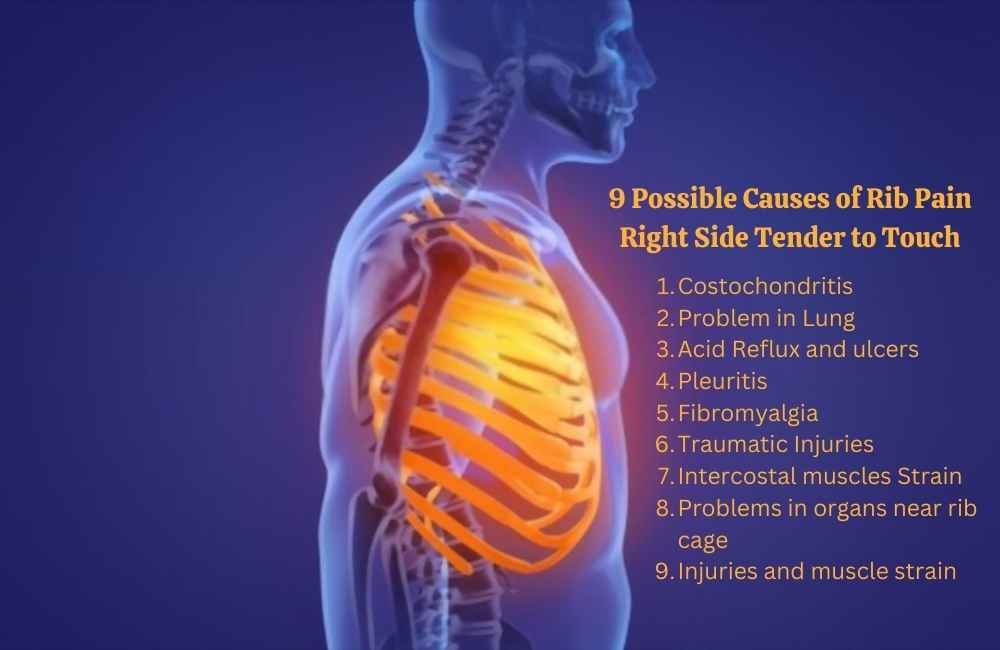
Cause 1 of 9: Costochondritis
This is the most common cause of rib pain right side tender to touch. The name ‘costochondritis’ says all you need to know about this condition. ‘Costo’ refers to the bony portion of your ribs. And ‘chondro’ refers to the cartilage attached to the rib. These are the cartilages that connect the front part of your bony ribs to the sternum.
Doctors use the suffix ‘itis’ to indicate inflammation. So, costochondritis is the inflammation of the costal cartilages. As you’ve read, these cartilages connect your breast bone to the ribs. And they are just beneath your skin. So, any inflammation here will cause rib pain which is tender to the touch.
Specific arthritis, virus, and situations like tuberculosis create this condition. Trauma to the chest and strain due to heavyweights lifting also trigger the causes of Costochondritis.
People diagnosed with Costochondritis usually experience pain across the upper rid. But in severe cases, the pain can run through the back and the abdomen. The pain can be severe to mild and tender to touch depending on the density of the pain.
Cause 2 of 9: Lung Problem
Various lung diseases can be the cause of rib cage pain. These include pneumonia, bronchitis, and lung cancer. In these conditions, the lung tissue and pleura are affected. And this might cause rib pain.
Lung cancer can be fatal. So, you should be on the lookout for its symptoms. These include Chest pain, cough mixed with blood, breathing difficulties, pain under the right rib when breathing, and coughing.
Though the majority of death numbers are more in lung cancer compared to others, early-stage treatment can cure it. So, if you have any of these symptoms, see a doctor immediately.
Pulmonary embolism can cause pain too. Here, blood clots from the legs can travel up to the lungs through the veins. This can make you feel intense chest pain.
Cause 3 of 9: Digestive issues
Heartburn due to Gastroesophageal reflux diseases can make you feel pain in the chest and ribs. You’ll also experience bloating and nausea. The pain can get worse after heavy meals.
In more serious cases, you might develop gastritis and peptic ulcers. These ulcers in the stomach lining can make you suffer from these terrible symptoms like vomiting with blood, and sudden severe abdomen pain. In this case, look for medical help without any delay.
Related Articles:
- Is Tea Acidic? 5 Non-acidic Alkaline Tea for You!
- Are pears acidic? 5 Reasons to add pears in your diet
- Are Apples Acidic? Apples for Acid Reflux [Good or Bad]
- Are Cherries Acidic? Cherries and GERD [Good or Bad]
Cause 4 of 9: Pleuritis
Pleuritis is an inflammation of the pleura. The pleura is a thin double-layered membrane surrounding the lungs. This membrane separates the lungs from the chest wall. This allows your lungs to expand and contract with minimum friction.
In pleuritis, rubbing those inflamed lines can create real deal pain in the chest. Patients get normal within two to 12 days on their own. That’s why you don’t need to worry about which doctor to consult for rib cage pain in this case. However, if the pain is too severe, you might opt to see a doctor.
Cause 5 of 9: Fibromyalgia
Fibromyalgia is a chronic condition presenting with burning, stabbing, or throbbing rib pain. Study shows that women are more likely to get this condition.
Though Fibromyalgia is a very common cause of rib pain, it is hard to treat and diagnose. Rib cage and sometimes chest pain, fatigue, morning stiffness, and mental fog are the symptoms to look for.
Cause 6 of 9: Traumatic Injuries
Trauma to the rib cage can give you serious rib pain on the left side or right side. Breakage, bruises, and even broken ribs due to falling while running on the ground, or car accidents can be the causes.
Swelling and sore pain while touching are the symptoms of traumatic rib injuries. So, if you are wondering, what makes ribs sore to touch? It’s probably an injury.
Cause 7 of 9: Intercostal muscles Strain
There are intercostal muscles inside our rib cage. These muscles can get strained due to heavy physical activities and injuries.
It can cause rib pain and tenderness in the affected area.This acute pain can get worse while deep breathing, or bending over.
You can face back rib pain even for a simple reason like wrong posture and exercise.
Cause 8 of 9: Problems in organs near the rib cage
Problems related to areas near the rib cage like gallstones, liver, kidney, or pancreatitis can lead to referred rib pain. Pain around the ribs and back symptoms can be an underlying situation for cardiac issues.
The pain under the right rib cage when bending over or doing household chores can be a heart attack indicator. Consult a doctor without any delay.
Cause 9 of 9: Problems in the ribs themselves
Some diseases affect the bones of your body. The common one is osteoporosis. In this condition, the calcium of your bones gradually decreases and makes your bones weaker.
Osteoporosis doesn’t cause any bone pain. However, it can make the bones brittle. So, they can fracture easily, sometimes even without trauma. So, if you had osteoporosis, then you might develop rib pain due to bone injury.
Different types of cancers can affect the bone too. Sometimes, these can cause rib cage pain too. But there will be other symptoms as well. But these are quite rare.
When to seek medical help for rib pain?
Rib pain could be an underlying symptom of conditions like heart attack and severe injuries. If you are thinking that you can get away without a doctor’s help, then you are wrong.
Seek medical help right away If you have any accidents or injuries. Minor accidents like falling or strain from over-exercising can lead to major damage.
Though in some cases you might get better with time. But if you are doubting any of the following symptoms, then take immediate action without further delay.
- Sharp pain while breathing or moving
- Shortage of breath
- High fever and loss of appetite
- The pain gets worse at night
- Pain traveling through the shoulder to arm
- Severe leg pain
- Light-colored stool or yellowish urine
- Cough mixed with blood
- Sudden weight loss
Rib cage pain treatments
Rib pain right side tender to touch treatment depends on the cause of the pain. However, to reduce pain, doctors use two types of methods. Have a look-
Pain due to Costochondritis
In the case of Costochondritis which means rib cartilage inflammation, the doctor can use a cold compress to reduce that and suggest over-the-counter medicines.
If the pain isn’t significant, then they might prescribe you anti-inflammatory medicines like NSAIDs. Other treatments involve injecting steroids into the affected spot.
Pain due to bone cancer
The doctor will run a couple of tests and apply different procedures to bone cancer patients. Because treatment for this depends on the origin and type of cancer.
Bone cancer can spread from the rib as well as other parts of your body. So after the determination of the actual origin, the doctor might suggest a removal surgery or biopsy of abnormal growths.
If the surgery radiates any risk factors or is impossible for you, then your doctor may perform chemotherapy or radiation therapy to shrink them first to do the surgical removal later on.
7 Prevention ways of rib cage pain
Though some advice can help you to prevent rib pain, remember to consult a doctor before taking any initiative. If you are looking for how to prevent rib cage pain at home, then your doctor might suggest:
- Take your medicines within time.
- Do a little stretching warm-up to strengthen your muscles before lifting heavy weights or any exercises.
- If you have a smoking habit, try to quit it to avoid cancer and lung issues that can trigger rid cage pain.
- Sanitize your hands frequently to prevent germs from getting into the body and give you diseases that can cause rib pain.
- Take care of yourself at home according to the doctor’s advice. Like, Taking an ice bag to injuries and showering with lukewarm water to soothe the pain.
- If you are experiencing rib pain because of internal injuries, muscle strain, or rib fracture, then give your body proper rest for a healthy recovery.
- Have a proper conversation before taking any steps.
Also, health screening is another best way to stay healthy and get actual health conditions before getting worse.
Conclusion
Rib pain at night or anytime can be a huge obstacle for you to finish your day-to-day task. In severe cases, It’s difficult to move or even breathe while having pain.
Whether the pain is due to serious injuries, inflammation, or pulled muscles, don’t try anything at home without consulting a doctor. Hope this article was helpful to you.
Related Posts



Subscribe for New Racipies
Get mental health tips, updates, and resources delivered to your inbox.