
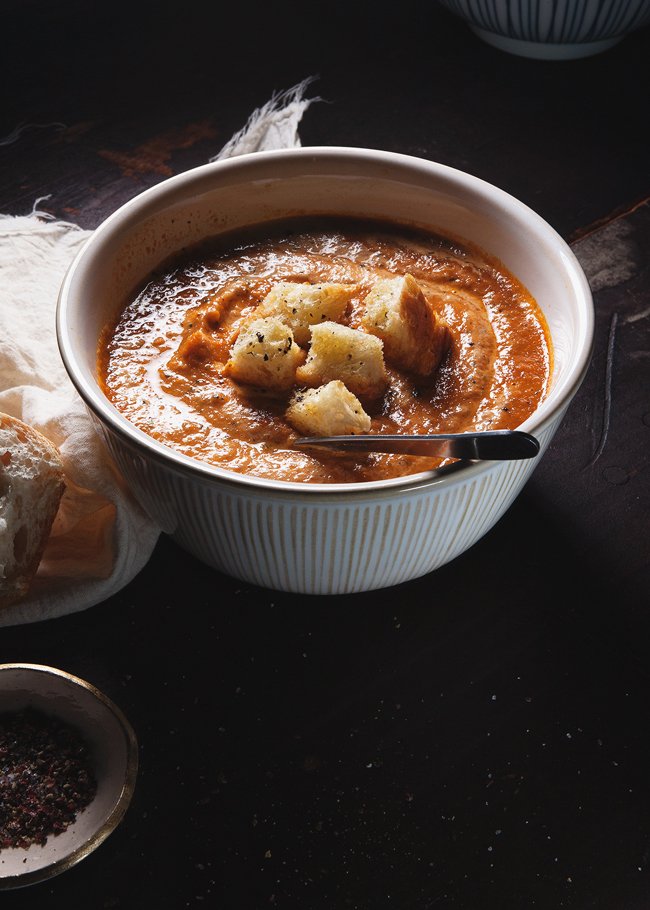
Tomato Soup

Medically reviewed by Christiana George Updated Date: June 8, 2023
Yesterday, I was working at Starbucks (Freelancers Central) when a lady standing by the doors tipped over into a drug-induced trance.
The baristas immediately called 9-1-1, but the woman sitting next to me, the one who’d seen the whole incident go down because she’d been standing outside making a phone call when it happened, just shook her head and informed me that the lady was ‘as high as a kite.’
Now that’s a feeling I can relate to. That world-weariness. After all, I had gone to school in the most psychedelic college town in the country (Berkeley), and lived in what is probably the most homeless-friendly big city in the WORLD (San Francisco). I’ve seen it all—so what if I’m only 26?—all the different variations of drug-induced catatonia and rants and everything in between.
This old man with white hair, he’s a regular who just hangs out in the cafe all day chatting with other regulars (except me, because I avoid eye contact with strangers, much in the style of Amelie Poulain), leapt up from his seat and raced outside, wanting to take charge of the situation. He reminded me of one of those alert guard dogs, the kind that’s been bred to inspect signs of disorder, and cleared aside the small crowd that had gathered around the woman to get a closer look.
He re-entered the cafe a few minutes later. “She’s on drugs,” he said disgustedly.
A few minutes later, the lady dizzily pushed herself up and teetered away. “She’s only on drugs,” Mr. Regular repeated, shaking his head.
This was when the firemen rushed onto the scene. They pulled up in their shiny truck with their sirens blaring, and parked gracefully into the empty space in front of the building that just happened to be big enough for one regular-sized fire truck.
“Did they need to bring so many men?” the woman beside me asked. Sure enough, five firemen stepped out, clad in their heavy protective gear. Men who meant business. Men who looked like they were ready to put out a fire.
“She doesn’t need firemen,” said Regular Man. “She needs to be slapped in the face and drenched with tomato soup!”
Tomato soup, now that’s an idea.
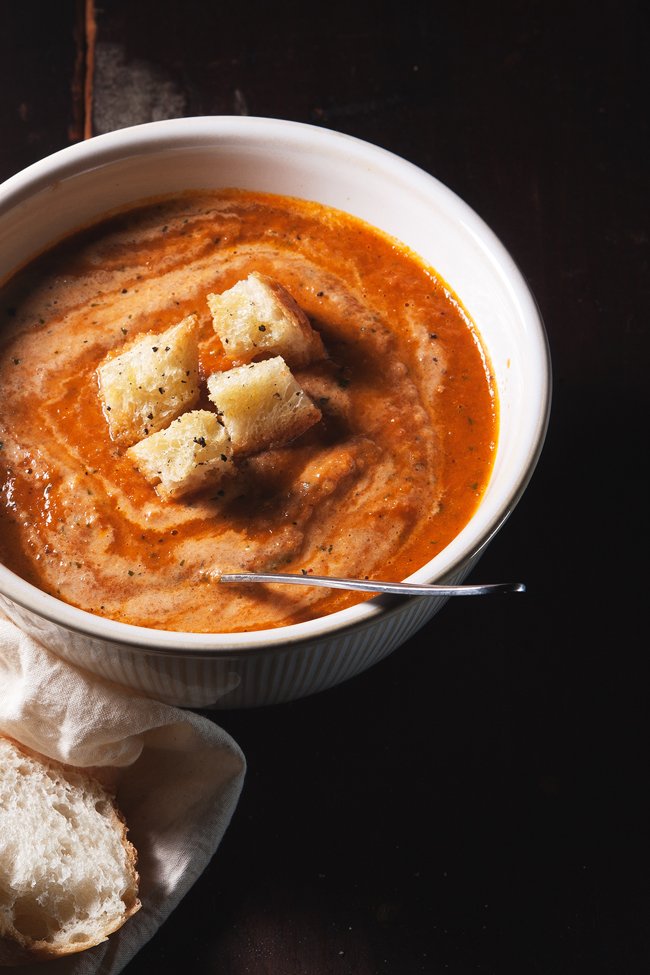
Did he mean what he said sadistically? Was he implying that the lady should be burned with a hot, acidic liquid as a sort of punishment? Or maybe he thought it would revivify her, the equivalent of pushing her into a molten pool. Or maybe he just wanted tomato soup for dinner and had made a Freudian slip.
Whatever the case, guessing does not change the fact: these are the kinds of moments that can inspire meals. I’m very easily persuaded, and I happen to really like tomato soup.
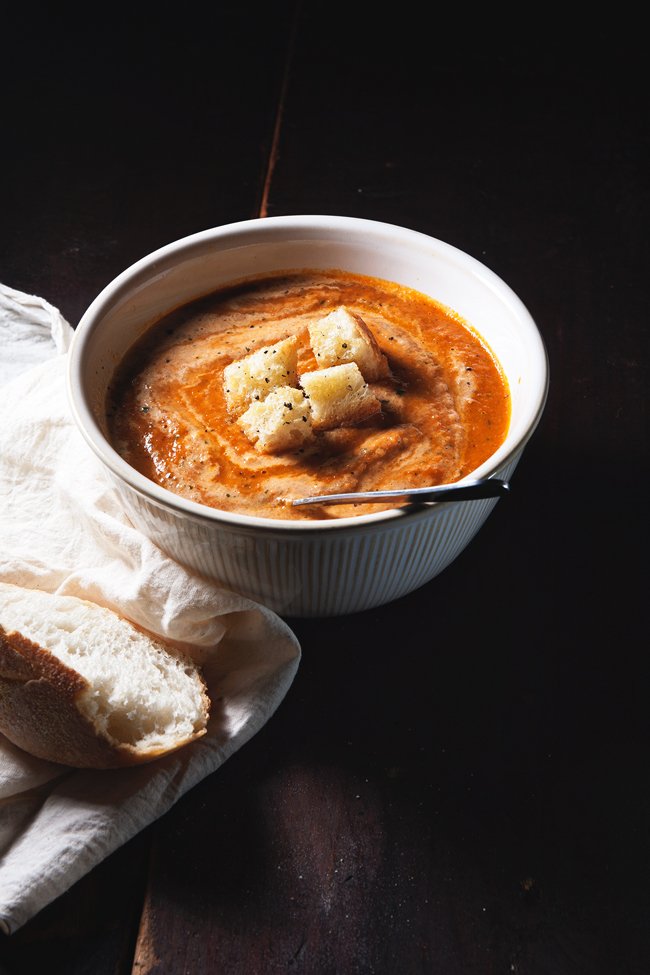
This recipe is one I’ve been making since my student days, so you can be sure that it’s low-maintenance. And it came in handy during my time in San Francisco, a city whose 365-days-per-year fog and gloom is enough to drive a person mad. You see, you need a soup as heartening as this to keep your spirits up, lest you succumb to drastic measures. Like quitting your job and chasing summer in the Southern Hemisphere. Well, that latter part was unintentional.
I don’t remember how I came upon this recipe anymore. I copied it long ago into a little pocket notebook that I have on me at all times—we all have one of these, I suspect—and have been faithfully following the same set of directions for a long time. I’m sure its source is not as obscure as I make it seem, but I prefer to keep it a mystery, for the sake of having a “family recipe” that I can pass down for generations. Or not. I don’t think that far ahead. (But it would be cool nonetheless.)
TOMATO SOUP
Serves 4
Ingredients:
- 1 28-ounce can of chopped tomatoes
- 1/4 cup olive oil
- salt & ground pepper to taste
- 2 stalks celery, diced
- 2 small carrots, diced
- 1 large yellow onion, diced
- 4 cloves garlic, minced
- 2 cups chicken broth
- 2 bay leaves
- 1/2 cup chopped basil
- 1/4 cup cream or milk, optional
Directions:
Preheat oven to 450 degrees F. Strain tomatoes, reserving the juices, and spread onto baking sheet. Season with salt and pepper, and drizzle with about 1 Tbsp olive oil. Roast until caramelized, about 15 minutes.
In a saucepan, heat the rest of the oil on medium-low heat. Add celery, carrots, onion, and garlic. Cook until softened, about 10 minutes. Add the roasted tomatoes, reserved juices, chicken broth, and bay leaves. Simmer until vegetables are tender, 15 to 20 minutes. Add basil and cream if using. Puree with an immersion blender.
Related Posts


Subscribe for New Racipies
Get mental health tips, updates, and resources delivered to your inbox.
Is Lamb Healthier Than Beef? 4 Things Nutritionists Won’t Tell You!

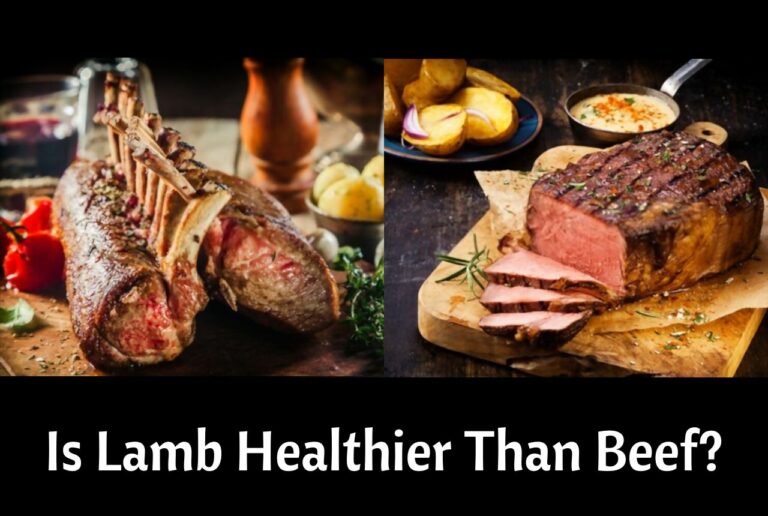
If you are looking for the authentic meaty taste in each bite, this is perhaps not the right page.
Just kidding!
Lamb may not be the staple meat in the US, but each time you go to any Mediterranean restaurant, the lamb kebab always attracts your attention.
But what about health and nutrition? Is lamb healthier than beef?
Lamb has 200% more heart-healthy Omega-3 fatty acids than beef. Lamb also has 30% more selenium than beef, which is good for immunity and cognitive functions. Beef has 6% fewer calories and 22% less fat, and 35% more zinc than lamb. It helps in diabetes control and muscle growth. Both have equal protein and minerals.
If you are really interested in the health benefits, side effects, and other good qualities of lamb compared to beef, I have tons to share with you! Stay with me before you light up your grill for a juicy steak or lamb chops.
Lamb Versus Beef Nutrition Facts
Nutritionally, there is not a huge difference between beef and lamb meat. However, preference varies according to people’s tastes and health conditions.
| Lamb (3.5-oz serving) | Beef (3.5-oz serving) | |
| Calories | 283 | 256 |
| Omega 3:6 ratio | 1:3.5 | 1:9.15 |
| Total Fat | 19.7 g | 15.3 g |
| Saturated fat | 8.1 g | 5.8 g |
| Monounsaturated fat | 8.3 g | 6.6 g |
| Polyunsaturated fat | 1.4 g | 0.5 g |
| Selenium | 40% of the DV (Daily Value) | 31% of the DV |
| Protein | 25 g | 27.7 g |
| Niacin | 34% of the DV | 27% of the DV |
| Zinc | 31% of the DV | 42% of the DV |
| Potassium | 7% of the DV | 7% of the DV |
| Iron | 11-23% of the DV | 11-26% of the DV |
| Vitamin B12 | 43% of the DV | 44% of the DV |
Lamb vs Beef Liver Nutrition
Why on earth am I talking about livers?
That must be the question on your mind right now. Right?
After the meat, the liver is the most popular organ people enjoy. It’s essential to know how nutritious those livers are.
| Lamb Liver (100 g) | Beef Liver (100 g) | |
| Calories | 249.3 g | 191 g |
| Total Fat | 10g (15% of DV) | 5.3 g (8% of DV) |
| Saturated Fat | 3 g | 2.9 g |
| Polyunsaturated Fat | 1.5 g | 1.1 g |
| Monounsaturated Fat | 2.1 g | 1.1 g |
| Cholesterol | 568 mg (189% of DV) | 396 mg (132% of DV) |
| Total Carbohydrates | 2.9 g (1% of DV) | 5.1 g (2% of DV) |
| Protein | 34.7 g | 29 g |
| Sodium | 64 mg | 79 mg |
| Potassium | 250.7mg | 352 mg |
| Vitamin A | 565.3% of DV | 634% of DV |
| Vitamin C | 7.6% of DV | 3.2% of DV |
| Calcium | 0.7% of DV | 0.5% of DV |
Lamb vs Beef: Which One Is For You?
It’s not easy when you have two great options: beef and lamb. However, some prefer the tenderness of the lamb, whereas others prefer the strong beefy taste of beef. Let’s see which one is for you.
Lamb vs Beef Taste
Lamb is more tender than beef and has a milder taste. It’s also sweeter, with a delicate flavor that’s hard to describe but can only be tasted by those who have tried it.

As such, lamb is often used as an ingredient in other dishes, such as stews and soups.
On the other hand, beef tends to have a more robust flavor profile than a lamb—it’s often described as “gamey” or “meaty.”
This may not sound appealing at first glance, but if you give yourself time before eating your steak (or any meat), you’ll find it much more palatable once you’ve delivered your palate some time to adjust.
Beef vs Lamb Protein
Protein is the most important nutrient for building muscle. The protein content of beef is slightly higher than lamb, but it’s still lower than other meats like chicken or pork.
Lamb has less protein than beef, but it’s still better for you in some ways because it contains an adequate amount of iron and B vitamins (which help with energy production).
Lamb vs Beef Cholesterol
Lamb is lower in cholesterol than beef, with a total fat content of 7 grams per serving. Beef contains more saturated fats and cholesterol than lamb. It is good news if you’re trying to lose weight or lower your risk for heart disease by avoiding saturated fats in your diet.
Besides, lamb also has more unsaturated fats, which helps lower LDL (bad) cholesterol while raising HDL (good) cholesterol.
Lamb vs Beef Calories
In terms of calories, however, beef is the leaner option. A 3.5-ounce serving of lamb contains approximately 283 calories, while the same serving of beef has only about 256 calories.
So, when it comes to calories, beef is the better choice. But lamb is the healthier option for other nutrients, such as omega-3 fatty acids.
Lamb And Beef Shawarma Calories
Shawarma is a delicious Middle Eastern dish that traditionally features lamb or beef.
Both options are incredibly flavourful, but there is often debate about which is healthier. So, what are the differences between lamb and beef shawarma?
For starters, lamb is generally higher in calories and fat than beef. Lamb also contains higher levels of certain nutrients, including iron and zinc. However, beef shawarma does have some advantages as well.
Beef is a good source of protein, and it also contains more B vitamins than lamb. Ultimately, the best option for you depends on your personal preferences and dietary needs.
If you’re looking for a juicy and meaty option, go for lamb shawarma. But for more protein, opt for beef. Or, if you can’t decide, try a mixed plate!
Lamb vs Beef Price
Lamb is a luxury meat that costs more than beef, while beef is a staple food that’s easy to find.
If you’re thinking about switching your diet, lamb may be right for you because it’s healthier than beef and has less fat, sodium, and cholesterol.
But if you only care about price, stick with the cheaper cuts of steak or hamburger patties!
Beef vs Lamb Meat Health Benefits
When it comes to red meat, there are many different options. But what are the health benefits of beef vs lamb? Is one better for you than the other? Here’s a look at the facts.
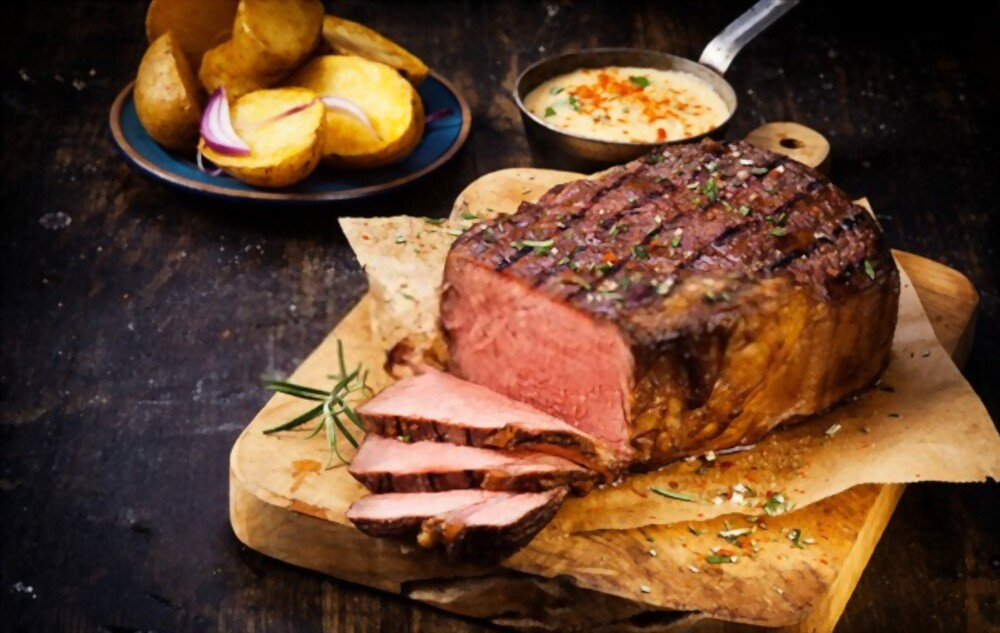
Lamb is a good source of protein, providing about 22 grams in a 3-ounce serving. It’s also a good source of niacin, vitamin B6, and phosphorus. Lamb is also relatively lean, with only about 7 grams of fat in a 3-ounce serving.
Beef is also a good source of protein, providing about 26 grams in a 3-ounce serving. It’s also a good source of niacin, vitamin B12, selenium, and zinc. Beef is slightly lower in fat than lamb, with about 5 grams in a 3-ounce serving.
So what does this all mean for your health? Both lamb and beef are excellent sources of protein and essential nutrients. However, beef may be the better option if you’re looking to save on calories and fat.
Lamb Is Always Better, And Healthier
- Lamb is more tender than beef, so it will be easier to prepare in your favorite recipes.
- Lamb has more flavor than beef, so you can use it to make a wide variety of dishes, from soups and stews to main dishes like burgers and steak fajitas!
- Lamb is slightly less healthy than beef because of its higher fat and cholesterol levels. However, the overall nutritional values make the meats ideal for those who want less fat while maintaining their health goals!
- In addition to being balanced in calories per pound, lamb has more protein per serving than most other meats; this helps keep you fuller longer after eating them (like how certain types of beans help us feel full longer too).
Related Article: 10 Best Foods to Eat to Lose Belly Fat
So, Lamb or Beef? Who is Winner?
Lamb and beef can both be part of a healthy diet, but they have some differences in terms of nutrition.
One major difference is that lamb tends to be higher in saturated fat and cholesterol than beef. This means that if you are trying to reduce your intake of these nutrients, it may be better to choose lean cuts of beef over lamb.
On the other hand, lamb is a good source of certain nutrients that are not as prevalent in beef. For example, it is higher in certain B vitamins, such as B12 and niacin, as well as minerals like zinc and iron. It is also a good source of conjugated linoleic acid (CLA), a type of fatty acid that has been linked to a number of health benefits.
Overall, it is important to choose a variety of protein sources in your diet and to consider both the nutritional profile and your personal preferences when deciding which meats to eat.
Related Posts






Subscribe for New Racipies
Get mental health tips, updates, and resources delivered to your inbox.