
Shrimp And Pork Dumplings, And How to Make Them

Medically reviewed by Christiana George Updated Date: January 2, 2026

Few foods are as personal to me as dumplings, nor as satisfying. A few scenes in my life where this humble dish has played a role:
One.
Growing up, packages of frozen dumplings sat in the freezer, for an easy dinner, or a quick lunch before Chinese school (typing those words sends a shiver down my spine). The perfect dipping sauce was soy sauce mixed with my parents’ homemade chili sauce.
Two.
When it comes to dumplings, siblings always seem to have a system worked out. Usually one likes the meaty interior; the other likes the dough-y exterior. In our case, I liked the meat and my sister liked the skin. Or so I thought. I found out years later that my sister doesn’t actually like dumplings.
Three.
My mom’s friend makes dumpling wrappers from scratch, and when our families got together to make dumplings, I was in awe of how expertly she could manipulate the dough. She was a master roller, creating perfect little rounds as fast as we could fill them. We were kids, so it seemed natural that our dumplings would come out looking a little mangy—but you couldn’t tell once they were in your mouth, now could you?
Four.
An annual gathering of friends. For a few years, a group of high school friends and I would meet over the summer for a meal of homemade dumplings. Making dumplings is a social activity, where everyone pulls up a chair around the kitchen table, grabs a peel, and, you know, hangs out. This dumpling-making extravaganza always took place at my friend’s house, and his parents were so delighted to have us over (engaging in such wholesome activity, you understand), that his mom would blend us fruit juices and his dad would prepare us his extra special dipping sauce. We’d fold and we’d fold and only stopped when the filling ran out. And the meal would be all the sweeter because it was homemade (although the fruit juices and the dipping sauce helped).


Few foods are as personal to me as dumplings, nor as satisfying. A few scenes in my life where this humble dish has played a role:
One.
Growing up, packages of frozen dumplings sat in the freezer, for an easy dinner, or a quick lunch before Chinese school (typing those words sends a shiver down my spine). The perfect dipping sauce was soy sauce mixed with my parents’ homemade chili sauce.
Two.
When it comes to dumplings, siblings always seem to have a system worked out. Usually one likes the meaty interior; the other likes the dough-y exterior. In our case, I liked the meat and my sister liked the skin. Or so I thought. I found out years later that my sister doesn’t actually like dumplings.
Three.
My mom’s friend makes dumpling wrappers from scratch, and when our families got together to make dumplings, I was in awe of how expertly she could manipulate the dough. She was a master roller, creating perfect little rounds as fast as we could fill them. We were kids, so it seemed natural that our dumplings would come out looking a little mangy—but you couldn’t tell once they were in your mouth, now could you?
Four.
An annual gathering of friends. For a few years, a group of high school friends and I would meet over the summer for a meal of homemade dumplings. Making dumplings is a social activity, where everyone pulls up a chair around the kitchen table, grabs a peel, and, you know, hangs out. This dumpling-making extravaganza always took place at my friend’s house, and his parents were so delighted to have us over (engaging in such wholesome activity, you understand), that his mom would blend us fruit juices and his dad would prepare us his extra special dipping sauce. We’d fold and we’d fold and only stopped when the filling ran out. And the meal would be all the sweeter because it was homemade (although the fruit juices and the dipping sauce helped).

Recently, I had my first dumplings on the East Coast, at a quiet little Upper West Side establishment. I ordered an extra large portion of shrimp and pork dumplings… now you see where I’m going.
In short, they were good. And it was the memory of those dumplings that inspired me to pick up ground pork and shrimp at the market the other day. Along with some dumpling wrappers and a little oblong head of Napa cabbage.
Dumplings are inherently easy to make, because you can fill them with anything. Chicken and corn, pork and mushroom, beef and lotus root. I judge by the smell. A splash of rice wine, a few dollops of corn starch, minced ginger in mounds, and a long drizzle of soy sauce.
Of course, I tend to add ingredients indiscriminately, zealously even. Anything faintly Chinese goes in the mix. I might’ve tossed in some garlic, some sesame oil, but I was referring to a recipe for once, and it didn’t call for these things. And thank goodness too, because the dumplings came out perfectly. They were wonderful. And Chris enthusiastically agreed.

SHRIMP AND PORK DUMPLINGS
Recipe from Steamy Kitchen
Makes about 3 dozen
Ingredients:
A handful (about 1 cup) of Napa cabbage
1 tsp salt
3/4 lb shrimp, peeled and deveined
1/2 lb ground pork
3 stalks of green onion, green and white parts, finely chopped
1 tsp fresh ginger, minced
2 Tbsp soy sauce
2 Tbsp corn starch
1 Tbsp rice wine
1/2 tsp salt
pepper to taste
About 3 dozen dumpling wrappers, which are round and can be found in Asian markets
Directions:
For the filling:
Chop the cabbage into thin slivers. In a small bowl, mix the cabbage with about 1 tsp of salt and leave it alone for about 15 minutes. Doing this draws out the liquid from the cabbage—otherwise, your dumplings will be soggy. Afterwards, take all the cabbage in your hands and squeeze out all the liquid. Then, finely chop the cabbage.
Cut the shrimp into small bits. You can use the food processor for this, but I don’t have one, so I just take a chef’s knife to the pile. Cut them into small pieces, but not so small that they becomes a paste.
In a large bowl, thoroughly mix the chopped shrimp, ground pork, chopped green onion, chopped cabbage, ginger, soy sauce, corn starch, rice wine, 1/2 tsp of salt, and pepper to taste.
Making the dumpling:
(Refer to the images above.) Pile a heaping Tbsp of the filling into the center of the skin. Have a little bowl of water ready. Dip a finger into the water and brush a ring along the outer rim of the skin. Fold it in half like a taco and squeeze. You want your dumplings to seal, tight. Otherwise, they’ll break when you’re cooking them. When pleating, you’re only going to pleat one side. With each pleat, press hard to seal it. As you pleat, the dumpling should start curling in the opposite direction. Pleat three times on each side of the center. When you’re finished, give the dumpling one last firm squeeze.
Note: If you’re going to step away from making the dumplings for awhile, you can prevent the skin from drying out by gently covering the skins with a damp (but not wet) paper towel.
Cooking:
You can now freeze them (indefinitely—I have tested this out many times) or cook them. I prefer to boil them.
Boil a pot of water big enough so the dumplings aren’t crowded together in the pot. Once the water’s boiling, slide in the dumplings and let the water come to a boil again. Cook for another few minutes. At this point, you can cut one open. Make sure the skin’s fully cooked through.
Other serving suggestions: pan-frying (to make potstickers) and steaming (line the bottom of the steamer with cabbage leaves or parchment paper with holes cut into it so the dumplings don’t stick to the steamer).
I usually eat around 8; Chris eats around 10; my friend Emily can eat, like, 3. Honestly, how many you eat depends on your hunger level.
And finally, dipping sauces can vary. Generally, I like to mix soy sauce with my parents’ homemade chili sauce and maybe a pinch of cilantro. A traditional dipping sauce consists of soy sauce and black rice vinegar. Basically, with soy sauce as a base, you can add minced garlic, minced ginger, sesame oil, chili oil, etc.
Finally, the black and white photos are courtesy of Chris. Thanks very much for helping me document the process, and nicely done!
Related Posts


Subscribe for New Racipies
Get mental health tips, updates, and resources delivered to your inbox.
Maple Chocolate Chip Zucchini Cookies

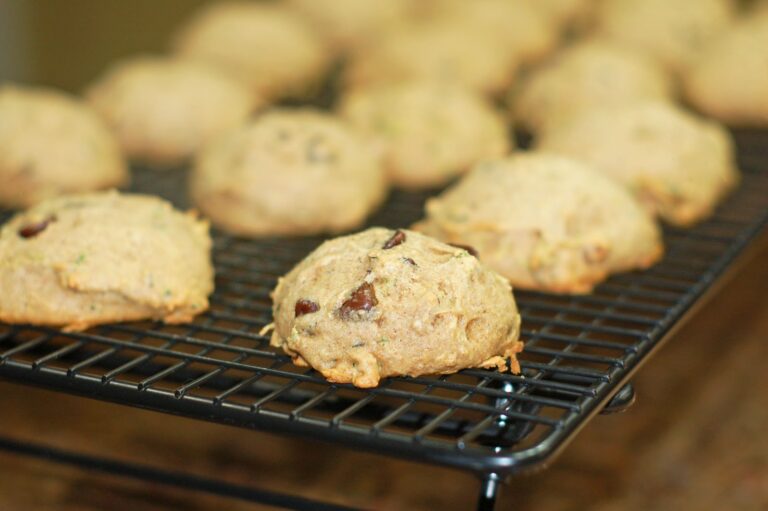
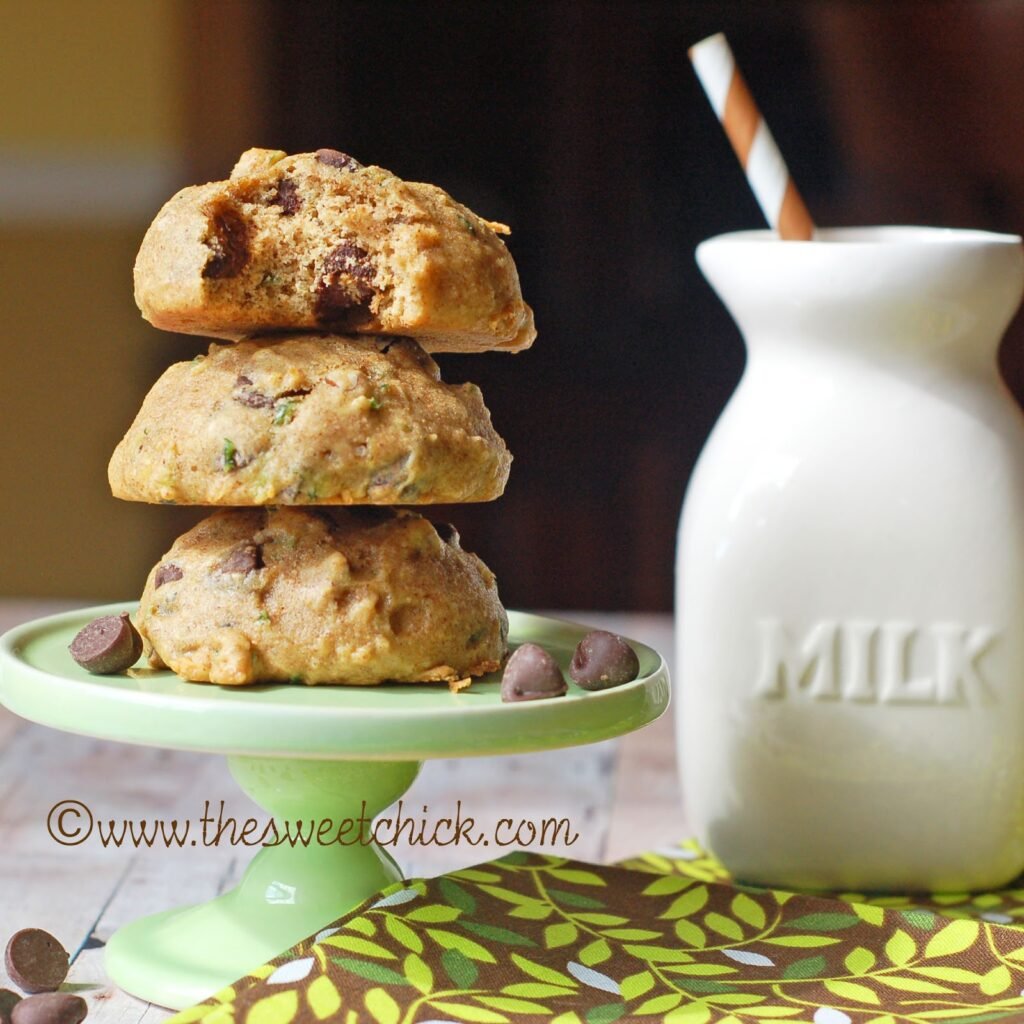
I figured you guys would be sick of pumpkin recipes by now and I was craving zucchini. I have made these zucchini cookies before using a recipe from my mom’s archives. I just adapted it to my taste. I was more in the mood for pecans and chocolate chips than walnuts and raisins.

I didn’t even have any sticks of butter on hand, so I had to make due with a tub of Smart Balance. I really needed cookies and I wasn’t driving to the store for butter.
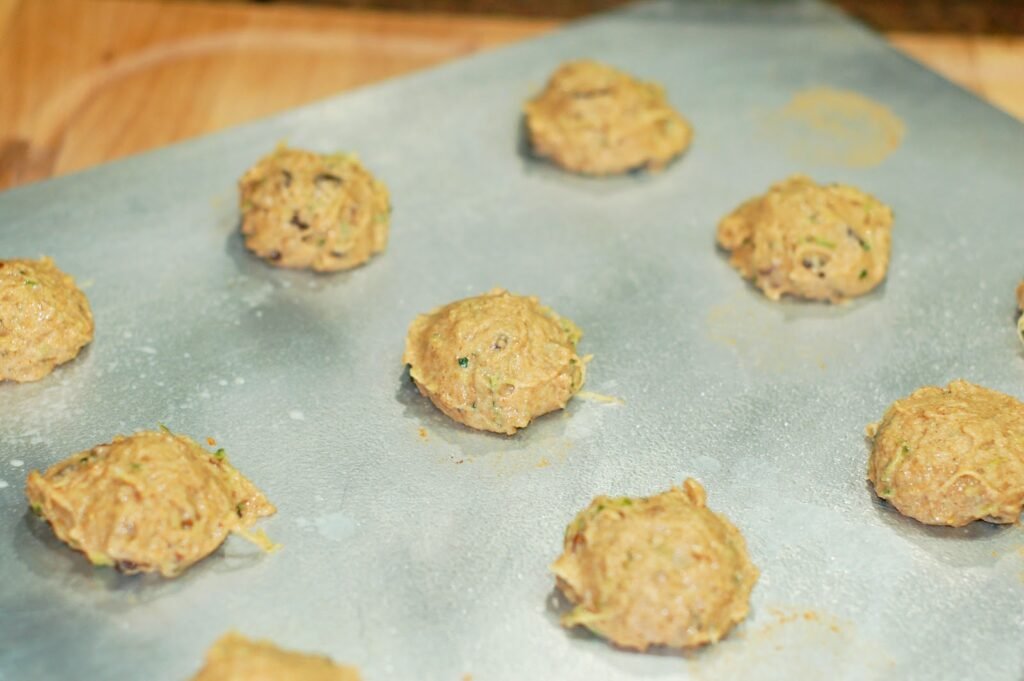
Never fear, the cookies turned out fine. In fact, they were nice and puffy, just like a chocolate chip zucchini cloud.

When you bite into them, you can taste the zucchini with a hint of cinnamon that really enhances the flavor of the chocolate chips. I like that they are not overly sweet. Although, it does make it harder to stop after eating just one. They go down real easy.
Maple Chocolate Chip Zucchini Cookies
by The Sweet Chick
Prep Time: 15 minutes
Cook Time: 12 minutes
Keywords: bake dessert zucchini maple syrup chocolate chips cookie
Ingredients (30 cookies)
- 1/2 cup butter
- 3/4 cup sugar
- 1/4 cup pure maple syrup
- 1 egg, beaten
- 1 teaspoon pure vanilla extract
- 1 cup all purpose flour
- 1 1/2 cups wheat flour
- 1 teaspoon cinnamon
- 1/4 teaspoon salt
- 1 teaspoon baking powder
- 1 teaspoon baking soda
- 1 cup shredded zucchini
- 1/2 cup semi sweet chocolate chips
- 1/3 cup chopped pecans
Instructions
Preheat oven to 350º F.
In a stand mixer add butter, sugar, syrup, egg, and vanilla. Beat on low until well mixed and texture is smooth.
In a separate bowl combine flours, cinnamon, salt, baking powder and baking soda. Stir until all is well blended.
Then slowly add dry mixture to the wet mixture and beat on low until it becomes a dough like consistency.
Then add zucchini, chocolate chips, and pecans. Mix until all is evenly distributed throughout the dough.
Using a spoon or cookie scoop, drop by tablespoon or so onto a greased cookie sheet leaving 2 inches between each dough ball.
Bake for 12 minutes or until the tops are slightly golden. Remove from the oven and wait 5 minutes, then remove from cookie sheet and place on cooling rack until completely cooled.
Then grab a glass of milk or a cup of coffee and see if you can resist eating more than one.
Related Posts
Subscribe for New Racipies
Get mental health tips, updates, and resources delivered to your inbox.