
Homemade Dulce de Leche

Medically reviewed by Christiana George Updated Date: December 17, 2022

Well, I finally did it. I made some dulce de leche this weekend. I have been thinking about it for a long time, but was too scared to do it. I remember hearing one of our friends making some on the stove top and it exploded and there was sticky stuff all over the kitchen and ceiling. No thanks, don’t want anyone of that.
Then lately I have been reading about some food bloggers making it in a slow cooker. Hmm. That sounded a little safer. Usually, they put the cans of sweetened condensed milk directly into the slow cooker fill with water and voila, done in about 10hrs. But then I found a blogger who had a different idea. She put the milk into canning jars instead of leaving it in the can, due to the potential BPA contamination. That sounded like a great idea for me. Here is the link I couldn’t wait to try it.

All you need are 2 jars (14 oz.) of sweetened condensed milk, 3 wide mouth 1/2 pint canning jars and a slow cooker. What could be easier.

You just have to make sure you put enough water in the slow cooker. These jars fit perfect in my Crockpot.
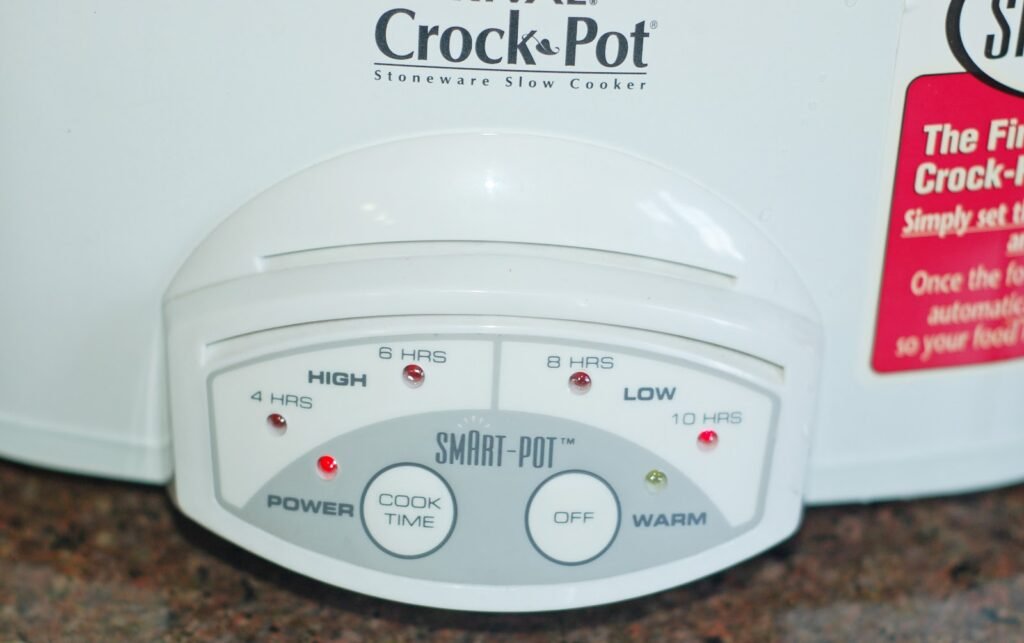
And then set it for 10hrs. You might be able to put it on high and do it faster, but I didn’t want to risk it. I followed the steps as instructed. The end result being a fantastic tasting dulce de leche. Smooth, creamy and ready to spread on whatever you like. I spread some on the mini donuts I had just made. Mmmm!
And the best part is that there is no mess. The dulce de leche is already in jars. I put mine in the fridge for later use, but like says, you can put a cute tag on it and give it as gifts. I know quite a few people who would enjoy receiving this gift.
Homemade Dulce de Leche
by The Sweet Chick
Prep Time: 5-10 min
Cook Time: 10 hrs
Keywords: slow-cooker topping sweetened condensed milk Spanish
Ingredients (3- 1/2pt jars)
- 2 cans (14 oz) sweetened condensed milk
Also needed
- 3 wide mouth 1/2 pt canning jars
- slow cooker
- water
Instructions
Pour the cans of sweetened condensed milk evenly into the 3 canning jars and close lids firmly by hand.
Place canning jars at the bottom of your slow cooker and fill with hot water till there is at least 1 inch of water above the level of the jars. The hot water will speed up the cooking process.
Set your slow cooker to 10 hours. I quickly checked the results after 9 hours, but I let it run the full 10 hours as recommended.
After 10 hours, carefully remove the jars from slow cooker with canning tongs. Of course I didn’t buy these and just using regular tongs with rubber grippers. Just be careful not to drop the jar.
Place jars on a heat safe surface and let the jars cool off to room temperature. If there is any rust on the outside lids of the jar, just simply wipe it off.
Once it has cooled off, just unscrew the lids and dip in a spoon. The lids will be sealed, but with a little prying, do come off easily. Your dulce de leche is ready to be served on crepes, pancakes, fruit, donuts, or whatever you wish.
Related Posts




Subscribe for New Racipies
Get mental health tips, updates, and resources delivered to your inbox.
Apricot Raspberry Galette, Or Look What I Made!

Under Elisabeth Prueitt’s tutelage, I feel invincible.
She’s the co-founder of Tartine Bakery in San Francisco, head pastry chef, and, purveyor of all things baked and sweet and wonderful. Along with her husband Chad Robertson, they’ve turned Tartine into something of an institution. This is a widely-acknowledged fact. Even if institutions are generally quite a bit older than the 10 years that this bakery’s been around. Anyway, I’m sure many of you savvy cooks and bakers have heard of it, so I won’t wax any more poetic except to say that the almond croissants are SO SO good.
Instead, I meant to give you a recipe for an apricot raspberry galette.
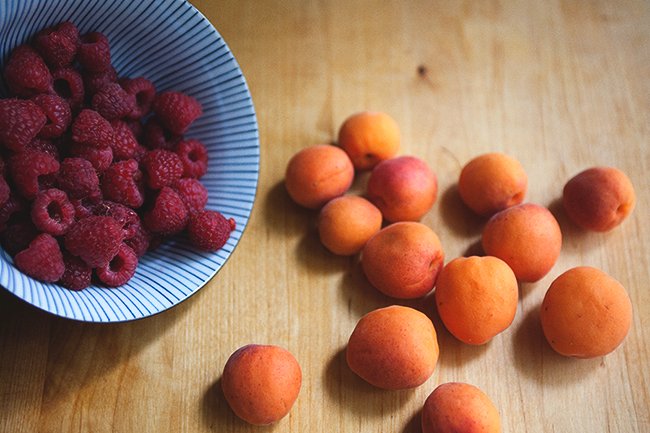
I’ve always been charmed by galettes; they’re so endearing and sweet, homely little things brimming with the fresh and organic. At the same time, I’ve always been intimidated by the idea of making the crust—tart doughs seem such fickle things. So in undertaking this recipe, I knew that I wanted to turn to Prueitt’s cookbook Tartine… she’s never led me astray, you see.
She describes galettes as “quintessentially beautiful rustic tarts… they are very satisfying to make.” I wanted to grasp satisfying! More than that, I wanted to feel the gratification that comes from sinking my teeth into something substantial. I wanted to feel the flour and butter between my fingers, build something lovely and wholesome completely out of scratch. The process of baking, of creating really, is never as palpable as when you’re getting your hands (and in my case, feet) dirty, smearing butter everywhere, flexing those arm muscles rolling and lifting and pleating. It’s a rewarding feeling.
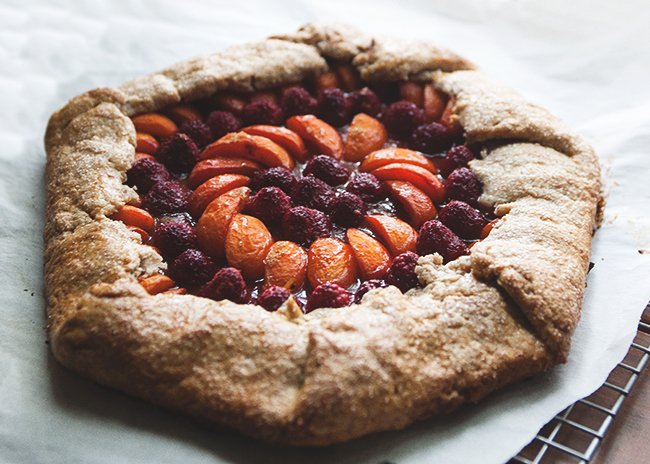
So I took out the rolling pin—we don’t see much of it these days—and began the painstaking process of flattening frozen butter into long thin strips in flour. Which came together into something that resembled dough. Which came together into something that resembled a free-formed tart. And when it came out of the oven, I was astonished to find a galette. It came out rustic indeed. Seven-sided, lopsided, shriveled fruit and all, I loved it upon sight. Because I’d made it from scratch.


APRICOT RASPBERRY GALETTE
Fruit Galette recipe in Tartine by Elisabeth Prueitt & Chad Robertson
Makes 1 large galette or 6 mini galettes
Ingredients:
For dough:
1 cup (2 sticks) unsalted butter, very cold
1/2 cup water
3/4 tsp salt
1 cup rye flour
1-1/2 cups all-purpose flour (or use all all-purpose if you’d like)
For filling:
3 cups fruit (berries, stone fruit, sauteed apples or pears, etc.)
2 to 4 Tbsp brown or granulated sugar
Lemon juice if needed
Egg wash:
1 large egg yolk
1 Tbsp heavy cream
Granulated sugar for sprinkling
Directions:
Cut the butter into 1-inch cubes and put them in the freezer. Measure the water, dissolve the salt into it, and put it into the freezer. Chill both the butter and the water for about 10 minutes.
Measure the flour onto your work surface and spread it into a rectangle about 1/3 inch deep. Don’t worry about mixing it, as it’ll get mixed in the process. Scatter the butter cubes over the flour and toss some flour over them so they don’t stick to your rolling pin. Begin rolling. When the butter starts flattening into long, thin strips, use a bench scraper to scoop up the sides so it’s about the same size as when you started. Repeat this rolling and scraping 3 to 4 more times.
Make a well in the center and pour in the cold water. With the bench scraper, scoop the sides of the dough into the center, mixing the water and flour in a cutting motion. Keep scraping and cutting until the dough is shaggy, then shape it into a rectangle about 10 by 7 inches. Dust the top lightly with flour. Roll out the flour until it’s about half as thin, then scrape all four sides back to its original shape and reroll. Repeat this a few more times until your dough is smooth, cohesive. You should end up with a 10 by 7 inch rectangle.
Transfer the dough to a large baking sheet, cover it with plastic wrap, and chill for about 1 hour.
While the dough is chilling, prepare your fruit. Peaches can be sliced into eighths, apricots quartered.
When the dough is chilled, you can divide it into six equal parts at this point. Roll the dough into a rough circle of about 14 inches in diameter if making a single galette or 6 to 7 inches if making mini galettes. (Prueitt gives lengthy instructions on how to do this, but for the sake of not being too fussy, I won’t go into details) Transfer the circle/s to a baking sheet and chill about 10 minutes.
Fill the center of each circle with fruit, leaving a 2-inch border if making a large galette, or a 1-inch border if making small. At this point, taste the fruit to decide how much sugar you want to sprinkle on top, anywhere from 2 to 4 Tbsp on the large galette or 1 to 2 tsp on each small galette. If you want, squeeze some lemon juice on top. Fold in the sides into that classically gorgeous galette shape, making sure to seal crevices where the juice can leak out. Chill for about 10 minutes, and start preheating the oven at 375 degrees F.
At this point, Prueitt says you can store them in the fridge, unwrapped, for a few hours or wrap them airtight and store them in the freezer for up to 2 weeks. Otherwise, make your egg wash by whisking together the cream and egg yolks. Brush the egg wash on the pastry edges and sprinkle them with granulated sugar.
Bake the galettes until the crust has visibly puffed and baked to a dark brown and the fruit juices are bubbling, 45 to 60 minutes for the large galette and 40 to 50 minutes for the small. Rotate halfway through for even browning. (If baking them straight from the freezer, tack on about 10 minutes to the baking time.) Remove from the oven and serve immediately, or let it cool and serve warm or at room temperature.
Related Posts




Subscribe for New Racipies
Get mental health tips, updates, and resources delivered to your inbox.