
Does Pepsi Have Caffeine? Full Breakdown of Pepsi Caffeine Content, Safety & Comparisons (2026)

Medically reviewed by Dr. Aris Thorne Updated Date: May 3, 2026

Have you ever grabbed a cold soda mid-afternoon, hoping for a quick energy boost—perhaps alongside a sweet treat like some apple pie donut holes—and wondered, does Pepsi have caffeine? You are definitely not alone in asking this. Many of my clinic patients bring up their daily beverage habits during routine checkups.
They often feel confused about what they are actually drinking on a daily basis. As a public health specialist, I hear this specific question all the time. People want to know if their favorite dark soda will keep them awake at night.
Well, the short answer is yes. But understanding exactly how much you are consuming is crucial for your overall cardiovascular health and sleep hygiene. Today, we are going to dive deep into the numbers. We will break down everything you need to know about your favorite fizzy drink. Let’s get into the details right now!
TL;DR: Quick Overview
- Yes, regular Pepsi does contain an active stimulant.
- A standard 12 oz can contains approximately 38 mg of this energy-boosting compound.
- This amount is significantly lower than a standard cup of coffee.
- Diet and Zero Sugar variations actually contain slightly different amounts.
- Healthy adults can safely consume this amount within FDA guidelines.
- Caffeine-free versions are readily available for those with sensitivities.
The Quick Answer About Pepsi’s Stimulant Levels
Many people ask if their afternoon soda habit is secretly fueling their anxiety. Yes, Pepsi contains caffeine. The specific amount varies slightly depending on the exact size and product variation you choose.
However, a typical 12 oz can has around 38 mg of caffeine. This puts it squarely in the moderate category for caffeinated beverages. Therefore, it provides a mild stimulant effect without overloading your system.
In my medical practice, I always remind patients to track these hidden sources of energy. Because you drink it cold, you might consume it much faster than a hot beverage. As a result, the compound hits your bloodstream quite rapidly.
Analyzing the Stimulant Content by Serving Size
Understanding your exact intake requires looking at the serving size. You rarely find just one size of soda at the convenience store nowadays. Consequently, you need to know how the numbers scale up.
If you grab a larger bottle, your total intake naturally increases. For example, upgrading from a can to a bottle changes the math entirely. Let’s break down the specific numbers based on standard US packaging.
| Size | Caffeine Amount |
| 12 oz (355 ml) | ~38 mg |
| 16 oz (473 ml) | ~51 mg |
| 20 oz (591 ml) | ~63 mg |
Measuring the Exact Milligrams in Your Drink

So, how many mg of caffeine in Pepsi are you actually getting? The range strictly falls between 38 and 63 mg for standard single-serve options. This is a very predictable amount compared to brewed beverages.
Unlike coffee, or even coffee-flavored homemade treats like no-bake mochaccino cookies, which change based on brewing time and ingredient concentration, soda formulation is precise. Therefore, you always know exactly what you are putting into your body. This consistency is especially relevant for people monitoring their daily intake.
Comparing Your Soda to a Cup of Joe
Patients frequently ask me how their soda habit compares to a morning brew. They wonder, does Pepsi have caffeine in it compared to coffee? The contrast is actually quite striking.
Coffee is significantly stronger than almost any dark cola on the market. In fact, a standard 8 oz cup of coffee delivers roughly 80 to 100 mg. Furthermore, many coffee shop sizes are much larger than 8 oz.
| Beverage | Caffeine Content |
| Pepsi (12 oz) | ~38 mg |
| Standard Coffee (8 oz) | 80–100 mg |
As a result, coffee has two to three times more stimulants than your soda. Therefore, switching from coffee to soda will dramatically lower your intake.
The Classic Rivalry: Cola vs. Cola
When discussing beverages, the ultimate comparison is always between the two major brands. People naturally want to know how the competitor stacks up. So, how do the two giants compare in the stimulant department?
| Drink | Caffeine (12 oz) |
| Pepsi | ~38 mg |
| Coca-Cola | ~34 mg |
Interestingly, Pepsi has slightly more caffeine than Coke. However, this 4 mg difference is practically negligible for your body. Most of all, you likely will not feel any difference in energy between the two.
What About the Zero Sugar Variant?
Many individuals switch to diet sodas to manage their weight and blood sugar, especially when balancing their diet against indulgent baked goods like triple chocolate nutella cookies. They frequently ask if Pepsi Zero Sugar has different stimulant levels. Surprisingly, the answer is a resounding yes.
Pepsi Zero Sugar contains roughly 69 mg per 12 oz can. This is nearly double the amount found in the regular version. The manufacturers do this specifically to enhance the flavor profile.
Because they remove the sugar, they add more stimulants to maintain a “bite.” In my clinic, I always warn patients about this hidden increase. If you are sensitive to jitteriness, this diet option might unexpectedly trigger symptoms.
Are There Any Stimulant-Free Options Available?
For patients with hypertension or insomnia, removing stimulants is crucial. They often ask if they have to give up their favorite flavor entirely. Thankfully, you do not have to quit cold turkey.
Yes, there are completely clear options available on the market. You can easily find Caffeine-Free Pepsi at most major grocery stores. Similarly, they offer a Caffeine-Free Diet Pepsi for those avoiding both sugar and stimulants.
I frequently recommend these alternatives to my pregnant patients. Furthermore, they are excellent choices if you crave a soda late at night—perhaps to wash down a few midnight mini hot chocolate donuts.
Global Variations: Canada, UK, Australia, and Europe
If you travel frequently, you might wonder about international formulations. Does the recipe change when you cross international borders? Generally, the stimulant content remains quite consistent globally.
Whether you are in Canada, the UK, Australia, or Europe, a standard can hovers around 38 mg. However, minor variations definitely occur due to strict local health regulations.
For instance, some European countries strictly regulate artificial additives. Yet, the core energy-boosting ingredients remain largely untouched across different markets. Thus, your overseas soda will provide a very similar energy lift.
The Real Reason Behind the Added Stimulants
You might wonder why soda companies add this chemical in the first place. Is it purely to keep us addicted and awake? While it provides a mild stimulant effect, that is not the only reason.
First of all, this compound is a crucial flavoring agent. It adds a distinct, slightly bitter note that balances the extreme sweetness of the corn syrup. Without it, the drink would taste overwhelmingly cloying and flat, much like how a rich dessert needs balance—similar to the deep, roasted notes found in dark chocolate Guinness fudge.
Furthermore, consumer preference heavily drives this formulation. People genuinely enjoy the subtle energy lift they get from a cold soda. Consequently, removing it entirely would drastically change the product’s identity.
Assessing the Safety Risks (A Medical Perspective)
As a physician, I constantly evaluate the safety of common dietary habits. Patients frequently ask if their daily soda intake is dangerous. To answer this, we must look at the total daily limits.
The Food and Drug Administration (FDA) provides very clear guidelines. For healthy adults, consuming up to 400 mg per day is generally considered safe. Therefore, drinking one or two cans is well within the safe zone.
You would have to drink over ten cans to hit the medical danger zone for stimulants alone. However, the massive sugar content is a completely different medical issue. I always advise monitoring the sugar long before worrying about the 38 mg of stimulants, especially if you are prone to enjoying high-calorie snacks like chocolate caramel cupcakes with soynut butter frosting alongside your beverage.
How These Stimulants Affect Your Body
Understanding the mechanism of action is vital for your health literacy. When you take a sip, the chemical rapidly absorbs through your stomach lining. Next, it travels directly into your bloodstream and to your brain.
It specifically works by blocking adenosine, a neurotransmitter that makes you feel tired. Consequently, it strongly stimulates your central nervous system. This process temporarily improves your awareness and cognitive function.
However, it can also simultaneously increase your resting heart rate. For most healthy people, this physiological response is harmless and temporary. Yet, those with cardiac arrhythmias should be extremely cautious.
Potential Side Effects of Overconsumption

While moderate amounts are safe, pushing the limits causes problems. In my practice, I see many patients suffering from overconsumption. They often do not realize their beverages are causing their physical symptoms.
If you drink too much, you will likely experience severe jitters and hand tremors. Furthermore, it frequently causes stubborn insomnia if consumed late in the day. Many patients also report heightened anxiety and nervousness.
Most noteworthy, excessive intake leads to temporarily increased blood pressure. If you regularly experience these symptoms, you must drastically reduce your intake immediately.
The Three-Way Comparison: Citrus Sodas vs. Dark Colas vs. Coffee
Sometimes, you need a serious energy boost to finish a long project. How do extreme sodas compare to traditional colas and coffee? Let us look at Mountain Dew, a popular high-energy choice.
| Drink | Caffeine Content |
| Pepsi | 38 mg |
| Mountain Dew | 54 mg |
| Coffee | 80–100 mg |
As you can see, Mountain Dew packs a significantly stronger punch. It contains 54 mg, bridging the gap between dark colas and coffee. Therefore, if you need more energy but hate coffee, citrus sodas provide a middle ground.
Formulation Trends for 2026
Patients sometimes ask if beverage companies are changing their recipes this year. They want to know if their favorite brands are suddenly becoming stronger. Looking at the industry trends for 2026, the formulations remain very stable.
The major brands have no plans to alter their classic recipes. The 38 mg standard will continue to be the norm for the foreseeable future. In contrast, energy drinks are the ones constantly increasing their potency.
Your traditional dark cola will remain a reliable, low-dose option. You can confidently rely on the current nutritional labels.
Frequently Asked Questions
Does regular soda give you an energy boost?
Yes, it provides a mild energy boost. It contains about 38 mg of stimulants per 12 oz can. This is enough to temporarily increase your alertness.
Can I find versions without any stimulants?
Absolutely. The company produces specific caffeine-free versions of both their regular and diet lines. These are great for evening consumption.
Is dark soda stronger than a brewed roast?
No, it is much weaker. A standard cup of brewed coffee has significantly more stimulants. Coffee usually contains double or triple the amount.
Why does the Zero Sugar version feel stronger?
It actually is stronger. The Zero Sugar formulation contains nearly double the stimulants of the regular version. This helps mimic the “bite” of the original flavor.
Is it medically safe to drink this daily?
Yes, the stimulant amount is safe in moderation for healthy adults. However, you must strongly consider the negative impacts of daily sugar intake.
Conclusion
Navigating the beverage aisle can sometimes feel like a complicated science experiment. With so many varying sizes and formulations, keeping track of your intake is vital. As we have discussed, understanding the exact numbers empowers you to make healthier daily choices.
You do not have to guess about what you are putting into your body anymore. Whether you prefer the classic taste, the zero-sugar bite, or the completely stimulant-free option, there is a choice for your specific health needs. Always remember that moderation is the ultimate key to preventive health.
In my medical experience, balancing these small daily habits prevents massive health issues down the road. Keep an eye on your total daily limits, especially if you mix sodas with coffee. So, the next time someone asks you, does pepsi have caffeine, you can confidently explain exactly how much is in their glass!
Evidence-Based References:
- Food and Drug Administration (FDA) – Spilling the Beans: How Much Caffeine is Too Much?https://www.fda.gov/consumers/consumer-updates/spilling-beans-how-much-caffeine-too-much
- Centers for Disease Control and Prevention (CDC) – The Buzz on Energy Drinks.https://www.cdc.gov/healthyschools/nutrition/energy.htm
- World Health Organization (WHO) – Guidelines on sugars intake for adults and children.https://www.who.int/publications/i/item/9789241549028
- American Heart Association – Caffeine and Heart Disease.https://www.heart.org/en/healthy-living/healthy-eating/eat-smart/nutrition-basics/caffeine-and-heart-disease
- MedlinePlus (National Library of Medicine) – Caffeine.https://medlineplus.gov/caffeine.html
- Mayo Clinic – Caffeine content for coffee, espresso, tea and more.https://www.mayoclinic.org/healthy-lifestyle/nutrition-and-healthy-eating/in-depth/caffeine/art-20049372
- National Sleep Foundation – Caffeine and Sleep.https://www.sleepfoundation.org/nutrition/caffeine-and-sleep
- Harvard TH Chan School of Public Health – The Nutrition Source: Caffeine.https://www.hsph.harvard.edu/nutritionsource/caffeine/
- National Center for Biotechnology Information (NCBI) / NIH – Exploring Safe Caffeine Exposure Levels for Vulnerable Populations https://www.ncbi.nlm.nih.gov/books/NBK202231/
- Mayo Clinic – Caffeine: How does it affect blood pressure? https://www.mayoclinic.org/diseases-conditions/high-blood-pressure/expert-answers/blood-pressure/faq-20058543
Related Posts



Subscribe for New Racipies
Get mental health tips, updates, and resources delivered to your inbox.
Tartine Croissant Recipe


Every now and again, I like to tackle big projects. I’m good at big projects. There’s something so reassuring about them, like you know there’s an end in sight, eventually, but it’s so far away that you’re not focused on it. Instead, you get to hunker down, keep your head low, and really sink yourself into the process. Drink some coffee while you’re at it, noodle around with other things while waiting (there’s always a lot of waiting).
BUT. Everything will be going swimmingly, until everything goes awry. That’s when, say, you open the oven to discover a hot tub’s worth of butter oozing around on the floor of your baking pan. It might be kind of like how Alexander Fleming felt when he realized he’d left a Petri dish uncovered in the lab—the horror!, the shame!, the contamination (him)!, the smell of frying croissants (me)!—except he discovered penicillin, and I ended up with rubbery croissants.
It’s in moments like these that your character will come through. You could give up, throw in the towel, decide to start down another path altogether. Knife-sharpening comes to mind, although that’s another one of those projects you could (and will be told to) spend a lifetime mastering. Or attempting the elusive scorpion pose. (I know, scary.) Alternatively, you could also decide to try again. According to my assessment, the latter demonstrates true grit. Or so I have to believe. Fine, mostly, I didn’t want to feel like I’d been defeated by a baked good.

So I took a step back and really tried to figure out where I’d gone wrong. I think it came down to one main reason: the butter hadn’t been soft enough when I’d started the lamination process. It seems that butter that isn’t sufficiently malleable will clump up and tear through the layers, resulting in lots of leakage points. Does that sound about right, seasoned croissant makers? But, a little leaking is normal too, and should not be a cause for concern. Along with a few other small tweaks, I felt ready to give croissants another go.
I’d initially made half a batch of plain croissants and half a batch of ham and cheese, but for my second attempt, I decided to pare down my expectations. If I could successfully make a batch of plain croissants, I could begin thinking about incorporating other ingredients. It’s kind of like how in Japan, sushi apprentices spend years mastering the art of making rice before they’re allowed to move on to even touching the other stuff. (Talk about integrity!)

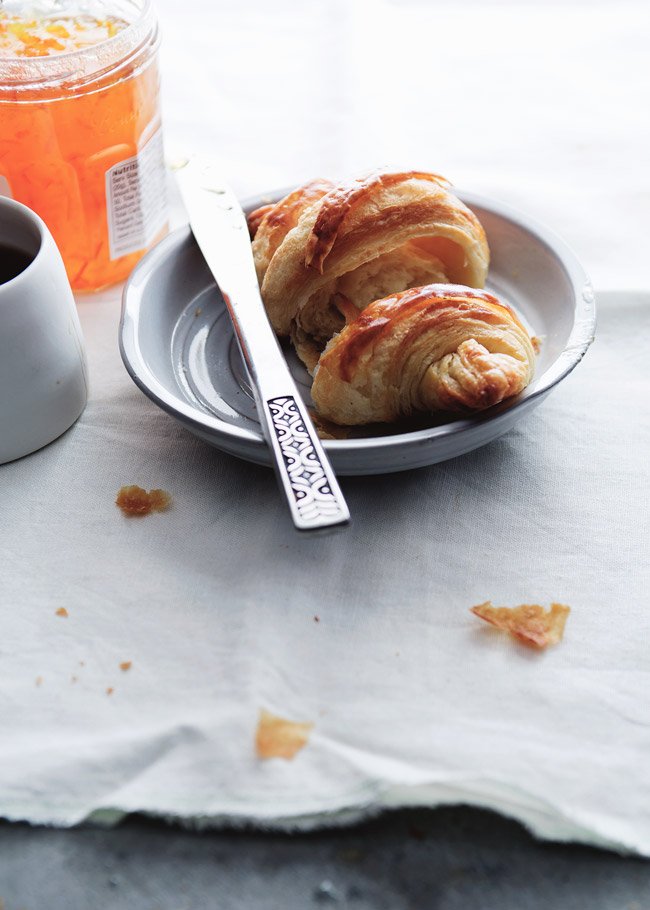
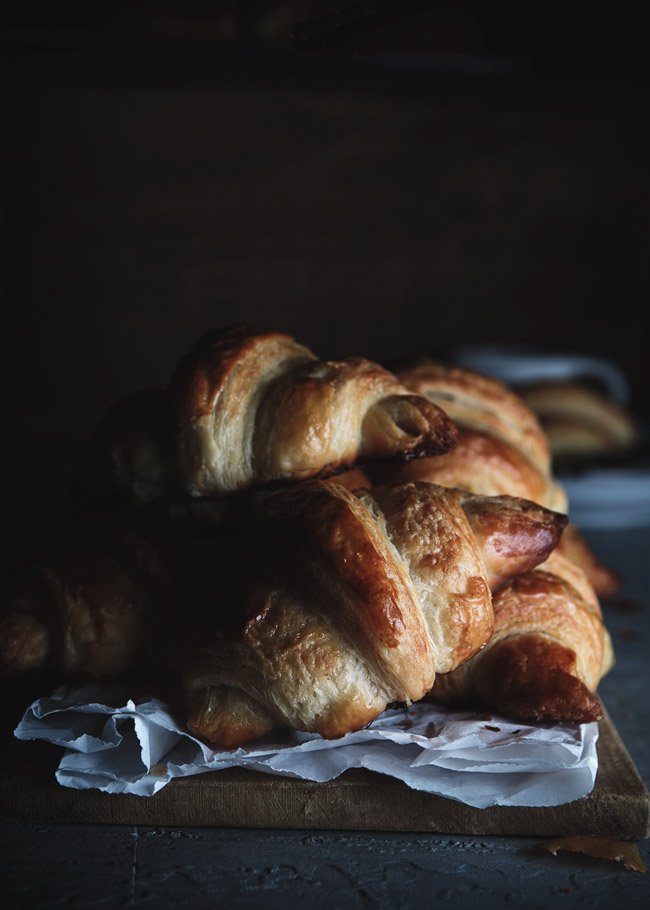
Of course you’re wondering how my second attempt went? Pretty well, I think. The insides were a bit doughier than I would’ve liked, but they actually tasted like croissants. Buttery, flaky, layers shattering upon contact. I love that initial tenderness of the innards when the croissants are pulled apart. They’re still steaming from their bake and taste incredibly luscious and fresh. I also love the way the tips burn slightly. They’re the crispest parts, all puff pastry-like and caramelized. And the shape, the shape! While svelte and long are generally qualities esteemed by women the world over, I love how cute and round mine came out. They’re like the Volkswagon Beetles of the croissant world.
I don’t know, I think Tartine just might approve.
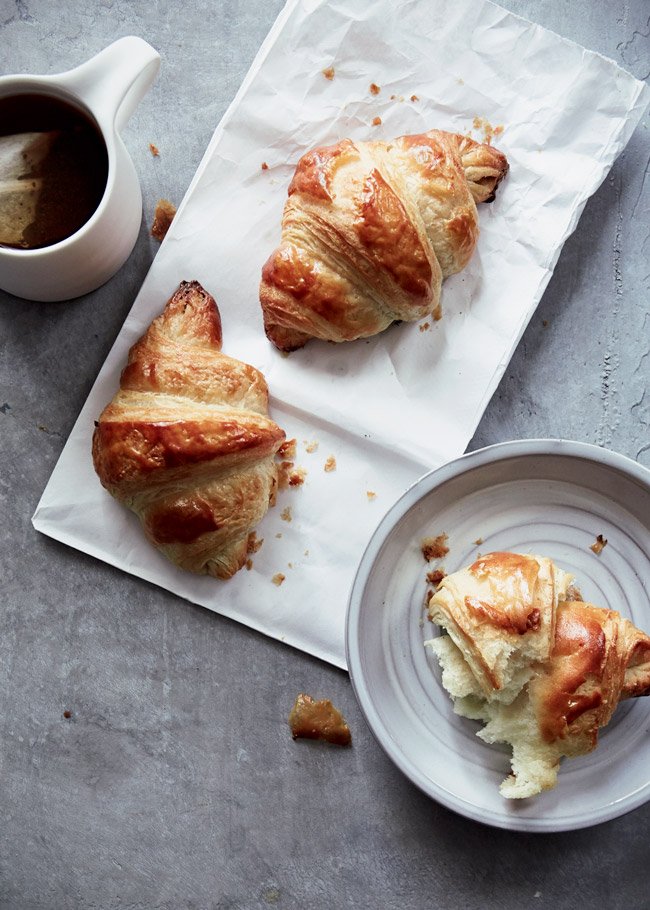
TARTINE CROISSANTS Recipe
Adapted from Tartine
Makes 10
Ingredients:
- For the preferment:
- 6 Tbsp nonfat milk
- 1/2 T (or 1.5 t) active dry yeast
- 2/3 cup all-purpose flour
And everything else:
- 2 t active dry yeast
- 1 cup minus 2 T (or 14 T) whole milk
- 3 cups all-purpose flour
- 1/6 cup sugar
- 2 t salt
- 1/2 T unsalted butter, melted
- 2-3/4 sticks (or 22 Tbsp) unsalted butter, cool but malleable
- 1 egg & a pinch of salt for the egg wash
Tartine Croissant Recipe Directions:
For the preferment: Heat up the milk so it’s warm but not hot (I mixed whole milk with hot water that had been heated in the kettle earlier in the day to make warm-ish “nonfat” milk.) and pour it in a mixing bowl. Sprinkle the yeast on top, stir to dissolve, and mix in the flour until a smooth batter forms. Cover and let rise until almost doubled in volume, 2 to 3 hours (or overnight if stored in the fridge).
For the rest of the recipe: Make the dough. Transfer the preferment to the bowl of a stand mixer fitted with the dough hook. Sprinkle in the yeast and mix on low speed until incorporated, a minute or two. You can stop the mixer to scrape down the sides if needed. When the mixture is well-mixed, increase the speed to medium and mix for a few minutes. Slowly add in half the milk and continue to mix until the milk is fully incorporated. (This will take awhile. I helped the process along by stopping the mixer and scraping down the sides.) Reduce the speed to low, add the flour, sugar, salt, melted butter, and the rest of the milk, and mix until everything comes together in a loose, shaggy-looking dough, about 3 minutes. Stop the mixer and let the dough rest for about 15 minutes. Once again, turn on the mixer and mix until the dough is smooth and elastic, no more than 4 minutes. (Mixing encourages gluten growth, which is not what you want in this case, so try to keep the mixing time as short as possible.) Once you’ve achived a smooth dough, cover the bowl and let the contents rise in a cool place until the volume increases by about half, 1.5 hours.
Lightly flour a work surface and transfer the dough to the surface. Press it into a rectangle about 2 inches thick, wrap in plastic wrap, and place the dough in the fridge for about 4 to 6 hours.
About an hour before removing the dough, put the butter in the bowl of your stand mixer fitted with the paddle attachment, and mix it on medium-high speed for a few minutes. This part is important, as the consistency of the butter is really important for lamination. What you’re going for is butter that’s malleable, but not melting. It should still be cool but amorphous, not retaining its original shape. I found it helpful to stop and scrape the butter that had built up on the side of the bowl with a spatula and into a bowl. If you do this a few times, poking the butter out of the holes of the paddle, you’ll end up with soft but cool butter. Place the bowl in the fridge to firm up a bit.
Now the lamination begins: Lightly flour a work surface and take dough and butter out of the fridge. Unwrap the dough and set it on the surface. With a rolling pin, roll the dough into a pronounced rectangle 20 inches wide and 8 inches long. Make sure the long side is facing you. Starting from the left, spread the butter over 2/3 of the dough using a combination of your hands and a spatula to apply it evenly (leave a slight margin). Fold the uncovered third over the center third, then fold the left third over that. (It’s like folding a letter.) What you end up with is called a plaque. Seal the seams of the plaque so that the butter is sealed within the dough.
Now onto the second turn: Turn the plaque 90 degrees so that the long side is once again facing you. Again, roll the dough out to a pronounced 20′x8″ rectangle and fold it like you did earlier. All the while, feel free to scatter a little flour over and under the dough to keep it from sticking to the rolling pin/surface, but brush off excess flour as it will affect the final product. Wrap the plaque in plastic wrap and place it in the fridge for about 1.5 hours.
The third and final turn: Repeat rolling out the plaque and folding it. Re-wrap it in plastic wrap and place it back in the fridge for about 1 hour. (At this point, the dough can be frozen, but let it warm up by spending a night in the fridge before rolling it out.)
Shaping: This time, roll the dough out to a pronounced rectangle at least 22.5″ wide and 9″ tall. Using a sharp knife or pizza wheel, cut off the excess margins. You basically want a 22.5″x9″ rectangle with the sides all trimmed off. Using a ruler, slice the dough into five equal rectangles that are 4.5″ wide and 9″ tall. Slice each of these in half so that you have 2 right-angled triangles (with a long side about 10″).
Have a large baking sheet covered with parchment paper ready. To shape, position each triangle so that the base faces you. Take the two points of the base in your fingers and stretch them a bit. Then furl the base upwards into a roll. Continue rolling with your palms, and at the end, grab the last tip, give it a slight stretch, and tuck the point underneath the rolled dough.
Place the croissant on the baking sheet, giving it plenty of space (Please note: in the picture above of the raw croissants, they are way too closely-spaced!). After all the croissants have been placed on the pan, set the croissants in a draft-free, cool place for a final rise, 2 to 3 hours. I placed the baking sheet in a large empty plastic bag. (It keeps a skin from forming, inhibiting the rise.)
Preheat your oven at 400 degrees F. When the croissants are just about ready (they’ll be puffy, and when you push one with your fingertips, the indent will stay), prepare the egg wash by whisking together the egg, a pinach of salt, and a splash of water. Apply the wash with a pastry brush over all the surfaces and edges. Slide the croissants into the oven. After 5 minutes, reduce the temperature to 350 degrees F and bake another 20 minutes until the croissants are golden-brown. And if some butter seeps out, that’s totally okay.
Check More Recipes:
Apricot Raspberry Galette, Or Look What I Made!
Related Posts




Subscribe for New Racipies
Get mental health tips, updates, and resources delivered to your inbox.