
Strawberry Rhubarb Ginger Crumb Bars

Medically reviewed by Christiana George Updated Date: January 6, 2026
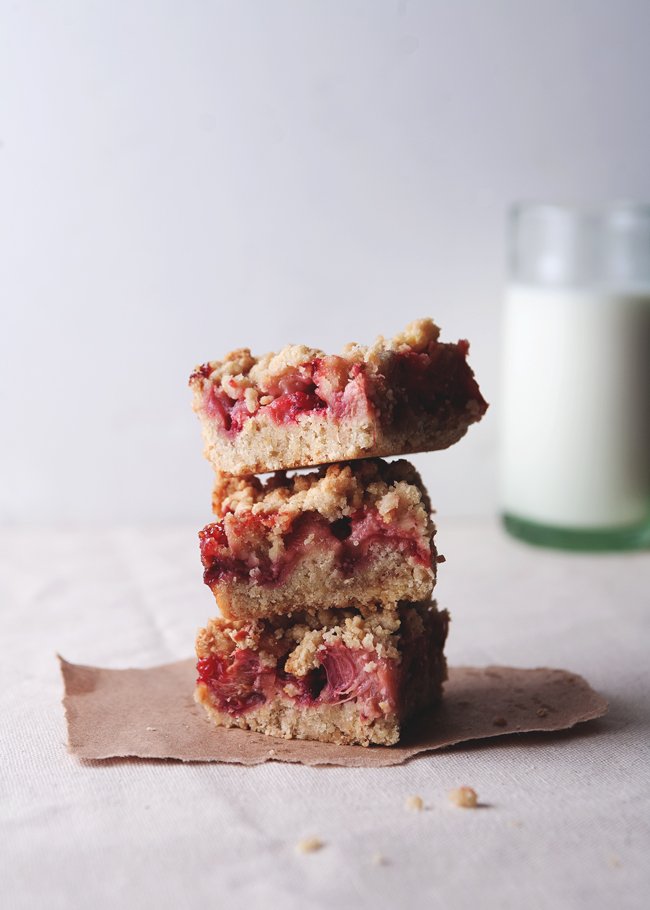
Is it still rhubarb season? I’d let a few stalks sit in the bottom drawer for so long that they turned rubbery, so I apologize if the season is over. The good news is, rhubarb can, evidently, be stored indefinitely in the vegetable compartment. As this recipe demonstrates; the glorious vegetable did not suffer in taste one bit.
I think I must’ve caught the rhubarb bug, because up until this year and Luzia’s rhubarb tiramisu, I’d never tasted it in my life. It’s another one of those foods Californians don’t go wild over because it doesn’t grow well in mild climates, at least not as far as I was aware, but Alanna proves otherwise. Her delicious array of rhubarb recipes clearly indicates that rhubarb appreciation is alive and well in the Golden State.
While I intended to make these much sooner, long weekends tend to throw me off schedule. Our Memorial Day weekend turned into more of a staycation, complete with the consumption of both vacation food and popcorn novels (I highly recommend Dark Places by Gillian Flynn—she’s actually a really good writer, don’t get me wrong) and a sunburn, despite the fact that most of the weekend was drab and rainy. What’s up with that anyway? I echo Amy’s thoughts—it’s extremely important, for my mental health, that the weather behaves the way it’s supposed to. It’s almost June, dammit! (I’m sitting here angrily typing away in an air-conditioned room. That might explain why I’m freezing.)
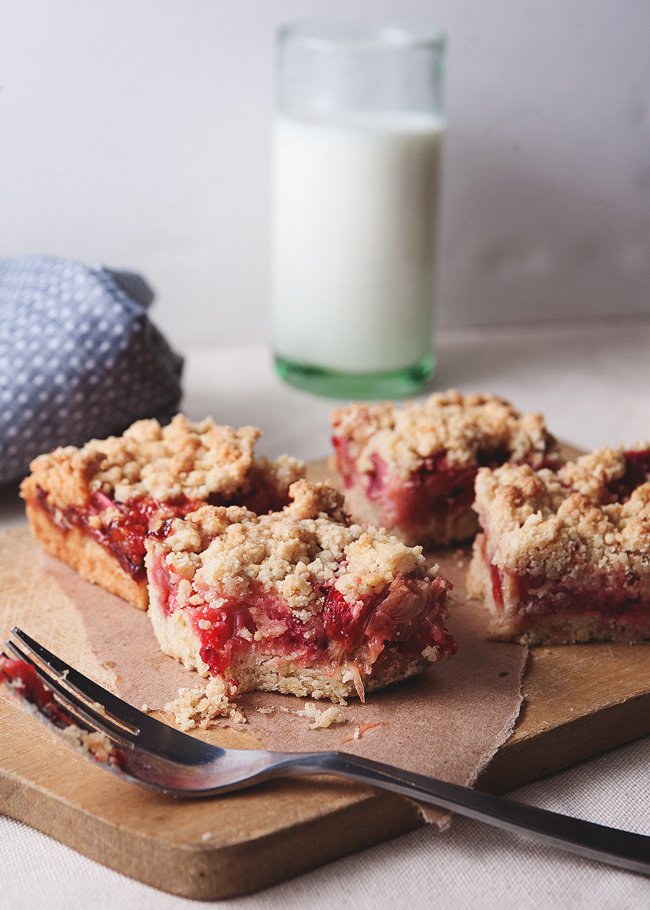
The recipe for these crumb bars has been passed around the web so many times, I’m not sure I can add too much to the collective wisdom. A few thoughts:
– The filling. I adapted the filling to include both strawberries and rhubarb. I loved the idea of adding a hint of ginger, but decided to go the crystallized route so you get the occasional nubbin of the stuff, bright zings, etc. I also added a little vanilla to contrast the rhubarb, and subbed out all the sugar for brown sugar. All in all, delicious! And that’s saying a lot because I don’t normally like fruit-based desserts.
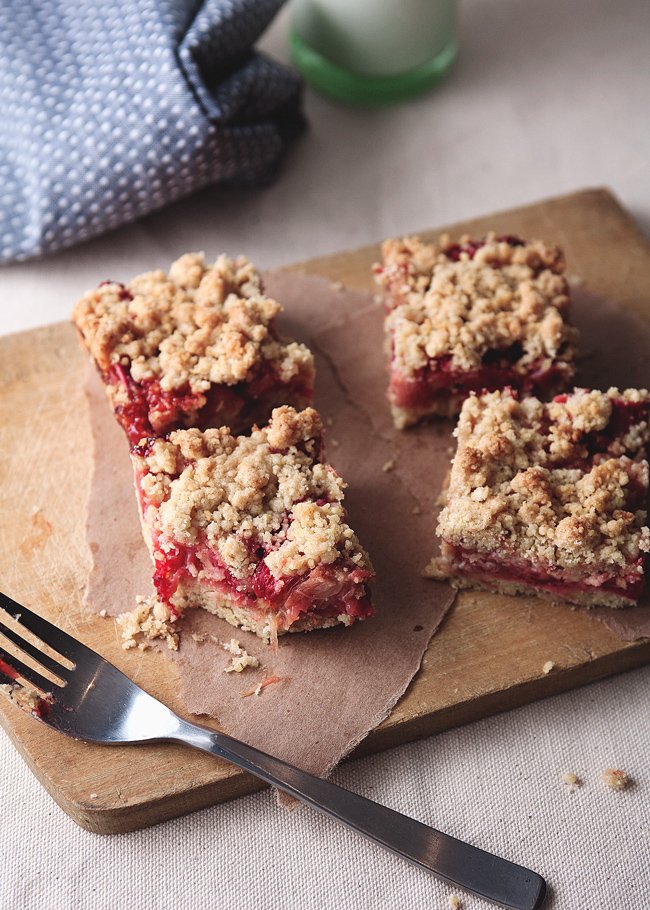
– The crumb topping to these bars is reminiscent of streusel, so I decided to play that up by substituting some of the all-purpose flour for oat flour and regular sugar for brown. In addition, I second Jess’s recommendation of patting down a thicker base. It gives the bars a nice, solid base, a thinner crumb layer, and more room for the gooey filling in the middle to seep into nooks and crannies. Yum.
– I also adapted the entire recipe for a 9″ square pan as opposed to a 9×12″ pan, because do I really want that much good stuff sitting in the kitchen? No.
– Resist the urge to cut into these straight away. Well, feel free to because warm desserts really are the best, but be aware that you’ll get scraggly edges, smeared crumbs, and an overall jammy mess. But that’s fine. In fact, if you’re not planning on impressing anyone, these bars are really good warm from the oven. (See how I just completely reversed my opinion within a few sentences? It’s because the opposing sides of my personality—the calm and sensible vs. the twitchy and impatient—can’t come to a consensus. Just do what you think is best.)
– Finally, do keep the bars refrigerated once they’ve cooled. The humidity’s starting up in these parts, which causes the dough to lose its structure and become slightly soft. This is more a matter of texture than taste, but no one wants a bar that crumbles in their hands, do they?
STRAWBERRY RHUBARB GINGER CRUMB BARS
Adapted from AllRecipes via Smitten Kitchen and Sweet Amandine
Makes 16 2-inch bars
Ingredients:
- 3/4 cup oat flour
- 1-1/2 cups all-purpose flour
- 1/2 cup sugar
- 1/4 cup brown sugar
- 3/4 tsp baking powder
- 1/4 tsp salt
- Zest of half a lemon
- 3/4 cup (1-1/2 sticks or 6 ounces) cold unsalted butter, cubed
- 1 large egg
For the filling:
- 2 cups ½-inch slices of rhubarb
- 2 cups sliced strawberries
- 2 Tbsp crystallized ginger
- Juice of half a lemon
- 1 tsp vanilla extract
- 1/2 cup brown sugar
- 4 tsp cornstarch
Directions:
Preheat oven to 375 degrees F and butter a 9″ square pan.
In a medium bowl, mix together the flours, sugars, baking powder, and salt. Stir in the lemon zest. Add the butter and egg, and work them into the mixture using your hands, a fork, or a pastry cutter. You want to end up with a crumbly, pebbly dough. Pat 2/3 of the dough into the prepared pan in an even layer.
Make the filling: In a medium bowl, mix the ginger, lemon juice, vanilla extract, brown sugar, and cornstarch. Gently mix in the rhubarb and strawberries.
Spoon the filling in an even layer over the patted-down dough. Sprinkle the remaining dough evenly over the top. Bake for 45 to 50 minutes until the crumb layer is golden-brown. If you’d like the bars to end up neatly-cut, wait for it to cool completely, overnight in the fridge if possible, before slicing it with a sharp knife.
Related Posts
Subscribe for New Racipies
Get mental health tips, updates, and resources delivered to your inbox.
Pumpkin Biscotti With Cranberries And Almonds

Apparently I’m on a pumpkin spree.
Allow me to grin sheepishly and assure you that pumpkin puree season is almost over, a fact that makes me feel both sad and just a little relieved. For Chris, at least. His pumpkin fatiguée has never run so high. (Although one serving of pumpkin pie should cure him of that.)
And admittedly, even my tolerance is beginning to wane. I tend towards the obsessive in many aspects of my life, and pumpkin is one of these things. As well as listening to the same song/album on repeat, wearing the same shirt for weeks on end, wanting to eat at the same restaurant every time I go out, etc. etc. The inevitable result of such overload is almost criminally tragic: after such sensory gluttony, said objects/activities become warped, twisted. I can never view them the same way again.
That early magic is so transcendent, yet transient. Like the first time I heard the song “Weird Fishes by Radiohead.” God, I was moved. It haunted me. I still love it—and the entire album for that matter—but how I wish I could hear it again for the first time. (You can.)
So seasonality may not be such a bad thing after all. I mean, I wouldn’t mind having access to perfectly ripe peaches the entire year round. But I’d be losing the experience of the anticipation, and the unadulterated captivation of the first bite. Which means more to me than you can know.
With all that being said, it’s almost time to retire pumpkin. Almost. After all, there’s still pumpkin pie to be had.

Traditional Italian biscotti is not the buttery, cake-y creations we have today. They’re supposed to be biscuits after all, and biscuits do not connote dessert. It was made exclusively with flour, sugar, eggs, almonds (not roasted or skinned), and pine nuts. And meant to last a long time. Centuries, if stored carefully, according to Pliny the Elder.
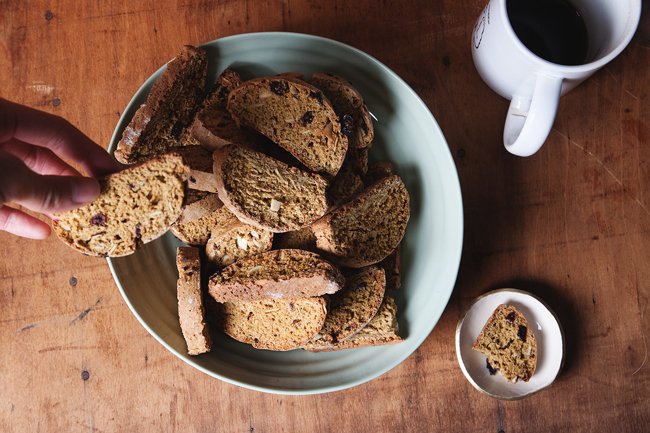
Purists would call the recipe below a bastardization then. At the same time, I didn’t want to make anything too extravagant, too rich, too filling. I didn’t want to dip my biscuits in chocolate, or adorn them knee-deep with toppings, or have them leave behind butter stains on my finger. Rather, I was craving a sensible, no-nonsense, pumpkin-flavored treat to eat alongside my mid-morning coffee.
And that’s how these biscotti came out.

Of course, my few modest additions helped ever so much with the flavor, if I do say so myself. Dried cranberries to make it feel more festive, slivered almonds because they were one of the original ingredients, cinnamon, ground ginger, and cardamom because why the hell not. I dusted the top with black sesame seeds, bird food really, and into the oven my fat little loaf went.
Twice.
Because that’s how you make biscotti. You bake it twice.

PUMPKIN BISCOTTI WITH CRANBERRIES AND ALMONDS
Adapted from The New Best Recipe
Makes about 50
Ingredients:
- 1-1/2 cups all-purpose flour
- 1 cup whole wheat flour
- 1 tsp baking powder
- 1/2 tsp baking soda
- 1/4 tsp salt
- 1 tsp cinnamon
- 1/2 tsp ground ginger
- 1/4 tsp cardamom
- 3/4 cup pumpkin puree
- 1 cup brown sugar
- 2 large eggs
- 1 tsp vanilla extract
- 1/2 cup slivered almonds
- 1/2 cup dried cranberries
- black sesame seeds for topping
Directions:
Preheat oven to 350 degrees F. Line a large baking sheet with parchment paper.
Whisk the flours, baking powder, baking soda, salt, and spices together in a medium bowl. Set aside. In a larger bowl, whisk the pumpkin puree, sugar, and eggs together until smooth. Stir in the vanilla extract, almonds, and cranberries. Pour the dry ingredients over the egg mixture and fold until just combined.
Halve the dough and turn each half onto the prepared baking sheet. Using floured hands, stretch each half into a long loaf about 12 inches. Shape and pat each one smooth. Sprinkle liberally with black sesame seeds.
Bake until the loaves begin to crackle on top, about 25 minutes. Rotate the pan halfway through baking. Remove from the oven and let the pan cool for about 10 minutes. Meanwhile, reduce the oven temperature to 325 degrees F.
Transfer the loaves onto a cutting board. Using a serrated knife, cut each loaf diagonally into thin slices, about 1/2-inch. Lay the slices back on the baking sheet and return them to oven. Bake until crisp and golden-brown on both sides, about 15 minutes. Halfway through baking, turn the cookies over and rotate the baking sheet.
Remove from oven, and let cool. Store in an airtight container.
Related Posts
Subscribe for New Racipies
Get mental health tips, updates, and resources delivered to your inbox.