
Are Gala Apples Acidic? pH Compared to Other Varieties

Medically reviewed by Jaclyn Weiner, RD, RDN, MEd, MS Updated Date: October 13, 2026
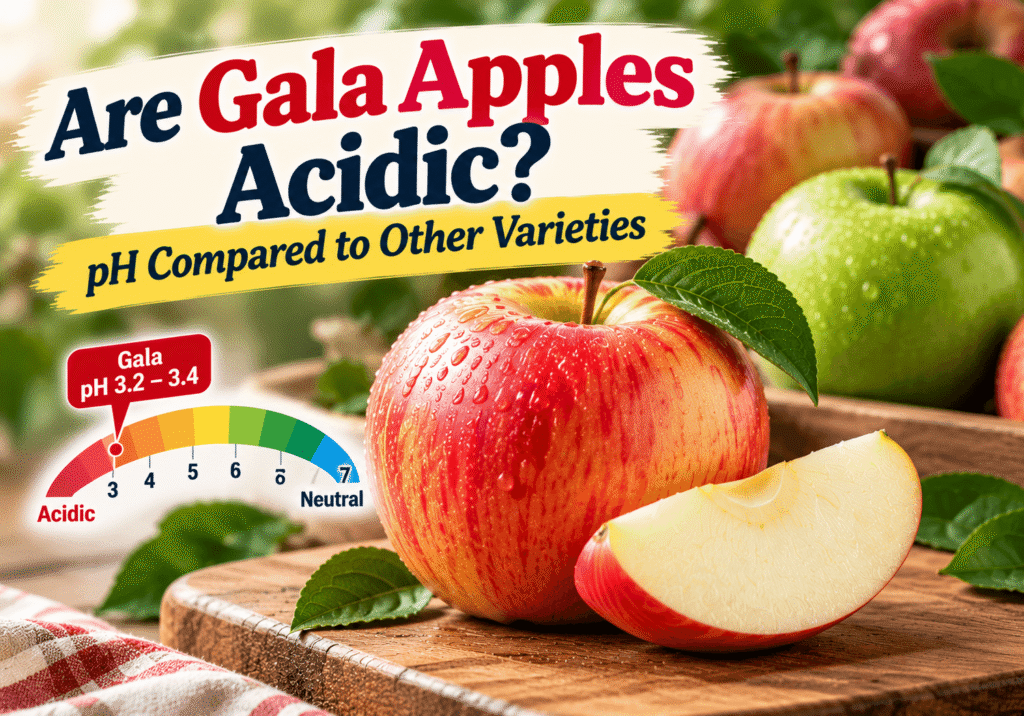
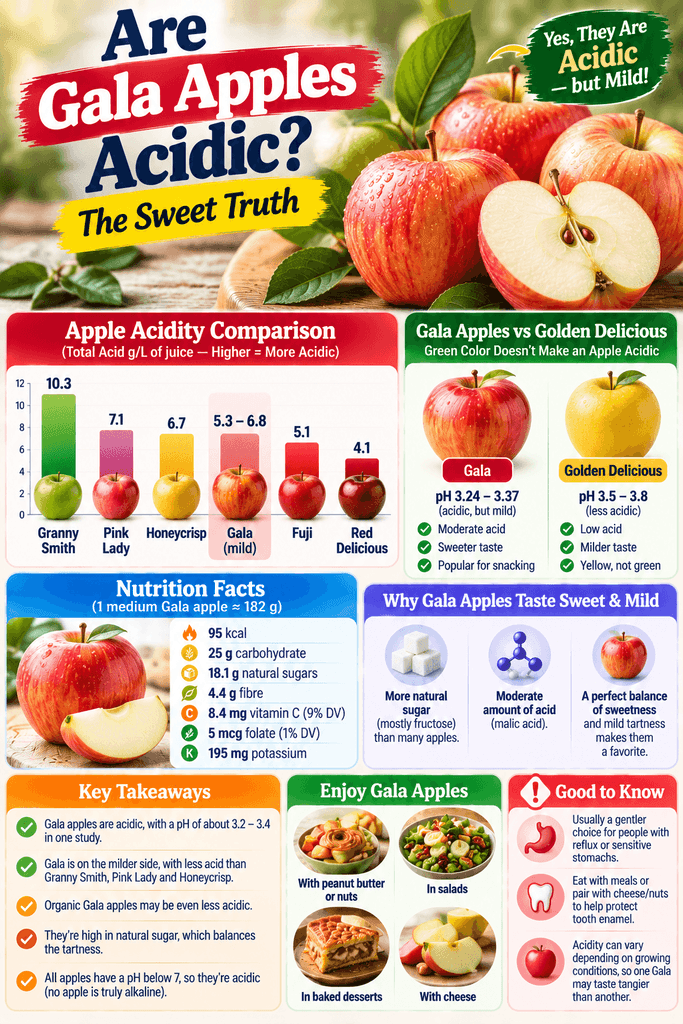
Yes, Gala apples are acidic, but they’re one of the milder apples you can buy. In a 2018 study of 11 apple varieties, Gala measured pH 3.24 to 3.37 with about 5.3 to 6.8 grams of total acid per liter of juice (Mezey and Serralegri, 2018). That’s roughly one-half to two-thirds of the acid in a Granny Smith, and it places Gala in the lower-to-middle part of the apple acidity range.
Gala’s mild, sweet flavor is a big reason it’s one of the most popular lunchbox apples. But “mild” doesn’t mean “not acidic.” Every apple, Gala included, has a pH well below neutral. In this guide, you’ll see exactly how Gala’s pH compares with Fuji, Honeycrisp, Pink Lady, Granny Smith, Red Delicious, and more, plus what that means for acid reflux, your teeth, and your kitchen.
Key Takeaways
- Gala apples are acidic, with a pH of about 3.2 to 3.4 in one study.
- Gala is on the milder side. It had less total acid than Granny Smith, Pink Lady, Kanzi, and Braeburn, and about the same as Fuji.
- Organic Gala tested even milder in one study, ranking among the least acidic apples.
- Gala tastes sweet because it’s high in natural sugar, mostly fructose.
- For people with reflux, Gala is one of the gentler apple choices, though no apple is proven “reflux-safe.”
- All apples sit between about pH 3 and 4, so the differences between varieties are real but modest.
For more apple varieties, see our guides to Granny Smith, Pink Lady, and Honeycrisp, or start with Are Apples Acidic?
Are Gala Apples Acidic or Alkaline?
Gala apples are acidic, not alkaline. On the pH scale, anything below 7 is acidic, 7 is neutral, and anything above 7 is alkaline. Gala juice measured pH 3.24 to 3.37 in the 2018 study (Mezey and Serralegri, 2018), which is solidly acidic, though not extreme.
Like all apples, Gala gets its acidity mainly from malic acid, the natural acid that gives apples their refreshing tang.
Why some people call apples “alkaline”
You may see apples on “alkaline food” lists. That refers to the estimated acid load a food leaves after digestion, not its pH. Most fruits and vegetables are considered alkaline-forming because they’re rich in potassium and other minerals (Remer and Manz, 1995). Either way, eating apples doesn’t change your blood pH, which your body keeps at about 7.35 to 7.45 (Hopkins et al., StatPearls).
What Is the pH of Gala Apples?
Gala isn’t listed in the FDA’s older table of food pH values, but researchers have measured it directly.
The 2018 apple variety study
A study published in the Athens Journal of Sciences tested Gala apples from both organic and conventional production (Mezey and Serralegri, 2018):
| Gala sample | pH | Total acid (g/L) | Sugar (°Brix) |
| Organic | 3.37 | 5.28 | 11.92 |
| Conventional | 3.24 | 6.84 | 12.83 |
Source: Mezey and Serralegri, Athens Journal of Sciences, 2018.
The organic Gala samples were noticeably less acidic, with a higher pH and less total acid, than the conventional ones. That’s a good reminder that growing conditions can shift an apple’s acidity.
Gala juice in Brazil
A separate study of apple juices made from Brazilian Gala and Fuji apples found Gala’s titratable acidity averaged about 0.28 grams per 100 mL, with a range of roughly 0.12 to 0.40 (Vieira et al., 2011). That’s a modest acid level for an apple and very close to Fuji’s average in the same study.
What these numbers tell us
- Gala’s pH is about 3.2 to 3.4, similar to most apples.
- Its total acid is moderate to low compared with tart varieties.
- Acidity varies with growing conditions, so one Gala may taste a little tangier than another.
Why Gala Apples Taste So Sweet and Mild
Gala’s flavor comes from a combination of moderate acid and plenty of sugar. USDA FoodData Central lists raw Gala apples at about 11.8 grams of sugar per 100 grams, most of it fructose (USDA FDC 1750341). That’s more sugar than Granny Smith (about 10.7 grams) (USDA FDC 1750342), with less acid to compete with it.
A sweet family history
Gala’s mild personality runs in the family. The variety was developed in New Zealand by grower James Hutton Kidd, who crossed Kidd’s Orange Red and Golden Delicious between the late 1920s and late 1930s. A seedling known as “Kidd’s D8” was selected during the Second World War, released in 1962 under the name Gala, and planted commercially in New Zealand starting in 1965. It was described as having “a sweet, aromatic flavor and fine, crisp flesh” (Good Fruit Grower).
Golden Delicious, one of Gala’s parents, is itself a low-acid apple. Its titratable acidity was reported at just 0.32% in comparison data published with the Pink Lady variety description (Cripps et al., 1993).
Does Gala Acidity Change? Storage, Ripeness, and Growing Method
A Gala apple’s acidity isn’t fixed. Three things can shift it:
1. Storage time
Apples gradually use up some of their acid after harvest. USDA physiologist Dr. Jim Mattheis notes that all apples lose acid during storage, although apples that start with more acid still end with more (Good Fruit Grower). In a Canadian study of Honeycrisp and McIntosh, juice pH rose and titratable acidity fell over six months of cold storage, while sugar readings went up (Gao and Rupasinghe, 2012). Gala wasn’t part of that study, but the same general pattern applies to apples. A Gala bought late in the season may taste a little milder than one bought right after harvest.
2. Organic vs. conventional growing
In the 2018 study, organic Gala had a higher pH (3.37 vs. 3.24) and about 23% less total acid (5.28 vs. 6.84 g/L) than conventional Gala (Mezey and Serralegri, 2018). Several other varieties showed a similar pattern. This was one study, so it doesn’t prove that organic apples are always less acidic, but it shows that growing conditions matter.
3. Ripeness
Riper apples generally taste sweeter and less sharp than underripe ones, because sugar builds up as fruit ripens. A fully colored, ripe Gala will usually taste milder than one picked early. If you’re sensitive to acid, choose apples that look fully ripe and feel firm but not hard.
The bottom line: two Gala apples can taste a little different, but Gala as a variety stays in the mild-to-moderate acid range.
Gala Apple pH Compared to Other Varieties
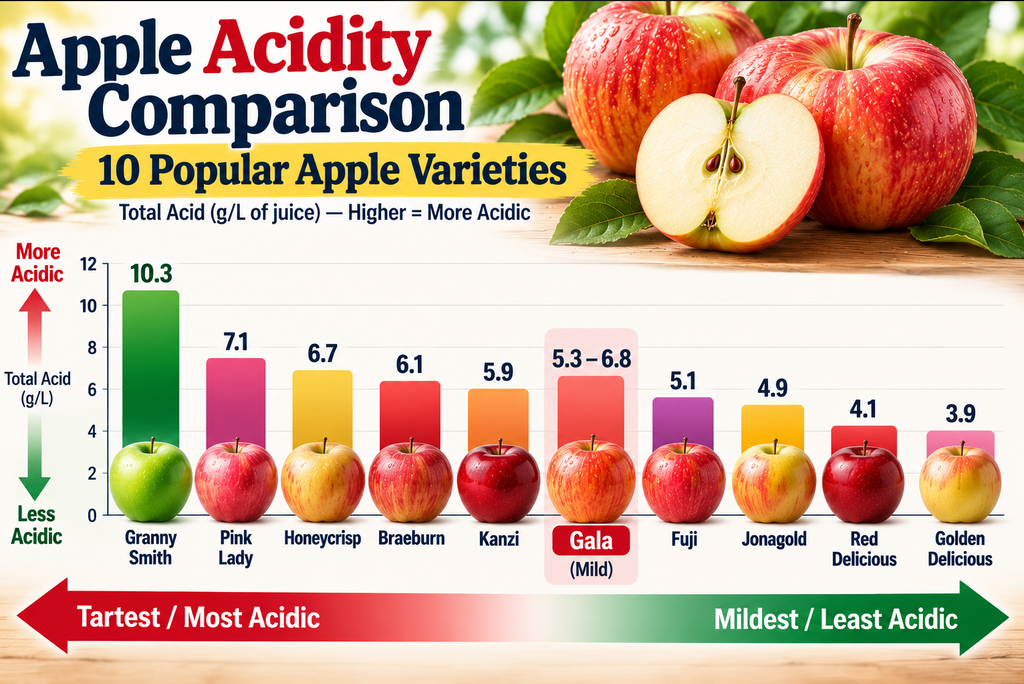
This is where Gala’s mildness really shows. The 2018 study measured 10 popular apple varieties under both organic and conventional growing (Mezey and Serralegri, 2018):
| Apple variety | pH (conventional) | Total acid, g/L (conventional) | pH (organic) | Total acid, g/L (organic) |
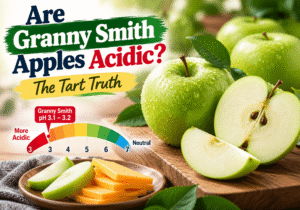
| Granny Smith | 3.12 | 10.34 | 3.20 | 10.26 |
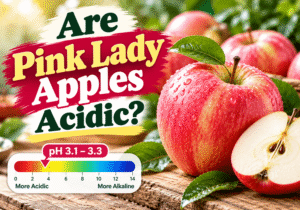
| Pink Lady | 3.13 | 8.17 | 3.28 | 7.44 |
| Kanzi | 3.20 | 7.83 | 3.19 | 8.71 |
| Braeburn | 3.16 | 7.78 | 3.29 | 6.37 |
| Gala | 3.24 | 6.84 | 3.37 | 5.28 |
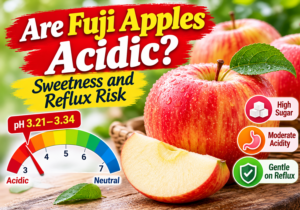
| Fuji | 3.21 | 6.61 | 3.34 | 5.33 |
| Golden Delicious | 3.19 | 6.31 | 3.33 | 4.99 |
| Envy | 3.31 | 5.45 | 3.46 | 5.24 |
| Red Delicious | 3.28 | 4.89 | 3.36 | 5.07 |
| Red Chief | 3.26 | 4.64 | 3.33 | 5.38 |
Source: Mezey and Serralegri, Athens Journal of Sciences, 2018, Tables 3 and 4. Sorted by conventional total acid, from highest to lowest.
Where does Gala rank? In the conventional samples, Gala landed in the middle of the pack. In the organic samples, it had one of the highest pH values and among the lowest total acid, putting it with the gentlest apples tested.
Gala vs Fuji
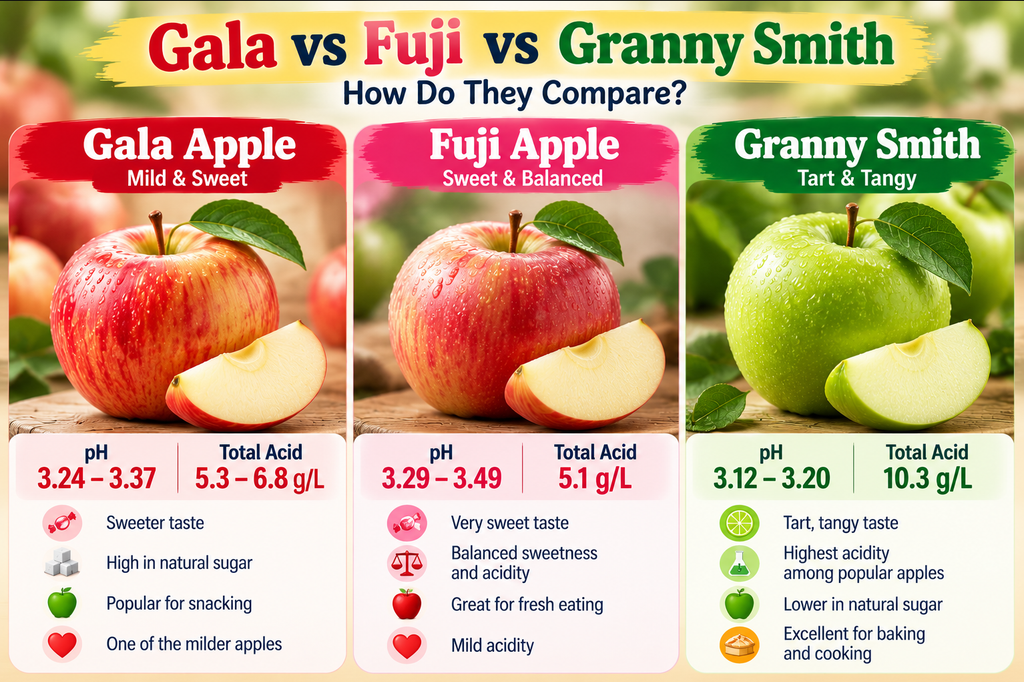
Gala and Fuji are very similar in acidity. In the 2018 study, their pH and total acid were nearly identical in both organic and conventional samples, and the Brazilian juice study found almost the same average acidity for both (Vieira et al., 2011). The main difference is sugar: Fuji had the highest sugar of all the apples tested in 2018, so it tends to taste even sweeter (Mezey and Serralegri, 2018).
Gala vs Honeycrisp
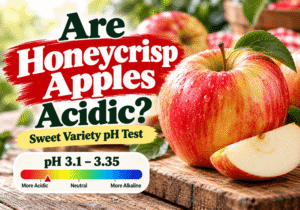
Honeycrisp wasn’t in the 2018 study, but other research found Honeycrisp juice at about pH 3.11 at harvest and 3.19 to 3.35 after storage (Gao and Rupasinghe, 2012), with titratable acidity of about 0.3% to 0.7% at harvest (Good Fruit Grower). Because these come from different studies, a direct comparison isn’t perfect, but Gala generally sits in a similar to slightly milder range. Read more in Are Honeycrisp Apples Acidic?
Gala vs Granny Smith
This one isn’t close. Granny Smith had about 1.5 times (conventional) to 2 times (organic) as much total acid as Gala in the 2018 study. If you find Granny Smith too sour, Gala is a much gentler swap. See Are Granny Smith Apples Acidic?
Gala vs Pink Lady
Pink Lady had about 20% to 40% more total acid than Gala in the 2018 study. Pink Lady tastes sweet-tart, while Gala tastes sweet and mild. See Are Pink Lady Apples Acidic?
Gala vs Red Delicious and Golden Delicious
Red Delicious and Golden Delicious had slightly less total acid than Gala in the conventional samples, while organic Gala was right alongside them. These three are among the mildest common apples. See Are Red Apples Acidic?
Gala vs other everyday foods
To put Gala’s pH in perspective, here’s how it compares with other foods, using FDA values:
| Food | Approximate pH |
| Lemon juice | 2.00–2.60 (FDA) |
| Gala apple | 3.24–3.37 (2018 study) |
| Apples, eating (general) | 3.30–4.00 (FDA) |
| Tomatoes, fresh | 4.30–4.90 (FDA) |
| Bananas | 4.50–5.29 (FDA) |
| Cantaloupe | 6.13–6.58 (FDA) |
Sources: FDA, Approximate pH of Foods and Food Products; Gala value from Mezey and Serralegri, 2018.
Gala is far less acidic than lemon juice but more acidic than tomatoes, bananas, and melons. For a full list of foods, see our complete guide to acidic foods.
Are Gala Apples Good for Acid Reflux?
For many people, Gala apples are a reasonable choice. Apples aren’t on the National Institute of Diabetes and Digestive and Kidney Diseases’ (NIDDK) list of foods that commonly worsen reflux. That list names citrus fruits, tomatoes, alcohol, chocolate, coffee and caffeine, high-fat foods, mint, and spicy foods (NIDDK).
And because Gala is lower in acid than tart varieties like Granny Smith and Pink Lady, it’s one of the gentler apples to try if acidic fruit sometimes bothers you.
A few important caveats:
- No apple is proven to treat or prevent reflux. There’s no research showing that Gala, or any apple, relieves heartburn.
- Triggers vary from person to person. The American College of Gastroenterology’s 2022 guideline recommends that people with GERD identify their own trigger foods (Katz et al., 2022).
- Gala is still acidic. If even mild apples bother you, try lower-acid fruits like bananas or melons.
Tips for eating Gala apples with reflux
- Eat them with a meal or snack, such as with oatmeal, yogurt, or cottage cheese.
- Start with a modest portion, like half an apple.
- Avoid eating close to bedtime. NIDDK suggests eating meals at least 3 hours before lying down if you have nighttime symptoms (NIDDK).
- Go easy on apple juice and cider, which are easy to drink in large amounts. See Is Apple Cider Safe for Acid Reflux?
- Keep a food diary to see how your body responds.
For a ranked list of gentler and tarter apples, see our guide to GERD-friendly apple varieties. For broader advice, read foods to avoid with GERD. If you have frequent heartburn (more than twice a week), trouble swallowing, or symptoms that don’t improve, see your doctor.
Gala Apples and Your Teeth
Gala apples are sweet and acidic, a combination that can be tough on teeth if you snack on them all day. The American Dental Association recommends:
- Eating acidic foods as part of a meal, not by themselves
- Rinsing with water, drinking milk, or eating cheese afterward to help neutralize acid
- Waiting about an hour before brushing after acidic foods
Source: American Dental Association, MouthHealthy.
Gala’s milder acidity is a bonus here, but these habits still help. Read more in Are Apples Good for Your Teeth?
Cooking and Baking with Gala Apples
Gala’s sweet, mild flavor makes it a great choice when you want apple flavor without much tang:
- Fresh snacking and lunchboxes: Its sweetness appeals to kids and adults alike.
- Salads: Sliced Gala adds sweetness and crunch to green salads and slaws.
- Applesauce and baking: Gala gives a sweet, mellow result. If you like more tang, mix it with a tarter apple like Granny Smith.
Cooking doesn’t remove an apple’s natural acid. The FDA lists applesauce at pH 3.10 to 3.60 (FDA), so cooked apple dishes are still acidic.
Recipes to try with Gala apples
- Honeycrisp apple salad: Gala works well as a sweeter swap.
- Maple apple muffins: A cozy breakfast bake.
- Apple cinnamon raisin pancakes: Sweet Gala pairs nicely with warm spices.
- Pumpkin banana apple yogurt smoothie: A mild, creamy option.
- Mom’s apple cake: Combine Gala with a tarter apple for balance.
A dash of cinnamon brings out Gala’s natural sweetness.
Are Gala Apples Healthy?
Yes. Gala apples are a low-fat, fiber-containing fruit. Here’s what USDA FoodData Central lists for 100 grams of raw Gala with skin (USDA FDC 1750341):
| Nutrient | Per 100 g |
| Calories | about 55 |
| Water | 84.7 g |
| Carbohydrates | 14.8 g |
| Fiber | 2.1 g |
| Total sugars | 11.8 g (mostly fructose) |
| Potassium | 106 mg |
A few notes:
- Keep the skin on for more fiber.
- Gala is a little higher in sugar than Granny Smith (11.8 g vs. 10.7 g per 100 g, per USDA), which is part of why it tastes sweeter.
- Managing blood sugar? Pair apples with protein or healthy fat. See Are Apples Good for Diabetics?
Frequently Asked Questions
Are Gala apples acidic or alkaline?
Gala apples are acidic, with a pH of about 3.24 to 3.37 in one study. Like most fruits, apples are considered alkaline-forming after digestion, but that doesn’t change your blood pH.
What is the pH of a Gala apple?
About 3.2 to 3.4. In a 2018 study, conventional Gala apples measured pH 3.24 and organic Gala apples measured pH 3.37.
Are Gala apples less acidic than other apples?
Gala is less acidic than Granny Smith, Pink Lady, Kanzi, and Braeburn, and about as acidic as Fuji. Red Delicious and Golden Delicious can be slightly milder.
Are Gala apples good for acid reflux?
They’re one of the gentler apple choices because of their moderate acid, but no apple treats reflux. Eat them with meals and in modest portions if you’re sensitive.
Which is less acidic, Gala or Fuji?
They’re nearly identical. Studies found very similar pH and acid levels for Gala and Fuji. Fuji usually tastes sweeter because it has more sugar.
Which is less acidic, Gala or Honeycrisp?
They’re in a similar range. Honeycrisp’s acid varies widely, from about 0.3% to 0.7% at harvest, so some Honeycrisp apples are tarter than Gala and some are similar.
Why do Gala apples taste so sweet?
Gala has plenty of natural sugar, about 11.8 grams per 100 grams, and only moderate acid, so sweetness dominates the flavor.
Are Gala apples healthy?
Yes. They’re low in calories and fat, provide fiber, and make an easy, nutritious snack.
The Bottom Line
Gala apples are acidic, with a pH of about 3.2 to 3.4, but they’re one of the milder apples available. They contain less acid than Granny Smith, Pink Lady, Kanzi, and Braeburn, and about the same as Fuji. Their natural sweetness, inherited partly from Golden Delicious, gives them their famously mild flavor.
If you’re looking for a gentler apple because of reflux or sensitive teeth, Gala is a smart pick. Just remember that it’s still acidic, so eat it with meals, keep portions reasonable, and pay attention to how your body responds.
Want to compare more apples? Read Are Granny Smith Apples Acidic?, Are Pink Lady Apples Acidic?, Are Honeycrisp Apples Acidic?, or Are Apples Acidic?
Medical disclaimer: This article is for general information only and isn’t a substitute for professional medical or dental advice. If you have frequent heartburn, GERD, or dental sensitivity, talk with your doctor, dentist, or a registered dietitian.
References
- Mezey J, Serralegri D. Selected quantitative parameters comparison of apples from bio- and conventional production. Athens Journal of Sciences. 2018;5(4):343–354. https://doi.org/10.30958/ajs.5-4-3
- Vieira RG, Prestes RA, Denardi F, Nogueira A, Wosiacki G. Chemical pattern of Brazilian apples: a chemometric approach based on the Fuji and Gala varieties. Ciência e Tecnologia de Alimentos. 2011;31(2):418–426. https://www.redalyc.org/pdf/3959/395940105021.pdf
- Gao J, Rupasinghe HPV. Characterization of ‘Honeycrisp’ and ‘McIntosh’ apple juice quality in relation to delayed cooling treatments. The Open Food Science Journal. 2012;6:12–15. https://benthamopen.com/contents/pdf/TOFSJ/TOFSJ-6-12.pdf
- Good Fruit Grower. How to measure Honeycrisp qualities (quoting Dr. Jim Mattheis, USDA-ARS). https://goodfruit.com/how-to-measure-honeycrisp-qualities
- Good Fruit Grower. Last bite: Gala breeder put flavor first. https://goodfruit.com/last-bite-gala-breeder-put-flavor-first
- Cripps JEL, Richards LA, Mairata AM. ‘Pink Lady’ apple. HortScience. 1993;28(10):1057. https://journals.ashs.org/downloadpdf/view/journals/hortsci/28/10/article-p1057.pdf
- USDA FoodData Central. Apples, gala, with skin, raw (FDC ID 1750341, Foundation Foods). https://fdc.nal.usda.gov/fdc-app.html#/food-details/1750341/nutrients
- USDA FoodData Central. Apples, granny smith, with skin, raw (FDC ID 1750342, Foundation Foods). https://fdc.nal.usda.gov/fdc-app.html#/food-details/1750342/nutrients
- U.S. Food and Drug Administration, CFSAN. Approximate pH of Foods and Food Products. 2007. Copy used: https://riverstonehealth.org/wp-content/uploads/FDA-Approximate-pH-of-Foods.pdf
- NIDDK. Eating, Diet, & Nutrition for GER & GERD. https://www.niddk.nih.gov/health-information/digestive-diseases/acid-reflux-ger-gerd-adults/eating-diet-nutrition
- Katz PO, Dunbar KB, Schnoll-Sussman FH, et al. ACG Clinical Guideline for the Diagnosis and Management of GERD. Am J Gastroenterol. 2022;117(1):27–56. https://doi.org/10.14309/ajg.0000000000001538
- American Dental Association, MouthHealthy. Dietary Acids and Your Teeth. https://www.mouthhealthy.org/all-topics-a-z/dietary-acids-and-your-teeth
- Remer T, Manz F. Potential renal acid load of foods and its influence on urine pH. J Am Diet Assoc. 1995;95(7):791–797. https://pubmed.ncbi.nlm.nih.gov/7797810/
- Hopkins E, Sanvictores T, Sharma S. Physiology, Acid Base Balance. StatPearls. https://www.ncbi.nlm.nih.gov/books/NBK507807/
Related Posts
Subscribe for New Racipies
Get mental health tips, updates, and resources delivered to your inbox.
Mini Chocolate Peanut Butter Donuts w/ Peanut Butter Glaze

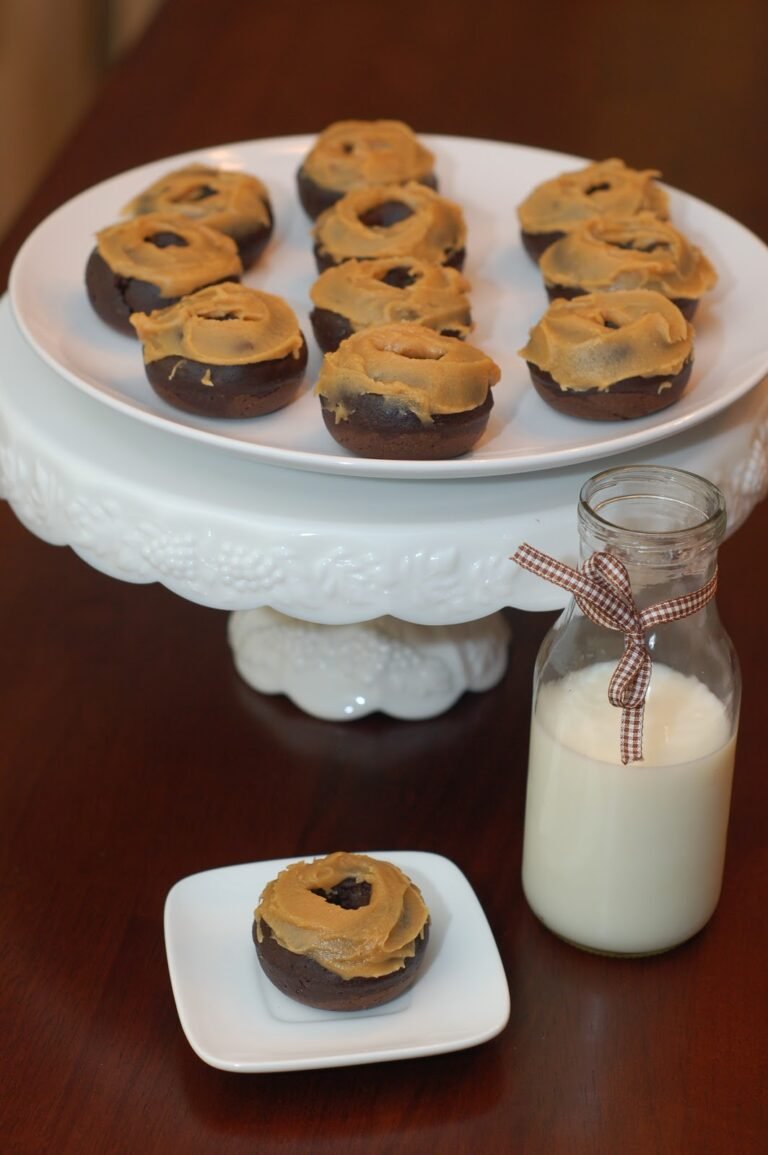

Whew! It’s been crazy busy in this neck of the woods these past couple of weeks. Between trying to do some Christmas shopping, celebrating Thanksgiving twice, decorating for Christmas, packing for vacation, going on vacation, unpacking from vacation, doing some more Christmas shopping and taking pictures of the kids for our Christmas cards, I have not had much time to sit. So now that I have a little time, I wanted to post another donut recipe I made before all the hoopla took place. Averie from healthyfoodforliving.com/recipes/ said I should try her donut recipes, so I chose to try the Peanut Butter Chocolate ones. I love chocolate and peanut butter together. These little gems satisfy my craving without feeling guilty. They are so light and fluffy, they don’t feel like a brick on your stomach like regular fried donuts. I am really getting some use out of my babycakes machine.

Mini Chocolate Peanut Butter Donuts
by loves veggies and yoga
Ingredients
- 2 tbsp butter, melted
- 2 tbsp peanut butter, melted
- 3/4 cup flour
- 1/3 cup granulated sugar
- 1/4 cup cocoa
- 1 tsp baking powder
- 1/4 tsp cinnamon
- 1/2 cup buttermilk ( I didn’t have any, so used reg. milk)
- 1 egg
- 1/2 tsp vanilla extract
Cooking Directions
- In a small bowl, soften/melt the butter and peanut butter in the microwave, about 15- 30 seconds. Stir.
- In a large bowl, mix together flour, cocoa powder, sugar, baking powder, cinnamon, buttermilk, egg, and vanilla. Mix well.
- Add the butter/peanut butter mixture and stir together until well blended.
- Fill each cooking reservoir with about 2 tbsp of batter.
- Bake 2-4 minutes or until toothpick inserted in donut comes out clean. Makes about 12 mini donuts.

Peanut Butter Glaze
by loves veggies and yoga
Ingredients
- 1 tbsp butter, melted
- 2 tbsp peanut butter, melted
- 1/3 cup powdered sugar
- 1/2 tsp vanilla extract
- 1 tbsp milk
Cooking Directions
- Mix the melted butter and peanut butter. Then add the powdered sugar and vanilla.
- Slowly add the water or milk, one teaspoon at a time, until desired consistency is achieved.

For some reason I am having trouble getting the glaze to adhere to the donuts, so I end up having to make the recipe a little thincker and put it on as more of a frosting. I wonder if the machine gives the donuts a slicker finish than if I baked them in the oven? I guess I will find out when I finally get to buy my pans. Maybe Santa will bring me some for Christmas.
Related Posts


Subscribe for New Racipies
Get mental health tips, updates, and resources delivered to your inbox.