
Acidic Foods: 25 Most Acidic Foods, Foods to Avoid, and Low-Acid Alternatives

Medically reviewed by Jaclyn Weiner, RD, RDN, MEd, MS Updated Date: October 10, 2026
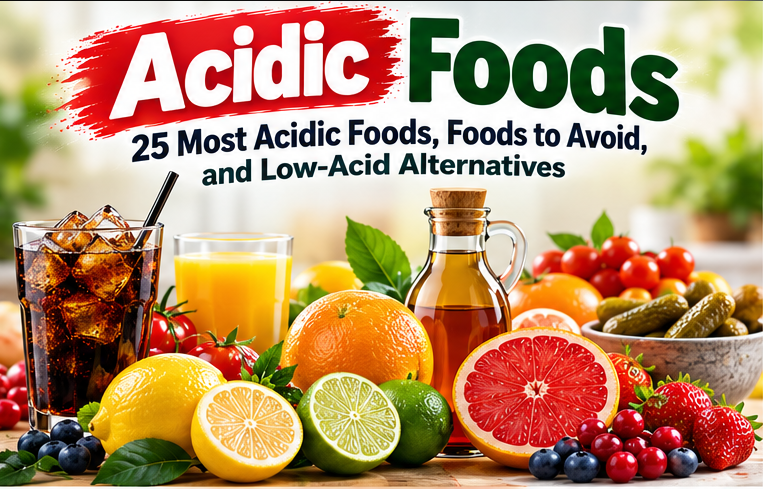
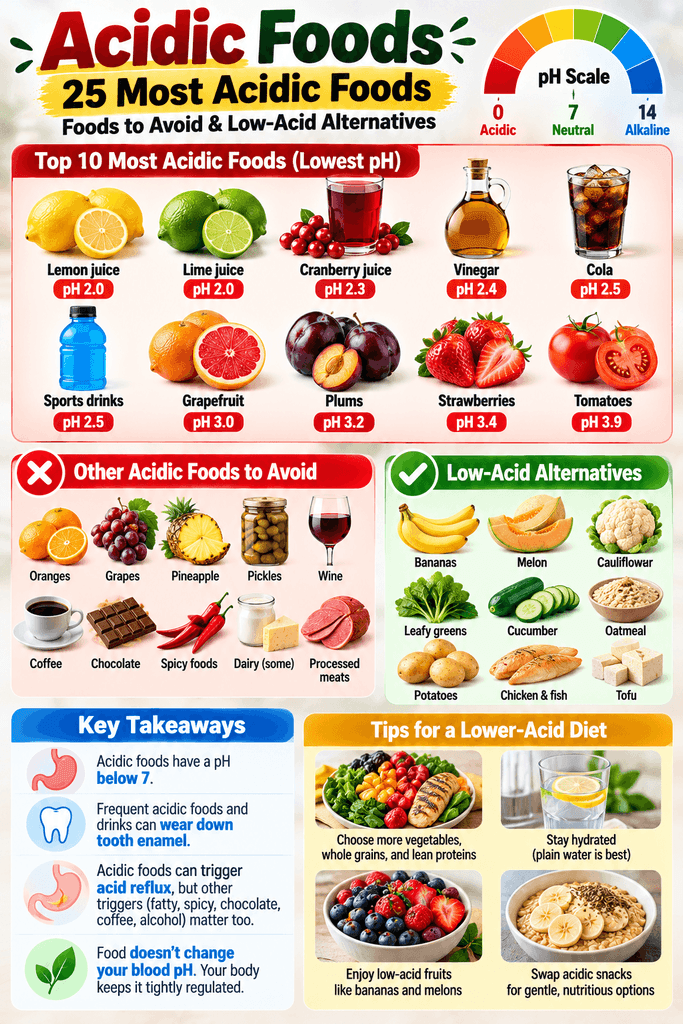
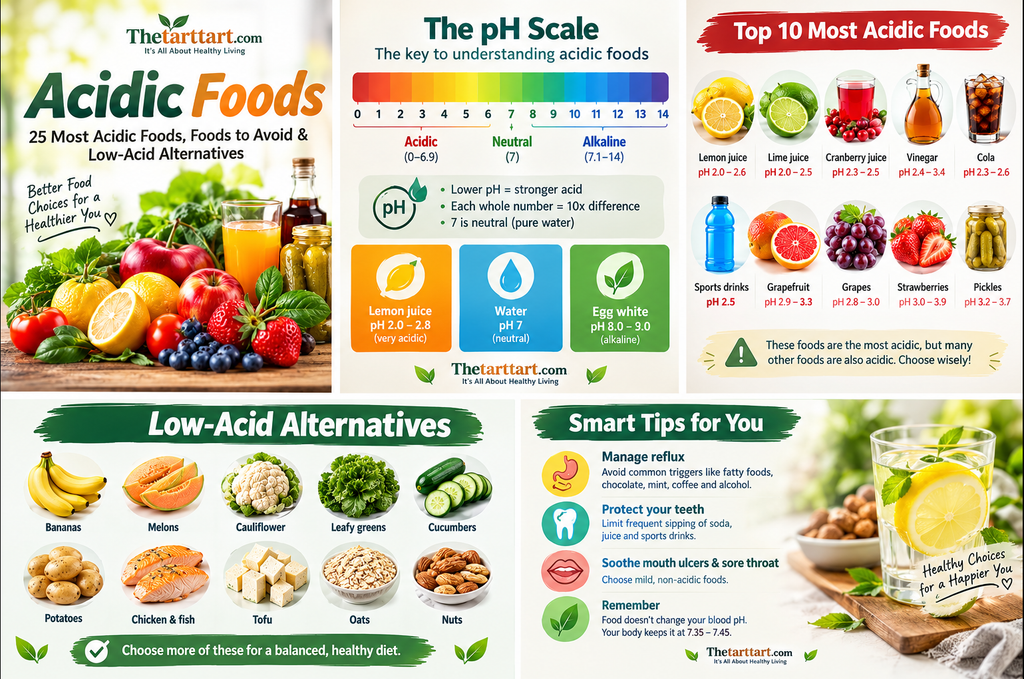
Acidic foods are foods with a pH below 7. The most acidic common foods and drinks include lemon and lime juice, cranberry juice, vinegar, colas, sports drinks, grapes, plums, grapefruit, strawberries, pickles, and tomato products. Most foods are at least slightly acidic. The ones to watch are the strongly acidic foods and drinks you have often, especially if you have acid reflux, sensitive teeth, or mouth sores.
That short answer leaves a lot out. “Acidic” can mean a food’s own pH, a food that triggers heartburn, or a food that is “acid-forming” after digestion, and these aren’t the same thing. A lemon is very acidic in the glass, yet nutritionists call it alkaline-forming. Chocolate is barely acidic but is a classic reflux trigger. Sparkling water seems harmless but can still soften tooth enamel when you sip it all day.
This guide untangles all of that. You’ll find an acidic foods chart with real pH measurements, a list of acidic foods by category, the 10 most acidic foods and most acidic fruits, a non-acidic foods list, and practical advice for reflux, GERD, teeth, mouth ulcers, and sore throats. Wherever you want more detail on a single food, follow the links to our individual “Is it acidic?” guides.
Key Takeaways
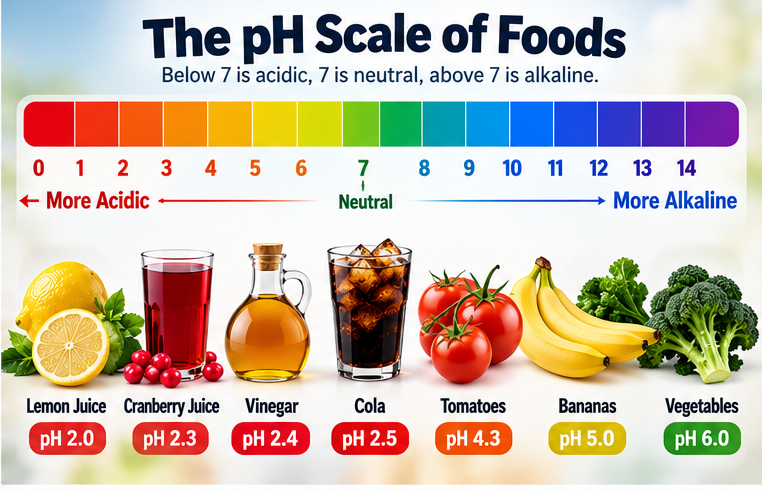
- pH runs from 0 to 14. Below 7 is acidic, 7 is neutral, and above 7 is alkaline. Each whole number is a tenfold difference.
- Almost all foods are somewhat acidic. Most vegetables, grains, fish, and dairy sit in the mild range (pH 5–7). Only a few, like egg whites and tofu, test alkaline.
- The most acidic foods are lemon and lime juice (pH 2.0–2.8), cranberry juice, vinegar, colas, and sports drinks.
- Reflux triggers aren’t only acidic foods. Fatty foods, chocolate, mint, coffee, alcohol, and spicy dishes can trigger symptoms too, and triggers vary from person to person.
- For teeth, how often matters as much as pH. Frequent sipping of soda, juice, and sports drinks is the biggest erosion risk.
- Food doesn’t change your blood pH. Your body keeps it at 7.35–7.45. Alkaline-diet claims beyond “eat more plants” aren’t supported.
What Are Acidic Foods? What makes a food acidic?
A food is acidic when it releases more hydrogen ions than it absorbs, which lowers its pH. In foods, that acidity usually comes from natural or added organic acids:
| Acid | Where you’ll find it |
| Citric acid | Lemons, limes, oranges, grapefruit, berries, pineapple, and many sodas and sour candies |
| Malic acid | Apples, cherries, plums, grapes, apricots, rhubarb |
| Tartaric acid | Grapes, tamarind, wine |
| Acetic acid | Vinegar, pickles, many sauces and dressings |
| Lactic acid | Yogurt, buttermilk, sauerkraut, kimchi, sourdough. Fermenting bacteria convert sugars into lactic acid, which is why UF/IFAS Extension notes that yogurt tastes tart |
| Phosphoric acid | Colas and some other soft drinks |
Understanding the pH scale of foods
- 0–6.9: acidic. The lower the number, the stronger the acid.
- 7: neutral. Pure water is neutral.
- 7.1–14: alkaline, or basic.
Because the scale is logarithmic, lemon juice at pH 2 is about 100 times more acidic than a food at pH 4, and 1,000 times more acidic than one at pH 5.
Food scientists use pH 4.6 as a key dividing line. Foods at or below 4.6 are “high-acid” and can be safely water-bath canned. Foods above 4.6 are “low-acid” and need pressure canning, as the UC Master Food Preserver program explains. That line is also a useful way to read the charts in this guide.
pH isn’t the whole story. Scientists also measure titratable acidity, the total amount of acid in a food, and buffering capacity, how strongly a food resists pH change. Two drinks with the same pH can affect your teeth very differently if one carries much more acid.
Are acidic foods the same as acid-forming foods?
No. This is the biggest source of confusion online:
- Acidic foods have a low pH before you eat them. Lemons are an example.
- Acid-forming foods leave an acid load for your kidneys to clear after digestion. Meat, cheese, and grains are examples. Researchers measure this as potential renal acid load (PRAL), an approach developed by Remer and Manz that predicts urine pH.
So a lemon is acidic on the tongue but alkaline-forming after digestion, because its minerals leave an alkaline residue. Meat is barely acidic on the plate but acid-forming.
Does food acidity change your body’s pH?
Not your blood. Your lungs and kidneys keep blood pH in a tight range of 7.35–7.45, as described in StatPearls’ review of acid-base physiology. Diet can shift your urine pH, but not your blood in any meaningful way. A systematic review in BMJ Open cited a trial in which diet changes moved urine pH by about one full unit, while blood pH moved by only about 0.014.
Acidic Foods Chart: pH of Common Foods
This chart gives approximate pH ranges from the FDA’s Approximate pH of Foods and Food Products and Clemson University Extension. Drink values come from peer-reviewed studies, cited in the drinks section. Actual pH varies with variety, ripeness, preparation, and brand, so treat these numbers as typical ranges, not exact values for every sample.
| Food or drink | Approx. pH | Category |
| Lemon juice | 2.00–2.60 | Highly acidic |
| Lime juice | 2.00–2.35 | Highly acidic |
| Cranberry juice | 2.30–2.52 | Highly acidic |
| Cola | 2.3–2.6 | Highly acidic |
| Vinegar | 2.40–3.40 | Highly acidic |
| Concord grapes | 2.80–3.00 | Highly acidic |
| Grapefruit juice | 2.90–3.25 | Highly acidic |
| Strawberries | 3.00–3.90 | Highly acidic |
| Blueberries | 3.12–3.33 | Highly acidic |
| Pineapple | 3.20–4.00 | Highly acidic |
| Dill pickles | 3.20–3.70 | Highly acidic |
| Apples | 3.30–4.00 | Acidic |
| Orange juice | 3.30–4.15 | Acidic |
| Sauerkraut | 3.30–3.60 | Acidic |
| Ketchup | 3.89–3.92 | Acidic |
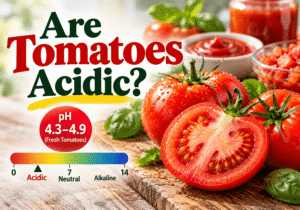
| Tomatoes | 4.30–4.90 | Mildly acidic |
| Bananas | 4.50–5.20 | Mildly acidic |
| Coffee | 4.85–5.13 | Mildly acidic |
| White bread | 5.00–6.20 | Mildly acidic |
| Watermelon | 5.18–5.60 | Less acidic |
| Potatoes | 5.40–5.90 | Less acidic |
| Carrots | 5.88–6.40 | Less acidic |
| White rice (cooked) | 6.00–6.70 | Near neutral |
| Oatmeal (cooked) | 6.20–6.60 | Near neutral |
| Avocados | 6.27–6.58 | Near neutral |
| Cow’s milk | 6.40–6.80 | Near neutral |
| Shrimp | 6.50–7.00 | Near neutral |
| Eggs (whole) | 6.58 | Near neutral |
| Tofu | 7.20 | Slightly alkaline |
| Egg white | 7.96 | Alkaline |
Fruit takeaways: Citrus, berries, grapes, plums, and pineapple are the most acidic fruits. Melons, avocados, bananas, figs, and papaya are the gentlest, which is why they often appear on reflux-friendly lists. Kiwi isn’t in the FDA list, but see our guide on whether kiwifruit is acidic.
Remember: a low pH doesn’t make a food unhealthy. Many of the most acidic foods on this chart, such as berries, citrus, and fermented vegetables, are among the most nutritious.
List of Acidic Foods: 25 Common Examples
Here are 25 everyday acidic foods and drinks, grouped by type, with their typical pH ranges.
Acidic fruits and fruit juices
- Lemons and lemon juice (pH 2.00–2.60). One of the most acidic foods in any kitchen, thanks to citric acid. Lemon juice is used to brighten dishes and to acidify foods for safe canning.
- Limes and lime juice (pH 2.00–2.80). Just as tart as lemons. Common in drinks, marinades, salsas, and Southeast Asian and Latin American dishes.
- Cranberries and cranberry juice (pH 2.30–2.52 for canned juice). Very acidic. That’s why cranberry products are usually sweetened.
- Grapefruit and grapefruit juice (pH 2.90–3.75). Strongly acidic citrus with a bitter edge.
- Oranges (3.69–4.34) and orange juice (3.30–4.15). Less acidic than lemons, but orange juice is a common reflux and enamel concern because people drink it in large amounts.
- Grapes (pH 2.80–3.82, depending on variety). Concord grapes are among the most acidic. Grapes contain tartaric and malic acids. Also see our guide on grape juice.
- Plums (pH 2.80–3.40 for blue plums). Tart skins and malic acid.
- Pineapple (pH 3.20–4.00) and pineapple juice (3.30–3.60). Pineapple is also a classic mouth-irritating fruit for people prone to canker sores.
- Strawberries (3.00–3.90) and raspberries (3.22–3.95). Berries are acidic but packed with vitamin C and fiber.
- Apples (pH 3.30–4.00). Malic acid gives apples their tang. Green and tart varieties like Jonathan and McIntosh are more acidic than sweet red Delicious apples.
Acidic vegetables and tomato-based foods
- Tomatoes (pH 4.30–4.90). Mildly acidic when fresh, but tomato paste (3.50–4.70), tomato juice (4.10–4.60), and ketchup (3.89–3.92) can be more concentrated sources of acid. Tomatoes are one of the most commonly reported reflux triggers.
- Sauerkraut (pH 3.30–3.60). Fermentation produces lactic acid, making sauerkraut far more acidic than raw cabbage (pH 5.50–6.75).
- Pickles (dill pickles, pH 3.20–3.70). Vinegar brine or fermentation makes pickled cucumbers much more acidic than fresh cucumbers (5.12–5.78). See also our guide to pickles.
- Rhubarb (pH 3.10–3.40). Botanically a vegetable but used like a fruit, and very tart.
- Bell peppers (pH 4.65–5.45). Mildly acidic. Pimentos are slightly more so (4.40–4.90).
Acidic drinks and carbonated beverages
- Colas (about pH 2.3–2.6). Phosphoric acid plus carbonation makes colas among the most acidic common drinks.
- Sports drinks (about 2.7–3.3). Usually acidified with citric acid for flavor.
- Energy drinks (average about 3.2). Highly acidic as well as caffeinated.
- Bottled iced teas and fruit juices (averages about 3.3–3.4). Added citric acid and fruit acids keep them tart.
- Sparkling water (average about 3.7). Carbonation forms carbonic acid, so even unsweetened fizzy water is mildly acidic. It’s still far less acidic than soda.
Vinegar, fermented foods, and sauces
- Vinegar (pH 2.40–3.40). Acetic acid makes vinegar one of the most acidic pantry items. Cider vinegar measures about 3.10.
- Vinegar-based dressings and condiments. Worcestershire sauce (3.63–4.00), chili sauce (2.77–3.70), and relishes (3.10–3.62) are all strongly acidic.
- Jams, jellies, and marmalades (about 2.87–4.50). Fruit acids are often boosted with added acid for proper setting.
Other foods with an acidic pH
- Fermented dairy. Buttermilk (4.41–4.83), cream cheese (4.10–4.79), and yogurt are more acidic than fresh milk because of lactic acid. See buttermilk and Greek yogurt.
- Kombucha and other fermented drinks. Fermentation produces organic acids, making kombucha quite tart.
Honorable mentions: honey (3.70–4.20), gelatin desserts (2.60), sour candies, which the American Dental Association notes often contain citric acid, and wine.
pH Chart: Vegetables and Legumes (75 items)
Most vegetables are only mildly acidic, roughly pH 5–6.8. The exceptions are tomatoes and anything pickled or fermented.
| Vegetable or legume | pH | Rating |
| Dill pickles | 3.20–3.70 | Very acidic |
| Sauerkraut | 3.30–3.60 | Very acidic |
| Bamboo shoots, preserved | 3.50–4.60 | Acidic |
| Tomato paste | 3.50–4.70 | Acidic |
| Tomato juice | 4.10–4.60 | Acidic |
| Tomatoes | 4.30–4.90 | Acidic to mildly acidic |
| Pimento | 4.40–4.90 | Acidic to mildly acidic |
| Peppers | 4.65–5.45 | Mildly acidic |
| Pumpkin | 4.90–5.50 | Mildly acidic |
| Mashed potatoes | 5.10 | Mildly acidic |
| Bamboo shoots, fresh | 5.10–6.20 | Mildly acidic |
| Cucumbers | 5.12–5.78 | Mildly acidic |
| Acorn squash (cooked) | 5.18–6.49 | Mildly acidic |
| Green peppers | 5.20–5.93 | Mildly acidic |
| Chives | 5.20–6.31 | Mildly acidic |
| Beets, cooked | 5.23–6.50 | Mildly acidic |
| Turnips | 5.29–5.90 | Mildly acidic |
| Beets | 5.30–6.60 | Mildly acidic |
| Sweet potatoes | 5.30–5.60 | Mildly acidic |
| Red onions | 5.30–5.80 | Mildly acidic |
| Parsnips | 5.30–5.70 | Mildly acidic |
| Shallots (cooked) | 5.30–5.70 | Mildly acidic |
| Wax beans | 5.30–5.70 | Mildly acidic |
| Yellow onions | 5.32–5.60 | Mildly acidic |
| Horseradish (learn more) | 5.35 | Mildly acidic |
| White onions (onions) | 5.37–5.85 | Mildly acidic |
| Potatoes | 5.40–5.90 | Mildly acidic |
| Kidney beans (dried beans) | 5.40–6.00 | Mildly acidic |
| Turnip greens (cooked) | 5.40–6.20 | Mildly acidic |
| Fennel, raw | 5.48–5.88 | Mildly acidic |
| Artichokes | 5.50–6.00 | Mildly acidic |
| Green cabbage | 5.50–6.75 | Mildly acidic |
| Eggplant | 5.50–6.50 | Mildly acidic |
| Leeks | 5.50–6.17 | Mildly acidic |
| Okra (cooked) | 5.50–6.60 | Mildly acidic |
| Spinach | 5.50–6.80 | Mildly acidic |
| Yams (cooked) | 5.50–6.81 | Mildly acidic |
| White squash (cooked) | 5.52–5.80 | Mildly acidic |
| White radishes | 5.52–5.69 | Mildly acidic |
| String (green) beans | 5.60 | Mildly acidic |
| Cauliflower, raw | 5.60 | Mildly acidic |
| Red cabbage | 5.60–6.00 | Mildly acidic |
| Ginger | 5.60–5.90 | Mildly acidic |
| Zucchini (cooked) | 5.69–6.10 | Mildly acidic |
| Celery | 5.70–6.00 | Mildly acidic |
| Parsley | 5.70–6.00 | Mildly acidic |
| Escarole | 5.70–6.00 | Mildly acidic |
| Iceberg lettuce | 5.70–6.13 | Mildly acidic |
| Yellow squash (cooked) | 5.79–6.00 | Mildly acidic |
| Fennel, cooked | 5.80–6.02 | Mildly acidic |
| Garlic | 5.80 | Mildly acidic |
| Red radishes (radishes) | 5.85–6.05 | Mildly acidic |
| Carrots | 5.88–6.40 | Mildly acidic |
| Watercress | 5.88–6.18 | Mildly acidic |
| Boston lettuce | 5.89–6.05 | Mildly acidic |
| Sweet corn | 5.90–7.30 | Mildly acidic to neutral |
| Corn, canned | 5.90–6.50 | Mildly acidic |
| Asparagus | 6.00–6.70 | Near neutral |
| Brussels sprouts | 6.00–6.30 | Near neutral |
| Hubbard squash (cooked) | 6.00–6.20 | Near neutral |
| Mushrooms | 6.00–6.70 | Near neutral |
| Soybeans (edamame) | 6.00–6.60 | Near neutral |
| Hominy (cooked) | 6.00–7.50 | Near neutral |
| Capers | 6.00 | Near neutral |
| Swiss chard (cooked) | 6.17–6.78 | Near neutral |
| White cabbage | 6.20 | Near neutral |
| Corn on the cob (cooked) | 6.22–7.04 | Near neutral |
| Peas (cooked) | 6.22–6.88 | Near neutral |
| Savoy cabbage | 6.30 | Near neutral |
| Broccoli, cooked | 6.30–6.52 | Near neutral |
| Broccoli, raw | 6.30–6.85 | Near neutral |
| Lentils (cooked) | 6.30–6.83 | Near neutral |
| Kelp (seaweed) | 6.30 | Near neutral |
| Kale (cooked) | 6.36–6.80 | Near neutral |
| Cauliflower, cooked | 6.45–6.80 | Near neutral |
| Chickpeas | 6.48–6.80 | Near neutral |
| Lima beans | 6.50 | Near neutral |
Vegetable takeaways: Tomatoes and tomato products, pickles, and sauerkraut are the clear acidic outliers. Leafy greens, crucifers, legumes, and corn sit close to neutral.
pH Chart: Dairy, Eggs, and Soy (19 items)
| Food | pH | Rating |
| Cream cheese | 4.10–4.79 | Acidic |
| Buttermilk | 4.41–4.83 | Acidic to mildly acidic |
| Sour milk (fine curd) | 4.70–5.65 | Mildly acidic |
| Cottage cheese | 4.75–5.02 | Mildly acidic |
| Roquefort cheese | 5.10–5.98 | Mildly acidic |
| Parmesan | 5.20–5.30 | Mildly acidic |
| Swiss (Gruyère) cheese | 5.68–6.62 | Mildly acidic |
| Cheddar | 5.90 | Mildly acidic |
| Evaporated milk | 5.90–6.30 | Mildly acidic |
| Butter | 6.10–6.40 | Mildly acidic |
| Egg yolk | 6.10 | Mildly acidic |
| Peanut butter | 6.28 | Mildly acidic |
| Cow’s milk | 6.40–6.80 | Near neutral |
| Cream, 40% | 6.44–6.80 | Near neutral |
| Cream, 20% | 6.50–6.68 | Near neutral |
| Whole egg (eggs) | 6.58 | Near neutral |
| Tofu (reflux guide) | 7.20 | Alkaline |
| Camembert | 7.44 | Alkaline |
| Egg white | 7.96 | Alkaline |
Fermented dairy, such as cultured buttermilk, cream cheese, and yogurt, is more acidic than fresh milk because bacteria produce lactic acid. Yogurt isn’t in the FDA table, but our guides cover Greek yogurt, goat milk, almond milk, coconut yogurt, and feta.
pH Chart: Fish and Seafood (18 items)
| Seafood | pH | Rating |
| Pickled herring | 4.50–5.00 | Acidic to mildly acidic |
| Cod (boiled) | 5.30–6.10 | Mildly acidic |
| Salmon, fresh (cooked) | 5.36–6.50 | Mildly acidic |
| Oysters | 5.68–6.17 | Mildly acidic |
| Sardines | 5.70–6.60 | Mildly acidic |
| American caviar | 5.70–6.00 | Mildly acidic |
| Tuna, canned | 5.90–6.20 | Mildly acidic |
| Mackerel, canned | 5.90–6.40 | Mildly acidic |
| Clams | 6.00–7.10 | Near neutral |
| Mussels | 6.00–6.85 | Near neutral |
| Scallops | 6.00 | Near neutral |
| Salmon, canned (red Alaska) | 6.07–6.16 | Near neutral |
| Herring | 6.10 | Near neutral |
| Haddock (broiled) | 6.17–6.82 | Near neutral |
| Sea trout (sautéed) | 6.20–6.33 | Near neutral |
| Crab meat | 6.50–7.00 | Near neutral |
| Shrimp | 6.50–7.00 | Near neutral |
| Lobster (cooked) | 7.10–7.43 | Alkaline |
The FDA list doesn’t include red meat or poultry. Fresh muscle meats generally fall in the mildly acidic range. Their “acid-forming” reputation comes from their protein and phosphorus content (PRAL), not their pH.
pH Chart: Grains, Breads, and Cereals (18 items)
| Food | pH | Rating |
| Zwieback | 4.84–4.94 | Mildly acidic |
| Corn flakes | 4.90–5.38 | Mildly acidic |
| White bread (toast) | 5.00–6.20 | Mildly acidic |
| Macaroni (cooked) | 5.10–6.41 | Mildly acidic |
| Rye bread | 5.20–5.90 | Mildly acidic |
| Bran flakes | 5.45–5.67 | Mildly acidic |
| Whole wheat bread | 5.47–5.85 | Mildly acidic |
| All-Bran cereal | 5.59–6.19 | Mildly acidic |
| Soda crackers | 5.65–7.32 | Mildly acidic to alkaline |
| Spaghetti (cooked) | 5.97–6.40 | Mildly acidic |
| Wheat flour | 6.00–6.30 | Near neutral |
| White rice, cooked (basmati) | 6.00–6.70 | Near neutral |
| Cream of Wheat (cooked) | 6.06–6.16 | Near neutral |
| Egg noodles (boiled) | 6.08–6.50 | Near neutral |
| Brown rice (cooked) | 6.20–6.80 | Near neutral |
| Oatmeal (cooked) | 6.20–6.60 | Near neutral |
| Puffed rice | 6.27–6.40 | Near neutral |
| Graham crackers | 7.10–7.92 | Alkaline |
Grains are among the gentlest foods by pH. Oatmeal, rice, and plain bread are classic reflux-friendly staples. See also jasmine rice, pita bread, and oat bran.
pH Chart: Condiments, Sweeteners, Preserves, and Soups (30 items)
| Food | pH | Rating |
| Vinegar | 2.40–3.40 | Very acidic |
| Gelatin dessert | 2.60 | Very acidic |
| Chili sauce (acidified) | 2.77–3.70 | Very acidic |
| Raspberry jam | 2.87–3.17 | Very acidic |
| Fruit jellies | 3.00–3.50 | Very acidic |
| Orange marmalade | 3.00–3.33 | Very acidic |
| Strawberry jam | 3.00–3.40 | Very acidic |
| Mint jelly | 3.01 | Very acidic |
| Cider vinegar (apple cider) | 3.10 | Very acidic |
| Red pepper relish | 3.10–3.62 | Very acidic |
| Sherry wine | 3.37 | Very acidic |
| Fruit jam | 3.50–4.50 | Acidic |
| Mustard | 3.55–6.00 | Acidic to mildly acidic |
| Worcestershire sauce | 3.63–4.00 | Acidic |
| Honey | 3.70–4.20 | Acidic |
| Ketchup | 3.89–3.92 | Acidic |
| Vegetable juice | 3.90–4.30 | Acidic |
| Corn starch | 4.0–7.0 | Varies |
| Soy sauce | 4.40–5.40 | Acidic to mildly acidic |
| Cream of tomato soup, canned | 4.62 | Mildly acidic |
| Molasses | 4.90–5.40 | Mildly acidic |
| Vegetable soup, canned | 5.16 | Mildly acidic |
| Maple syrup (light) | 5.15 | Mildly acidic |
| Corn syrup | 5.0 | Mildly acidic |
| Sugar (brown sugar) | 5.0–6.0 | Mildly acidic |
| English walnuts | 5.42 | Mildly acidic |
| Cream of split pea soup | 5.70 | Mildly acidic |
| Chicken broth | 5.80 | Mildly acidic |
| New England clam chowder | 6.40 | Near neutral |
| Brewed tea (learn more) | 7.20 | Alkaline |
Spices are used in tiny amounts, so their pH rarely matters. See our guides on cinnamon, turmeric, black pepper, and coconut aminos.
pH Chart: Drinks (14 items)
Drinks deserve special attention because they bathe your teeth and esophagus in acid. In a 2023 study in the Dubai Medical Journal, 306 beverages were tested and 88% had a pH below 4.0. Coffee values come from a 2018 Scientific Reports study.
| Drink | pH | Rating |
| Lowest-pH cola tested | 2.32 | Very acidic |
| Coca-Cola | 2.62 | Very acidic |
| Gatorade (orange) | 2.70 | Very acidic |
| Malt beverages (average) | 2.99 | Very acidic |
| Carbonated soft drinks (average) | 3.01 | Very acidic |
| Energy drinks (average) | 3.24 | Very acidic |
| Sports drinks (average) | 3.30 | Very acidic |
| Iced teas, bottled (average) | 3.33 | Very acidic |
| Red Bull (original) | 3.42 | Very acidic |
| Packaged juices (average) | 3.43 | Very acidic |
| Sparkling water (average) | 3.72 | Acidic |
| Coconut water (average) | 4.64 | Mildly acidic |
| Coffee, hot or cold brew | 4.85–5.13 | Mildly acidic |
| Club soda | 4.99 | Mildly acidic |
Brewed tea (7.20) and milk (6.40–6.80) are among the least acidic common drinks. Plain water is neutral at pH 7. Herbal options like chamomile tea and ginger tea are popular choices for reflux. Fermented kombucha is highly acidic.
What Are the Most Acidic Foods? What are the 10 most acidic foods?
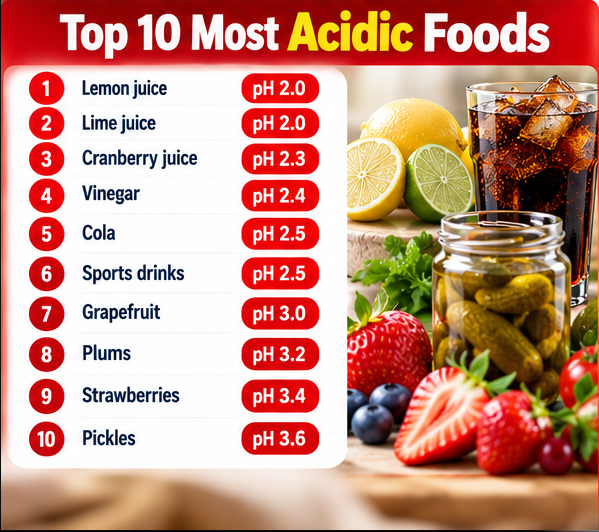
Using FDA and peer-reviewed pH measurements, these are among the lowest-pH common foods and drinks. Values overlap, and they change with brand, variety, and preparation, so treat this as a guide rather than a strict ranking:
- Lemon juice: 2.00–2.60
- Lime juice: 2.00–2.35
- Cranberry juice: 2.30–2.52
- Cola soft drinks: about 2.3–2.6
- Vinegar: 2.40–3.40
- Gelatin desserts: about 2.60
- Sports drinks: about 2.7–3.3
- Concord grapes: 2.80–3.00
- Blue plums: 2.80–3.40
- Grapefruit juice: 2.90–3.25
What are the 10 most acidic fruits?
Among fresh fruits and pure fruit juices, these have the lowest pH in the FDA’s list:
- Limes: 2.00–2.80
- Lemons (juice): 2.00–2.60
- Cranberries (juice): 2.30–2.52
- Loganberries: 2.70–3.50
- Gooseberries: 2.80–3.10
- Concord grapes: 2.80–3.00
- Blue plums: 2.80–3.40
- Pomegranate: 2.93–3.20
- Grapefruit: 3.00–3.75
- Strawberries: 3.00–3.90
Close behind are blueberries (3.12–3.33), pineapple (3.20–4.00), raspberries (3.22–3.95), peaches (3.30–4.05), and apples (3.30–4.00).
Which common drinks have a low pH?
Drinks are where acid exposure adds up fastest. In a study of 306 beverages in the Dubai Medical Journal, 88% had a pH below 4.0. Average pH by category:
| Drink category | Average pH |
| Malt beverages | 2.99 |
| Carbonated soft drinks | 3.01 |
| Energy drinks | 3.24 |
| Sports drinks | 3.30 |
| Bottled iced teas | 3.33 |
| Packaged juices | 3.43 |
| Sparkling water | 3.72 |
| Coconut water | 4.64 |
Specific examples included Coca-Cola at 2.62, Gatorade (orange) at 2.70, and Red Bull at 3.42. Black coffee is much milder, at about 4.85–5.13 whether hot or cold brewed, according to a Scientific Reports study. Brewed tea is about 7.2, milk 6.4–6.8, and plain water is neutral.
How food pH varies by preparation and brand
- Ripeness: Fruits usually become less acidic as they ripen. Green mangoes (5.80–6.00) and ripe mangoes (3.40–4.80) are an exception, so always check the specific food.
- Variety: Jonathan apples measure about 3.33, while Delicious apples measure about 3.90.
- Processing: Concentrating, pickling, and fermenting usually lower pH. Compare tomato paste with fresh tomatoes, or sauerkraut with cabbage.
- Cooking: Cooking can shift pH slightly. Raw cauliflower is about 5.60, and cooked cauliflower is 6.45–6.80.
- Brand and recipe: Juices, sodas, and sauces vary widely depending on added acids.
Acidic Foods and Drinks to Limit
Top 5 acidic foods and drinks to consider limiting
You don’t need to avoid acidic foods entirely. But if you have reflux, sensitive teeth, or mouth sores, these five are worth limiting first:
- Colas and other soft drinks. They’re very acidic (pH about 2.3–3.0), often sugary, and frequently sipped over long periods. The American Dental Association calls soft drinks and sports drinks the main culprits in dental erosion.
- Sports and energy drinks. They’re acidic (about 2.7–3.3) and often consumed during exercise, when your mouth is dry.
- Citrus juices and lemonade. Orange, grapefruit, and lemon drinks are highly acidic and easy to drink in large amounts. The ADA suggests treating them as “an occasional treat instead of a daily habit.”
- Sour candies. Many are coated in citric acid and stay in your mouth a long time.
- Tomato-based sauces and ketchup. These are concentrated acid sources and a common reflux trigger.
Foods that may trigger acid reflux
The National Institute of Diabetes and Digestive and Kidney Diseases (NIDDK) lists foods and drinks that some people find make reflux worse:
- Acidic foods, such as citrus fruits and tomatoes
- Alcoholic drinks
- Chocolate
- Coffee and other sources of caffeine
- High-fat foods
- Mint
- Spicy foods
Most items on this list aren’t especially acidic. They’re on it because they can relax the muscle between the stomach and esophagus, slow digestion, or irritate an already-inflamed esophagus. Triggers vary: a food that bothers one person may be fine for another.
Acidic foods that can affect tooth enamel
The ADA explains that acids wear away enamel, the hard outer layer of your teeth, and that this tooth erosion is permanent. Early signs include sensitivity to hot, cold, or sweet foods and yellowing teeth. The main concerns are:
- Soft drinks and sports drinks, including sugar-free versions, since carbonation adds acidity
- Citrus fruits and juices, lemonade, and citrus-flavored drinks
- Sour candies
- Sticky dried fruits, which cling to teeth
- Frequent sipping of any acidic drink
Enamel starts to demineralize at about pH 5.5, and erosion risk rises sharply below pH 4, according to the Dubai Medical Journal study. Frequency and contact time matter as much as pH.
Foods that may irritate mouth ulcers or a sore throat
Mouth ulcers (canker sores): Mayo Clinic lists “spicy or acidic foods” among possible canker sore triggers. It suggests avoiding foods that irritate your mouth, such as acidic fruits like pineapple, grapefruit, and oranges, along with nuts, certain spices, and salty foods.
Sore throat: Many people find that acidic citrus juices, tomato sauces, vinegar, and spicy foods sting a raw throat. Mayo Clinic’s sore throat self-care tips recommend soothing options instead:
- Warm broth
- Caffeine-free tea
- Warm water with honey (never give honey to children under 1)
- Ice pops
It also suggests avoiding caffeine and alcohol, which can be drying.
Non-Acidic Foods List: What Foods Are Low in Acid?
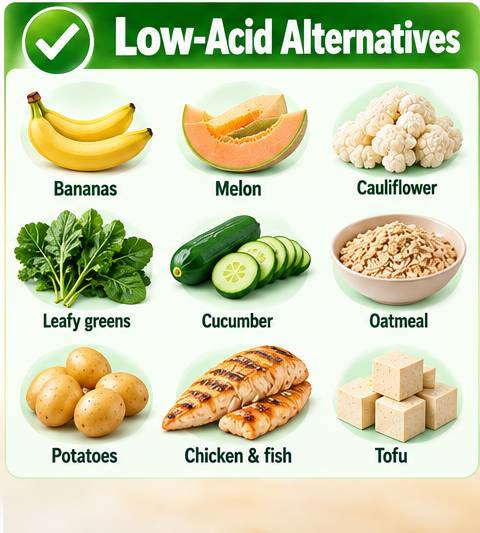
A quick clarification: “non-acidic” is usually used informally. Almost every food has a measurable pH, and most are at least slightly below 7. In practice, “non-acidic” or “low-acid” means foods that are close to neutral (pH 6–7) or mildly acidic, and that most people find gentle on the stomach, mouth, and teeth.
Low-acid fruits
| Fruit | Approx. pH |
| Cantaloupe | 6.13–6.58 |
| Honeydew melon | 6.00–6.67 |
| Avocados | 6.27–6.58 |
| Ripe olives (black) | 6.00–7.50 |
| Coconut (coconut milk) | 5.50–7.80 |
| Papaya | 5.20–6.00 |
| Figs | 5.05–5.98 |
| Watermelon (juice) | 5.18–5.60 |
| Bananas | 4.50–5.20 |
| Dates | 4.14–4.88 |
Melons, bananas, avocados, figs, and papaya are the go-to low-acid fruits for sensitive stomachs. Pears (3.50–4.60) are in the middle but are often well tolerated.
Low-acid vegetables
Most vegetables are naturally low in acid:
| Vegetable | Approx. pH |
| Sweet corn | 5.90–7.30 |
| Broccoli | 6.30–6.85 |
| Cooked kale | 6.36–6.80 |
| Cooked lentils | 6.30–6.83 |
| Chickpeas | 6.48–6.80 |
| Mushrooms | 6.00–6.70 |
| Asparagus | 6.00–6.70 |
| Brussels sprouts | 6.00–6.30 |
| Peas (cooked) | 6.22–6.88 |
| Spinach | 5.50–6.80 |
| Carrots | 5.88–6.40 |
| Celery | 5.70–6.00 |
| Sweet potatoes | 5.30–5.60 |
| Zucchini (cooked) | 5.69–6.10 |
Grains, protein foods, and dairy
- Grains: cooked white rice (6.00–6.70), brown rice (6.20–6.80), oatmeal (6.20–6.60), noodles (6.08–6.50), and rye bread (5.20–5.90). See also basmati rice.
- Fish and seafood: most fresh fish and shellfish run about pH 6–7. Examples include salmon (5.36–6.50), shrimp (6.50–7.00), crab (6.50–7.00), and lobster (7.10–7.43).
- Eggs and soy: whole eggs (6.58), egg whites (7.96), and tofu (7.20).
- Dairy: milk (6.40–6.80), cream (6.44–6.80), butter (6.10–6.40), and mild cheeses like cheddar (5.90) are near neutral. Fermented dairy is more acidic. Plant milks such as almond milk are usually mild too.
Low-acid snacks and meal ideas
Low-acid breakfast ideas:
- Oatmeal with banana slices and a drizzle of honey
- Scrambled eggs with spinach on whole-grain toast
- Rice porridge (congee) with a soft-cooked egg
- Plain or lightly sweetened yogurt with melon. Yogurt is mildly acidic, but many people tolerate it.
Low-acid lunch and dinner ideas:
- Grilled salmon with brown rice and steamed broccoli
- Chicken and vegetable stir-fry with ginger instead of chili and vinegar
- Lentil or split-pea soup made without tomatoes
- Baked sweet potato with black beans and avocado
- Pasta with olive oil, garlic, zucchini, and parmesan instead of tomato sauce
Low-acid snacks:
- Melon cubes, banana, or ripe pear
- Rice cakes with almond butter
- Carrot and celery sticks with hummus
- Plain popcorn or whole-grain crackers
- A handful of almonds or pumpkin seeds
Low-acid drinks: water, milk or fortified plant milk, and herbal teas such as chamomile or ginger tea. Coconut water (about 4.6) is milder than juice or soda.
Are any foods completely non-acidic?
Very few foods are truly neutral or alkaline. In FDA data, egg whites (7.96), graham crackers (7.10–7.92), Camembert (7.44), lobster (7.10–7.43), tofu (7.20), and brewed tea (7.20) test at or above 7. Ripe olives, fresh coconut, hominy, and sweet corn can reach neutral too. That’s fine, because “mildly acidic” foods are perfectly healthy for most people.
Acidic Foods to Eat and Foods to Avoid for Acid Reflux and GERD
Foods that commonly trigger reflux
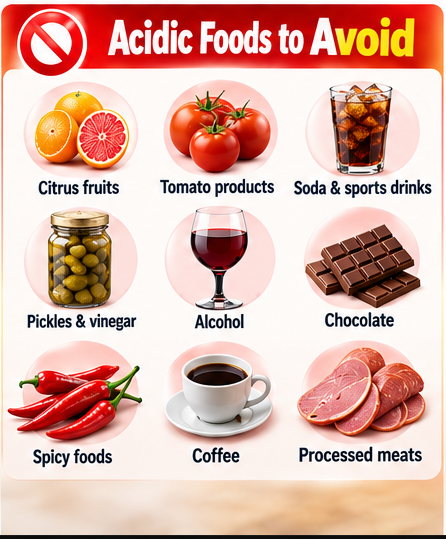
The foods most often linked to reflux symptoms are citrus fruits and juices, tomatoes and tomato sauces, chocolate, mint, coffee and caffeinated drinks, alcohol, high-fat and fried foods, and spicy dishes. That list comes from NIDDK. Carbonated drinks also bother many people. Does lemon cause acid reflux? For people with sensitive reflux, lemon and other citrus can worsen heartburn, mainly by irritating an inflamed esophagus. Are tomatoes bad for acid reflux? They’re one of the most commonly reported triggers, especially concentrated sauces and ketchup.
For a fuller list, see our guide to foods to avoid with GERD.
Foods that may be better tolerated
No food “cures” GERD or permanently neutralizes stomach acid. But many people find these GERD-friendly food choices easier to tolerate:
- Low-acid fruits: melons, bananas, pears, papaya, figs
- Vegetables: green beans, broccoli, carrots, leafy greens, zucchini, potatoes, sweet potatoes
- Whole grains: oatmeal, rice, whole-grain bread, millet
- Lean proteins: skinless chicken, fish, tofu, egg whites, beans
- Healthy fats in moderation: avocado, nuts, olive oil
- Gentler drinks: water, herbal teas, plant milks
If you’re managing related stomach irritation, our 7-day meal plan for gastritis shows how to put these foods together.
How to identify your personal food triggers
NIDDK suggests working with your doctor to cut back on specific foods and see whether symptoms improve. The American College of Gastroenterology guideline likewise recommends identifying and avoiding your own triggers instead of following one rigid list. A simple approach:
- Keep a food and symptom diary for 2 weeks. Record what you ate, when, portion sizes, and any symptoms.
- Look for patterns. Do symptoms follow tomato sauce? Coffee? Large or late meals?
- Remove one suspected trigger at a time for a week or two, then reintroduce it.
- Notice portion and timing effects. Many people tolerate a small amount of a trigger food at lunch but not a large serving at night.
Meal timing and other practical considerations
- Eat earlier. NIDDK suggests finishing meals at least 3 hours before lying down, and the ACG advises avoiding meals within 2–3 hours of bedtime. This is the single most useful step for nighttime reflux.
- Eat smaller meals. Large meals put more pressure on the stomach.
- Raise the head of your bed if you have nighttime symptoms (ACG).
- Lose weight if you’re overweight (NIDDK and ACG).
- Avoid tobacco.
- Talk to your doctor if you have heartburn more than twice a week, trouble swallowing, unexplained weight loss, vomiting, or chest pain. Chest pain always needs urgent medical attention.
Acidic Foods vs Alkaline Foods
How acidic and alkaline foods differ
| Acidic foods | Alkaline (basic) foods | |
| pH | Below 7 | Above 7 |
| Taste | Sour, tart, tangy | Often bland or slightly bitter |
| Examples | Citrus, berries, vinegar, tomatoes, soda | Egg whites, tofu, some crackers, brewed tea |
| Common acids | Citric, malic, acetic, lactic, phosphoric | — |
Alkaline-diet charts often mean something different by “alkaline foods.” They usually mean alkaline-forming foods, like most fruits and vegetables, as opposed to acid-forming foods like meat, cheese, and grains. A lemon is acidic but alkaline-forming. Meat is barely acidic but acid-forming.
Acidic foods and body pH: what science says
Your blood pH stays at 7.35–7.45 regardless of diet, because your lungs and kidneys constantly balance it. Food can change your urine pH, which is why acid-forming and alkaline-forming diets show up in urine tests, but it doesn’t meaningfully change blood pH in healthy people.
What does the alkaline diet claim?
Alkaline-diet promoters say acid-forming foods make the body “too acidic” and cause disease, including cancer. A systematic review in BMJ Open found no evidence that an alkaline diet or alkaline water prevents or treats cancer. It concluded that promoting them for that purpose “is not justified.”
What the alkaline diet gets right is its emphasis on vegetables, fruits, legumes, and nuts, and on limiting processed meats and refined foods. That’s a healthy pattern, just not for the reasons claimed.
One real exception: in chronic kidney disease, the kidneys struggle to clear acid. In one clinical trial, adding fruits and vegetables helped treat metabolic acidosis about as well as an alkali medication. That’s a medical situation that needs supervision by a kidney specialist.
Can alkaline foods neutralize stomach acid?
Not in any lasting way. Your stomach is meant to be very acidic, and it keeps making acid to digest food. Some foods, like oatmeal, bananas, or a glass of milk, may feel soothing for a short time, but they don’t permanently lower stomach acid. Antacids and other reflux medications are the tools designed for that, and you should use them as directed by a pharmacist or doctor.
Are Acidic Foods Bad for You?
Potential effects on teeth
Acidic foods and drinks can contribute to dental erosion, especially when you have them often. The American Dental Association recommends:
- Have acidic drinks with meals instead of sipping them all day.
- Use a straw for acidic drinks, and don’t swish or hold them in your mouth.
- Rinse with water, or have milk or cheese, after acidic foods. Dairy helps neutralize acids.
- Wait an hour before brushing after acidic foods, so saliva can wash away acids and enamel can re-harden.
- Chew sugar-free gum to boost saliva.
Should you brush right after acidic foods? No. Brushing softened enamel can wear it away faster.
Acidic foods and digestive symptoms
For most people, acidic foods cause no digestive problems. For people with reflux, GERD, gastritis, or an irritated stomach, very acidic foods can cause burning or discomfort, especially on an empty stomach or late at night. Eating them with meals, in smaller portions, often helps.
Do acidic foods have nutritional benefits?
Yes. Benefits of acidic foods include:
- Vitamin C: The NIH Office of Dietary Supplements lists citrus fruits, peppers, kiwifruit, strawberries, and tomatoes among the best sources.
- Better iron absorption: Vitamin C helps your body absorb iron from plant foods, so a squeeze of lemon on spinach or beans is useful.
- Antioxidants and fiber: berries, grapes, plums, and apples are rich in polyphenols and fiber.
- Flavor without salt: acids like lemon juice and vinegar brighten food, which can help you use less salt.
- Fermented foods: yogurt, sauerkraut, and kimchi add variety, and some contain live cultures.
Who may need individualized dietary advice?
Talk with a doctor or registered dietitian if you have:
- GERD or frequent heartburn
- Gastritis or ulcers
- Recurrent mouth ulcers
- Dental erosion or sensitive teeth
- Chronic kidney disease
- Food allergies
- Diabetes, so you can balance sugary acidic drinks
- A need to limit specific foods because of your medications
Frequently Asked Questions About Acidic Foods
What foods are acidic?
Foods with a pH below 7 are acidic, which includes most foods. The most acidic are lemons, limes, cranberries, grapefruit, grapes, plums, berries, pineapple, vinegar, pickles, sauerkraut, tomato products, sodas, and sports drinks. Vegetables, grains, fish, eggs, and milk are only mildly acidic or near neutral.
What are the 10 most acidic foods?
Among common foods and drinks, the lowest pH values belong to lemon juice, lime juice, cranberry juice, colas, vinegar, gelatin desserts, sports drinks, Concord grapes, blue plums, and grapefruit juice, roughly pH 2.0–3.3. Exact rankings vary with brand, variety, and ripeness.
What foods are not acidic?
Truly non-acidic foods are rare. Egg whites, tofu, brewed tea, lobster, Camembert, and graham crackers test at or above pH 7. Near-neutral, low-acid foods include melons, avocados, bananas, most vegetables, oatmeal, rice, fish, eggs, and milk.
What foods reduce acidity?
No food permanently reduces stomach acid, and none changes your blood pH. For reflux, many people feel better choosing low-acid foods such as oatmeal, bananas, melons, vegetables, lean proteins, and whole grains, and avoiding personal triggers and late meals. Antacids or prescribed medicines treat excess stomach acid.
Are acidic foods bad for you?
No. Many acidic foods, like citrus, berries, tomatoes, and fermented vegetables, are highly nutritious. Acidity mainly matters for tooth enamel when you have acidic foods and drinks often, and for people whose reflux or mouth sores are triggered by acidic foods. Moderation and timing help.
What are the most acidic fruits?
Limes, lemons, cranberries, loganberries, gooseberries, Concord grapes, blue plums, pomegranates, grapefruit, and strawberries are among the most acidic fruits, with pH values from about 2.0 to 3.9. The least acidic fruits include melons, avocados, bananas, papaya, and figs.
Are acidic foods bad for teeth?
They can be, when eaten often. The American Dental Association explains that acids wear away enamel, and that erosion is permanent. To protect your teeth, have acidic drinks with meals, use a straw, rinse with water or have dairy afterward, and wait an hour before brushing.
Can you be allergic to acidic foods?
There’s no allergy to acidity itself. You can be allergic or sensitive to specific foods that happen to be acidic, such as citrus, tomatoes, or strawberries. Many people also feel burning or stinging from acidic foods on mouth sores or an irritated throat, which is irritation, not an allergy. See an allergist for suspected reactions.
What should you eat if you have acid reflux?
Choose foods you tolerate well. These are often oatmeal, rice, whole grains, bananas, melons, vegetables, lean proteins, eggs, and healthy fats in moderation. Limit your personal triggers, which commonly include citrus, tomatoes, chocolate, mint, coffee, alcohol, fatty foods, and spicy dishes. Eat smaller meals and stop eating three hours before bed.
Conclusion
Acidic foods are everywhere, and that’s not a problem in itself. Most foods are slightly acidic, and many of the most acidic ones, such as citrus, berries, and fermented vegetables, are among the healthiest you can eat. What matters is context:
- For reflux, focus on your triggers, which may include citrus and tomatoes but also fat, chocolate, coffee, mint, and alcohol, and on smaller, earlier meals.
- For your teeth, limit how often you sip acidic drinks, rinse with water, and wait before brushing.
- For mouth ulcers or a sore throat, temporarily swap acidic and spicy foods for gentle, low-acid options.
- For overall health, skip the alkaline-diet myths but keep its best advice: eat more vegetables and fruits.
Use the charts above to find where your favorite foods fall, and explore our individual guides for any food you’re curious about.
Medical disclaimer: This article is for general information only and isn’t a substitute for professional medical or dental advice. If you have frequent heartburn, GERD, mouth ulcers that don’t heal, dental erosion, or kidney disease, talk with your doctor, dentist, or a registered dietitian.
References
- U.S. Food and Drug Administration, Center for Food Safety and Applied Nutrition. Approximate pH of Foods and Food Products. April 2007. Copy used: https://riverstonehealth.org/wp-content/uploads/FDA-Approximate-pH-of-Foods.pdf
- Clemson University Cooperative Extension. pH Values of Common Foods and Ingredients. https://www.clemson.edu/extension/food/_files/ph-of-common-foods-table.pdf
- UC Master Food Preserver Program, UC Agriculture and Natural Resources. Understanding pH and Why It’s Important in Food Preservation. 2025. https://ucanr.edu/program/uc-master-food-preserver/article/understanding-ph-and-why-its-important-food-preservation
- Meyer SB, Medina-Solórzano A, Dahl WJ. Shopping for Health: Yogurt (FSHN12-01). UF/IFAS Extension. https://ask.ifas.ufl.edu/publication/FS185/pdf
- Remer T, Manz F. Potential renal acid load of foods and its influence on urine pH. Journal of the American Dietetic Association. 1995;95(7):791–797. https://pubmed.ncbi.nlm.nih.gov/7797810/
- Hopkins E, Sanvictores T, Sharma S. Physiology, Acid Base Balance. StatPearls. https://www.ncbi.nlm.nih.gov/books/NBK507807/
- Fenton TR, Huang T. Systematic review of the association between dietary acid load, alkaline water and cancer. BMJ Open. 2016;6(6):e010438. https://bmjopen.bmj.com/content/6/6/e010438.full
- Nassar M, Islam MS, Hasan N, Al-Khazraji A, Maki H. Erosive potential of various beverages in the United Arab Emirates: pH assessment. Dubai Medical Journal. 2023;6(2):124–133. https://doi.org/10.1159/000530094
- Rao NZ, Fuller M. Acidity and antioxidant activity of cold brew coffee. Scientific Reports. 2018;8:16030. https://doi.org/10.1038/s41598-018-34392-w
- American Dental Association, MouthHealthy. Dietary Acids and Your Teeth. https://www.mouthhealthy.org/all-topics-a-z/dietary-acids-and-your-teeth
- Mayo Clinic. Canker sore: Symptoms and causes. https://www.mayoclinic.org/diseases-conditions/canker-sore/symptoms-causes/syc-20370615
- Mayo Clinic. Sore throat: Diagnosis and treatment. https://www.mayoclinic.org/diseases-conditions/sore-throat/diagnosis-treatment/drc-20351640
- National Institute of Diabetes and Digestive and Kidney Diseases. Eating, Diet, & Nutrition for GER & GERD. https://niddk.nih.gov/health-information/digestive-diseases/acid-reflux-ger-gerd-adults/eating-diet-nutrition
- Katz PO, Dunbar KB, Schnoll-Sussman FH, et al. ACG Clinical Guideline for the Diagnosis and Management of Gastroesophageal Reflux Disease. American Journal of Gastroenterology. 2022;117(1):27–56. https://doi.org/10.14309/ajg.0000000000001538
- NIH Office of Dietary Supplements. Vitamin C: Fact Sheet for Consumers. https://ods.od.nih.gov/factsheets/VitaminC-Consumer/
- Goraya N, Simoni J, Jo CH, Wesson DE. A comparison of treating metabolic acidosis in CKD stage 4 hypertensive kidney disease with fruits and vegetables or sodium bicarbonate. Clinical Journal of the American Society of Nephrology. 2013;8(3):371–381. https://doi.org/10.2215/CJN.02430312
Related Posts
Subscribe for New Racipies
Get mental health tips, updates, and resources delivered to your inbox.
Are Brussels Sprouts Safe for Acid Reflux?


Are Brussels Sprouts a Friend or Foe for Acid Reflux?
Brussels sprouts, those miniature cabbage-like vegetables, are packed with nutrients and loved for their health benefits. However, for individuals dealing with acid reflux, the question arises: Are Brussels sprouts safe to include in their diet? While this green veggie is nutrient-rich and versatile, its effects on acid reflux symptoms can vary from person to person.
In this article, we’ll explore the acidity of Brussels sprouts, their nutritional profile, and whether they are a safe choice for those managing acid reflux. Keep reading to find tips on how to enjoy Brussels sprouts without aggravating reflux symptoms.
Understanding Acid Reflux: Causes and Triggers
What Is Acid Reflux?
Acid reflux, or gastroesophageal reflux disease (GERD) when chronic, is a condition where stomach acid flows back into the esophagus. This occurs when the lower esophageal sphincter (LES), a muscle that prevents the backward flow of stomach contents, doesn’t close properly.
Common Symptoms of Acid Reflux:
- Heartburn: A burning sensation in the chest or throat.
- Regurgitation: The sensation of acid or food coming back into the mouth.
- Sour or bitter taste in the throat.
- Chronic cough, hoarseness, or throat discomfort.
Common Dietary Triggers of Acid Reflux
Certain foods and drinks can relax the LES or increase stomach acid production, triggering reflux. These include:
- Acidic foods (e.g., citrus fruits, tomatoes).
- Fatty and fried foods.
- Spicy dishes.
- Caffeine and carbonated beverages.
- Large or heavy meals.
Where do Brussels sprouts fit into this list? Let’s find out.
Author Tip: 7 Kinds of Foods to Avoid with GERD
Are Brussels Sprouts Acidic or Alkaline?
The Acidity of Brussels Sprouts
Brussels sprouts are considered a low-acid food, with a pH level of around 6.0 to 6.8, making them closer to neutral. Unlike acidic foods like citrus or vinegar, Brussels sprouts are unlikely to cause irritation in the esophagus due to their pH level.
Do Brussels Sprouts Trigger Acid Reflux?
While Brussels sprouts are not inherently acidic, they can cause digestive discomfort in some people. This is due to their high fiber and sulfur content, which can produce gas and bloating. For individuals with sensitive digestive systems, these effects might indirectly aggravate acid reflux symptoms.
Related to Read: Are Brussels Sprouts Good for Acid Reflux?
Nutritional Profile of Brussels Sprouts
What Makes Brussels Sprouts a Superfood?
According to the research, brussels sprouts are nutrient-dense, offering a wealth of vitamins, minerals, and antioxidants. Here’s what you get in a one-cup serving (around 88 grams) of cooked Brussels sprouts:
- Calories: 38
- Fiber: 4 grams
- Vitamin C: 124% of the daily recommended intake (DRI)
- Vitamin K: 182% of the DRI
- Folate: 12% of the DRI
- Potassium: 8% of the DRI
Health Benefits of Brussels Sprouts
Following is the list of brussels sprouts health benefits:
- Rich in Antioxidants: The high levels of vitamin C and other antioxidants combat inflammation and promote overall health.
- Supports Digestive Health: The fiber content aids in digestion and promotes regular bowel movements.
- Boosts Immunity: Vitamin C helps strengthen the immune system.
- Promotes Bone Health: Vitamin K is essential for maintaining strong bones and preventing fractures.
- Supports Heart Health: The potassium in Brussels sprouts helps regulate blood pressure and improve heart health.
Are Brussels Sprouts Safe for Acid Reflux Sufferers?
When Brussels Sprouts Might Help Acid Reflux?
- Low Acidity: The pH of Brussels sprouts makes them a safe choice compared to more acidic foods.
- Fiber Benefits: Fiber helps with digestion and may reduce reflux symptoms by preventing overeating.
- Nutrient Density: The vitamins and minerals in Brussels sprouts contribute to overall gut health, which can alleviate acid reflux in the long term.
When Brussels Sprouts Might Aggravate Acid Reflux?
- Gas and Bloating: Brussels sprouts are cruciferous vegetables, meaning they contain raffinose, a complex sugar that can cause gas and bloating. This pressure on the stomach can trigger reflux.
- Overeating: Consuming large portions of Brussels sprouts can cause stomach discomfort, leading to reflux symptoms.
- Preparation Methods: Adding acidic or high-fat toppings, like lemon juice or butter, can make Brussels sprouts less reflux-friendly.
Tips for Eating Brussels Sprouts Safely with Acid Reflux
1. Start with Small Portions
Begin with a small serving (1/2 cup) to see how your body reacts to Brussels sprouts.
2. Cook Thoroughly
Cooking methods like steaming, boiling, or roasting can reduce the gas-producing compounds in Brussels sprouts, making them easier to digest.
3. Avoid Acidic Additions
Skip toppings like lemon juice, vinegar, or spicy seasonings that could aggravate reflux symptoms. Instead, use mild herbs and spices like parsley or thyme.
4. Pair with Alkaline Foods
Combine Brussels sprouts with alkaline foods like quinoa or sweet potatoes to neutralize stomach acid.
Reflux-Friendly Alternatives to Brussels Sprouts
If Brussels sprouts cause discomfort, consider these milder, reflux-friendly vegetables:
1. Zucchini
A low-acid vegetable that’s easy on the stomach and versatile in cooking.
2. Green Beans
Mild and nutritious, green beans are a safe choice for those with acid reflux.
3. Carrots
Slightly sweet and rich in beta-carotene, carrots are unlikely to trigger reflux.
4. Spinach
This leafy green is alkalizing and packed with nutrients, making it a great substitute for Brussels sprouts.
Author Tip: Are Salads Healthy? The Truth About Nutrient-Rich Greens
Lifestyle Tips for Managing Acid Reflux
1. Eat Smaller, Frequent Meals
Large meals can put pressure on the LES, so stick to smaller portions throughout the day.
2. Avoid Eating Late at Night
Finish your meals at least 2-3 hours before bedtime to reduce nighttime reflux.
3. Elevate Your Head While Sleeping
Using a wedge pillow or elevating the head of your bed can prevent acid from flowing back into the esophagus.
4. Maintain a Healthy Weight
Excess weight can increase abdominal pressure, worsening reflux symptoms.
Conclusion: Are Brussels Sprouts Safe for Acid Reflux?
Brussels sprouts are generally safe for acid reflux sufferers due to their low acidity and high nutrient content. They can be a healthy addition to a reflux-friendly diet when consumed in moderation and prepared using gentle cooking methods. However, individuals prone to gas or bloating may need to limit their intake of Brussels sprouts to avoid triggering reflux symptoms.
By listening to your body, making adjustments to portion sizes, and avoiding acidic toppings, you can enjoy the many health benefits of Brussels sprouts without compromising your digestive comfort.
FAQs: Brussels Sprouts and Acid Reflux
Q1: Are Brussels sprouts acidic or alkaline?
Brussels sprouts are mildly acidic with a pH of 6.0 to 6.8, but they are considered low-acid and alkalizing in the body.
Q2: Can Brussels sprouts cause gas and bloating?
Yes, Brussels sprouts contain raffinose, a complex sugar that can produce gas and bloating in some people.
Q3: Are raw Brussels sprouts safe for acid reflux?
Raw Brussels sprouts may be harder to digest and can increase the risk of gas and bloating, potentially triggering reflux. Cooked Brussels sprouts are a safer option.
Q4: How should I prepare Brussels sprouts to make them reflux-friendly?
Steam, boil, or roast Brussels sprouts, and avoid acidic toppings like lemon juice or vinegar.
Q5: What are some reflux-friendly alternatives to Brussels sprouts?
Zucchini, green beans, carrots, and spinach are excellent alternatives for those with sensitive stomachs.
Related Posts
Subscribe for New Racipies
Get mental health tips, updates, and resources delivered to your inbox.