
Are Honeycrisp Apples Acidic? pH Test, Reflux & Apple Chart

Medically reviewed by Jaclyn Weiner, RD, RDN, MEd, MS Updated Date: October 10, 2026
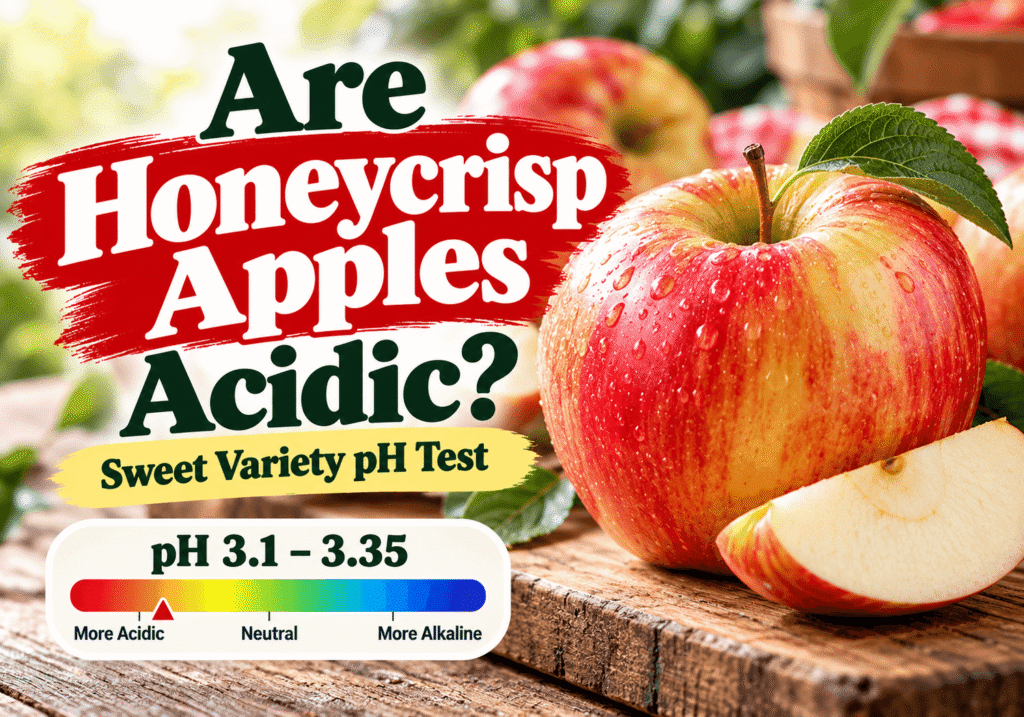
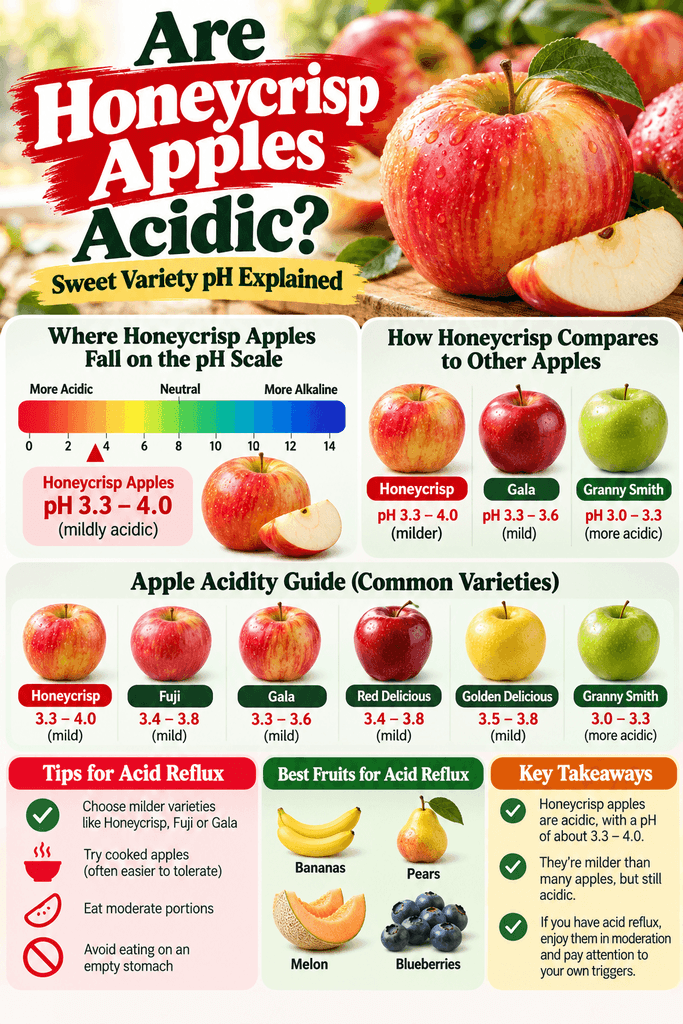
Yes, Honeycrisp apples are acidic. In a lab study of fresh-pressed juice, Honeycrisp measured a pH of about 3.1 at harvest, rising to roughly 3.2 to 3.35 after several months of cold storage (Gao and Rupasinghe, 2012). That’s more acidic than a tomato and in the same range as most other apples. Honeycrisp’s total acid content usually falls between 0.3% and 0.7%, which puts it in the middle of the apple family: more acidic than Red Delicious, but much less tart than Granny Smith (Good Fruit Grower, quoting USDA physiologist Jim Mattheis).
So why does Honeycrisp taste so sweet? Because it’s also loaded with sugar, which balances out the acid. The tang is still there; your taste buds just notice the honey first.
In this guide, we’ll walk through the real pH numbers, compare Honeycrisp with Gala, Fuji, Granny Smith, and other popular apples, and answer the big questions: Are Honeycrisp apples bad for acid reflux? Which apple is the least acidic? And what’s the best fruit to eat if you get heartburn?
Key Takeaways
- Honeycrisp apples are acidic. Their juice measured about pH 3.1 at harvest and about 3.2 to 3.35 after storage in one study.
- Total acid is moderate. Honeycrisp typically contains 0.3% to 0.7% acid at harvest, between low-acid Red Delicious (0.2% to 0.3%) and tart Granny Smith (0.7% to 1.0%).
- Acid drops in storage. Honeycrisp gets less acidic and slightly sweeter-tasting the longer it’s stored.
- Honeycrisp tastes sweet because of sugar, not because it’s low in acid.
- Apples aren’t on the government’s list of common reflux triggers, but some people still react to them. Your own experience matters most.
- No apple is truly “low-acid.” All common varieties have a pH roughly between 3 and 4.
For a broader look at apples in general, see our guide: Are Apples Acidic?
Are Honeycrisp Apples Acidic or Alkaline?
Honeycrisp apples are acidic, not alkaline (or “basic”). On the pH scale, anything below 7 is acidic, 7 is neutral, and anything above 7 is alkaline. Honeycrisp juice tests around pH 3.1 to 3.35, well into the acidic range.
The main acid in apples is malic acid. In fact, it’s named after the Latin word for apple, malum. Malic acid gives apples their bright, refreshing tang.
But aren’t apples “alkaline-forming”?
You may have read that apples are “alkaline” in the body. That’s a different idea from pH. Nutrition researchers use a score called potential renal acid load (PRAL) to estimate whether a food leaves an acid or alkaline load for the kidneys after digestion. Most fruits and vegetables have a negative PRAL, meaning they’re considered alkaline-forming, because they’re rich in minerals like potassium (Remer and Manz, 1995).
So both statements are true:
- On the plate, Honeycrisp apples are acidic (pH around 3.1 to 3.35).
- After digestion, apples are generally considered alkaline-forming.
Neither one changes your blood pH. Your body keeps blood pH in a tight range of about 7.35 to 7.45, no matter what you eat (Hopkins et al., StatPearls).
Are Honeycrisp apples “acid loving”?
This search term is about gardening, not eating. “Acid-loving” plants, like blueberries, need very acidic soil. Apple trees, including Honeycrisp, aren’t in that group. Ohio State University fruit specialist Diane Miller notes that apples grow across a wide range of soils, but a soil pH of 6.0 to 7.0 makes nutrient management easier (apples.extension.org). That’s only slightly acidic to neutral.
The Honeycrisp pH Test: What the Numbers Say
Honeycrisp was developed by the University of Minnesota, which made the original cross in 1960 and released the variety to growers in 1991 (MNopedia). Because it’s newer than many classic apples, it doesn’t appear in the FDA’s older food pH table. Fortunately, several research groups have measured it.
Study 1: Honeycrisp juice pH
Researchers in Nova Scotia measured juice from Honeycrisp and McIntosh apples at harvest and after six months of cold storage (Gao and Rupasinghe, 2012):
| Apple and timing | pH | Titratable acidity (mg/100 g juice) | Sugar (°Brix) |
| Honeycrisp, at harvest | 3.11 | 733.6 | 10.0 |
| Honeycrisp, after 6 months’ storage | 3.19–3.35 | 576–603 | 12.1–12.5 |
| McIntosh, at harvest | 3.04 | 961.5 | 9.8 |
| McIntosh, after 6 months’ storage | 3.25–3.33 | 432–553 | 11.2–11.8 |
Source: Gao and Rupasinghe, The Open Food Science Journal, 2012.
Two patterns jump out. First, Honeycrisp was slightly less acidic than McIntosh at harvest, both by pH and by total acid. Second, both apples became less acidic in storage, while their sugar readings went up. The authors explain that apples use up some of their malic acid for energy after harvest.
Study 2: Honeycrisp’s acid range in the orchard
USDA physiologist Dr. Jim Mattheis told Good Fruit Grower magazine that Honeycrisp’s titratable acidity at harvest ranges from 0.3% to 0.7%. For comparison, he gave 0.2% to 0.3% for Red Delicious and 0.7% to 1.0% for Granny Smith. In one orchard, Honeycrisp acid fell from 0.5% in early September to 0.34% by mid-October (Good Fruit Grower).
Study 3: Honeycrisp acidity in New York
Cornell Cooperative Extension tested Honeycrisp from many New York orchards over two seasons for a SARE-funded project. They sorted the apples into three groups: high acid (above 0.6%), medium (0.4% to 0.6%), and low (below 0.4%). In the first year, the average was about 0.56% at harvest, and it generally declined over months of storage. Results varied a lot by orchard, and a drought year produced more low-acid fruit (Cornell Cooperative Extension / SARE).
What these numbers mean for you
- The Honeycrisp you buy in spring is likely less acidic than one picked fresh in September, because acid declines in storage.
- Not every Honeycrisp is the same. Orchard, weather, and harvest timing all change the acid level.
- Honeycrisp is solidly acidic but not one of the tartest apples.
Why Honeycrisp Tastes Sweet Even Though It’s Acidic
Many people search “are Honeycrisp apples acidic in taste?” because they taste so sweet. The answer is that sweetness and acidity aren’t opposites. An apple can be high in both.
USDA FoodData Central lists raw Honeycrisp apples at about 12.4 grams of sugar per 100 grams, most of it fructose (USDA FDC 1750343). That sugar balances the malic acid, so your tongue reads the apple as “sweet with a little tang.”
Acid is actually an important part of why people love Honeycrisp. In Cornell’s taste tests, apples in the high-acid group got the highest overall liking scores, followed by medium and then low. The researchers noted that a “bland” flavor in Honeycrisp has been associated with low acidity (Cornell Cooperative Extension / SARE). In other words, the acid is what keeps Honeycrisp from tasting flat.
This is the same pattern we’ve seen with tomatoes. Cherry tomatoes taste sweet but often contain plenty of acid too. You can read more in our article Are Cherry Tomatoes Acidic?
Apple Acidity Chart: Honeycrisp vs. Gala, Fuji, Granny Smith, and More
How does Honeycrisp compare with other popular apples? Here’s an apple acidity chart built from published measurements. Because each study used different apples, growing regions, and methods, compare numbers within a source more than across sources.
| Apple variety | pH | Source |
| Granny Smith | 3.12–3.20 | Mezey and Serralegri, 2018 |
| McIntosh | 3.04 (harvest); 3.34 | Gao and Rupasinghe, 2012; FDA |
| Honeycrisp | 3.11 (harvest) to 3.35 (stored) | Gao and Rupasinghe, 2012 |
| Fuji | 3.21–3.34 | Mezey and Serralegri, 2018 |
| Gala | 3.24–3.37 | Mezey and Serralegri, 2018 |
| Golden Delicious | 3.19–3.33; 3.60 | Mezey and Serralegri, 2018; FDA |
| Jonathan | 3.33 | FDA |
| Winesap | 3.47 | FDA |
| Red Delicious | 3.28–3.36; 3.90 | Mezey and Serralegri, 2018; FDA |
Sources: Mezey and Serralegri, Athens Journal of Sciences, 2018 (organic and conventional apples); Gao and Rupasinghe, 2012; FDA, Approximate pH of Foods.
And here’s how much total acid (titratable acidity) common apples typically contain at harvest, which often matters more for taste than pH:
| Apple variety | Typical titratable acidity at harvest |
| Red Delicious | 0.2%–0.3% |
| Honeycrisp | 0.3%–0.7% |
| Granny Smith | 0.7%–1.0% |
Source: USDA’s Dr. Jim Mattheis, quoted in Good Fruit Grower.
Are Gala apples acidic?
Yes. Gala apples measured pH 3.24 to 3.37 in a 2018 study of organic and conventional apples (Mezey and Serralegri, 2018). A study of Brazilian Gala juice found average titratable acidity of about 0.28 g per 100 mL (Vieira et al., 2011), on the lower side for apples. Gala tastes mild and sweet, and its acidity is generally modest.
Are Fuji apples acidic?
Yes. Fuji apples measured pH 3.21 to 3.34 in the 2018 study, similar to Gala. But Fuji had the highest sugar content of all the varieties tested, at about 14.4 °Brix in the conventional samples (Mezey and Serralegri, 2018). That’s why Fuji tastes especially sweet. The Brazilian study found Fuji juice averaged about 0.25 g of acid per 100 mL, similar to Gala (Vieira et al., 2011).
Granny Smith: the tart champion
Granny Smith had the lowest pH (3.12 to 3.20) and about twice the total acid of the other apples in the 2018 study (Mezey and Serralegri, 2018). If you’re sensitive to acid, Granny Smith is the apple most worth limiting.
What kind of apple is the least acidic?
Based on total acid, Red Delicious is usually the least acidic common apple, with titratable acidity around 0.2% to 0.3% at harvest (Good Fruit Grower). The FDA also lists Delicious apples at a relatively high pH of 3.90 (FDA). Sweet varieties like Fuji and Gala are also on the milder side. For more on red varieties, see Are Red Apples Acidic?
But keep this in perspective: every common apple has a pH between roughly 3 and 4. There’s no truly “low-acid” apple. The differences between varieties are real but modest, and storage time, ripeness, and growing conditions can shift any apple’s acidity.
Apples vs. other foods
Here’s a surprising comparison: apples are generally more acidic than tomatoes. Fresh tomatoes range from about pH 4.3 to 4.9, while apples sit around 3.0 to 4.0 (FDA). Yet tomatoes are named as a reflux trigger far more often than apples. That tells you pH isn’t the only thing that matters for heartburn. See our guides Are Tomatoes Acidic? and the complete guide to acidic foods for more comparisons.
Are Honeycrisp Apples Bad for Acid Reflux?
For most people, no. Apples aren’t on the National Institute of Diabetes and Digestive and Kidney Diseases’ (NIDDK) list of foods that commonly make reflux worse. That list includes citrus fruits, tomatoes, alcohol, chocolate, coffee and other caffeine sources, high-fat foods, mint, and spicy foods (NIDDK).
That said, reflux triggers are personal. The American College of Gastroenterology’s 2022 GERD guideline recommends that people identify and avoid their own trigger foods rather than following a one-size-fits-all list (Katz et al., 2022). Some people with reflux do notice burning after acidic fruits, including apples.
Are Honeycrisp apples good for acid reflux?
There’s no good scientific evidence that apples, Honeycrisp or otherwise, treat or relieve acid reflux. You may have seen claims that “an apple a day stops heartburn,” but these aren’t backed by clinical studies. The best way to think about Honeycrisp is as a generally well-tolerated fruit for many people with reflux, not as a remedy.
Is Honeycrisp acidic for acid reflux compared with other apples?
Honeycrisp sits in the middle. It’s typically less tart than Granny Smith and McIntosh at harvest, but more acidic than Red Delicious. Stored Honeycrisp apples (the ones you buy in winter and spring) tend to be less acidic than freshly harvested ones.
What is the best apple to eat for acid reflux?
No study has compared apple varieties for heartburn. But if acidic fruit bothers you, these choices may be gentler, based on their acid content:
- Red Delicious: the lowest total acid of common apples.
- Fuji and Gala: sweet, with modest acidity.
- Stored Honeycrisp: less acidic than freshly picked.
- Avoid or limit Granny Smith: the most acidic common apple.
Tips for eating apples with reflux
- Eat apples as part of a meal or with protein, such as apple slices with a little peanut butter or cheese.
- Start with a small portion, like half an apple, and see how you feel.
- Try peeling the apple if the skin seems to bother you. Some people find peeled or cooked apples easier to eat, though there’s no research on this for reflux.
- Avoid eating right before bed. NIDDK suggests eating meals at least 3 hours before lying down if you have nighttime symptoms (NIDDK).
- Watch apple products. Applesauce (pH 3.10 to 3.60) and apple juice (pH 3.35 to 4.00) are also acidic (FDA), and juice is easy to drink in large amounts. See Is Apple Cider Safe for Acid Reflux? and Is Apple Butter Acidic?
For a list of common triggers, see our guide to foods to avoid with GERD. If you have heartburn more than twice a week, trouble swallowing, or symptoms that don’t improve, talk with your doctor.
Does an apple cause acidity on an empty stomach?
This is a popular question, especially in parts of South Asia, where “acidity” often means heartburn or indigestion. There’s no solid research showing that eating an apple on an empty stomach causes heartburn in healthy people. Your stomach already contains acid far stronger than any apple.
Still, some people feel discomfort when they eat acidic fruit alone, especially first thing in the morning. If that’s you, try eating your apple with or after a meal, such as alongside oatmeal or yogurt. The American Dental Association also recommends eating acidic foods with meals to protect your teeth (ADA).
What Is the Best Fruit for Acid Reflux?
No single fruit prevents reflux, and NIDDK doesn’t recommend specific fruits. But if acidic fruits bother you, lower-acid fruits may be easier to enjoy. Here’s how some common fruits compare, using FDA pH values:
| Fruit | Approximate pH (FDA) | Acid level |
| Cantaloupe | 6.13–6.58 | Very mild |
| Honeydew melon | 6.00–6.67 | Very mild |
| Papaya | 5.20–6.00 | Mild |
| Figs (Calimyrna) | 5.05–5.98 | Mild |
| Watermelon | 5.18–5.60 | Mild |
| Bananas | 4.50–5.29 | Mild to moderate |
| Pears (Bartlett) | 3.50–4.60 | Moderate |
| Apples (eating) | 3.30–4.00 | Moderate |
| Peaches | 3.30–4.05 | Moderate |
| Oranges (Florida) | 3.69–4.34 | Moderate, but citrus is a common trigger |
| Grapefruit | 3.00–3.75 | More acidic, a common trigger |
Source: FDA, Approximate pH of Foods and Food Products.
Melons, papaya, figs, and bananas are among the least acidic fruits. Citrus fruits are the ones NIDDK specifically names as possible triggers (NIDDK). Apples fall in the middle: more acidic than melons and bananas, but not usually named as a trigger.
Remember, pH is only part of the story. A ripe banana is low in acid but may still bother some people, while others eat apples daily without trouble. Track your own reactions.
Honeycrisp Apples and Your Teeth
Apples are acidic, so frequent snacking can expose your teeth to acid. The American Dental Association suggests:
- Eating acidic foods as part of a meal, not by themselves
- Rinsing with water, drinking milk, or eating cheese afterward, since dairy can help neutralize acids
- Waiting about an hour after eating acidic foods before brushing, so saliva can help re-harden enamel
Source: American Dental Association, MouthHealthy.
A Honeycrisp apple with a slice of cheddar isn’t just tasty; it’s a tooth-friendly combo. For more, read Are Apples Good for Your Teeth?
Are Honeycrisp Apples Healthy?
Yes. Honeycrisp apples are a nutritious, fiber-containing fruit. Here’s what USDA FoodData Central lists for 100 grams of raw Honeycrisp with skin (USDA FDC 1750343):
| Nutrient | Per 100 g |
| Calories | about 54 |
| Water | 85.0 g |
| Carbohydrates | 14.7 g |
| Fiber | 1.7 g |
| Total sugars | 12.4 g (mostly fructose) |
| Potassium | 98 mg |
A few notes:
- Eat the skin for more fiber.
- The sugar is natural, but if you’re managing blood sugar, pair apples with protein or fat. See Are Apples Good for Diabetics?
- Honeycrisp’s crisp, juicy texture makes it a satisfying snack for very few calories.
Delicious Ways to Enjoy Honeycrisp Apples
Honeycrisp is excellent raw, but it also works in salads and baking. Try these recipes from our kitchen:
- Honeycrisp apple salad: A fresh, crunchy salad that shows off the apple’s sweet-tart flavor.
- Mom’s apple cake: A cozy, classic apple cake.
- Little Brown Bettys: An old-fashioned baked apple dessert, similar to an apple crisp.
- Maple apple muffins: Great for breakfast or a snack.
- Apple cinnamon raisin pancakes: A weekend favorite with warm spices.
- Pumpkin apple scones: A fall treat that pairs apples with pumpkin.
Are Honeycrisp apples good for apple crisp? Yes, many bakers like them because they hold their shape and balance sweetness with tartness. Since Honeycrisp is sweeter than Granny Smith, you may want to reduce the sugar in your recipe slightly. Pairing apples with cinnamon adds warmth without much acidity.
Frequently Asked Questions
Are Honeycrisp apples acidic or alkaline?
They’re acidic. Honeycrisp juice measured about pH 3.1 at harvest and 3.2 to 3.35 after storage. However, like most fruits, apples are considered alkaline-forming after digestion.
Are Honeycrisp apples bad for acid reflux?
Not for most people. Apples aren’t on NIDDK’s list of common reflux triggers, but individual reactions vary. Eat them with meals and in modest portions if you’re sensitive.
Are Honeycrisp apples good for acid reflux?
They’re generally well tolerated, but there’s no evidence that apples treat or relieve reflux.
What kind of apple is the least acidic?
Red Delicious usually has the least total acid of common apples (about 0.2% to 0.3%). Fuji and Gala are also relatively mild. Granny Smith is the most acidic.
Are Gala apples acidic?
Yes. Gala apples measured about pH 3.24 to 3.37 in one study, with modest overall acidity and a mild, sweet taste.
Are Fuji apples acidic?
Yes. Fuji apples measured about pH 3.21 to 3.34 in one study. They’re among the sweetest apples, which makes them taste less acidic.
What is the best apple to eat for acid reflux?
There’s no research comparing apples for reflux. Based on acid content, Red Delicious, Fuji, and Gala are gentler choices than Granny Smith.
Does eating an apple on an empty stomach cause acidity?
There’s no solid evidence that it does for healthy people. If apples bother you on an empty stomach, eat them with or after a meal.
Are Honeycrisp apples sweet or tart?
Both. Honeycrisp is known for a sweet, honey-like flavor with a touch of tartness. Its acid content is moderate, and its sugar content is high.
The Bottom Line
Honeycrisp apples are acidic, with a juice pH of about 3.1 at harvest and around 3.2 to 3.35 after storage. Their total acid is moderate, less than Granny Smith and McIntosh but more than Red Delicious. They taste sweet because they’re high in natural sugar, not because they lack acid.
For most people, including many with occasional heartburn, Honeycrisp apples are a healthy, well-tolerated snack. If acidic fruit bothers you, try smaller portions, eat apples with meals, choose milder varieties like Red Delicious, Fuji, or Gala, and pay attention to your own triggers.
Want to compare more foods? Read Are Apples Acidic? or browse our complete guide to acidic foods.
Medical disclaimer: This article is for general information only and isn’t a substitute for professional medical or dental advice. If you have frequent heartburn, GERD, or dental sensitivity, talk with your doctor, dentist, or a registered dietitian.
References
- Gao J, Rupasinghe HPV. Characterization of ‘Honeycrisp’ and ‘McIntosh’ apple juice quality in relation to delayed cooling treatments. The Open Food Science Journal. 2012;6:12–15. https://benthamopen.com/contents/pdf/TOFSJ/TOFSJ-6-12.pdf
- Kahlke C, et al. Acidity of Honeycrisp – Key to Eating Quality and Competitiveness of Northeastern Apple Growers (ONE24-449). Cornell Cooperative Extension / Northeast SARE. https://projects.sare.org/project-reports/one24-449
- Good Fruit Grower. How to measure Honeycrisp qualities (quoting Dr. Jim Mattheis, USDA-ARS). https://goodfruit.com/how-to-measure-honeycrisp-qualities
- Mezey J, Serralegri D. Selected quantitative parameters comparison of apples from bio- and conventional production. Athens Journal of Sciences. 2018;5(4):343–354. https://doi.org/10.30958/ajs.5-4-3
- Vieira RG, Prestes RA, Denardi F, Nogueira A, Wosiacki G. Chemical pattern of Brazilian apples: a chemometric approach based on the Fuji and Gala varieties. Ciência e Tecnologia de Alimentos. 2011;31(2):418–426. https://www.redalyc.org/pdf/3959/395940105021.pdf
- U.S. Food and Drug Administration, CFSAN. Approximate pH of Foods and Food Products. 2007. Copy used: https://riverstonehealth.org/wp-content/uploads/FDA-Approximate-pH-of-Foods.pdf
- USDA FoodData Central. Apples, honeycrisp, with skin, raw (FDC ID 1750343, Foundation Foods). https://fdc.nal.usda.gov/fdc-app.html#/food-details/1750343/nutrients
- MNopedia (Minnesota Historical Society). Honeycrisp apple. https://mnopedia.org/node/24441
- Miller DD. Select and prepare a site for planting apple trees. apples.extension.org (Cooperative Extension). https://apples.extension.org/select-and-prepare-a-site-for-planting-apple-trees/
- NIDDK. Eating, Diet, & Nutrition for GER & GERD. https://www.niddk.nih.gov/health-information/digestive-diseases/acid-reflux-ger-gerd-adults/eating-diet-nutrition
- Katz PO, Dunbar KB, Schnoll-Sussman FH, et al. ACG Clinical Guideline for the Diagnosis and Management of GERD. Am J Gastroenterol. 2022;117(1):27–56. https://doi.org/10.14309/ajg.0000000000001538
- American Dental Association, MouthHealthy. Dietary Acids and Your Teeth. https://www.mouthhealthy.org/all-topics-a-z/dietary-acids-and-your-teeth
- Remer T, Manz F. Potential renal acid load of foods and its influence on urine pH. J Am Diet Assoc. 1995;95(7):791–797. https://pubmed.ncbi.nlm.nih.gov/7797810/
- Hopkins E, Sanvictores T, Sharma S. Physiology, Acid Base Balance. StatPearls. https://www.ncbi.nlm.nih.gov/books/NBK507807/
Related Posts
Subscribe for New Racipies
Get mental health tips, updates, and resources delivered to your inbox.
Chocolate Caramel Cupcakes with Soynut Butter Frosting

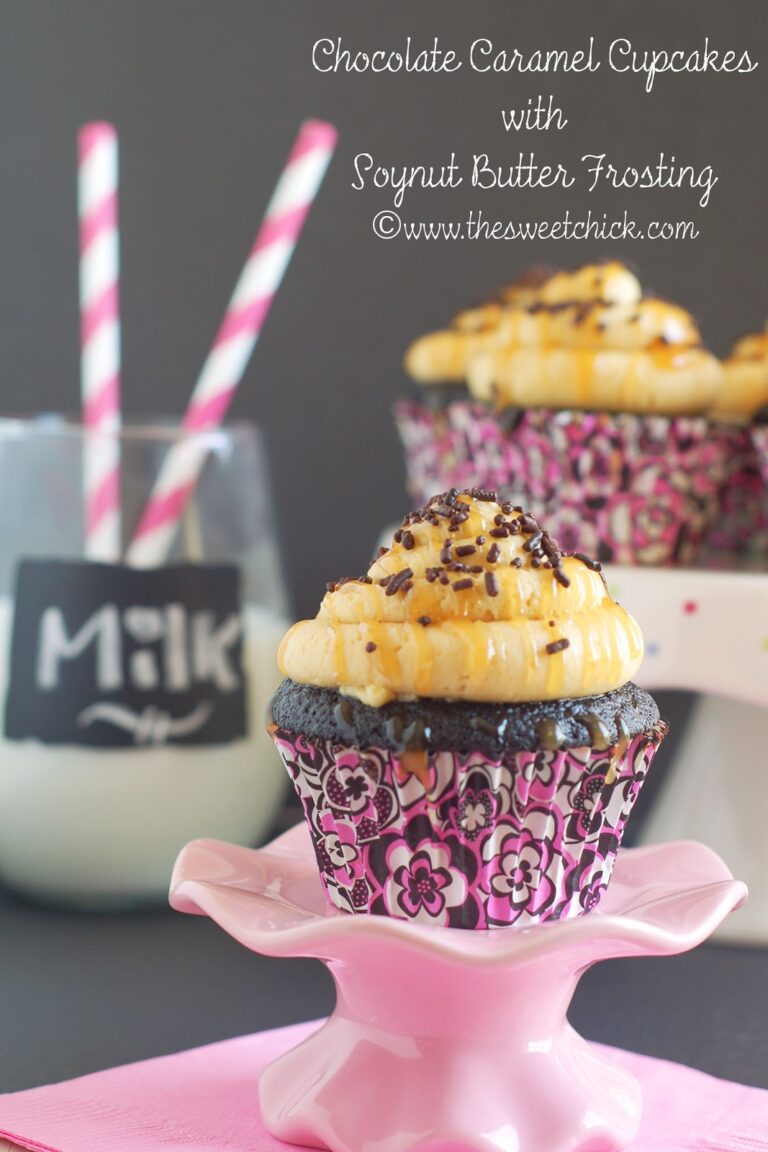

Ok, so Thanksgiving is almost here and Christmas is right behind and there is so much to do. Cooking, baking, shopping, decorating, wrapping. Of course relaxing is not one of them. Instead of stressing out, I made cupcakes. Who needs yoga? Have a cupcake.
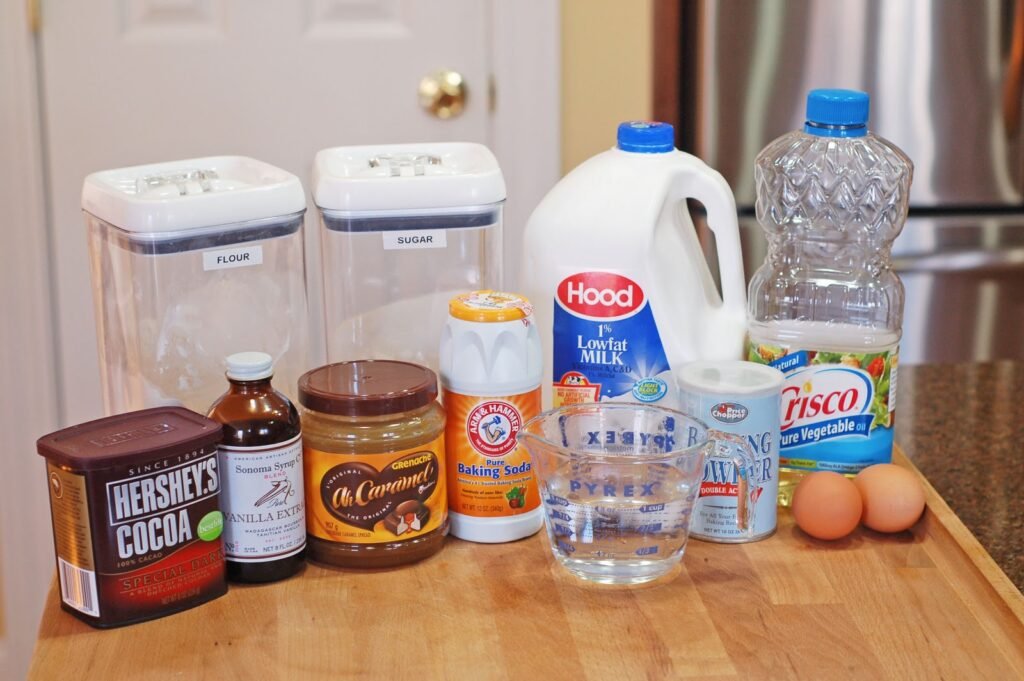
For the cupcakes, I used the recipe on the back of the Hershey’s Cocoa can, except replacing 1 cup of sugar for 1 cup of caramel. The cupcakes were great, but not much caramel flavor. I will have to add some more next time.

For the frosting, I adapted the recipe I used to make my Peanut Butter Fluff Frosting. I used soynut butter instead of peanut butter. The combo of the salty soynut butter and the sweet chocolate cupcakes was just what I was looking for. I even drizzled some extra caramel on top and added dark chocolate sprinkles to finish it off.
Chocolate Caramel Cupcakes with Soynut Butter Frosting
by The Sweet Chick
Prep Time: 15 minutes
Cook Time: 20 minutes
Keywords: bake dessert chocolate caramel soynut butter marshmallow fluff cupcake
Ingredients (32 cupcakes)
For the cupcakes
- 1 cup sugar
- 1 3/4 cups all purpose flour
- 3/4 cup Hershey’s Dark Cocoa
- 1 1/2 teaspoons baking powder
- 1 1/2 teaspoons baking soda
- 1 teaspoon salt
- 2 eggs, beaten
- 1 cup milk
- 1/2 cup vegetable oil
- 2 teaspoons vanilla extract
- 1 cup caramel (or caramel topping)
- 1 cup boiling water
For the frosting
- 1 stick unsalted butter, softened
- 1 cup creamy soynut butter
- 4 cups powdered sugar
- 1/2 cup marshmallow fluff
- 5-6 tablespoons milk
Instructions
For the cupcakes
Heat oven to 350 F. Line muffin tins with cupcake liners.
In a large bowl or stand mixer, stir together sugar, flour, cocoa, baking powder, baking soda, and salt.
Add eggs, milk, oil, vanilla, and caramel. Beat on medium speed for about 2 minutes.
Stir in boiling water (batter will be thin).
Pour batter into prepared muffin tins using a small ladle. If you use a regular scoop like I did, you will make a mess.
Bake at 350º F for 20 minutes or until toothpick inserted in center comes out clean. Cool completely before frosting.
For the frosting
With a mixer, blend butter and soynut butter until smooth.
Sift in confectioners’ sugar and beat on low speed.
Add milk and increase speed to high.
Add fluff. Beat for 1 minute.
Using a small spatula or a cake decorating tip and bag, add frosting to the cupcakes.
Drizzle with extra caramel and sprinkle with dark chocolate bits if you want.
Related Posts


Subscribe for New Racipies
Get mental health tips, updates, and resources delivered to your inbox.