
Are Tomatoes Acidic? Tomato pH, Reflux Tips & Low-Acid Swaps

Medically reviewed by Jaclyn Weiner, RD, RDN, MEd, MS Updated Date: October 10, 2026
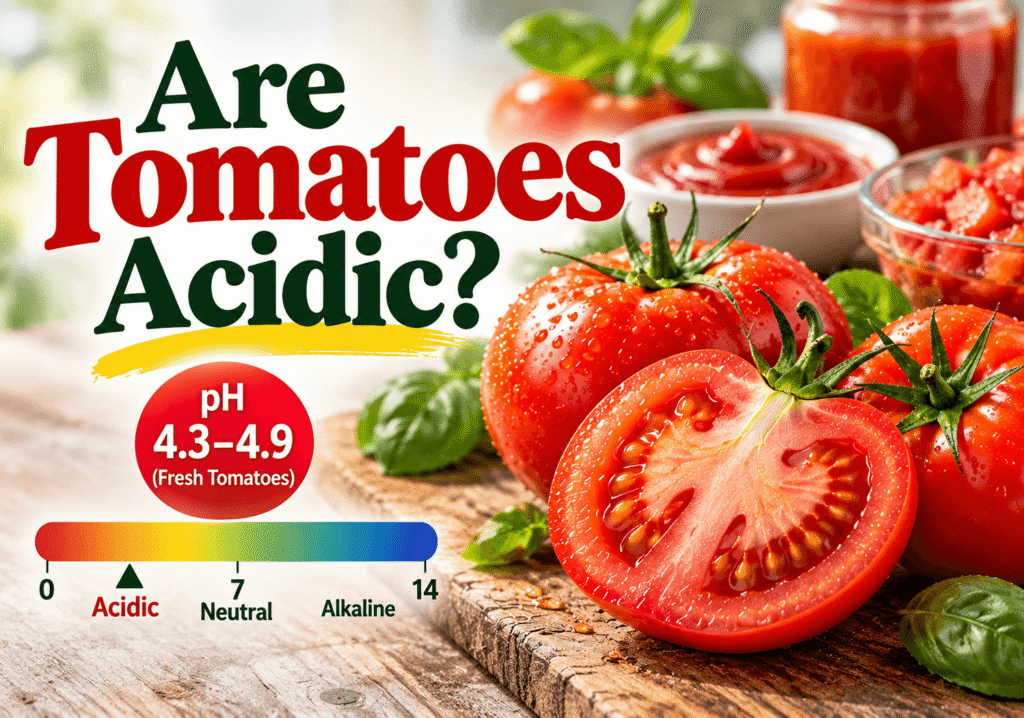
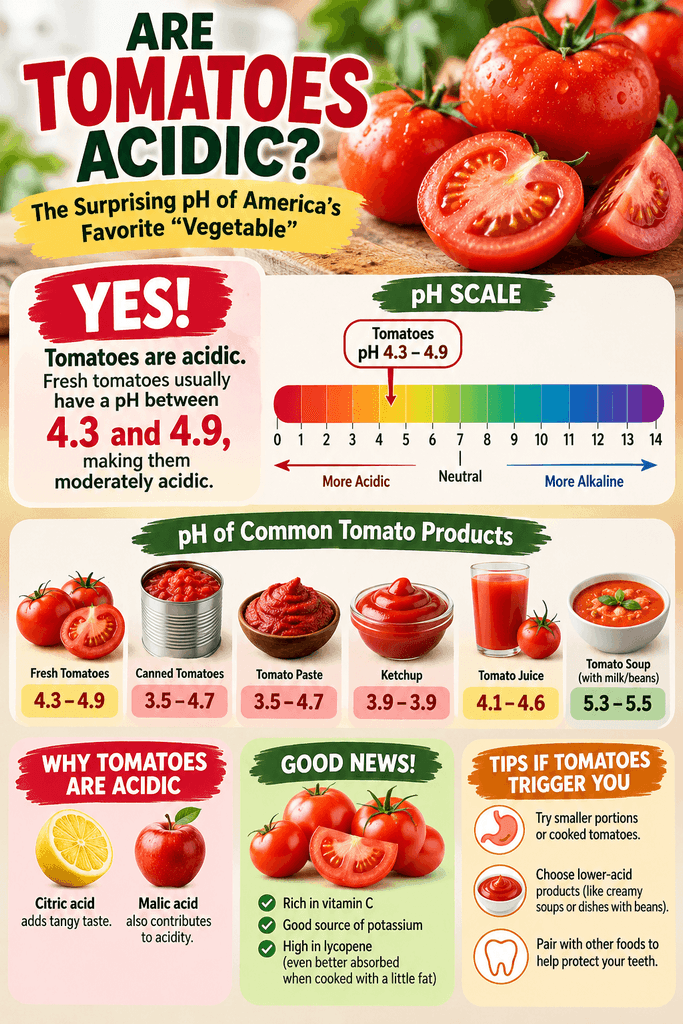
Yes, tomatoes are acidic. Fresh tomatoes usually have a pH between 4.3 and 4.9, according to the FDA’s table of food pH values. That makes them moderately acidic. They are less acidic than lemons, oranges, apples, or strawberries, but more acidic than most vegetables, such as cucumbers, potatoes, and carrots. Some tomato products, including canned tomatoes, tomato paste, and ketchup, can drop as low as pH 3.5.
Most people can eat tomatoes without a problem. However, tomato acidity matters if you get heartburn, have sensitive teeth, get mouth sores, or plan to can tomatoes at home. This guide covers all of that. You’ll learn the real pH of tomatoes and tomato products, why tomatoes taste tangy, how ripeness and cooking change things, and how to keep enjoying tomatoes when your stomach doesn’t agree with them.
Key Takeaways
- Fresh tomatoes have a pH of about 4.3 to 4.9. That’s moderately acidic, and close to the pH 4.6 line that matters for safe canning.
- Citric acid and malic acid give tomatoes their tangy taste.
- Tomato products vary. Ketchup (about pH 3.9) and some canned tomatoes and pastes (as low as 3.5) can be more acidic than fresh tomatoes.
- Yellow tomatoes aren’t really lower in acid. They have more sugar, so they taste milder.
- Tomatoes are a common heartburn trigger, but not for everyone. Doctors now suggest finding your own triggers instead of cutting out every acidic food.
- Botanically, a tomato is a fruit. But the U.S. Supreme Court ruled it a vegetable for tax purposes back in 1893.
- Tomatoes are still very nutritious. They give you vitamin C, potassium, and lycopene, which your body absorbs better from cooked tomatoes eaten with a little fat.
For a bigger picture of how tomatoes compare with hundreds of other foods, see our complete guide to acidic foods.
Are Tomatoes Acidic? The Short Answer
Tomatoes are acidic because their pH is below 7, which is neutral. On the 0 to 14 pH scale, anything under 7 counts as acidic and anything above 7 counts as alkaline (or “basic”).
But “acidic” covers a huge range. Lemon juice sits around pH 2.0 to 2.6. Fresh tomatoes sit around 4.3 to 4.9. Each step down the pH scale is about ten times more acidic. So lemon juice is roughly 100 times more acidic than a typical tomato. That’s why biting into a tomato feels tangy, while biting into a lemon makes your whole face pucker.
Here’s an easy way to think about where tomatoes fall:
- Strongly acidic (pH 2 to 3.5): lemon and lime juice, vinegar, cranberry juice, colas
- Moderately acidic (pH 3.5 to 4.6): most fruits, ketchup, tomato juice, many canned tomatoes, and many fresh tomatoes
- Mildly acidic (pH 4.6 to 6.9): most vegetables, grains, meat, fish, and milk
Fresh tomatoes straddle the line between “moderately” and “mildly” acidic. A sweet, very ripe tomato might test around 4.7 or 4.8, while a tart, firm one could be closer to 4.3.
What Is the pH of Tomatoes and Tomato Products?
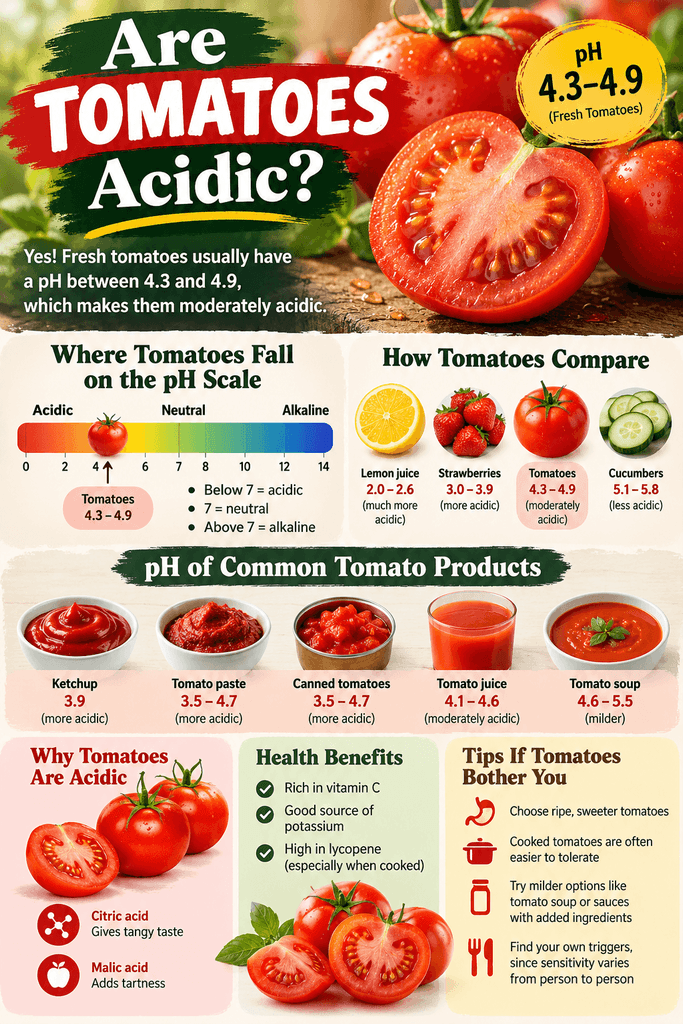
The best-known source for food pH values is a table compiled by the U.S. Food and Drug Administration (FDA). It lists ranges instead of single numbers, because pH changes with the variety, growing conditions, ripeness, and processing. Here are the FDA’s values for tomatoes and common tomato products.
| Tomato food | Approximate pH (FDA) | How acidic? |
| Chili sauce, acidified | 2.77–3.70 | Very acidic |
| Tomatoes, canned | 3.50–4.70 | Moderate to mild |
| Tomato paste | 3.50–4.70 | Moderate to mild |
| Ketchup | 3.89–3.92 | Moderate |
| Vegetable juice | 3.90–4.30 | Moderate |
| Tomato juice | 4.10–4.60 | Moderate |
| Tomatoes, fresh | 4.30–4.90 | Moderate to mild |
| Tomato puree | 4.30–4.47 | Moderate |
| Tomatoes, strained | 4.32–4.58 | Moderate |
| Tomatoes, wine-ripened | 4.42–4.65 | Moderate |
| Cream of tomato soup, canned | 4.62 | Mild |
| Beans in tomato sauce, canned (vegetarian) | 5.32 | Mild |
| Tomato rice soup, condensed | about 5.50 | Mild |
Source: FDA, Approximate pH of Foods and Food Products. Values are ranges reported for typical samples, and individual brands or batches can fall outside them.
A few things stand out in this table:
- Fresh tomatoes are not the most acidic tomato food. Ketchup, some canned tomatoes, and some tomato pastes can be noticeably more acidic.
- Creamy and mixed dishes are milder. Cream of tomato soup and beans in tomato sauce have higher pH values because milk, beans, and other ingredients dilute the tomato acid.
- The ranges overlap a lot. One can of tomatoes may be more acidic than another, depending on the tomatoes used and whether the maker added citric acid.
Why does canned food sometimes have added acid?
If you read the label on a can of diced tomatoes, you’ll often see citric acid in the ingredient list. Manufacturers add it on purpose. Because fresh tomatoes can have a pH slightly above 4.6, extra acid helps make sure every batch is acidic enough to be processed safely (more on that in the canning section below). Some ketchups and sauces also contain vinegar, which lowers the pH further and adds that familiar tang.
Why Are Tomatoes Acidic?
Tomatoes are acidic because they naturally contain organic acids, mainly citric acid and malic acid. Citric acid is the same acid that makes lemons sour. Malic acid is the main acid in apples.
A 2023 study in the journal Horticulturae measured sugars and acids in several tomato types grown in Croatia. Researchers found citric acid levels of roughly 385 to 729 mg per 100 grams of fresh tomato and malic acid levels of about 277 to 484 mg per 100 grams. The tomatoes in that study had pH values between 4.04 and 4.41. The more citric acid a tomato had, the lower (more acidic) its pH tended to be (Anđelini et al., 2023).
Acid plus sugar equals flavor
Acid is a big part of why a good tomato tastes like a tomato. The same study points out that the balance of sugars and organic acids shapes tomato flavor (Anđelini et al., 2023). A tomato with plenty of both tastes rich and bright. A tomato with lots of sugar and less acid tastes sweet but a bit flat. A tomato with lots of acid and little sugar tastes sharp or sour.
This is also why your taste buds can fool you. A sweet cherry tomato may seem less acidic than a tart beefsteak tomato, but the extra sugar can simply be covering up the sourness. Taste is not a reliable pH test.
Is a Tomato a Fruit or a Vegetable?
Here’s the “surprising” part of the story. Botanically, a tomato is a fruit. In plant science, a fruit is the part of a flowering plant that develops from the flower and holds the seeds. Tomatoes do exactly that, just like peppers, cucumbers, eggplants, and squash.
In the kitchen, though, a tomato is treated as a vegetable. We put it in salads, sauces, sandwiches, and soups, not in fruit salad or pie.
This argument actually reached the U.S. Supreme Court. In the 1880s, a tariff law taxed imported vegetables but not imported fruit. A family of importers named Nix argued that tomatoes were fruit and shouldn’t be taxed. In the 1893 case Nix v. Hedden, the Court disagreed. Justice Horace Gray wrote: “Botanically speaking, tomatoes are the fruit of a vine, just as are cucumbers, squashes, beans, and peas.” But he explained that in everyday language, people call tomatoes vegetables because they are usually served with dinner, not as dessert. So, for the tariff, tomatoes were vegetables (Nix v. Hedden, 149 U.S. 304 (1893)).
Why does this matter for acidity? Because many people expect “vegetables” to be mild and “fruits” to be tart. Tomatoes sit right in between. They are more acidic than most vegetables but less acidic than most fruits, which makes perfect sense once you know they are botanically a fruit that we eat like a vegetable.
How Tomatoes Compare With Other Foods
To put tomato acidity in context, here’s how fresh tomatoes compare with common fruits and vegetables, again using the FDA’s pH table.
| Food | Approximate pH (FDA) | More or less acidic than tomatoes? |
| Lemon juice | 2.00–2.60 | Much more acidic |
| Strawberries | 3.00–3.90 | More acidic |
| Apples (eating) | 3.30–4.00 | More acidic |
| Orange juice | 3.30–4.19 | More acidic |
| Tomatoes, fresh | 4.30–4.90 | — |
| Peppers (general) | 4.65–5.45 | Slightly less acidic |
| Cucumbers | 5.12–5.78 | Less acidic |
| Potatoes | 5.40–5.90 | Less acidic |
| Eggplant | 5.50–6.50 | Less acidic |
| Zucchini, cooked | 5.69–6.10 | Less acidic |
| Carrots | 5.88–6.40 | Much less acidic |
Source: FDA, Approximate pH of Foods and Food Products.
Notice that tomatoes’ closest relatives aren’t all alike. Tomatoes, peppers, potatoes, and eggplant all belong to the nightshade family, yet potatoes and eggplant are far less acidic than tomatoes. If you’re curious about other nightshades, see our guides to bell peppers, red peppers, and green peppers.
Does Tomato Acidity Change? Ripeness, Variety, and Cooking
A tomato’s pH isn’t fixed. It shifts depending on how ripe the tomato is, what kind it is, and what you do to it in the kitchen.
Green tomatoes vs. ripe tomatoes
Green (unripe) tomatoes are generally more acidic than ripe red tomatoes, according to Purdue Extension’s guide to preserving tomatoes (Purdue Extension, 2015). That’s one reason fried green tomatoes and green tomato relish taste so tart. As a tomato ripens, it builds up sugar, and the balance between sugar and acid shifts, so a ripe tomato tastes sweeter.
There’s a catch for home canners, though. Purdue Extension advises against canning tomatoes from vines that have died or been killed by frost, and recommends firm, vine-ripened fruit instead (Purdue Extension, 2015). When food safety depends on staying at or below pH 4.6, it pays to start with good-quality tomatoes.
Are yellow or “low-acid” tomatoes really less acidic?
You may have seen yellow, orange, or white tomatoes sold as “low-acid.” This is mostly a myth. Purdue Extension says it plainly: “Yellow tomatoes are not really any lower in acid than red; they contain more sugar and, therefore, have a sweeter taste” (Purdue Extension, 2015).
In other words, “low-acid” tomatoes usually taste less acidic because of extra sugar, not because their pH is much higher. That’s an important point for two groups of people:
- Home canners should treat every tomato variety the same and add acid as directed.
- People with heartburn may find milder-tasting tomatoes more pleasant, but they shouldn’t assume a yellow tomato will be gentler on their stomach. The only way to know is to try a small amount and see how you feel.
Cherry, Roma, heirloom, and beefsteak tomatoes
Every tomato type can vary widely, and there isn’t a reliable ranking of tomato varieties by pH. The FDA lists a single range (4.30–4.90) for fresh tomatoes and a slightly narrower range (4.42–4.65) for wine-ripened tomatoes. Growing conditions, soil, weather, and harvest time can all shift the numbers.
Roma (paste) tomatoes are meatier and contain less water, so they cook down into thick sauces. Slicing tomatoes, like beefsteak types, are juicier. Purdue Extension recommends paste varieties for sauce and ketchup and slicing varieties for juice, mainly because of texture and water content, not acidity (Purdue Extension, 2015).
Does cooking make tomatoes more acidic?
Cooking doesn’t add acid to tomatoes, but it can change how acidic a dish tastes and how acidic it is per spoonful:
- Simmering removes water. When you cook tomatoes down into sauce or paste, the acids become more concentrated in each bite. That’s partly why tomato paste can range as low as pH 3.5.
- Added ingredients change the pH. Vinegar in ketchup or barbecue sauce makes it more acidic. Cream, cheese, beans, or broth make it less acidic.
- Canned tomatoes often contain citric acid. As mentioned earlier, this is added for safety and can make canned tomatoes more acidic than the fresh ones you’d buy at the market.
Can you make tomato sauce less acidic?
Yes, there are a few common kitchen tricks:
- Add a pinch of baking soda. Baking soda (sodium bicarbonate) is alkaline, so it neutralizes some of the acid. Add a small pinch, stir, and taste. You’ll see a little fizzing as it reacts. Too much will make the sauce taste soapy or flat.
- Add something creamy. A splash of milk, cream, or a spoonful of ricotta softens both the taste and the acidity. That’s why cream of tomato soup is milder than plain tomato juice.
- Add sweet vegetables. Grated carrot, roasted red pepper, or a bit of pumpkin puree adds natural sweetness and bulk, so each serving has less tomato.
- Add a pinch of sugar. Sugar won’t change the pH much, but it balances the sour taste. This helps flavor, not necessarily heartburn.
- Roast your tomatoes. Slow roasting brings out their sweetness and makes them taste mellower. Try our slow-roasted tomatoes to see the difference.
Keep in mind that a milder taste doesn’t guarantee a dish won’t trigger reflux. Fat, spice, and portion size matter too.
Tomato Products Ranked by Acidity
If you’re trying to cut back on acidic foods, it helps to know which tomato products are the tangiest. Based on the FDA’s ranges, here’s a rough order from most acidic to least acidic:
- Acidified chili sauce (pH 2.77–3.70): The added acid makes this the sharpest tomato-based condiment on the FDA list.
- Canned tomatoes and tomato paste (as low as pH 3.50): Their wide ranges reach the low 3s, especially when citric acid is added.
- Ketchup (pH 3.89–3.92): Vinegar keeps ketchup consistently acidic, even though it tastes sweet.
- Vegetable juice (pH 3.90–4.30): Tomato-based vegetable juice blends are more acidic than plain tomato juice in the FDA table.
- Tomato juice (pH 4.10–4.60): Drinking it straight gives your teeth and esophagus a big dose of acid at once.
- Fresh tomatoes (pH 4.30–4.90): Usually milder than most processed versions.
- Cream of tomato soup (pH 4.62): Dairy softens the acidity.
- Canned pork and beans in tomato sauce (pH 5.10–5.80): The beans dilute the tomato, putting these closer to neutral.
This is an approximate guide, not a strict ranking. Brands differ, and the ranges overlap. Still, the pattern is clear: the more concentrated the tomato and the more vinegar or citric acid added, the more acidic the product.
Salsa, marinara, and pizza sauce aren’t listed separately in the FDA table, but they are generally made from tomatoes plus other acidic ingredients like lime juice, vinegar, or wine, so it’s reasonable to treat them as moderately acidic. Fresh salsa like our roasted corn pico de gallo also contains onion and chili, which some people with reflux find bothersome too.
Are Tomatoes Bad for Acid Reflux and GERD?
For many people, yes, tomatoes can trigger heartburn. The National Institute of Diabetes and Digestive and Kidney Diseases (NIDDK) lists tomatoes and tomato products among foods that may make reflux symptoms worse, along with citrus, chocolate, coffee, fatty and fried foods, mint, spicy foods, and alcohol (NIDDK).
But “can trigger” is not the same as “always triggers.” Plenty of people with occasional heartburn eat tomatoes with no trouble.
Why tomatoes can cause heartburn
Gastroesophageal reflux happens when stomach contents, including stomach acid, flow back up into the esophagus (the tube between your mouth and stomach). Your stomach is built to handle very strong acid. Your esophagus isn’t. When it’s already irritated, acidic foods like tomatoes can sting on the way down, and some people notice more burning after eating them.
It’s worth knowing that tomato acid is far weaker than your own stomach acid. The bigger issue is usually how much you eat, when you eat it, and what you eat it with. A huge plate of spaghetti with meat sauce and cheese, eaten right before bed, combines several triggers at once: a large portion, fat, tomato, and lying down soon after.
You may not need to cut tomatoes completely
The American College of Gastroenterology’s 2022 guideline on GERD doesn’t recommend that everyone with reflux avoid a long list of foods. Instead, it suggests that people identify and avoid their own personal triggers. It also recommends avoiding meals within 2 to 3 hours of bedtime, and losing weight for people who are overweight (Katz et al., 2022).
That means a smart approach is to test, not guess:
- Keep a simple food and symptom diary for one to two weeks.
- Notice patterns. Do you get heartburn after tomato sauce but not after a few cherry tomatoes in a salad?
- Try a short break from tomato foods if they seem to be a problem, then add a small amount back to see what happens.
- Talk with your doctor if you have heartburn more than twice a week, trouble swallowing, unplanned weight loss, or symptoms that don’t improve.
For a broader list, see our guide to foods to avoid with GERD.
Tips for eating tomatoes when you have reflux
If tomatoes bother you a little but you don’t want to give them up, these strategies may help:
- Eat smaller portions. A few slices on a sandwich are very different from a big bowl of tomato soup.
- Eat tomatoes as part of a meal, not on an empty stomach. Pairing them with low-acid foods like oatmeal, basmati rice, or potatoes can make the meal gentler overall.
- Choose fresh over concentrated. Fresh tomatoes are often easier to tolerate than tomato paste, ketchup, or long-simmered sauce.
- Go easy on the fat and spice. Greasy pizza, spicy arrabbiata, and cheese-heavy lasagna stack several triggers together.
- Finish eating 2 to 3 hours before bed, as the ACG guideline recommends.
- Watch your drinks. Pairing tomato dishes with coffee, wine, or soda adds even more potential triggers.
Tomato-free swaps for reflux-friendly meals
If you decide to take a break from tomatoes, these swaps can keep your meals flavorful:
| Instead of… | Try… |
| Marinara or pizza sauce | Pesto, garlic and olive oil, or a white sauce made with milk |
| Tomato soup | Pumpkin, butternut squash, carrot, or sweet potato soup |
| Ketchup | A little mustard, mashed avocado, or a yogurt-based dip |
| Salsa | Guacamole or a cucumber-herb salsa with cucumbers |
| Tomatoes in salads | Cucumber, shredded carrot, roasted beets, or zucchini |
| Tomato-based chili | A white chicken chili made with beans and broth |
Some people make a tomato-free “red sauce” by blending cooked carrots, beets, and pumpkin with garlic and herbs. It won’t taste exactly like marinara, but it gives you that color and a similar cozy feel on pasta.
Tomatoes and Gastritis or Stomach Ulcers
Gastritis means inflammation of the stomach lining. Many people with gastritis or ulcers find that acidic, spicy, or fatty foods make their discomfort worse, while others notice no difference. There isn’t a single proven “gastritis diet,” so the best approach is similar to reflux: notice which foods bother you, eat smaller meals, and follow your doctor’s treatment plan.
If tomatoes seem to bother your stomach, try cooked dishes with a little dairy or a mild tomato soup in small amounts rather than raw tomato salads or concentrated sauces. For meal ideas built around gentler foods, see our 7-day meal plan for gastritis.
Are Tomatoes Bad for Your Teeth?
Acidic foods and drinks can soften tooth enamel, the hard outer layer of your teeth. Over time, repeated acid exposure can lead to dental erosion, which can make teeth sensitive and more likely to wear down.
But the American Dental Association (ADA) points out that how often and how long your teeth are exposed to acid matters, not just how acidic a food is. The ADA suggests enjoying acidic foods like tomatoes and citrus as part of a meal rather than snacking on them alone all day (American Dental Association).
Here’s how to protect your teeth while still eating tomatoes:
- Eat tomatoes with meals, when your mouth makes more saliva to help neutralize acid.
- Don’t sip tomato juice or vegetable juice slowly over a long time. Drink it with food, or use a straw.
- Rinse with water after eating tomato-heavy foods.
- Wait before brushing. Brushing right after acidic foods can wear softened enamel, so give your mouth some time first.
- Pair tomatoes with cheese. Dairy foods like mozzarella in a caprese salad can help balance a meal.
Tomatoes aren’t nearly as hard on teeth as lemon juice, sodas, or sports drinks, which are much more acidic. For most people, tomatoes in normal meals aren’t a dental worry.
Tomatoes and Mouth Sores
If you’ve ever eaten tomato salsa with a canker sore, you probably felt the sting. Mayo Clinic lists spicy or acidic foods among the foods that can trigger canker sores in some people, and tomatoes fall in the acidic group (Mayo Clinic).
While a sore is healing, it may help to:
- Skip raw tomatoes, salsa, and ketchup for a few days.
- Choose soft, mild foods like yogurt, mashed potatoes, oatmeal, and eggs.
- Avoid spicy and salty snacks, which can also sting.
- See a doctor or dentist if a sore is unusually large, very painful, or lasts more than two weeks.
Are Tomatoes Acid-Forming or Alkaline-Forming in the Body?
You may have read that some foods are “acid-forming” and others are “alkaline-forming.” This is a different question from a food’s pH.
A food’s pH describes the food itself, before you eat it. Whether a food is “acid-forming” describes what’s left for your kidneys to handle after digestion. Scientists estimate this with a score called potential renal acid load (PRAL). Foods high in protein, like meat, cheese, and grains, tend to be acid-forming. Most fruits and vegetables tend to be alkaline-forming, because they are rich in minerals like potassium and magnesium (Remer and Manz, 1995).
Tomatoes, like most vegetables and fruits, are rich in potassium and are generally considered alkaline-forming, even though they are acidic on the plate. It’s the same paradox as lemons: sour to taste, but not acid-forming.
Can tomatoes change your blood pH?
No. Your body keeps your blood pH in a very tight range, about 7.35 to 7.45, using your lungs, kidneys, and chemical buffers (Hopkins et al., StatPearls). Eating tomatoes, or any other food, won’t make your blood more acidic or more alkaline. Diet can change the pH of your urine, because that’s one way your kidneys get rid of extra acid, but that’s normal and healthy.
So you don’t need to avoid tomatoes to “alkalize” your body. If you like the idea of an alkaline diet, the part that’s worth keeping is simple: eat more fruits and vegetables, including tomatoes.
Why Tomato Acidity Matters for Home Canning
This is where tomato pH becomes a real safety issue.
The bacterium that causes botulism, Clostridium botulinum, can’t grow and make its toxin in foods with a pH of 4.6 or lower. That’s why acidic foods can be safely canned in a boiling-water bath, while low-acid foods (pH above 4.6), like green beans and corn, must be processed in a pressure canner to reach higher temperatures (UC Master Food Preserver Program).
Tomatoes are a borderline case. Their pH usually runs from 4.3 to 4.9, so some tomatoes are above 4.6. You can’t tell which ones just by looking or tasting. That’s why food safety experts say to always add acid when canning tomatoes, whatever the variety.
How much acid to add when canning tomatoes
Penn State Extension recommends:
| Jar size | Bottled lemon juice | OR citric acid |
| Pint | 1 tablespoon | ¼ teaspoon |
| Quart | 2 tablespoons | ½ teaspoon |
Source: Penn State Extension; also Purdue Extension.
A few important tips:
- Use bottled lemon juice, not fresh. Bottled lemon juice has a consistent acidity level. Fresh lemons vary, so you can’t be sure you’re adding enough (Penn State Extension).
- Add the acid directly to each jar before filling it.
- Don’t can tomatoes from dead or frost-killed vines (Purdue Extension, 2015).
- Yellow and “low-acid” varieties still need added acid.
- Follow a tested recipe from a trusted source, such as a university extension service or the USDA, and don’t change the amounts of low-acid ingredients like onions and peppers.
If the extra lemon juice makes your tomatoes taste too tart, you can add a little sugar when you open the jar and cook with it. Don’t skip the acid.
Tomato Nutrition: Why They’re Still Worth Eating
Acidity aside, tomatoes are one of the most nutritious and affordable foods you can buy. Here’s what you get in 100 grams of raw red tomato (about two-thirds of a medium tomato), based on USDA FoodData Central:
| Nutrient | Amount per 100 g |
| Calories | 18 |
| Water | 94.5 g |
| Carbohydrates | 3.9 g |
| Fiber | 1.2 g |
| Sugars | 2.6 g |
| Protein | 0.9 g |
| Vitamin C | 13.7 mg |
| Potassium | 237 mg |
| Vitamin A (RAE) | 42 mcg |
| Vitamin K | 7.9 mcg |
| Folate | 15 mcg |
| Lycopene | 2,573 mcg |
| Beta-carotene | 449 mcg |
| Lutein + zeaxanthin | 123 mcg |
Source: USDA FoodData Central, Tomatoes, red, ripe, raw, year-round average (FDC ID 170457).
Vitamin C
Tomatoes are a good everyday source of vitamin C. According to the NIH Office of Dietary Supplements, one medium raw tomato has about 17 mg of vitamin C (19% of the Daily Value), and ¾ cup of tomato juice has about 33 mg (37% DV) (NIH ODS). Vitamin C helps your body make collagen, heal wounds, and absorb iron from plant foods.
Interestingly, vitamin C is itself an acid (ascorbic acid), but tomatoes contain far more citric and malic acid, so vitamin C is only a small part of their tang.
Lycopene
Lycopene is the red pigment that gives tomatoes their color. It’s a type of carotenoid, a plant compound with antioxidant activity. Tomatoes and tomato products are the main source of lycopene in most American diets.
Here’s a fun twist: processed tomatoes can give you more usable lycopene than fresh ones. In a small study published in the American Journal of Clinical Nutrition, people absorbed about 2.5 times more lycopene from tomato paste than from fresh tomatoes, when both meals contained the same amount of lycopene and some corn oil (Gärtner et al., 1997). Heat and processing break down the tomato’s cell walls, and fat helps your body absorb lycopene.
That creates a small trade-off for people with reflux. Concentrated, cooked tomato products deliver more lycopene, but they can also be more acidic and more likely to cause heartburn. If you tolerate tomatoes well, a sauce with a little olive oil is a great choice. If you don’t, you can still get plenty of carotenoids from carrots, sweet potatoes, pumpkin, and leafy greens.
Low in calories, high in water
With only 18 calories per 100 grams and almost 95% water, tomatoes add volume, color, and flavor to meals for very few calories. They fit easily into almost any eating plan. If you’re building healthier meals, check out our guides to whether salads are healthy and whether soups are healthy.
Easy Ways to Enjoy Tomatoes (Acid-Smart Recipes)
If tomatoes agree with you, here are some favorites from our kitchen, along with tips to make them a little gentler:
- Slow-roasted tomatoes: Roasting concentrates sweetness and mellows the tang. Serve with eggs, grains, or toast.
- Tomato soup: Stir in a splash of milk or cream to soften the acidity.
- Caprese salad: Fresh mozzarella balances juicy tomatoes. Use a light hand with balsamic vinegar if you’re sensitive.
- Grilled kale with ricotta and tomatoes: Creamy ricotta pairs nicely with bright tomatoes.
- Shakshuka: Eggs poached in tomato sauce. Go easy on the chili if spice bothers you.
- Pasta puttanesca: Bold and briny with olives and capers. Save it for days your stomach feels fine.
- Caponata: A sweet-and-sour Sicilian eggplant dish. Eggplant is much less acidic than tomato, so it dilutes the acid.
- My lasagna and petite lasagnas: The small portions in petite lasagnas make portion control easy.
- Broccoli rabe and egg pizza: A lighter pizza idea for tomato lovers who want to change things up.
Frequently Asked Questions
Are tomatoes acidic or alkaline?
Tomatoes are acidic, with a pH of about 4.3 to 4.9. However, like most fruits and vegetables, they are considered alkaline-forming after digestion because they are rich in potassium. Neither fact changes your blood pH.
What is the pH of a tomato?
Fresh tomatoes usually have a pH between 4.30 and 4.90, according to the FDA. Canned tomatoes and tomato paste can range from 3.50 to 4.70, and ketchup is about 3.9.
Are cherry tomatoes less acidic?
Not necessarily. Cherry tomatoes often taste sweeter because they’re high in sugar, but sweetness doesn’t mean a higher pH. There’s no reliable evidence that cherry tomatoes are consistently less acidic than other tomatoes.
Which tomatoes are the least acidic?
No tomato variety is proven to be truly “low-acid.” Yellow and orange tomatoes taste milder because they have more sugar, but Purdue Extension notes they’re not really lower in acid than red tomatoes. Fully ripe tomatoes tend to taste less tart than green ones.
Is tomato sauce more acidic than fresh tomatoes?
It can be. Cooking concentrates the acids, and many sauces include vinegar, wine, or added citric acid. Creamy tomato sauces and soups are usually less acidic.
Is ketchup acidic?
Yes. Ketchup has a pH of about 3.89 to 3.92, mainly because it contains vinegar. That makes it more acidic than fresh tomatoes, even though it tastes sweet.
Are tomatoes bad for acid reflux?
Tomatoes are a common reflux trigger, but not everyone reacts to them. Doctors recommend finding your own triggers with a food diary, eating smaller meals, and not eating within 2 to 3 hours of bedtime.
Does adding baking soda make tomato sauce less acidic?
Yes. Baking soda is alkaline, so a small pinch neutralizes some of the acid in tomato sauce. Use very little, because too much can leave a soapy taste.
Is tomato juice acidic?
Yes. Tomato juice has a pH of about 4.10 to 4.60. Because people tend to sip it, it can expose teeth to acid for longer, so drink it with a meal.
Do I need to add lemon juice when canning tomatoes?
Yes. Because some tomatoes have a pH above 4.6, add 1 tablespoon of bottled lemon juice (or ¼ teaspoon citric acid) per pint, or 2 tablespoons (or ½ teaspoon citric acid) per quart.
The Bottom Line
Tomatoes are acidic, but only moderately so. With a pH of about 4.3 to 4.9, fresh tomatoes are more acidic than most vegetables but less acidic than lemons, apples, oranges, and strawberries. Ketchup, tomato paste, and some canned tomatoes can be more acidic than fresh tomatoes, while creamy tomato soups and bean dishes are milder.
For most people, tomatoes are a healthy, low-calorie food packed with vitamin C, potassium, and lycopene. If they give you heartburn, you don’t automatically have to give them up. Try smaller portions, eat them with meals, choose fresh over concentrated, and avoid eating late at night. And if you can tomatoes at home, always add acid, no matter what variety you grow.
Want to compare tomatoes with other foods? Visit our complete guide to acidic foods, or explore single-food guides like are limes acidic, is Greek yogurt acidic, are pickles acidic, and is tea acidic.
Medical disclaimer: This article is for general information only and isn’t a substitute for professional medical or dental advice. If you have frequent heartburn, GERD, stomach pain, mouth sores that don’t heal, or dental sensitivity, talk with your doctor, dentist, or a registered dietitian.
References
- U.S. Food and Drug Administration, CFSAN. Approximate pH of Foods and Food Products. April 2007. Copy used: https://riverstonehealth.org/wp-content/uploads/FDA-Approximate-pH-of-Foods.pdf
- Anđelini M, Major N, Išić N, et al. Sugar and organic acid content is dependent on tomato (Solanum lycopersicum L.) peel color. Horticulturae. 2023;9(3):313. https://doi.org/10.3390/horticulturae9030313
- Nix v. Hedden, 149 U.S. 304 (1893). Legal Information Institute, Cornell Law School. https://www.law.cornell.edu/supremecourt/text/149/304
- Purdue Extension (adapted from Penn State; LaBorde L, Zepp M). Let’s Preserve: Tomatoes (HHS-803-W). 2015. https://www.extension.purdue.edu/extmedia/hhs/hhs-803-w.pdf
- Penn State Extension. Acidifying Canned Products for Safety. https://extension.psu.edu/acidifying-canned-products-for-safety
- UC Master Food Preserver Program, UC ANR. Understanding pH and Why It’s Important in Food Preservation. https://ucanr.edu/program/uc-master-food-preserver/article/understanding-ph-and-why-its-important-food-preservation
- NIDDK. Eating, Diet, & Nutrition for GER & GERD. https://www.niddk.nih.gov/health-information/digestive-diseases/acid-reflux-ger-gerd-adults/eating-diet-nutrition
- Katz PO, Dunbar KB, Schnoll-Sussman FH, et al. ACG Clinical Guideline for the Diagnosis and Management of Gastroesophageal Reflux Disease. Am J Gastroenterol. 2022;117(1):27–56. https://doi.org/10.14309/ajg.0000000000001538
- American Dental Association, MouthHealthy. Dietary Acids and Your Teeth. https://www.mouthhealthy.org/all-topics-a-z/dietary-acids-and-your-teeth
- Mayo Clinic. Canker sore: Symptoms and causes. https://www.mayoclinic.org/diseases-conditions/canker-sore/symptoms-causes/syc-20370615
- Remer T, Manz F. Potential renal acid load of foods and its influence on urine pH. J Am Diet Assoc. 1995;95(7):791–797. https://pubmed.ncbi.nlm.nih.gov/7797810/
- Hopkins E, Sanvictores T, Sharma S. Physiology, Acid Base Balance. StatPearls. https://www.ncbi.nlm.nih.gov/books/NBK507807/
- USDA FoodData Central. Tomatoes, red, ripe, raw, year round average (FDC ID 170457, SR Legacy). https://fdc.nal.usda.gov/fdc-app.html#/food-details/170457/nutrients
- NIH Office of Dietary Supplements. Vitamin C: Fact Sheet for Health Professionals. https://ods.od.nih.gov/factsheets/VitaminC-HealthProfessional/
- Gärtner C, Stahl W, Sies H. Lycopene is more bioavailable from tomato paste than from fresh tomatoes. Am J Clin Nutr. 1997;66(1):116–122. https://pubmed.ncbi.nlm.nih.gov/9209178/
Related Posts
Subscribe for New Racipies
Get mental health tips, updates, and resources delivered to your inbox.
Chocolate Caramel Cupcakes with Soynut Butter Frosting



Ok, so Thanksgiving is almost here and Christmas is right behind and there is so much to do. Cooking, baking, shopping, decorating, wrapping. Of course relaxing is not one of them. Instead of stressing out, I made cupcakes. Who needs yoga? Have a cupcake.
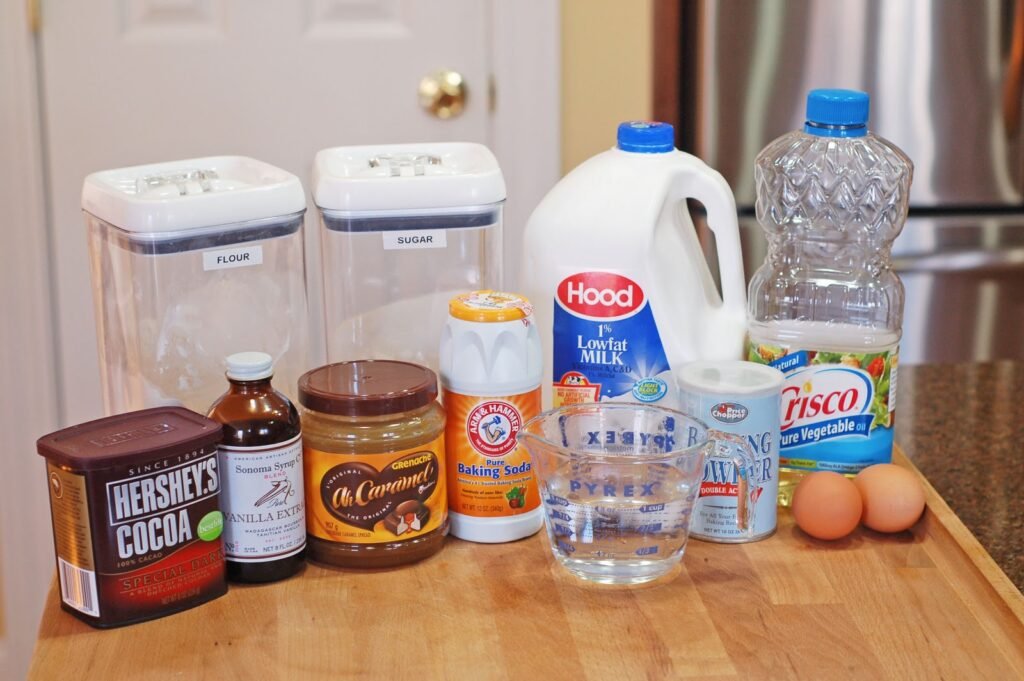
For the cupcakes, I used the recipe on the back of the Hershey’s Cocoa can, except replacing 1 cup of sugar for 1 cup of caramel. The cupcakes were great, but not much caramel flavor. I will have to add some more next time.

For the frosting, I adapted the recipe I used to make my Peanut Butter Fluff Frosting. I used soynut butter instead of peanut butter. The combo of the salty soynut butter and the sweet chocolate cupcakes was just what I was looking for. I even drizzled some extra caramel on top and added dark chocolate sprinkles to finish it off.
Chocolate Caramel Cupcakes with Soynut Butter Frosting
by The Sweet Chick
Prep Time: 15 minutes
Cook Time: 20 minutes
Keywords: bake dessert chocolate caramel soynut butter marshmallow fluff cupcake
Ingredients (32 cupcakes)
For the cupcakes
- 1 cup sugar
- 1 3/4 cups all purpose flour
- 3/4 cup Hershey’s Dark Cocoa
- 1 1/2 teaspoons baking powder
- 1 1/2 teaspoons baking soda
- 1 teaspoon salt
- 2 eggs, beaten
- 1 cup milk
- 1/2 cup vegetable oil
- 2 teaspoons vanilla extract
- 1 cup caramel (or caramel topping)
- 1 cup boiling water
For the frosting
- 1 stick unsalted butter, softened
- 1 cup creamy soynut butter
- 4 cups powdered sugar
- 1/2 cup marshmallow fluff
- 5-6 tablespoons milk
Instructions
For the cupcakes
Heat oven to 350 F. Line muffin tins with cupcake liners.
In a large bowl or stand mixer, stir together sugar, flour, cocoa, baking powder, baking soda, and salt.
Add eggs, milk, oil, vanilla, and caramel. Beat on medium speed for about 2 minutes.
Stir in boiling water (batter will be thin).
Pour batter into prepared muffin tins using a small ladle. If you use a regular scoop like I did, you will make a mess.
Bake at 350º F for 20 minutes or until toothpick inserted in center comes out clean. Cool completely before frosting.
For the frosting
With a mixer, blend butter and soynut butter until smooth.
Sift in confectioners’ sugar and beat on low speed.
Add milk and increase speed to high.
Add fluff. Beat for 1 minute.
Using a small spatula or a cake decorating tip and bag, add frosting to the cupcakes.
Drizzle with extra caramel and sprinkle with dark chocolate bits if you want.
Related Posts





Subscribe for New Racipies
Get mental health tips, updates, and resources delivered to your inbox.