
Are Roma Tomatoes Acidic? Better for Acid Reflux Than Beefsteak?

Medically reviewed by Jaclyn Weiner, RD, RDN, MEd, MS Updated Date: October 10, 2026
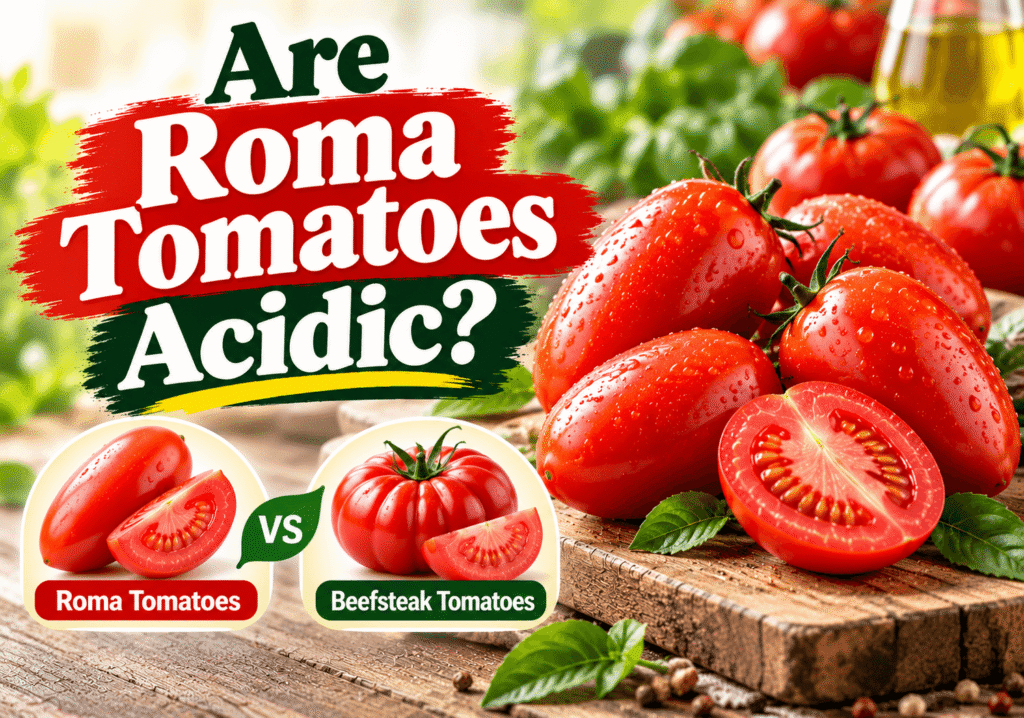
Yes, Roma tomatoes are acidic. Like every tomato, they have a pH below 7. The FDA lists fresh tomatoes at about pH 4.3 to 4.9 and doesn’t give Roma tomatoes a separate value (FDA). In one North Dakota State University test, a Roma-type variety called La Roma measured pH 5.08, which is on the mild side for a tomato (NDSU Extension). But an older study found that plum tomatoes, the group Romas belong to, were the most acidic of five tomato types tested (Mahakun et al., 1979).
So are Romas better for acid reflux than big beefsteak tomatoes? There’s no good evidence that they are. Both are acidic, results vary from study to study, and no research has compared tomato varieties for heartburn. What you make with them, how much you eat, and when you eat it matter far more than the variety.
This guide explains what the research really says about Roma tomato acidity, how Romas compare with beefsteak tomatoes, why sauce made from Romas can still bother your stomach, and practical ways to enjoy them if you have reflux.
Key Takeaways
- Roma tomatoes are acidic, like all tomatoes. Fresh tomatoes generally range from pH 4.3 to 4.9.
- Studies disagree on whether Romas are more or less acidic than other tomatoes. One study found plum types the most acidic; a newer test found a Roma variety on the mild side.
- Growing conditions can matter more than variety. In one North Dakota test, every variety, including slicers, measured above pH 4.9.
- There’s no proof Romas are easier on reflux than beefsteak tomatoes. Portion size, cooking method, fat, and timing matter more.
- Roma tomatoes are usually cooked into sauce, and thick, concentrated sauces are a common heartburn trigger.
- Always add acid when canning Romas, no matter how mild they taste.
For the full background on tomato pH, see our main guide, Are Tomatoes Acidic?, and our companion article, Are Cherry Tomatoes Acidic?
Are Roma Tomatoes Acidic? The Short Answer
Roma tomatoes are acidic because they contain natural plant acids, mainly citric acid and malic acid, which give tomatoes their tangy flavor. Their pH is below 7, the neutral point on the pH scale.
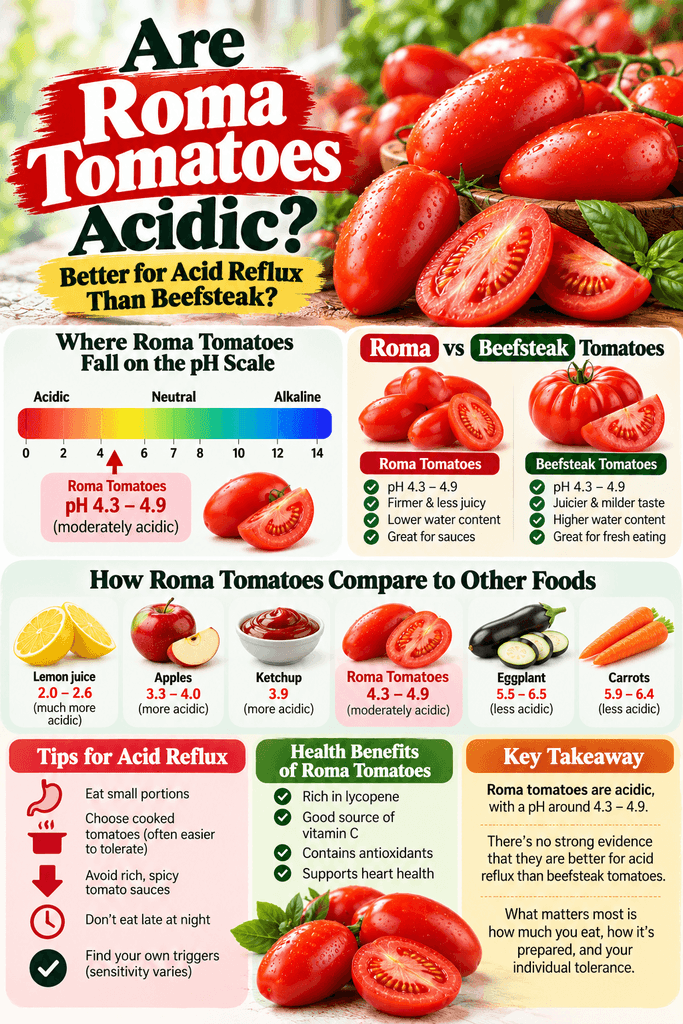
But “acidic” doesn’t mean “very acidic.” Here’s how fresh tomatoes compare with some everyday foods, using FDA pH values:
| Food | Approximate pH (FDA) |
| Lemon juice | 2.00–2.60 |
| Apples (eating) | 3.30–4.00 |
| Tomato paste | 3.50–4.70 |
| Ketchup | 3.89–3.92 |
| Fresh tomatoes (including Roma) | 4.30–4.90 |
| Eggplant | 5.50–6.50 |
| Carrots | 5.88–6.40 |
Source: FDA, Approximate pH of Foods and Food Products. The FDA groups all fresh tomatoes together.
Each step on the pH scale is a tenfold change, so lemon juice is roughly 100 times more acidic than a typical tomato. Roma tomatoes are moderately acidic: tangier than most vegetables but milder than citrus and most fruit. For hundreds more foods, see our complete guide to acidic foods.
What Is the pH of Roma Tomatoes?
There’s no single official pH for Roma tomatoes, but a few studies give us useful clues. The numbers don’t all point the same way, which is exactly why you should be skeptical of any website that gives a precise “Roma pH.”
Study 1: North Dakota’s variety test
North Dakota State University (NDSU) Extension grew 14 tomato varieties in Williston, North Dakota, and measured their pH. Several were paste or Italian-style types similar to Roma (NDSU Extension):
| Variety | pH of raw tomatoes |
| Bush Celebrity (round slicer) | 4.93 |
| HA3510 | 4.95 |
| Dr. Carolyn | 5.01 |
| Classica | 5.05 |
| Super Italian Paste | 5.06 |
| La Roma | 5.08 |
| Opalka | 5.08 |
| Russian | 5.09 |
| Super Marzano | 5.20 |
Selected varieties from Table 1 of NDSU Extension publication FN1396. All 14 varieties tested above pH 4.6.
Two things stand out. First, every variety in this test was above pH 4.9, which is higher (less acidic) than the FDA’s typical range. The researchers’ conclusion was a safety warning: since all the tomatoes were above pH 4.6, they all needed added lemon juice for safe canning. Second, the paste-style varieties, including La Roma and Super Marzano, landed in the same narrow range as the round slicing tomato, Bush Celebrity. In this test, variety type made only a small difference. Where the tomatoes were grown seems to have mattered more.
Study 2: San Marzano tomatoes in Italy
San Marzano tomatoes are a famous Italian plum tomato closely related to Romas. A study in the journal Food Chemistry analyzed many San Marzano lines and found a mean pH of 4.6, with individual samples ranging from about 4.2 to 5.1. The authors noted this was “somewhat higher” than the pH of the hybrid processing tomatoes used by industry, and that San Marzano tomatoes had lower total acidity (about 0.35 g per 100 g, versus 0.44 g in hybrids) (Loiudice et al., 1995).
That suggests some Italian plum tomatoes can be a bit less acidic than standard processing tomatoes. But the range is wide, and some samples were still quite acidic.
Study 3: Plum tomatoes were the most acidic type
An older study in the Journal of Food Science compared the acid content of five different tomato fruit types. The researchers reported that “tissues from plum tomatoes were the most acidic of the 5 types” (Mahakun et al., 1979). Roma tomatoes are plum tomatoes, so this result points the other way from the San Marzano findings.
So which is right?
All three can be true at once. Tomato acidity depends on the specific variety, the soil, the weather, how ripe the fruit is, and even where the samples were grown. Studies done in different places, decades apart, won’t give identical answers.
The fair conclusion is this: Roma tomatoes fall within the normal tomato acidity range. Some Roma and plum varieties may test slightly milder than average, and some may test more acidic. You can’t count on a Roma being low-acid.
Roma vs. Beefsteak Tomatoes: Which Is More Acidic?
Beefsteak tomatoes are the big, juicy slicing tomatoes you put on burgers and sandwiches. Romas are smaller, egg-shaped, and firmer. They look and cook very differently, but how do they compare on acidity?
| Feature | Roma (plum/paste) tomatoes | Beefsteak (slicing) tomatoes |
| Shape and size | Small to medium, oval or egg-shaped | Large, round or flattened |
| Texture | Firm, meaty flesh with fewer seeds and less juicy gel | Very juicy, lots of seeds and gel |
| Best uses | Sauces, paste, roasting, canning | Slicing, sandwiches, salads |
| pH | Within the normal tomato range; studies disagree on whether higher or lower | Within the normal tomato range; little published variety data |
| Better for reflux? | No proven advantage | No proven advantage |
Sources: FDA; NDSU Extension; Mahakun et al., 1979; Purdue Extension.
There’s very little published pH data specifically for beefsteak varieties, so a direct, fair comparison isn’t possible. What we can say is that neither type is reliably low-acid.
Where the acid is inside a tomato
Here’s an interesting detail that helps explain the confusion. Inside a tomato, the acid isn’t spread evenly. The 1979 Journal of Food Science study found that the locular tissue, the jelly-like gel around the seeds, had the highest acidity and the most citric acid, while the pericarp, the firm outer flesh, had the highest pH (the least acidic part) (Mahakun et al., 1979).
Roma tomatoes are known for meaty flesh and less seedy gel, while beefsteak tomatoes are full of juicy gel pockets. You might expect that to make Romas milder. Yet the same study found plum tomatoes were the most acidic type overall. In other words, tomato structure alone doesn’t predict acidity, and you can’t tell how acidic a tomato is by looking at it.
A practical tip: remove the seeds and gel
Although there’s no study on whether it helps reflux, the finding that the gel is the most acidic part of a tomato offers a simple kitchen experiment. If raw tomatoes bother you, try scooping out the seeds and gel before slicing or dicing them. Romas make this easy because they have less gel to begin with. You’ll be eating mostly the outer flesh, which tested as the least acidic part of the fruit in that study.
Do Romas have less water?
Romas feel drier and meatier, which is why cooks prize them for sauce. But USDA data show that raw Roma tomatoes are still about 94.7% water, almost the same as regular red tomatoes at 94.5% (USDA FDC 1999634; USDA FDC 170457). The difference is mostly in structure: more firm flesh and less loose, juicy gel, rather than much less water overall.
Roma vs. San Marzano and Other Paste Tomatoes
Roma is just one of several paste, or plum, tomatoes. You’ll also see San Marzano, Amish Paste, Opalka, and others at farmers’ markets and in seed catalogs. Some are sold as “low-acid.”
Here’s what the evidence supports:
- San Marzano: One study found an average pH of 4.6 and lower total acidity than hybrid processing tomatoes, but with a wide range of 4.2 to 5.1 (Loiudice et al., 1995).
- Opalka, Super Italian Paste, Super Marzano: In NDSU’s test, these paste types measured pH 5.06 to 5.20, very close to La Roma at 5.08 and the round slicer Bush Celebrity at 4.93 (NDSU Extension).
- “Low-acid” labels: When a gardener asked Ask Extension about low-acid tomatoes, the expert listed San Marzano and Amish Paste among varieties marketed that way, but explained that “low-acid tomatoes are just as acidic as other tomatoes” and simply taste less sour because they’re sweeter (Ask Extension, 2024).
Purdue Extension makes the same point about yellow tomatoes: they’re not really lower in acid, they just contain more sugar (Purdue Extension, 2015). Taste is not a pH test. A mellow-tasting paste tomato can still carry plenty of acid.
Fresh vs. Canned Roma Tomatoes
Many cans of whole, crushed, or puréed tomatoes are labeled as Roma, plum, or San Marzano style, so canned tomatoes are worth a look too.
Check the ingredient list and you’ll often see citric acid. Manufacturers add it so every batch stays safely acidic, since fresh tomatoes can test above pH 4.6. That’s one reason the FDA lists canned tomatoes at pH 3.50 to 4.70, a range that reaches lower (more acidic) than fresh tomatoes at 4.30 to 4.90 (FDA).
What does this mean for you?
- If you’re sensitive to acid, fresh Romas may be gentler than some canned tomatoes, especially brands with added citric acid.
- Tomato paste is the most concentrated form. It can range as low as pH 3.5, so use it in small amounts.
- Canned tomatoes without added citric acid do exist, but they’re still tomatoes, and their pH won’t be dramatically higher.
If you make sauce from scratch with fresh, ripe Romas, you have more control over the final dish: you can seed them, skip extra acidic ingredients like wine or vinegar, and balance the sauce with vegetables or dairy.
Are Roma Tomatoes Better for Acid Reflux Than Beefsteak?
This is the question many people really want answered, so let’s be direct: no study has shown that Roma tomatoes cause less heartburn than beefsteak or any other tomato.
The National Institute of Diabetes and Digestive and Kidney Diseases (NIDDK) lists tomatoes and tomato products as foods that may make acid reflux worse, without singling out any variety (NIDDK). And as the studies above show, Roma pH can land anywhere in the normal tomato range.
Why Romas might actually be harder on reflux
Ironically, Roma tomatoes may end up causing more heartburn for some people, not because of the tomato itself but because of how it’s usually eaten. Romas are the classic sauce tomato. Purdue Extension recommends paste varieties for sauce and ketchup (Purdue Extension, 2015). And sauces often come with other reflux triggers:
- Concentration: Simmering cooks off water, so a spoonful of thick sauce carries more tomato acid than a slice of fresh tomato. The FDA lists tomato paste as low as pH 3.5 (FDA).
- Big portions: A plate of pasta with sauce often contains far more tomato than a sandwich slice.
- Fat and cheese: Lasagna, pizza, and meat sauces add fat, which NIDDK also lists as a possible trigger.
- Garlic, onion, and spice: Common in Italian sauces and bothersome for some people.
- Late dinners: Pasta night often means a big meal close to bedtime.
A few slices of beefsteak tomato on a sandwich at lunch may be much easier on your stomach than a large bowl of Roma-based marinara at 9 p.m.
What the experts recommend instead
The American College of Gastroenterology’s 2022 guideline on GERD suggests that people with reflux identify their own trigger foods rather than avoiding every possible one, and avoid eating within 2 to 3 hours of bedtime (Katz et al., 2022).
That means the best way to know whether Romas or beefsteaks suit you better is to test them yourself:
- Eat the same amount of each type, prepared the same way (for example, a few raw slices with lunch), on different days.
- Write down how you feel in a simple food diary.
- Then try cooked versions, such as a small serving of sauce, and compare.
- Look for patterns over a week or two before deciding which tomatoes, if any, to limit.
If you have heartburn more than twice a week, trouble swallowing, or symptoms that don’t improve, talk with your doctor. For more on common triggers, see our guide to foods to avoid with GERD.
How to Make Roma Tomato Sauce Gentler on Your Stomach
If you love cooking with Romas but your stomach sometimes complains, these kitchen strategies can help. None of them make tomatoes acid-free, but they can make a dish easier to tolerate.
- Keep portions modest. Serve sauce as a light coating, not a deep pool, and fill the rest of the plate with vegetables and grains.
- Seed the tomatoes. Scoop out the seeds and gel before cooking. It’s a simple trick with Romas, and the gel was the most acidic part of the fruit in research (Mahakun et al., 1979).
- Add sweet, low-acid vegetables. Blend in grated carrots, roasted red bell peppers, or a scoop of pumpkin puree so each serving has less tomato.
- Add a pinch of baking soda. Baking soda is alkaline and neutralizes some acid. Add a tiny pinch, stir, and taste. Too much makes sauce taste soapy.
- Stir in something creamy. A spoonful of ricotta or a splash of milk softens both taste and acidity.
- Go light on fat and spice. Choose lean protein over sausage, and skip chili flakes if they bother you.
- Eat earlier. Have tomato-based dinners at least 2 to 3 hours before bed, as the ACG guideline suggests (Katz et al., 2022).
- Serve it with gentle sides. Pair sauce with potatoes, basmati rice, or plenty of steamed vegetables.
Adding sugar to sauce is a popular trick too, but it mainly balances the taste of acid without changing the pH much.
Tomato-free sauce ideas
If tomatoes clearly trigger your reflux, you can still enjoy pasta night:
- Pesto or garlic and olive oil (go easy on the garlic if it bothers you)
- A white sauce made with milk and a little cheese
- Roasted vegetable puree made from butternut squash, sweet potatoes, carrots, and herbs
- Eggplant-based dishes, since eggplant is much less acidic than tomato
Roma Tomatoes, Gastritis, and Mouth Sores
Gastritis: People with an inflamed stomach lining often find acidic, spicy, or fatty foods uncomfortable, but reactions vary. If tomato sauce bothers you, try small amounts of fresh, seeded Roma tomatoes as part of a meal instead. For gentle meal ideas, see our 7-day meal plan for gastritis.
Mouth sores: Mayo Clinic lists spicy or acidic foods among the foods that can trigger canker sores in some people (Mayo Clinic). While a sore heals, skip tomato sauce and salsa for a few days.
Teeth: The American Dental Association suggests eating acidic foods like tomatoes as part of a meal rather than on their own, because how often your teeth are exposed to acid matters (American Dental Association).
Canning Roma Tomatoes: Always Add Acid
Roma tomatoes are a favorite for home canning, but their pH is exactly why you need to be careful.
The bacterium that causes botulism can’t grow in foods at pH 4.6 or below (UC Master Food Preserver Program). In NDSU’s test, La Roma (5.08) and Super Marzano (5.20) were both well above 4.6, and so was every other variety tested. After lemon juice was added, the salsa made from them dropped safely below 4.6 (NDSU Extension).
Even the Utah State University variety study, where all the tomatoes tested below 4.6, concluded that home canners should add acid “regardless of the varieties used,” because you can’t know a tomato’s pH by looking at it (Heflebower and Washburn, 2010).
Colorado State University Extension recommends adding the following to each jar (Colorado State University Extension):
| Jar size | Bottled lemon juice | Citric acid | 5% vinegar |
| Pint | 1 tablespoon | ¼ teaspoon | 2 tablespoons |
| Quart | 2 tablespoons | ½ teaspoon | 4 tablespoons |
A few more tips:
- Use bottled lemon juice, not fresh, for a consistent acid level.
- Don’t can tomatoes from dead or frost-killed vines, because their acidity may change (NDSU Extension).
- Follow a tested recipe from a university extension service or the USDA.
Roma Tomato Nutrition
Roma tomatoes are low in calories and offer useful nutrients. Here’s what USDA FoodData Central lists for 100 grams of raw Roma tomato:
| Nutrient | Roma tomato, raw (per 100 g) |
| Calories | 19 |
| Water | 94.7 g |
| Carbohydrates | 3.8 g |
| Fiber | 1.0 g |
| Protein | 0.7 g |
| Vitamin C | 17.8 mg |
| Potassium | 193 mg |
| Lycopene | 2,863 mcg |
| Beta-carotene | 276 mcg |
Source: USDA FoodData Central, Tomato, roma (FDC ID 1999634).
- Vitamin C: 17.8 mg per 100 grams is about 20% of the 90 mg Daily Value (NIH Office of Dietary Supplements).
- Lycopene: The red pigment in tomatoes. Your body absorbs it better from cooked tomato products eaten with a little fat. In one study, people absorbed about 2.5 times more lycopene from tomato paste than from fresh tomatoes (Gärtner et al., 1997). That’s good news for Roma sauce lovers who tolerate it well.
Delicious Ways to Use Roma Tomatoes
If tomatoes agree with you, Romas shine in cooked dishes. Try them in these recipes from our kitchen:
- Tomato soup: Romas make a thick, rich soup. A splash of cream softens the acidity.
- Slow-roasted tomatoes: Halved Romas roast beautifully and turn sweet and jammy.
- Pasta puttanesca: A bold, briny sauce. Save it for good-stomach days.
- Shakshuka: Eggs poached in a Roma tomato sauce. Go easy on the chili if needed.
- My lasagna and petite lasagnas: The petite version makes portion control easier.
- Caponata: Eggplant does most of the work here, so there’s less tomato per bite.
- Roasted corn pico de gallo: Firm Romas dice neatly and don’t get watery. Seed them first if you’re sensitive.
- Caprese salad: Traditionally made with slicing tomatoes like beefsteaks, but sliced Romas work too.
Frequently Asked Questions
Are Roma tomatoes less acidic than regular tomatoes?
Not reliably. One study found a Roma variety on the mild side (pH 5.08), and San Marzano plum tomatoes averaged a slightly higher pH than hybrids. But another study found plum tomatoes the most acidic of five types. Romas fall within the normal tomato range.
What is the pH of a Roma tomato?
There’s no official value. The FDA lists fresh tomatoes at pH 4.30 to 4.90. In one North Dakota test, the La Roma variety measured 5.08.
Are Roma tomatoes good for acid reflux?
Not especially. No research shows Romas cause less heartburn than other tomatoes. Many people find concentrated Roma sauces more troublesome than a few fresh slices, so portion size and preparation matter most.
Are beefsteak tomatoes more acidic than Romas?
There isn’t enough published data to say. Both types fall within the usual tomato pH range, and growing conditions can matter as much as variety.
Are San Marzano tomatoes less acidic?
They may be slightly. One study found San Marzano tomatoes averaged pH 4.6, a bit higher than hybrid processing tomatoes, but individual samples ranged from 4.2 to 5.1.
Does removing the seeds make tomatoes less acidic?
It may help a little. Research found the gel around tomato seeds is the most acidic part of the fruit, and the outer flesh is the least acidic. There’s no study on whether seeding tomatoes reduces heartburn, though.
Do I need to add lemon juice when canning Roma tomatoes?
Yes. In one test, La Roma tomatoes measured pH 5.08, above the 4.6 safety limit. Add 1 tablespoon of bottled lemon juice per pint or 2 tablespoons per quart.
The Bottom Line
Roma tomatoes are acidic, with a pH in the normal tomato range. Some Roma and San Marzano varieties may test a little milder than average, while other research found plum tomatoes the most acidic type. Either way, you can’t count on Romas being a low-acid tomato.
Are they better for reflux than beefsteak tomatoes? There’s no evidence that they are. Romas are usually cooked into thick sauces, which can concentrate acid and often come with fat, garlic, spice, and big portions. If tomatoes bother you, focus on what you can control: smaller servings, seeded tomatoes, gentler sauces, low-acid sides, and earlier dinners. And if you can Romas at home, always add acid.
Want to learn more? Read Are Tomatoes Acidic?, Are Cherry Tomatoes Acidic?, or browse our complete guide to acidic foods.
Medical disclaimer: This article is for general information only and isn’t a substitute for professional medical advice. If you have frequent heartburn, GERD, stomach pain, or mouth sores that don’t heal, talk with your doctor or a registered dietitian.
References
- U.S. Food and Drug Administration, CFSAN. Approximate pH of Foods and Food Products. April 2007. Copy used: https://riverstonehealth.org/wp-content/uploads/FDA-Approximate-pH-of-Foods.pdf
- Garden-Robinson J, Houge K, Smith R. Why Add Lemon Juice to Tomatoes and Salsa Before Canning? (FN1396). NDSU Extension, 2018 (reviewed 2023). https://www.ndsu.edu/agriculture/extension/publications/why-add-lemon-juice-tomatoes-and-salsa-canning
- Mahakun N, Leeper PW, Burns EE. Acidic constituents of various tomato fruit types. Journal of Food Science. 1979;44(4):1241–1244. https://agris.fao.org/search/en/records/65df7afe4c5aef494fe2d0d4
- Loiudice R, Impembo M, Laratta B, et al. Composition of San Marzano tomato varieties. Food Chemistry. 1995;53(1):81–89. https://doi.org/10.1016/0308-8146(95)95791-4
- Heflebower R, Washburn C. The influence of different tomato varieties on acidity as it relates to home canning. Journal of Extension. 2010;48(6). https://doi.org/10.34068/joe.48.06.21
- Ask Extension. Which cherry tomatoes are the lowest in acid? Question #867021, 2024. https://ask.extension.org/kb/faq.php?id=867021
- Purdue Extension. Let’s Preserve: Tomatoes (HHS-803-W). 2015. https://www.extension.purdue.edu/extmedia/hhs/hhs-803-w.pdf
- Bunning M, Kendall P, Shackelton E. A Guide to Canning Tomatoes and Tomato Products. Colorado State University Extension (reviewed 2025). https://extension.colostate.edu/resource/a-guide-to-canning-tomatoes-and-tomato-products
- UC Master Food Preserver Program, UC ANR. Understanding pH and Why It’s Important in Food Preservation. https://ucanr.edu/program/uc-master-food-preserver/article/understanding-ph-and-why-its-important-food-preservation
- NIDDK. Eating, Diet, & Nutrition for GER & GERD. https://www.niddk.nih.gov/health-information/digestive-diseases/acid-reflux-ger-gerd-adults/eating-diet-nutrition
- Katz PO, Dunbar KB, Schnoll-Sussman FH, et al. ACG Clinical Guideline for the Diagnosis and Management of GERD. Am J Gastroenterol. 2022;117(1):27–56. https://doi.org/10.14309/ajg.0000000000001538
- Mayo Clinic. Canker sore: Symptoms and causes. https://www.mayoclinic.org/diseases-conditions/canker-sore/symptoms-causes/syc-20370615
- American Dental Association, MouthHealthy. Dietary Acids and Your Teeth. https://www.mouthhealthy.org/all-topics-a-z/dietary-acids-and-your-teeth
- USDA FoodData Central. Tomato, roma (FDC ID 1999634, Foundation Foods). https://fdc.nal.usda.gov/fdc-app.html#/food-details/1999634/nutrients
- USDA FoodData Central. Tomatoes, red, ripe, raw, year round average (FDC ID 170457). https://fdc.nal.usda.gov/fdc-app.html#/food-details/170457/nutrients
- NIH Office of Dietary Supplements. Vitamin C: Fact Sheet for Health Professionals. https://ods.od.nih.gov/factsheets/VitaminC-HealthProfessional/
- Gärtner C, Stahl W, Sies H. Lycopene is more bioavailable from tomato paste than from fresh tomatoes. Am J Clin Nutr. 1997;66(1):116–122. https://pubmed.ncbi.nlm.nih.gov/9209178/
Related Posts

Subscribe for New Racipies
Get mental health tips, updates, and resources delivered to your inbox.
Are Pistachios Healthy? Nutrition & Health Benefits

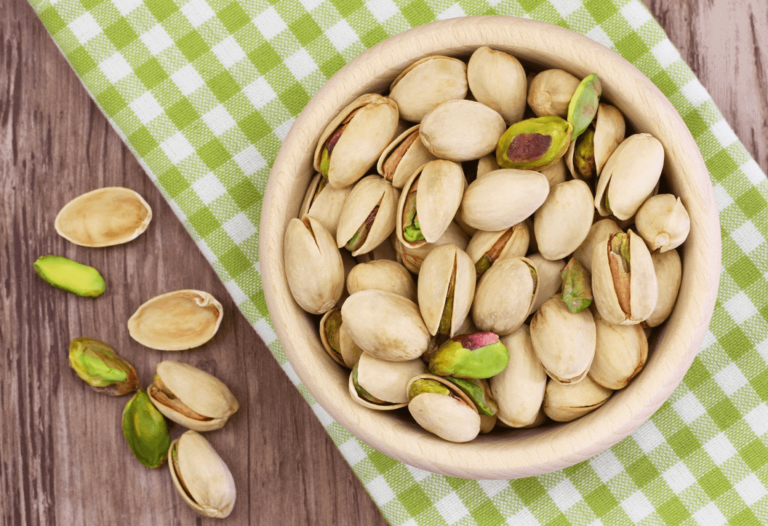
Are you looking for a healthy snack that is full of nutrients and comes with many health benefits? Well, among the array of choices, pistachios stand out. Now, you might wonder, are pistachios truly a healthy option?
Pistachios are full of nutrients such as Calcium, Vitamin B6, Vitamin C, Iron, Magnesium, potassium, etc. And as for the health benefits, it is high in antioxidants, helps you lose weight, promotes various blood health conditions, and reduces many heart-related problems.
That’s not all. The above information is just an overview. If you are willing to learn more about pistachios, stay with us.
Are Pistachios Healthy?
Yes, pistachios are a healthy food. They are a good source of protein, fiber, healthy fats, antioxidants, and vitamins and minerals.
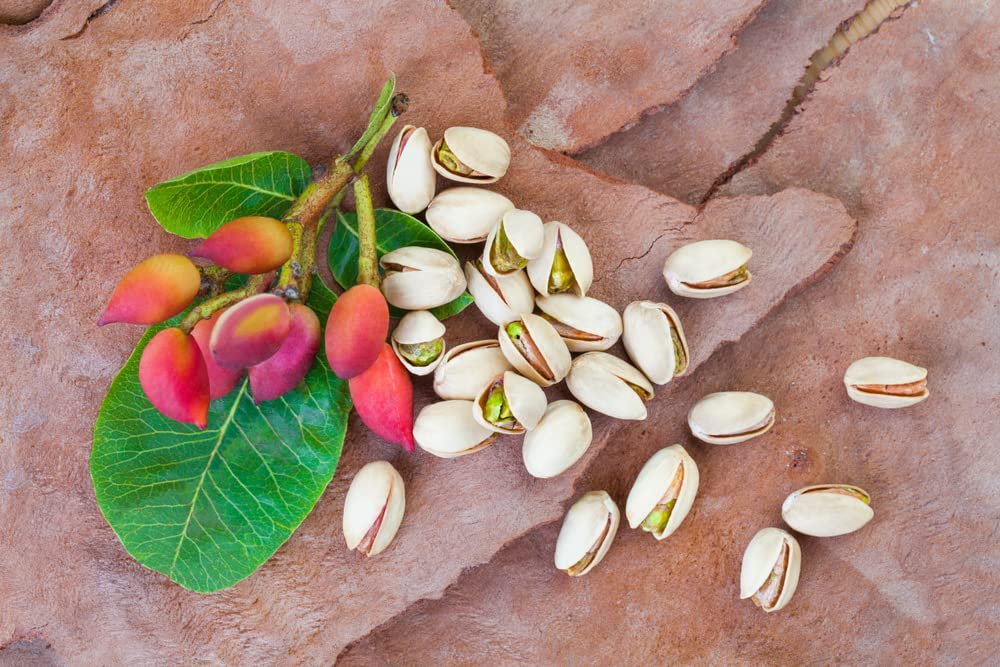
Pistachios are flooded with nutrition which is good for your body. It does not just contain protein and carbohydrates. It’s also a great source of calories, fiber, fat, thiamine, manganese, vitamin b6, calcium, potassium, phosphorus, and copper.
| Nutrient | Amount per 100 grams | Percent Daily Value (%DV) |
| Calories | 557 | 28 |
| Fat | 47.4 grams | 73% |
| Saturated fat | 6.4 grams | 32% |
| Polyunsaturated fat | 11.9 grams | – |
| Monounsaturated fat | 28.2 grams | – |
| Sodium | 95 milligrams | 4% |
| Carbohydrates | 27.3 grams | 9% |
| Fiber | 10.6 grams | 42% |
| Sugar | 8.2 grams | |
| Protein | 20.7 grams | 41% |
| Vitamin A | 0% | – |
| Vitamin C | 0% | – |
| Calcium | 136 milligrams | 14% |
| Iron | 4.2 milligrams | 23% |
| Potassium | 1072 milligrams | 31% |
| Magnesium | 292 milligrams | 73% |
| Phosphorus | 456 milligrams | 45% |
| Manganese | 2.2 milligrams | 96% |
| Copper | 1.6 milligrams | 89% |
| Thiamin | 0.8 milligrams | 53% |
| Vitamin B6 | 1.1 milligrams | 55% |
In hundred grams of pistachio, you will get this much nutritious value; the main thing is the calories and protein you are getting, which are respectively 557 and 20.7 g.
These percentages are based on “Reference Daily Intake.” These help you to maintain the proper blood and hemoglobin regulation.
There must be many benefits for all those nutrients, right? Let’s take a look at that!
Pistachio Health Benefits
The benefits list of pistachios is long, and this will take some time. Pistachios have many benefits that help keep your body healthy, lose weight, and keep you in shape.
Besides, preventing diseases, maintaining regular blood circulation, and building muscle is also on the benefits list.
Did I mention the other benefits? Well, let’s get into it.
Rich in Nutrients
As discussed in the previous section, pistachios contain various nutrients, such as thiamine, manganese, vitamin b6, calcium, potassium, phosphorus, and copper.
Thiamine is a vitamin b-1, which helps your body consume energy from all other nutrients. Also, it maintains the development of your blood cells.
On the other hand, manganese, calcium, potassium, phosphorus, and copper help your body to,
- Increase and development of tissue, bones, proper and hormones.
- Proper brain function and nerve system.
- Build strong muscles and repair damaged cells.
- Prevent high blood pressure and diabetes.
- Regulate proper heartbeat.
- Maintain and increase the immune system and blood function.
Besides these, there is more!
High In Antioxidants
Do you know antioxidants can reduce the risk of cancer or heart diseases? Or any diseases?
As we know, you will find lutein, γ-Tocopherol, and zeaxanthin in the pistachios. Gamma tocopherol helps reduce the risks of diseases and also minimizes the possibility of brain disorders such as Alzheimer’s.
On the other hand, lutein and zeaxanthin are great for the health of your eyes. Those improve your visual sensitivity to the eyes, enhance vision sharpness, protect your eye tissues from sunlight damage, and so on.
Low In Calories
Usually, nuts are filled with high calories. But pistachios have low calories compared to other nuts in this category.
28 grams of pistachios contain;
- One hundred fifty-nine calories. Which is very low, 20%, compared to other nuts.
- Contain 20% of the weight.
- A high amount of amino acid helps your body dilate blood vessels.
Aid Weight Management
Pistachios can help you in the journey of weight management. Those can help you gain weight and even lose weight.
Let’s see first how it can help you lose weight. As we know, pistachios have fiber and protein. What these do is give you a feeling of fullness. And you don’t have the urge to eat more.
A study shows that people who eat pistachios regularly have lower body mass index. One of the reasons for this could be that the fat item doesn’t release from the pistachios wall. It results in not digesting the fat.
On the other hand, pistachios can also be a reason for gaining weight. As they are a go-to snack item, you can eat them in large amounts.
Even though they contain fewer calories, eating more than what you should cause you to consume too many calories. If you cannot lose those calories, you might gain weight.
Promote Blood Health
Pistachios help your blood health on many levels, such as blood sugar control, improved blood pressures level, lower cholesterol level, and blood vessel health.
A study shows that pistachios help the good cholesterol to increase and bad cholesterol to decrease. It also helps improve the blood pressure level.
Besides, pistachios have endothelium in them. And guess what! Endothelium reduces vasodilation which results in decreasing blood flow, which results in promoting blood vessel health.
That’s not all! Antioxidants in the pistachios help lower the blood sugar level and overall blood sugar health.
High In Protein For Vegans And Vegetarians
In 28 grams of pistachios, there are 6 grams of protein. Besides, it contains a good amount of amino acids, making it perfect for vegans and vegetarians.
Pistachios provide enough calories and protein to make you feel full. And give them the energy to go through. As a bonus, it helps manage their weight.
Important For Heart Health
As we know, it contains amino acids, which lowers cholesterol level. And that results in reducing the possibility of heart diseases such as heart attack.
Pistachios are also filled with fiber, which makes them the perfect snack for a heart-healthy option.
Reduce Colon Cancer Risk
Do you know pistachios can reduce colon cancer risk as well? It’s true. As it contains high fiber, it can help lower cholesterol and reduce the risk of colorectal and colon cancer.
Besides, it can help you lose and maintain a healthier weight over time.
Beneficial For Gut Health
Improving gut health is one of the most significant benefits of pistachios. First, it contains a high amount of fiber and moves your gut undigested.
Therefore, there are gut bacteria that turn them into fatty acids. That helps to reduce and improve the digestive system and other heart diseases.
Besides, it also increases the number of good bacteria, which pushes out harmful bacteria. This maintains the balance and makes your gut healthier.
What’s The Healthiest Way To Eat Pistachios?
Pistachios are great as a snack containing vitamin E, B vitamins, copper, and iron. And it also helps with mindfulness and maintaining weight. But there are some ways to consume this:
- You can make pesto with it. Then eat this with fish bread or salad or trail mix.
- Use it as a nut-based crust with cream pie, especially coconut lime cream pie.
- Crushed pistachios in muffins or banana bread and also cookies.
- Pesto mixed with olive oil and fresh basil.
- Use as salad toppers.
You can follow these to consume pistachios more healthily.
Pistachio Side Effects
We have already discussed all the nutrition facts and how pistachios can be beneficial for your body. But there are some side effects also that we should consider.
One of the significant side effects is high blood pressure. Besides, taking large amounts of pistachios can cause high blood sodium levels, hypertension, and fainting.
As we know, pistachios contain a high level of fiber. It can directly affect your digestive system, causing allergies, nausea, and itchiness.
Another significant side effect is inducing the risk of kidney stones, weight gain, increased risk of heart disease, and bowel problems. Also, high manganese levels in pistachios can be problematic for pregnant women.
So, be careful while consuming pistachios and don’t take too much all at once.
FAQs
Are pistachios good for weight loss?
Yes, pistachios are good for weight loss. Pistachios are full of protein and calories. So, consuming these can give you the feeling of fullness and lead you to consume less food.
Are pistachios fattening?
Yes, pistachios can be fattening if you take too many pistachios. Pistachios contain a high amount of calories and fat. So if you cannot lose those calories, this might cause fattening.
Do pistachios cause constipation?
No, pistachios don’t cause constipation. As we know, pistachios are rich in fiber, easing the process of constipation.
How many pistachios a day to lower cholesterol?
There is no exact amount of how many pistachios you should take. But you can take three to four ounces or two to three pistachios daily, lowering cholesterol levels.
Conclusion
We hope the answer to the question, are pistachios healthy or not. Pistachios are rich in nutrients such as thiamine, manganese, vitamin b6, calcium, potassium, phosphorus, and copper.
Pistachios also come with many health benefits. It can help you improve your weight management, promote blood health and reduce the risk of many diseases. Though, don’t take too many pistachios, which can lead to many side effects.
Good luck!
Related Posts






Subscribe for New Racipies
Get mental health tips, updates, and resources delivered to your inbox.