
Baked Stuffed Chicken Breast Recipe

Medically reviewed by Christiana George Updated Date: June 8, 2023

I have been asked by many of you to share a recipe for a stuffed chicken breast. After all, it is a very popular dish in the United States, especially southern states. In fact, it is one of the most ordered dishes in many restaurants.
Personally, I like to make my own version of these chicken breasts because they are so much healthier than the ones served at restaurants and are also cheaper too! You can use this recipe as a guide when you want to make some baked stuffed chicken breasts at home.
Ingredients:
1-1/2 teaspoons salt
1/2 teaspoon pepper
3 tablespoons all-purpose flour, divided
3 tablespoons butter or margarine, divided
2 large sweet red peppers, cut into strips (about 4 cups) or 1 can (16 ounces) whole tomatoes, drained and chopped fine (about 2 cups) and 1 cup fat-free chicken broth.
1/2 cup chopped onion
1-1/2 cups (6 ounces) shredded part-skim mozzarella cheese, divided
4 boneless skinless chicken breast halves (about 1-1/2 pounds total), cut horizontally almost in half to make 6 pieces.
1/3 cup grated Parmesan cheese
Directions:
Preheat oven to 400 degrees F. Lightly grease a 13x9x2-inch baking dish. Arrange chicken breasts in dish, spacing evenly. Sprinkle with 1 teaspoon salt and 1/4 teaspoon pepper.
Place about 2 tablespoons flour in each breast half, patting on flour to coat well.
In a 10-inch skillet over medium heat, melt 1 tablespoon butter and the remaining 2 tablespoons butter; add onion and red peppers; cook until tender, stirring occasionally (about 5 minutes).
Stir in tomatoes and broth; bring to boiling over high heat. Reduce heat to low; simmer 5 minutes or until mixture thickens slightly.
Remove from heat; stir in remaining 1 tablespoon flour and the remaining 1/2 teaspoon pepper. Spoon tomato mixture evenly over chicken breasts, spreading to cover completely (about 3/4 cup sauce for each breast half).
Top with about 2 tablespoons mozzarella cheese for each breast half, spreading to cover completely. Sprinkle with Parmesan cheese.
Bake at 400 degrees F for 30 minutes or until chicken is no longer pink (170 degrees F) and juices run clear when thickest part of chicken is pierced with a knife.
Remove from oven. Cover with foil and let stand for 5 minutes before serving.
Nutrition Facts:
1 serving = 3 pieces chicken + 1/3 cup tomato sauce + 2 tablespoons mozzarella cheese + 2 tablespoons Parmesan cheese
Nutrition-Per-Serving:
Calories: 326.4; Total Fat: 12.7g; Cholesterol: 82mg; Sodium: 579.5mg; Total Carbohydrate: 8.6g; Dietary Fiber: 0.6g; Protein: 36.8g
Related Posts



Subscribe for New Racipies
Get mental health tips, updates, and resources delivered to your inbox.
Lemon Frozen Yogurt, à la Jeni’s Splendid Ice Cream

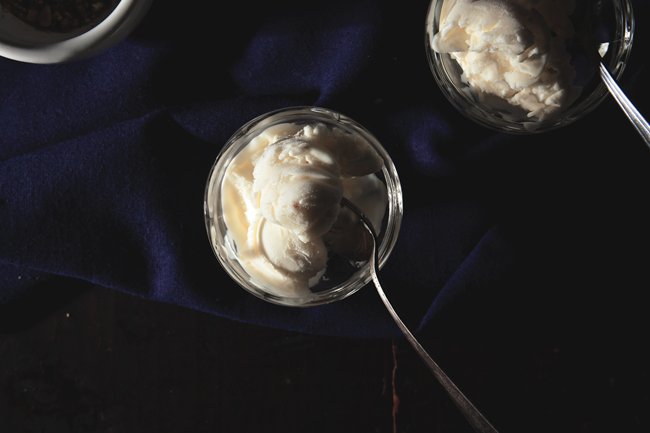
A couple weeks back, I mentioned how I got to try Jeni’s Splendid Ice Cream for the first time ever. And while the famous salted caramel was lip-smackingly good (intensely salty AND sweet), I couldn’t stop thinking about the lemon and blueberry fro-yo, particularly because of the lemon frozen yogurt base. It was tangy and delicate, falling just short of palate-cleansing because it was still quite creamy.
So even though it’s not really frozen desserts weather anymore (oh hell, who am I kidding? I could eat frozen desserts any time of the year (although I think that claim’s actually going to be tested this winter (and are parentheses within parentheses within parentheses grammatically incorrect?))), I couldn’t wait until next year to try out this recipe.
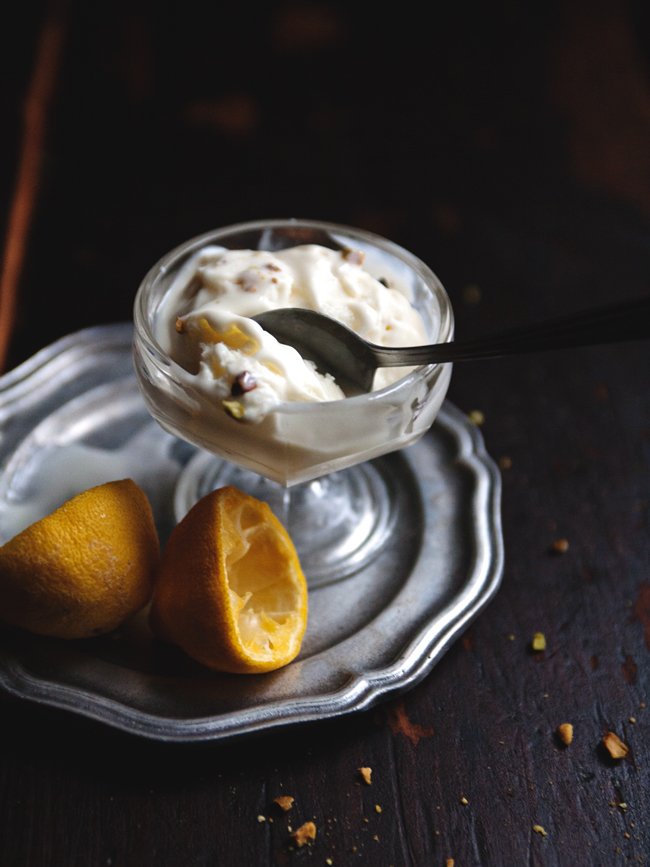
Like Molly said, the recipe’s a bit fussy. It requires very exact timing and the use of many many bowls. And I didn’t even make the blueberry swirl because I wanted the unadulterated taste of lemon. But I didn’t mind it—following directions gets to be kind of meditative after awhile. Just know that you’ve been warned, if you decide to go through with it.
If you follow the directions precisely—ROOM TEMPERATURE cream cheese! I can’t stress that enough—you will most certainly end up with a lovely quart of fro-yo in the lightest shade of yellow. It doesn’t turn icy even after it’s been in the freezer for a few days, it doesn’t melt too fast (or too slow for that matter). It really is the perfect way to savor Jeni’s at home.
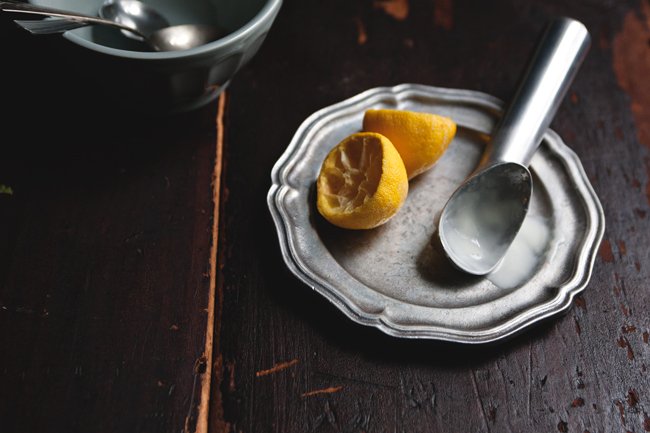
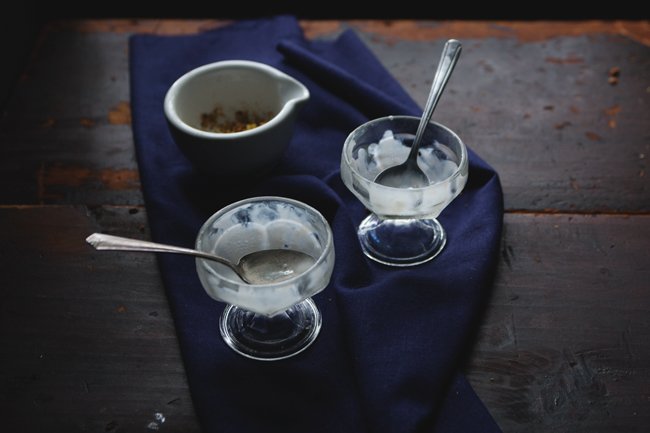
LEMON FRO-YO
Recipe from Jeni’s Splendid Ice Creams at Home via Orangette
Yields over a quart
Ingredients:
For the lemon syrup:
2 to 4 lemons
3 Tbsp sugar
For the frozen yogurt base:
1 quart plain low-fat yogurt
1-1/2 cups whole milk
2 Tbsp corn starch
2 oz. (4 Tbsp) cream cheese, softened
1/2 cup heavy cream
2/3 cup sugar
1/4 cup light corn syrup
Zest from one lemon, reserved from lemon syrup
Directions:
One day in advance, Put a mesh sieve lined with 2 layers of cheesecloth over a bowl and pour the plain yogurt into the sieve. Cover with plastic wrap and refrigerate 6 to 8 hours (I kept it in the fridge for over 24 hours and it turned out fine).
For the lemon syrup, first use a vegetable peeler to peel the zest off one lemon in long strips. Reserve for the frozen yogurt base. Then juice enough of the lemons to yield 1/2 cup. Combine the lemon juice and sugar in a small saucepan and bring to a boil over medium-high heat, stirring to dissolve the sugar. Remove from heat and set aside to cool.
For the frozen yogurt:
Remove the plain yogurt from the fridge and measure out 1-1/4 cups worth. Set aside.
Combine 2 Tbsp of the milk in a small bowl with the corn starch.
In a bowl (that will eventually need to fit the entire fro-yo base), whisk the cream cheese until smooth (very smooth! The cream cheese should definitely be at room temperature or it will whisk into clumps).
Combine the remaining milk, heavy cream, sugar, corn syrup, and strips of lemon in a large pot (Jeni specifies a pot with 4-quart capacity, but I really don’t think it’s necessary for this particular recipe. A large-ish pot will do). Bring to a rolling boil over medium-high heat and boil for exactly 4 minutes. Towards the end of the 4 minutes, whisk the corn starch and milk until it’s a smooth slurry. Remove the pot from the heat and slowly whisk in the corn starch mixture. Return the pot to the heat, and continue to cook, stirring consistently, for 1 more minute, until the liquid starts to thicken. Remove from heat, and gradually whisk the milk mixture into the bowl with the cream cheese until smooth. Add the reserved 1-1/4 cup plain yogurt and the lemon syrup. Whisk until smooth.
Let cool, then refrigerate the mixture for about 6 hours. Remove from fridge, pick out the strips of lemon (you could pour the mix through a sieve, but it’s quite thick and unmanageable at this point). Pour the mixture into the canister of an ice cream machine, and spin until thick and creamy.
Once done churning, pour the fro-yo in a container and refrigerate it until firm.
Related Posts
Subscribe for New Racipies
Get mental health tips, updates, and resources delivered to your inbox.