
Mixed Berries Galette

Medically reviewed by Christiana George Updated Date: June 8, 2023
When we moved into our apartment in San Francisco, we bought a giant bookshelf and filled it to the brim with books. Over time, the overflow started lying in stacks in front, and by the time we moved out, we had so many books that Chris ended up having to donate most of the collection. The rest we stored at my parents’ house, boxes and boxes full. It wasn’t so much that I had a book-buying problem. Chris is just helpless at the sight of used bookstores. They are treasure troves to him, much in the same way good grocery stores—the kinds with bulk bins and small-batch anythings—are to me.
Moving to New York seemed like a good chance to wipe the slate clean. Chris curated a small collection of his most beloved books and shipped them to our new apartment in Brooklyn. Except, over time, as he discovered his favorite bookstores in New York, his modest collection grew and grew. We expanded to THREE bookshelves, started double-layering books on each shelf, and then the stacks started up again. The book area even started its own collection: of dust bunnies. It was a mess.
The thing about collections is, the collector starts to lose sight of the point of the collection. Presumably you start one because you love whatever it is you’re collecting, but the more you own of something, the less attention each individual item gets. We’re so inoculated with the idea that more is better, but perhaps real merit lies in realizing when enough is enough.
And so, when furnishing our new, smaller apartment, we decided to limit ourselves to one regular-sized bookshelf which demanded that we downsize our collection yet again. Chris committed himself to maintaining an equilibrium of books which he’s kept up to this day, and since then, has discovered clarity, focus, and a lightening of the spirit. Which sounds kind of hippie dippie bordering on hokey, but is not, I promise.
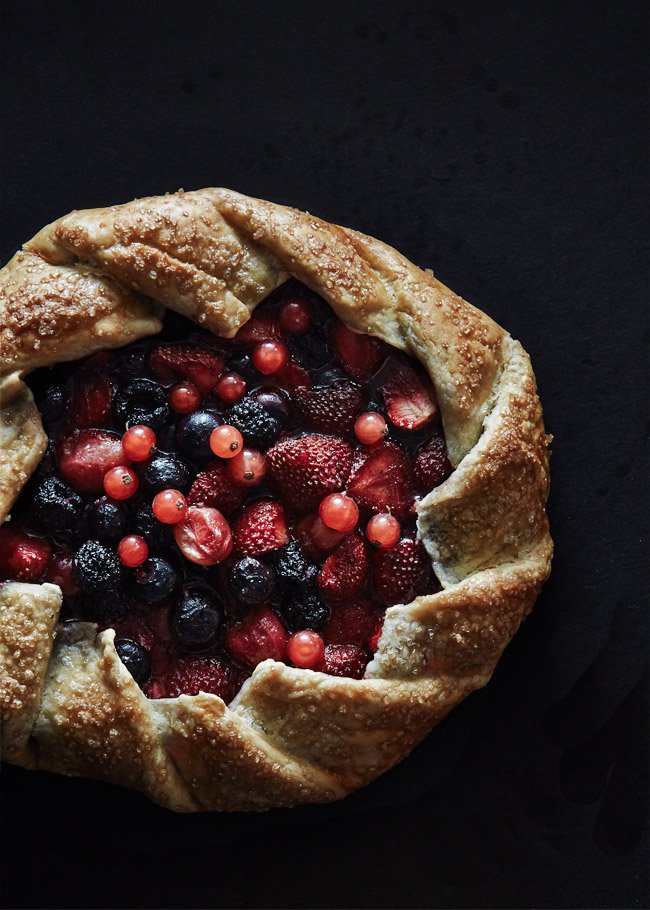
On my part, I decided to part with quite a few cookbooks. Back to the basics, if you will. Or just the favorites. And I too find such pleasure in lingering over what’s left of my collection. Each and every book is an absolute gem. The recipe for the crust of these mixed berry galettes are from Kim Boyce’s Good to the Grain, a classic to me and one that will always have a place on my shelf.

Happy 4th, y’all. Also, Chris and I went to Iceland! If you’re interested, I created an album on Flickr.
RYE GALETTE CRUST for MIXED BERRIES GALETTES
From Good to the Grain by Kim Boyce
Makes 2 9-inch tarts
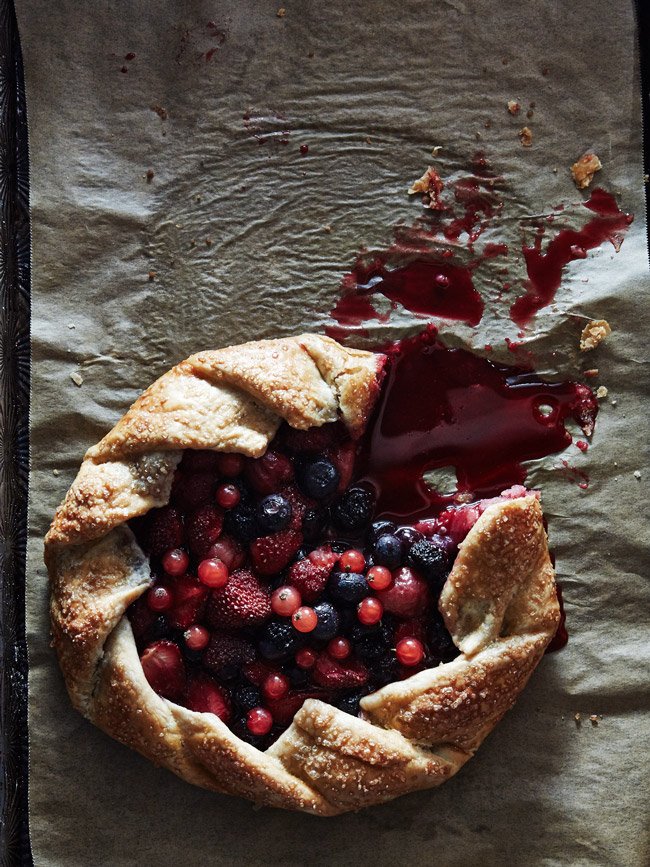
This recipe is for the crust only. Filling-wise, I tossed about 2 cups of mixed berries with 3 T sugar, a liberal pinch of cinnamon, and a dash vanilla extract (about 1/4 t). Next time, I would add either flour or corn starch to thicken the juices because they leaked all over the place and made the baking sheet look like a crime scene. Also, if you too use redcurrants, add them after baking. And I’d omit the gooseberries altogether.
Ingredients:
- 3/4 cup ice water
- 1 cup rye flour
- 1 cup all-purpose flour
- 1 T sugar
- 1 t salt
- 1-1/2 sticks (12 T) cold unsalted butter
- 1 t apple cider vinegar
Directions:
Sift the flours, sugar, and salt in a large bowl. Cut the butter into 1/2-inch pieces and add them to the dry mixture. Working quickly, rub the butter between your fingers, breaking it into smaller chunks. When the chunks are sizes ranging from peas to hazelnuts, add the vinegar and 8 T ice water. Mix the ingredients with your hands until you can squeeze them into a shaggy lump (add water 1 T at a time if it’s not coming together). Wrap the dough in plastic wrap and place in fridge for at least 1 hour.
Unwrap the dough onto a floured surface. Pat the dough into a rough square, then, using a rolling pin, roll the dough to a rectangle about 8-1/2 by 11 inches. Resist the urge to add extra flour or water. Fold the rectangle as you would a letter, into thirds, with the seam ending on the left. Rotate the dough 90 degrees clockwise so that the seam faces the top. Roll the dough into another 8-1/2 by 11-inch rectangle and repeat the folding and rotation. Roll it out once again, then, after folding, wrap the dough tightly in plastic wrap. Chill for at least an hour before use.
You’ll cut the dough in half when you’re ready to bake, resulting in two galettes, capisce?
Related Posts




Subscribe for New Racipies
Get mental health tips, updates, and resources delivered to your inbox.
Apricot Raspberry Galette, Or Look What I Made!

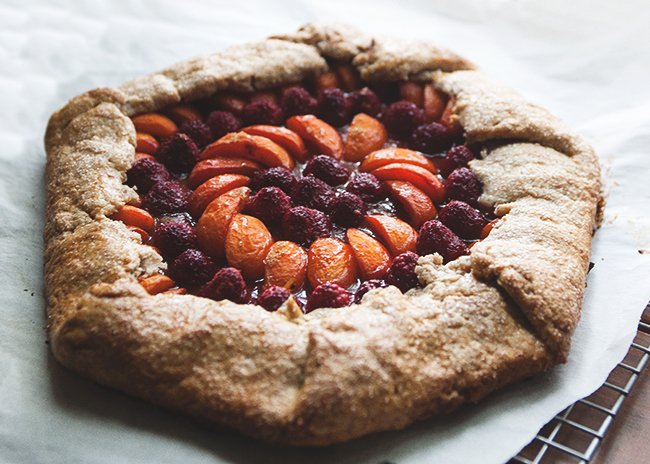
Under Elisabeth Prueitt’s tutelage, I feel invincible.
She’s the co-founder of Tartine Bakery in San Francisco, head pastry chef, and, purveyor of all things baked and sweet and wonderful. Along with her husband Chad Robertson, they’ve turned Tartine into something of an institution. This is a widely-acknowledged fact. Even if institutions are generally quite a bit older than the 10 years that this bakery’s been around. Anyway, I’m sure many of you savvy cooks and bakers have heard of it, so I won’t wax any more poetic except to say that the almond croissants are SO SO good.
Instead, I meant to give you a recipe for an apricot raspberry galette.
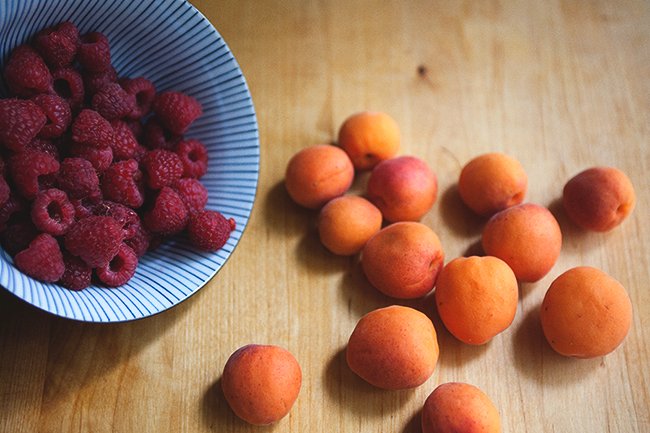
I’ve always been charmed by galettes; they’re so endearing and sweet, homely little things brimming with the fresh and organic. At the same time, I’ve always been intimidated by the idea of making the crust—tart doughs seem such fickle things. So in undertaking this recipe, I knew that I wanted to turn to Prueitt’s cookbook Tartine… she’s never led me astray, you see.
She describes galettes as “quintessentially beautiful rustic tarts… they are very satisfying to make.” I wanted to grasp satisfying! More than that, I wanted to feel the gratification that comes from sinking my teeth into something substantial. I wanted to feel the flour and butter between my fingers, build something lovely and wholesome completely out of scratch. The process of baking, of creating really, is never as palpable as when you’re getting your hands (and in my case, feet) dirty, smearing butter everywhere, flexing those arm muscles rolling and lifting and pleating. It’s a rewarding feeling.
So I took out the rolling pin—we don’t see much of it these days—and began the painstaking process of flattening frozen butter into long thin strips in flour. Which came together into something that resembled dough. Which came together into something that resembled a free-formed tart. And when it came out of the oven, I was astonished to find a galette. It came out rustic indeed. Seven-sided, lopsided, shriveled fruit and all, I loved it upon sight. Because I’d made it from scratch.


APRICOT RASPBERRY GALETTE
Fruit Galette recipe in Tartine by Elisabeth Prueitt & Chad Robertson
Makes 1 large galette or 6 mini galettes
Ingredients:
For dough:
1 cup (2 sticks) unsalted butter, very cold
1/2 cup water
3/4 tsp salt
1 cup rye flour
1-1/2 cups all-purpose flour (or use all all-purpose if you’d like)
For filling:
3 cups fruit (berries, stone fruit, sauteed apples or pears, etc.)
2 to 4 Tbsp brown or granulated sugar
Lemon juice if needed
Egg wash:
1 large egg yolk
1 Tbsp heavy cream
Granulated sugar for sprinkling
Directions:
Cut the butter into 1-inch cubes and put them in the freezer. Measure the water, dissolve the salt into it, and put it into the freezer. Chill both the butter and the water for about 10 minutes.
Measure the flour onto your work surface and spread it into a rectangle about 1/3 inch deep. Don’t worry about mixing it, as it’ll get mixed in the process. Scatter the butter cubes over the flour and toss some flour over them so they don’t stick to your rolling pin. Begin rolling. When the butter starts flattening into long, thin strips, use a bench scraper to scoop up the sides so it’s about the same size as when you started. Repeat this rolling and scraping 3 to 4 more times.
Make a well in the center and pour in the cold water. With the bench scraper, scoop the sides of the dough into the center, mixing the water and flour in a cutting motion. Keep scraping and cutting until the dough is shaggy, then shape it into a rectangle about 10 by 7 inches. Dust the top lightly with flour. Roll out the flour until it’s about half as thin, then scrape all four sides back to its original shape and reroll. Repeat this a few more times until your dough is smooth, cohesive. You should end up with a 10 by 7 inch rectangle.
Transfer the dough to a large baking sheet, cover it with plastic wrap, and chill for about 1 hour.
While the dough is chilling, prepare your fruit. Peaches can be sliced into eighths, apricots quartered.
When the dough is chilled, you can divide it into six equal parts at this point. Roll the dough into a rough circle of about 14 inches in diameter if making a single galette or 6 to 7 inches if making mini galettes. (Prueitt gives lengthy instructions on how to do this, but for the sake of not being too fussy, I won’t go into details) Transfer the circle/s to a baking sheet and chill about 10 minutes.
Fill the center of each circle with fruit, leaving a 2-inch border if making a large galette, or a 1-inch border if making small. At this point, taste the fruit to decide how much sugar you want to sprinkle on top, anywhere from 2 to 4 Tbsp on the large galette or 1 to 2 tsp on each small galette. If you want, squeeze some lemon juice on top. Fold in the sides into that classically gorgeous galette shape, making sure to seal crevices where the juice can leak out. Chill for about 10 minutes, and start preheating the oven at 375 degrees F.
At this point, Prueitt says you can store them in the fridge, unwrapped, for a few hours or wrap them airtight and store them in the freezer for up to 2 weeks. Otherwise, make your egg wash by whisking together the cream and egg yolks. Brush the egg wash on the pastry edges and sprinkle them with granulated sugar.
Bake the galettes until the crust has visibly puffed and baked to a dark brown and the fruit juices are bubbling, 45 to 60 minutes for the large galette and 40 to 50 minutes for the small. Rotate halfway through for even browning. (If baking them straight from the freezer, tack on about 10 minutes to the baking time.) Remove from the oven and serve immediately, or let it cool and serve warm or at room temperature.
Related Posts




Subscribe for New Racipies
Get mental health tips, updates, and resources delivered to your inbox.