
Oreo Bites

Medically reviewed by Christiana George Updated Date: December 17, 2022


I finally found a package of the new Neopolitan Oreos at Walmart. I bought two packages. One to eat and one to make something with. They were actually pretty tasty. Taste testing is oh so hard, but someone has to do it. I thought the strawberry/vanilla taste would go perfect with cream cheese. Kinda cheesecake like. So I decided to make Oreo bites. Same recipe I used to my Pumpkin Pops


I also found these cute spring sprinkles from Wilton at the craft store. I had to have them! So all I had left to buy was some white candy melt and some white chocolate. And some mini cupcake wrappers to go with my sprinkles.

Of course I tried one when they were done. They did have a cheesecake like taste. Yummy!
Then I decided to make two kinds of Oreo bites. So back to the store it was to get regular Oreos, more cream cheese, and some dark chocolate melt. I like using the candy melt because it hardens quick and it stays hard, so when moving the bites around you don’t get fingerprints all over them. But I like to add real chocolate to the mix to add a more intense chocolate flavor.

Just looking at this photo makes my mouth water. They are so moist and full of flavor. These bites are super easy to make and no bake!

Oreo Bites
by The Sweet Chick
Prep Time: 30 min.
Ingredients (24 bites)
- 1 pkg regular Oreos (or 1 1/2 pkgs Neopolitan Oreos)
- 8 oz. container cream cheese
- 1 bag dark chocolate candy melt (or vanilla)
- 1 bar (4 oz.) Ghiradelli dark chocolate (or white)
- sprinkles
Instructions
Grind Oreo cookies in a food processor and hand mix or use stand mixer to combine with cream cheese until it becomes a dough like consistency. Roll Oreo mixture into quarter size balls and place in airtight container lined with wax paper. Places the container in the refrigerator overnight to set.
After the balls are set, melt candy and chocolate in the microwave as per directions on package. (30 second intervals , stirring in between)
Remove Oreo balls from the refrigerator. Dip the Oreo balls into candy coating mixture until all covered. I use a fork. Once covered, remove and softly tap and rotate until excess candy melt falls off. Then place pops on wax paper.
Carefully add the sprinkles to the top of the balls before the candy melt hardens.
When candy melt does harden, scrape off any excess on the bottom of the ball and place in mini cupcake wrapper. Voila, done!
Related Posts





Subscribe for New Racipies
Get mental health tips, updates, and resources delivered to your inbox.
Are Lychees Acidic? pH of the Sweet Asian Fruit

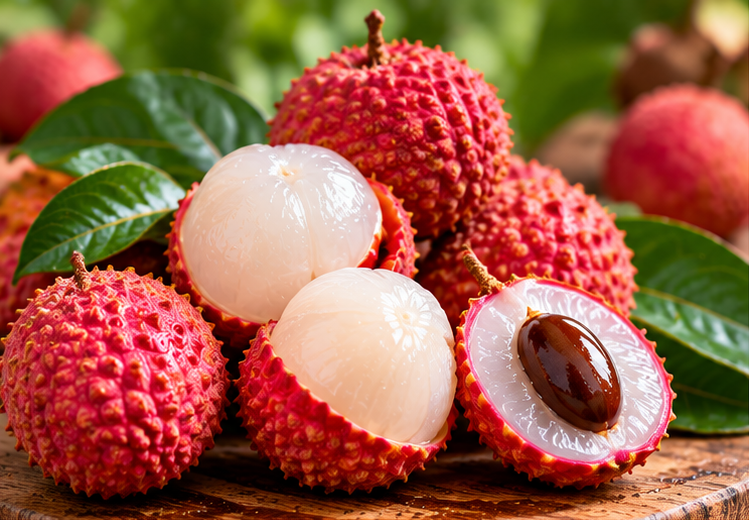
Lychees are only mildly acidic, and they’re one of the gentlest fruits you can eat. The FDA lists lychee at a pH of about 4.70 to 5.01 (FDA). That’s less acidic than apples, pineapple, mangoes, and most berries, and close to bananas. The small amount of acid lychees do have is mostly malic acid, and it drops sharply as the fruit ripens. That’s why ripe lychees taste so sweet and floral rather than tangy.
Lychees do come with one important safety note that has nothing to do with acidity: unripe lychees eaten on an empty stomach have been linked to dangerous low blood sugar in undernourished children. This guide covers lychee pH, how lychees compare with other fruits, what they mean for acid reflux, and how to enjoy them safely.
Key Takeaways
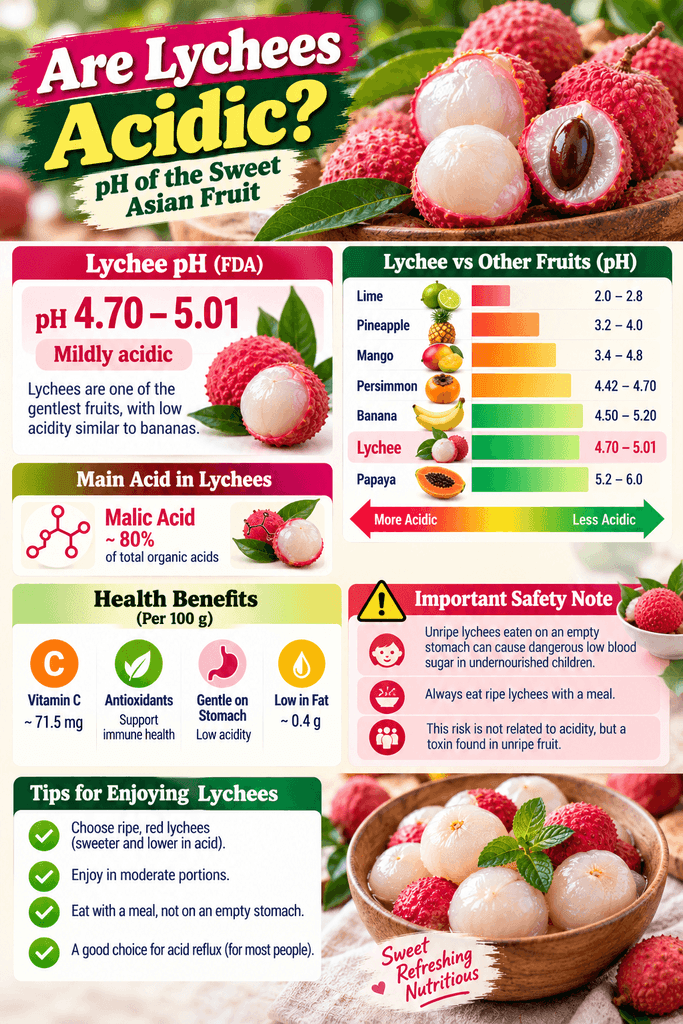
- Lychees are mildly acidic, with an FDA pH range of 4.70 to 5.01, in the same low-acid group as bananas.
- Malic acid is the main acid, making up roughly 80% of lychee’s organic acids, and it falls sharply as the fruit ripens.
- They’re one of the better fruits for acid reflux, though their high sugar content means portions still matter.
- They’re rich in vitamin C, with about 71.5 mg per 100 g.
- Eat ripe lychees with a meal, not on an empty stomach. A 2014 outbreak in India linked lychee eating and skipped meals to severe low blood sugar and brain illness in children
Are Lychees Acidic? The Short Answer
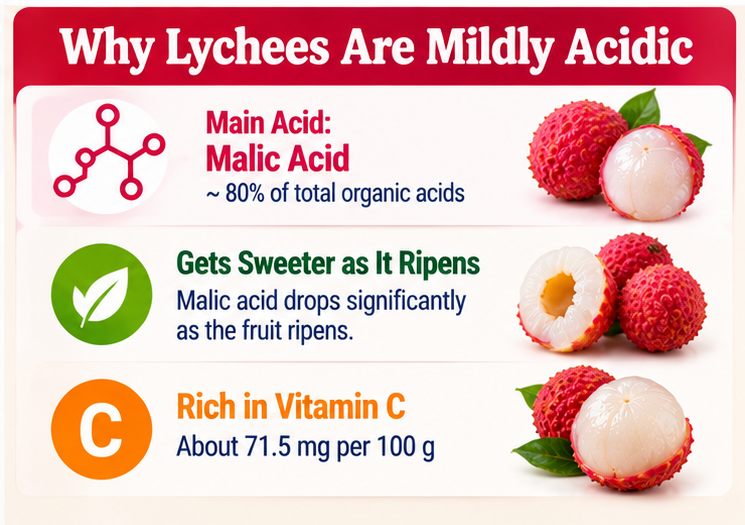
Technically, yes. Anything below pH 7 is acidic, and lychees sit just under pH 5. But compared with most fruits, they’re on the mild end. Here’s how the FDA lists lychee next to other popular fruits (FDA):
| Fruit | Approximate pH (FDA) |
| Lime | 2.00–2.80 |
| Grapes, seedless | 2.90–3.82 |
| Pineapple | 3.20–4.00 |
| Apples, eating | 3.30–4.00 |
| Mangoes, ripe | 3.40–4.80 |
| Persimmons | 4.42–4.70 |
| Bananas | 4.50–5.20 |
| Lychee | 4.70–5.01 |
| Jackfruit | 4.80–6.80 |
| Papaya | 5.20–6.00 |
| Cantaloupe | 6.13–6.58 |
| Avocados | 6.27–6.58 |
Source: FDA, Approximate pH of Foods and Food Products.
Lychee’s pH of 4.70 to 5.01 means it’s roughly 100 times less acidic than a lime at pH 2.8, since each step on the pH scale is a tenfold change. Among popular tropical and Asian fruits, only papaya, melons, coconut, and avocados are milder.
What Makes Lychees Taste So Sweet?
Lychees have a famously sweet, floral taste with just a hint of tang. Their chemistry explains why.
Malic acid leads, and it fades with ripening
A 2023 study of litchi fruit acidity reports that “the dominant acidity-related organic acid in litchi pulps is malate, followed in low levels by citrate and tartrate,” with malic acid making up about 80% of total organic acids (Jiang et al., 2023).
The same study found that malic acid drops dramatically as lychees ripen. In one cultivar it fell by about 91%, and in another by about 72%, between early development and the red ripe stage (Jiang et al., 2023). A separate study of the Indian cultivar ‘Rose Scented’ also found that titratable acidity decreased and pulp pH rose as the fruit matured (Singh et al., 2013).
Malic acid is the same main acid found in apples, including tart Granny Smith apples. In lychees, though, there’s far less of it by the time the fruit is ripe.
Lots of natural sugar
Lychees are also high in sugar. USDA lists 15.2 g of sugar per 100 g of raw lychees (USDA FDC 169086). In the ‘Rose Scented’ study, soluble solids reached about 18.7 °Brix at harvest, with a sugar-to-acid ratio above 23 (Singh et al., 2013).
University of Florida describes ripe lychee pulp as having an “excellent subacid flavor,” meaning only lightly acidic, and notes that “fruit picked while immature are not sweet and have poor flavor” (Crane et al., UF/IFAS HS6).
Are Lychees Good for Acid Reflux?
For most people, lychees are one of the friendlier fruit choices for reflux. They aren’t on the National Institute of Diabetes and Digestive and Kidney Diseases (NIDDK) list of foods that may make reflux worse, which includes citrus fruits, tomatoes, alcohol, chocolate, coffee and caffeine, high-fat foods, mint, and spicy foods (NIDDK). Their low acidity and almost-zero fat also work in their favor.
Reflux triggers do vary, though. The American College of Gastroenterology’s 2022 guideline recommends that people with GERD identify their own triggers and avoid eating within 2 to 3 hours of bedtime (Katz et al., 2022).
What to watch out for
- Large portions: Lychees are easy to eat by the handful. A cup (190 g) contains about 29 g of sugar (USDA FDC 169086). Big servings of any food can leave you feeling overly full.
- Lychee drinks and cocktails: Lychee martinis, sodas, and bubble teas may add alcohol, carbonation, caffeine, or citric acid. Check what else is in the glass.
- Canned lychees in syrup: These add extra sugar. Drain them or choose fruit packed in juice.
Tips for eating lychees with reflux
- Choose ripe, fresh lychees. Ripe fruit has the least acid.
- Start with a small handful and see how you feel.
- Pair them with low-acid foods, like oatmeal, Greek yogurt, coconut yogurt, or cottage cheese.
- Swap lychees in for sharper fruits like pineapple or citrus in fruit salads and smoothies.
- Eat them earlier in the day. NIDDK suggests eating meals at least 3 hours before lying down if you have nighttime symptoms (NIDDK).
For a broader list, see our guide to foods to avoid with GERD. If you have heartburn more than twice a week, trouble swallowing, or symptoms that don’t improve, talk with your doctor.
Safety Note: Don’t Eat Lychees on an Empty Stomach
This is the most important lychee safety fact, and it isn’t about acidity.
Lychees naturally contain two compounds, hypoglycin A and methylenecyclopropylglycine (MCPG), that researchers have linked to dangerously low blood sugar. In 2014, investigators studied an outbreak of acute brain illness among children in Muzaffarpur, India, the country’s largest lychee-growing region (Shrivastava et al., 2017):
- 390 children met the case definition, and 122 (31%) died.
- Eating lychees in the 24 hours before illness was strongly linked to getting sick.
- Skipping the evening meal was also linked to illness and made the lychee association stronger.
- 62% of children tested on admission had low blood sugar (70 mg/dL or less).
- Metabolites of hypoglycin A or MCPG were found in 66% of case urine samples and none of the controls. The lychee fruit itself contained both toxins.
The researchers recommended “minimising litchi consumption, ensuring receipt of an evening meal and implementing rapid glucose correction” for suspected cases (Shrivastava et al., 2017).
What this means for you
This outbreak happened in a major lychee-growing region, and skipping the evening meal made the risk greater. For most well-nourished people eating ripe lychees as a snack or dessert, the risk is very low. Still, these simple habits make sense:
- Eat lychees with or after a meal, not as a replacement for one.
- Choose ripe fruit. Avoid green or unripe lychees [VERIFY: unripe-fruit risk is widely reported; the Lancet study abstract tested litchi arils but did not compare ripe vs unripe].
- Keep portions reasonable, especially for children.
- Don’t let children fill up on lychees and skip dinner.
- Seek care immediately if anyone develops vomiting, confusion, drowsiness, or seizures after eating lychees, particularly a child who hasn’t eaten a proper meal.
Lychees, Teeth, and Gastritis
Teeth: Lychees are low in acid but high in sugar. The American Dental Association recommends eating acidic foods as part of a meal, rinsing with water or having milk or cheese afterward, and waiting about an hour before brushing (American Dental Association). The same habits help with sugary fruit snacks. Our article on whether apples are good for your teeth covers similar questions.
Gastritis: Mild, low-acid fruits like ripe lychees are often easier to tolerate than citrus or berries. Start with a few, eaten with food. Our 7-day meal plan for gastritis has more gentle meal ideas.
Lychee Nutrition
Per 100 grams, raw lychees provide (USDA FDC 169086; UF/IFAS HS6):
| Nutrient | Per 100 g | Per cup (190 g) |
| Water | 81.8 g | — |
| Calories | 66 | About 125 |
| Carbohydrates | 16.5 g | About 31 g |
| Fiber | 1.3 g | About 2 g |
| Sugars | 15.2 g | About 29 g |
| Vitamin C | 71.5 mg | About 136 mg |
| Potassium | 171 mg | About 325 mg |
A few highlights:
- Vitamin C: One cup provides about 136 mg, well above the adult Recommended Dietary Allowance of 75 to 90 mg per day (NIH Office of Dietary Supplements).
- Low fat, low calorie per piece: UF/IFAS describes lychees as “low in calories and a good source of potassium” (UF/IFAS HS6).
- High in sugar, low in fiber: With about 15 g of sugar and only 1.3 g of fiber per 100 g, lychees can add up quickly. If you’re managing blood sugar, keep portions small. Our guide on whether apples are good for diabetics covers how to think about fruit and blood sugar.
How Lychees Compare to Other Asian and Tropical Fruits
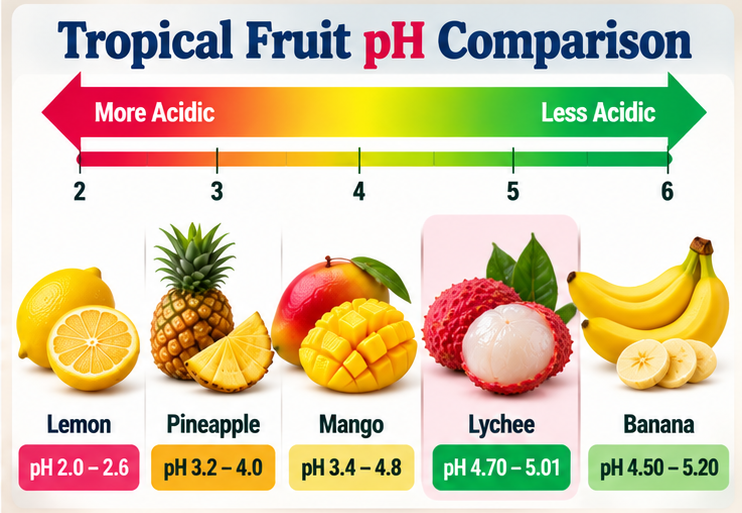
Here’s how lychee stacks up against the other tropical fruits we’ve covered:
| Fruit | Approximate pH | Acid level | Special note |
| Passion fruit | About 2.4–3.2 (studies) | Very high | Close to citrus |
| Pineapple | 3.20–4.00 (FDA) | High | Common reflux complaint |
| Guava | About 3.7–4.2 (studies) | Moderate | Very high vitamin C |
| Starfruit | About 3.9–4.6 (studies) | Moderate | Avoid with kidney disease |
| Mango | 3.40–4.80 (FDA) | Moderate | Varies with ripeness |
| Dragon fruit | About 4.3–5.5 (studies) | Low | Very mild flavor |
| Lychee | 4.70–5.01 (FDA) | Low | Eat ripe, with a meal |
| Banana | 4.50–5.20 (FDA) | Low | Classic gentle fruit |
| Papaya | 5.20–6.00 (FDA) | Very low | One of the mildest |
pH values from the FDA or from the studies cited in our individual fruit guides.
So among tropical fruits, lychees belong with dragon fruit, bananas, and papaya in the low-acid group. For the full picture, see our complete guide to acidic foods.
Acid-Smart Ways to Enjoy Lychees
Lychees are delicious on their own: just peel the thin shell, eat the translucent fruit, and discard the large brown seed. If you’d like to get creative, try these ideas:
- Smoothies: Blend peeled, seeded lychees into our fruit yogurt shake with banana for a floral, low-acid drink.
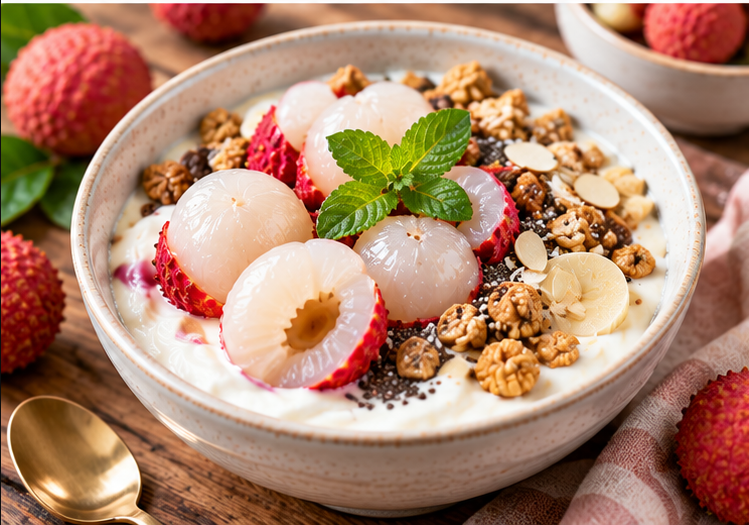
- Breakfast bowls: Top Greek yogurt or oatmeal with halved lychees and our pumpkin pie spice granola.
- Creamy desserts: Serve lychees with our whipped ricotta with mixed berries or alongside a scoop of ginger ice cream.
- Summer rolls: Add halved lychees to our avocado summer rolls for a sweet surprise.
- Treats: Chopped lychees make a fun addition to our tropical dream rice krispie treats.
The lychee swaps haven’t been tested in our kitchen, so adjust to taste.
Kitchen tip: Always remove the seed before serving lychees to young children, and cut the fruit into small pieces. Whole lychees are round and slippery, which can make them a choking risk for little ones [VERIFY: choking-hazard guidance is general pediatric advice; add a CDC or AAP citation if available].
Frequently Asked Questions
Are lychees acidic or alkaline?
Lychees are mildly acidic. The FDA lists lychee at pH 4.70 to 5.01, which makes it one of the least acidic common fruits, close to bananas.
Are lychees good for acid reflux?
For most people, yes. Lychees are low in acid and fat and aren’t on NIDDK’s list of common reflux triggers. Eat ripe fruit in moderate portions, ideally with a meal.
What acid is in lychee?
Malic acid is the main one, making up roughly 80% of lychee’s organic acids, with smaller amounts of citric and tartaric acid. Malic acid levels drop sharply as lychees ripen.
Are lychees more acidic than bananas?
They’re about the same. The FDA lists bananas at pH 4.50 to 5.20 and lychee at 4.70 to 5.01, so both are in the low-acid group.
Is it safe to eat lychees on an empty stomach?
It’s best not to. A 2014 outbreak in Muzaffarpur, India, linked eating lychees and skipping the evening meal to severe low blood sugar and brain illness in children. Eat ripe lychees with or after a meal.
Are canned lychees acidic?
The FDA table doesn’t list canned lychees separately. Canned lychees are usually packed in sugar syrup, which adds sugar. Check the label for added citric acid, and drain the syrup if you want less sugar.
Are lychees healthy?
Yes, in reasonable amounts. They’re rich in vitamin C, low in fat, and hydrating. But they’re high in natural sugar and low in fiber, so it’s easy to overeat them.
The Bottom Line
Lychees are only mildly acidic, with an FDA pH of 4.70 to 5.01. Their small amount of acid is mostly malic acid, which drops sharply as the fruit ripens, leaving that famously sweet, floral flavor. That puts lychees in the same gentle, low-acid group as bananas, dragon fruit, and papaya.
For most people with reflux or a sensitive stomach, ripe lychees are a good fruit choice. Just remember two things: lychees are high in sugar, so watch portions, and always eat them with or after a meal, never as a substitute for one, especially for children.
Keep exploring with Are Dragon Fruits Acidic?, Are Starfruits Acidic?, Are Persimmons Acidic?, or our complete guide to acidic foods.
Medical disclaimer: This article is for general information only and isn’t a substitute for professional medical advice. If you have frequent heartburn, GERD, diabetes, or any symptoms after eating lychees, talk with your doctor or a registered dietitian.
References
- U.S. FDA. Approximate pH of Foods and Food Products.
- Jiang Y, et al. (2023). Combined metabolome and transcriptome analyses unveil the molecular mechanisms of fruit acidity variation in litchi. Int J Mol Sci 24(3):1871. MDPI
- Singh A, Mishra DS, Kumar R, Kumar P (2013). Physico-chemical changes in litchi cv. Rose Scented during fruit development and maturation. Indian J. Hortic. 70(3):328–332. PDF
- Crane JH, Balerdi CF, Maguire I. Lychee Growing in the Florida Home Landscape (HS6/MG051). UF/IFAS.
- Shrivastava A, et al. (2017). Association of acute toxic encephalopathy with litchi consumption in an outbreak in Muzaffarpur, India, 2014: a case-control study. Lancet Glob Health 5(4):e458–e466. DOAJ
- USDA FoodData Central. Litchis, raw (FDC 169086).
- NIH Office of Dietary Supplements. Vitamin C Fact Sheet.
- NIDDK. Eating, Diet & Nutrition for GER & GERD.
- Katz PO, et al. (2022). ACG Clinical Guideline for GERD. doi:10.14309/ajg.0000000000001538
- American Dental Association. Dietary Acids and Your Teeth.
Related Posts



Subscribe for New Racipies
Get mental health tips, updates, and resources delivered to your inbox.