
Are Guavas Acidic? Guava pH vs Other Tropical Fruits

Medically reviewed by Jaclyn Weiner, RD, RDN, MEd, MS Updated Date: October 14, 2026
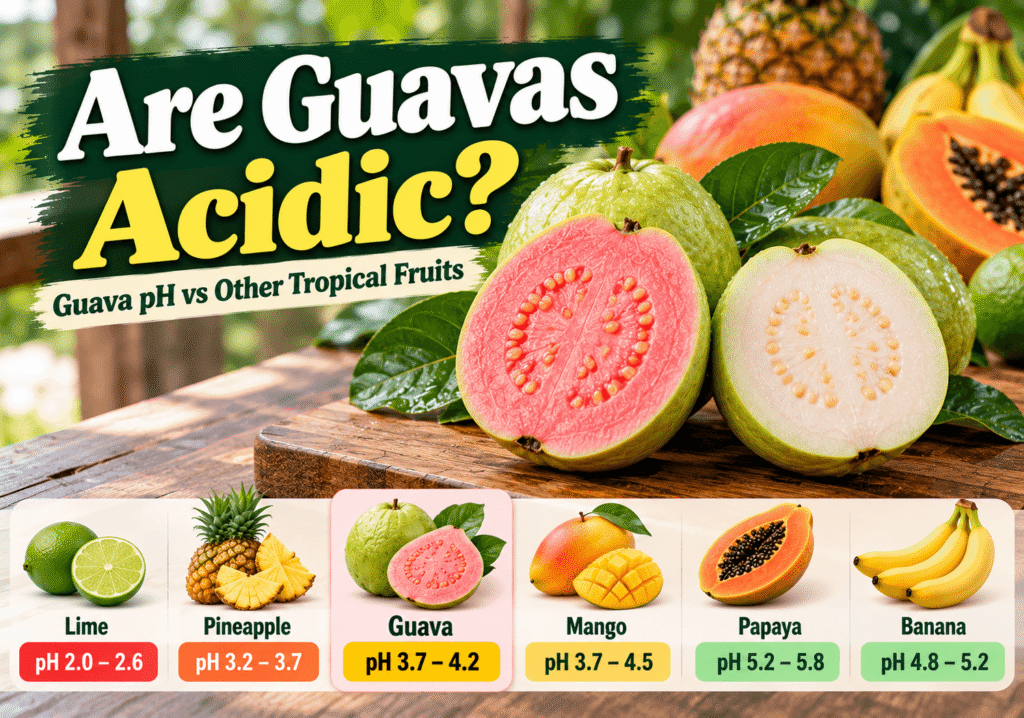
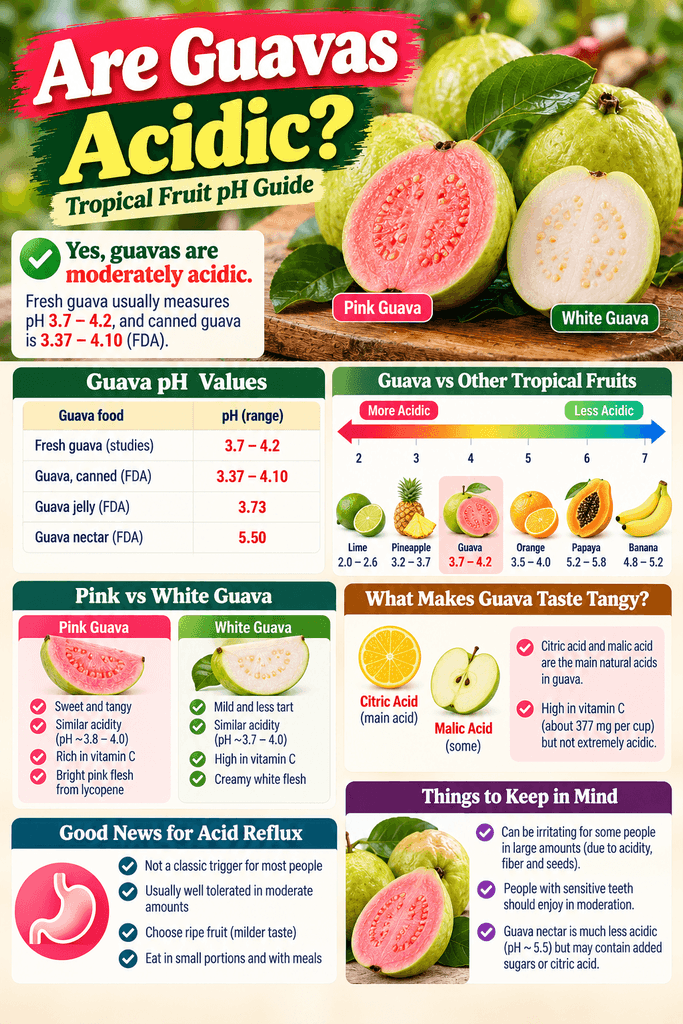
Yes, guavas are acidic, but only moderately. Fresh guava pulp usually measures a pH of about 3.7 to 4.2 in lab studies (Batista et al.; Choi & Shin, 2025), and the FDA lists canned guava at 3.37 to 4.10 (FDA). Their tang comes mainly from citric acid, with some malic acid. That makes guava less acidic than lime, pineapple, or grapefruit, but more acidic than papaya, banana, or coconut.
Guava is also one of the richest food sources of vitamin C, which leads many people to assume it must be extremely acidic. It isn’t. This guide explains where guava really sits on the pH scale and how pink and white guava compare. It also covers how guava stacks up against other tropical fruits and what people with acid reflux or sensitive teeth should know.
Key Takeaways
- Guavas are moderately acidic. Fresh guava pulp measures about pH 3.7 to 4.2 in studies, and canned guava is 3.37 to 4.10 per the FDA.
- Citric acid is the main acid, followed by malic acid.
- Pink and white guava are similar in acidity. Studies show variety, growing conditions, and ripeness matter more than flesh color.
- Guava sits in the middle of the tropical-fruit range: less acidic than lime, pineapple, and tamarind, and more acidic than papaya, banana, and avocado.
- High vitamin C doesn’t mean high acidity. One cup of guava has about 377 mg of vitamin C, but its pH is similar to that of many common fruits.
- Guava isn’t a classic reflux trigger, but its acidity, fiber, and seeds can bother some people in large amounts.
Are Guavas Acidic? The Short Answer
Yes. Anything with a pH below 7 is acidic, and guava lands well below that. Here’s what the main sources report:
| Guava food | pH | Source |
| Fresh guava (Brazilian cultivars and selections) | 3.72–4.22 | Batista et al. |
| Fresh guava (five Korean cultivars) | 3.77–3.99 | Choi & Shin, 2025 |
| Fresh guava pulp (Brazil) | 3.76 | Santos et al., 2014 |
| Fresh guava (Mexico) | 4.13 | Rev. Mex. Cienc. Agríc., 2018 |
| Guava, canned | 3.37–4.10 | FDA |
| Guava jelly | 3.73 | FDA |
| Guava nectar | 5.50 | FDA |
The FDA table doesn’t list fresh guava, so fresh values come from published studies. Results vary with variety, region, and ripeness.
Put simply, fresh guava usually falls between pH 3.7 and 4.2. That’s in the same “moderately acidic” zone as apples, peaches, and oranges. Notice that guava nectar, at pH 5.50, is listed as much less acidic than the fresh fruit. The FDA table doesn’t explain why. Commercial nectars are usually blended with water and sweeteners, so recipes vary a lot, and you should check the label for added citric acid.
What Makes Guava Taste Tangy?
Guava’s tang comes from natural fruit acids. A 2025 study of five guava cultivars found that citric acid and malic acid were the main organic acids in every one (Choi & Shin, 2025):
| Cultivar (flesh color) | Citric acid (mg/100 g) | Malic acid (mg/100 g) | pH |
| Gihyun gold no. 2 (red) | 439 | 179 | 3.98 |
| Redlee (red) | 346 | 162 | 3.99 |
| Gihyun red (white) | 414 | 141 | 3.77 |
| Gihyun gold no. 3 (white) | 621 | 37 | Not individually reported |
| Gihyun green (white) | 382 | 93 | Not individually reported |
Source: Choi & Shin, 2025, Foods 14:3645. All five cultivars had a pH below 4. Values rounded.
Citric acid is the same acid that makes limes and lemon juice so sharp. Malic acid is the main acid in apples, including tart Granny Smith apples. Guava has much less of both than citrus, which is why it tastes sweet-tart rather than sour.
How much total acid does guava have?
pH tells you how strong the acidity is. Titratable acidity tells you how much acid is in the fruit overall. Guava’s titratable acidity varies a lot:
- Indian cultivars: about 0.25% to 0.60% across twenty cultivars (Khan et al., 2019).
- Brazilian accessions: about 0.33% to 0.67%, expressed as citric acid, across sixty genotypes (Corrêa et al., 2012).
- Korean cultivars: a higher 1.33% to 1.76%, as citric acid (Choi & Shin, 2025).
For comparison, Granny Smith apples carry about 0.7% to 1.0% titratable acidity at harvest (Good Fruit Grower). So most guavas carry less total acid than a tart green apple, though some varieties carry more. (These figures come from different studies and methods, so treat them as a general guide.)
Pink Guava vs White Guava: Which Is More Acidic?
Guavas come with pink (or red) flesh and white (or creamy) flesh. Many shoppers assume one is clearly sweeter or less acidic. The research doesn’t show a simple pattern.
| Pink/red guava | White guava | |
| Acidity | Similar; varies by cultivar | Similar; varies by cultivar |
| pH (Korean study) | 3.98–3.99 | 3.77 to below 4 |
| Titratable acidity (Indian study) | 0.25%–0.39% | 0.25%–0.60% |
| Soluble solids, or sweetness (Indian study) | 8.79–11.25 °Brix | 7.11–9.61 °Brix |
| Lycopene | Present | Not detected |
Sources: Choi & Shin, 2025; Khan et al., 2019. Indian ranges calculated from the study’s table.
What the studies show:
- Acidity overlaps. In the Indian study, pink and white cultivars both started at 0.25% acidity. Some white cultivars were more acidic, but popular white Allahabad Safeda measured the same 0.25% as pink Lalit and Arka Kiran (Khan et al., 2019).
- Pink guavas in that study ran a little sweeter, with higher soluble solids. Pink Arka Kiran had the highest sweetness and vitamin C of all twenty cultivars, with “a meagre amount of acidity.”
- Pink color comes from lycopene. In the Korean study, lycopene was found only in red-fleshed cultivars (Choi & Shin, 2025). Lycopene is the same red pigment found in tomatoes, and it has nothing to do with acidity.
The bottom line: If you’re acid-sensitive, choosing pink over white won’t make a big difference. A fully ripe guava of any color is the better bet.
Guava’s Vitamin C: Why It Doesn’t Mean “Super Acidic”
Guava is famous for its vitamin C. USDA lists 228 mg of vitamin C per 100 grams of raw common guava, or about 377 mg per cup (USDA FDC 173044). That’s several times the adult Recommended Dietary Allowance of 75 to 90 mg per day (NIH Office of Dietary Supplements).
Vitamin C’s chemical name is ascorbic acid, so it’s natural to assume guava must be extremely acidic. But the numbers don’t support that:
- Guava’s pH (about 3.7 to 4.2) is similar to that of many ordinary fruits.
- In the Korean study, citric acid alone ranged from about 346 to 621 mg per 100 g, more than the ascorbic acid measured in every sample (Choi & Shin, 2025).
- Lemons and limes, with pH values as low as 2.0, are far more acidic than guava, even though guava has more vitamin C.
So guava gives you a big dose of vitamin C without being one of the harshest fruits on your stomach or teeth.
How Guava Compares to Other Tropical Fruits
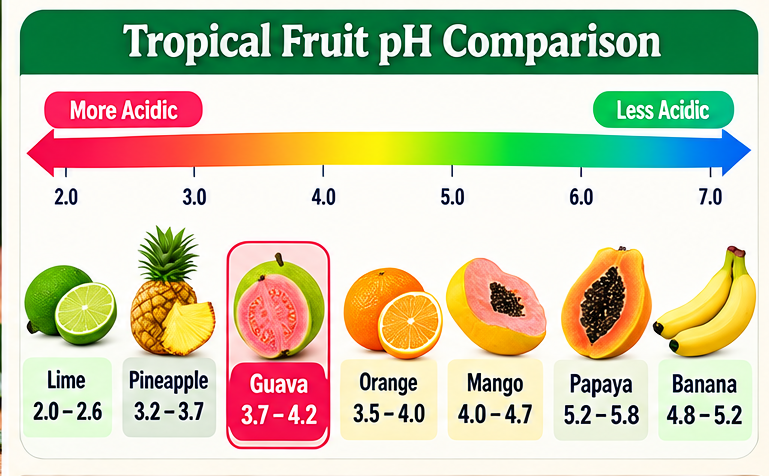
Here’s where guava falls among tropical and subtropical fruits in the FDA’s pH table (FDA):
| Fruit | Approximate pH |
| Lime | 2.00–2.80 |
| Pomegranate | 2.93–3.20 |
| Tamarind | 3.00 |
| Grapefruit | 3.00–3.75 |
| Pineapple | 3.20–4.00 |
| Guava, canned | 3.37–4.10 |
| Guava, fresh (studies) | About 3.7–4.2 |
| Mangoes, ripe | 3.40–4.80 |
| Oranges, Florida | 3.69–4.34 |
| Persimmons | 4.42–4.70 |
| Bananas | 4.50–5.20 |
| Lychee | 4.70–5.01 |
| Jackfruit | 4.80–6.80 |
| Papaya | 5.20–6.00 |
| Coconut, fresh | 5.50–7.80 |
| Avocados | 6.27–6.58 |
Source: FDA, Approximate pH of Foods and Food Products; fresh guava from the studies cited above.
A few takeaways:
- Guava is gentler than the sharpest tropical fruits. Limes, pineapple, and grapefruit are all more acidic.
- It’s in the same range as mangoes and oranges.
- For the lowest-acid tropical choices, look to bananas, papaya, coconut water, and avocados.
- Persimmons are another sweet, low-acid option if guava feels too tangy.
For the full picture, see our complete guide to acidic foods.
Are Guavas Good for Acid Reflux?
Guava isn’t usually named as a reflux trigger. The National Institute of Diabetes and Digestive and Kidney Diseases (NIDDK) lists citrus fruits, tomatoes, alcohol, chocolate, coffee and caffeine, high-fat foods, mint, and spicy foods as foods that may worsen reflux (NIDDK). Guava isn’t on that list.
Still, guava is moderately acidic and rich in citric acid, the same acid found in citrus. Some people with reflux may notice it, especially in large portions or on an empty stomach. The American College of Gastroenterology’s 2022 guideline recommends that people with GERD identify their own triggers rather than avoiding long lists of foods, and avoid eating within 2 to 3 hours of bedtime (Katz et al., 2022).
Fiber and seeds
Guava is very high in fiber, with 5.4 g per 100 g, or about 9 g per cup (USDA FDC 173044). Fiber is great for overall health, but a sudden big serving can leave some people feeling bloated or overly full. Guava also contains many small, hard seeds. If you have trouble chewing or a sensitive stomach, start with small portions.
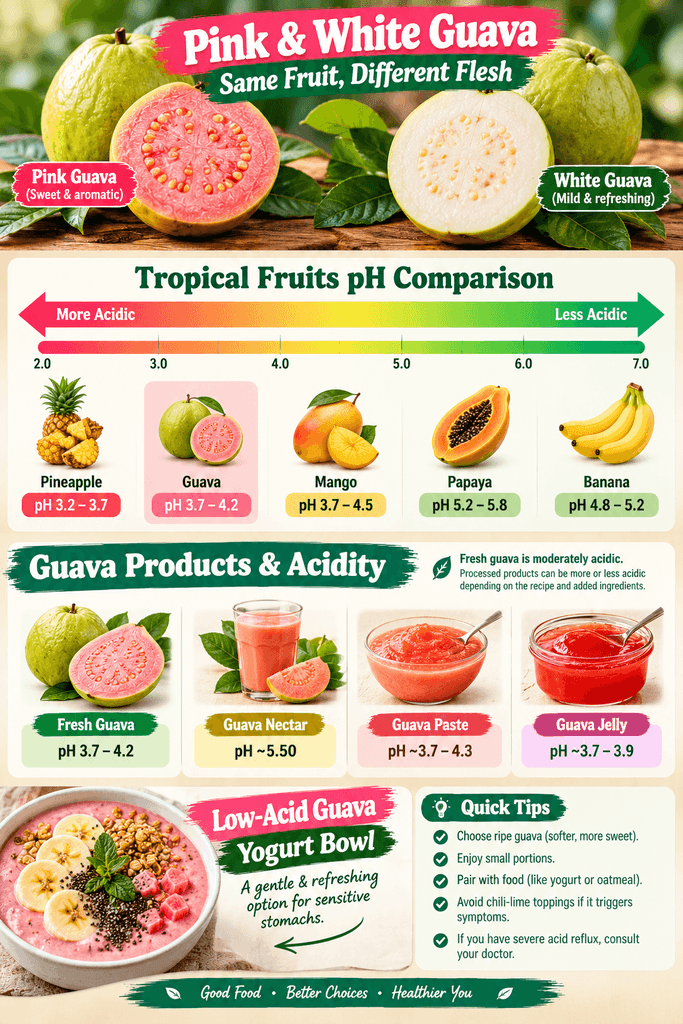
Tips for eating guava with reflux
- Choose fully ripe guava. Ripe fruit is softer, sweeter, and more fragrant.
- Start with half a fruit and see how you feel.
- Eat it with a meal or a low-acid food, like oatmeal, Greek yogurt, or cottage cheese.
- Skip the chili-lime topping. If you like guava with chili powder, salt, and lime, know that this adds two more possible triggers.
- Watch guava juice drinks. Check labels for added citric acid and sugar.
- Don’t eat it right before bed. NIDDK suggests eating meals at least 3 hours before lying down if you have nighttime symptoms (NIDDK).
For a broader list, see our guide to foods to avoid with GERD. If you have heartburn more than twice a week, trouble swallowing, or symptoms that don’t improve, talk with your doctor.
Guava, Teeth, and Gastritis
Teeth: Guava’s acidity is moderate, but frequent snacking still exposes your teeth to acid and natural sugar. The American Dental Association recommends eating acidic foods as part of a meal, rinsing with water or having milk or cheese afterward, and waiting about an hour before brushing (American Dental Association). Guava paste and jelly are especially sticky and sugary, so enjoy them with a meal. Our article on whether apples are good for your teeth covers similar questions.
Gastritis: If you have gastritis, very acidic or spicy foods may be uncomfortable. Try a small amount of ripe guava without chili or lime, or swap in a lower-acid fruit like banana or papaya. Our 7-day meal plan for gastritis has more gentle ideas.
Guava Nutrition Highlights
Per 100 grams, raw common guava provides (USDA FDC 173044):
| Nutrient | Per 100 g | Per cup (165 g) |
| Calories | 68 | 110 |
| Fiber | 5.4 g | 9 g |
| Sugars | 8.92 g | 15 g |
| Vitamin C | 228 mg | 377 mg |
| Potassium | 417 mg | 690 mg |
| Folate | 49 mcg | 81 mcg DFE |
| Lycopene | 5,204 mcg | Not listed |
A few highlights:
- Vitamin C: Guava ranks among the richest common fruit sources.
- Fiber: One cup provides about 9 grams, a big contribution toward daily fiber needs.
- Lycopene: USDA’s raw guava entry lists about 5,204 mcg of lycopene per 100 g, roughly double the 2,573 mcg in raw red tomatoes (USDA FDC 170457). Pink and red guavas are the source of that lycopene.
- Sugar: Fresh guava has moderate natural sugar, but guava paste, jelly, and sweetened juices add much more. If you’re managing blood sugar, our guide on whether apples are good for diabetics covers how to think about whole fruit.
Fresh Guava vs Guava Products
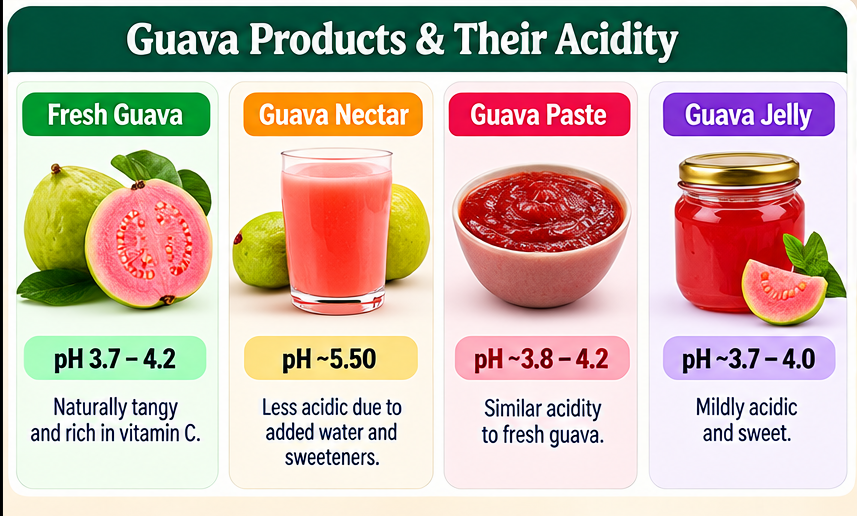
| Guava product | pH (FDA) | What to know |
| Fresh guava | About 3.7–4.2 (studies) | Most fiber and vitamin C; no added sugar |
| Canned guava | 3.37–4.10 | Often packed in syrup; check for added sugar and citric acid |
| Guava jelly | 3.73 | High in sugar; small portions only |
| Guava nectar | 5.50 | Higher pH than fresh fruit, but often sweetened |
| Guava paste | Not listed | Very high in sugar; sticky on teeth |
pH values from the FDA unless noted.
Processing can also affect vitamin C, which is easily damaged by heat and long storage (NIH ODS). For the most vitamin C and fiber with no added sugar, fresh guava is the best choice.
Acid-Smart Ways to Enjoy Guava
If guava agrees with you, try it in these ideas:
- Smoothies: Blend ripe guava (strained if you dislike seeds) into our fruit yogurt shake with banana to keep it mellow.
- Breakfast bowls: Top oatmeal or yogurt with diced guava and our pumpkin pie spice granola.
- Tropical treats: Add a little guava jam to our tropical dream rice krispie treats.
- Cheese pairings: Guava paste and cheese are a classic sweet-savory combination. Try it in place of quince paste in our dulce de membrillo and brie tartelettes.
- Summer rolls: Slip thin guava slices into our avocado summer rolls for a sweet contrast.
The guava swaps haven’t been tested in our kitchen, so adjust to taste.
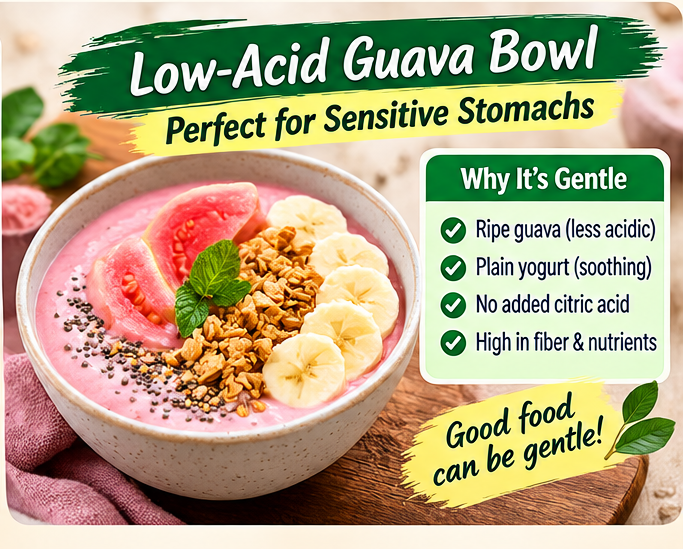
Kitchen tip: A ripe guava gives slightly when pressed and smells sweet and floral. Firm, green, odorless guavas will taste sharper.
Frequently Asked Questions
Are guavas acidic or alkaline?
Guavas are acidic. Fresh guava pulp measures about pH 3.7 to 4.2 in published studies, and the FDA lists canned guava at 3.37 to 4.10. The main acids are citric and malic acid.
Is pink guava more acidic than white guava?
Not consistently. Studies show both types overlap in acidity, and variety matters more than flesh color. Pink guava gets its color from lycopene, which doesn’t affect acidity.
Is guava good for acid reflux?
It isn’t a common trigger and isn’t on NIDDK’s reflux list. But it’s moderately acidic and high in fiber, so some people notice it. Eat ripe guava in small portions with a meal, and skip chili-lime toppings.
Is guava more acidic than pineapple?
No. The FDA lists pineapple at 3.20 to 4.00, and fresh guava usually measures about 3.7 to 4.2, so pineapple tends to be more acidic.
Does guava’s vitamin C make it very acidic?
No. Vitamin C is ascorbic acid, but guava’s pH is similar to many ordinary fruits. Citric acid makes up most of its acid content.
Is guava juice acidic?
Yes, but less than you might think. The FDA lists guava nectar at pH 5.50, higher than fresh guava. Many commercial guava drinks add sugar and sometimes citric acid, so check the label.
Which tropical fruits are less acidic than guava?
Bananas, lychee, papaya, coconut, and avocado all have higher pH values than guava in the FDA table, so they’re less acidic.
The Bottom Line
Guavas are moderately acidic, with fresh pulp usually measuring about pH 3.7 to 4.2. Their tang comes mainly from citric acid, with some malic acid. Pink and white guavas are similar in acidity, and guava’s huge vitamin C content doesn’t make it unusually acidic.
Among tropical fruits, guava sits in the middle: gentler than lime, pineapple, and grapefruit, but tangier than banana, papaya, and coconut. For most people, ripe guava is a nutritious, fiber-rich treat. If you’re acid-sensitive, eat it ripe, keep portions moderate, pair it with a meal, and skip the chili-lime topping.
Keep exploring with Are Mangoes Acidic?, Are Pineapples Acidic?, Are Persimmons Acidic?, or our complete guide to acidic foods.
Medical disclaimer: This article is for general information only and isn’t a substitute for professional medical advice. If you have frequent heartburn, GERD, gastritis, or ongoing stomach discomfort, talk with your doctor or a registered dietitian.
References
- U.S. FDA. Approximate pH of Foods and Food Products.
- Choi B, Shin Y (2025). Comparative analysis of physicochemical characteristics… of five guava cultivars harvested in Korea. Foods 14:3645. PDF
- Batista PF, et al. Characterization of guava fruits and cultivar selections in the Submédio São Francisco Region of Brazil. SciELO
- Santos AAC, et al. (2014). Physicochemical evaluation and hygroscopic behavior of powdered guava obtained by spray drying. Rev. Ciênc. Agron. 45(3):508–514. SciELO
- Physicochemical properties of guayabilla, myrtle and guava (2018). Rev. Mex. Cienc. Agríc. 9(6). Link
- Khan AA, Das A, Sarkar SK (2019). Profiling of fruit physico-chemical attributes of guava cultivars. J Pharmacogn Phytochem 8(5):588–592. PDF
- Corrêa LC, Santos CAF, Lima GPP (2012). Chemical and biochemical characterization of guava and araçá fruits. Acta Hortic. 959. PDF
- USDA FoodData Central. Guavas, common, raw (FDC 173044); Tomatoes, red, ripe, raw (FDC 170457).
- NIH Office of Dietary Supplements. Vitamin C Fact Sheet.
- Good Fruit Grower. How to measure Honeycrisp qualities.
- NIDDK. Eating, Diet & Nutrition for GER & GERD.
- Katz PO, et al. (2022). ACG Clinical Guideline for GERD. doi:10.14309/ajg.0000000000001538
- American Dental Association. Dietary Acids and Your Teeth.
Related Posts
Subscribe for New Racipies
Get mental health tips, updates, and resources delivered to your inbox.
Blueberry Yum Yum Smoothie

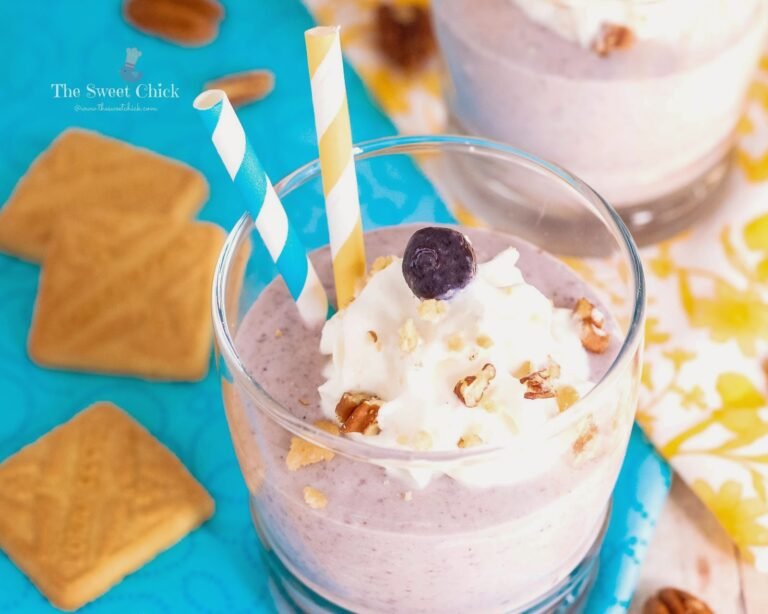

I had never heard of a Blueberry Yum Yum dessert until one of my neighbors suggested I make it. Of course I did. It’s super easy and oh my, it is so delectable. It’s a no bake layer cake made with crushed Lorna Doone shortbread cookies, blueberry pie filling, whipped topping, cream cheese, powdered sugar, and pecans. What’s not to like about that? I thought it would be perfect to make as a dessert smoothie. Yeah, I know it’s not a healthy smoothie, but sometimes you have to be bad. You can use low fat whipped topping and cream cheese if it makes you feel better. Me, I’m sticking to the good stuff.

Williams-Sonoma contacted me to be a part of their Smoothie Week with their first installment being “Not Your Typical Smoothie”. I think this fits the bill. I am a dessert girl, so of course I had to make a dessert smoothie.

I used my Blentec to make this, but in all fairness it should work in any blender. If you don’t have a blender you should check out Williams-Sonoma, they have a sale on blenders and free shipping going on right now.
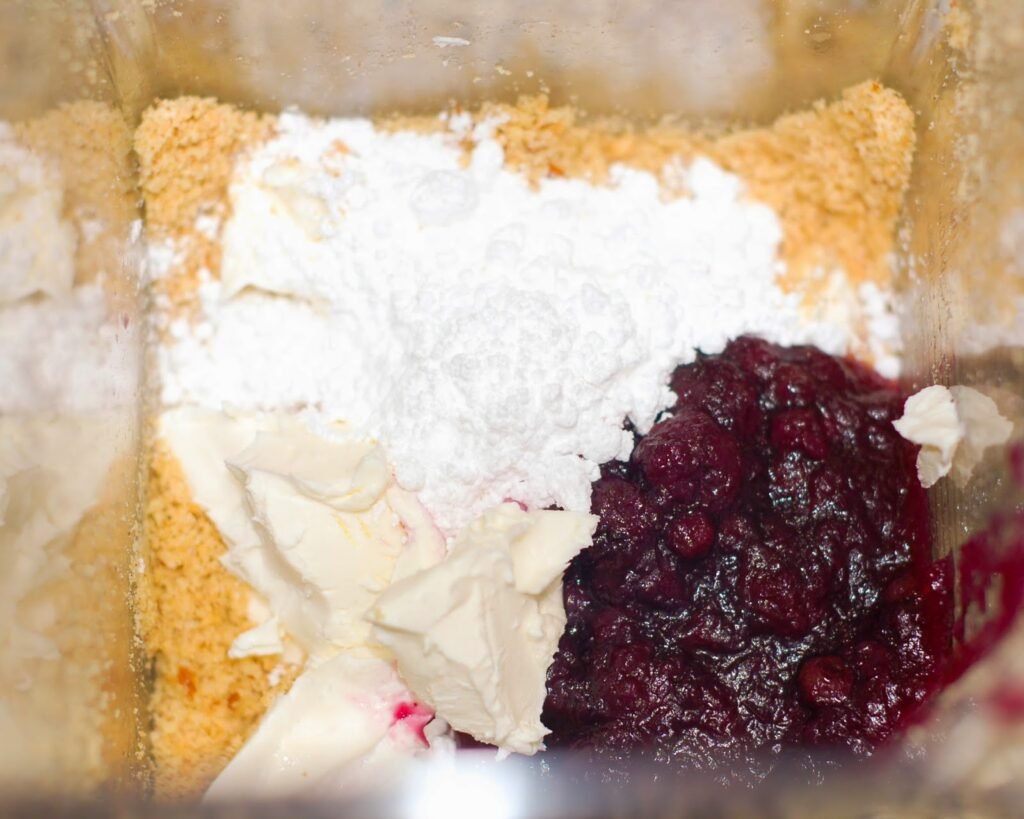
The cookies crumble fairly easy and I had pre-chopped the nuts, so it all worked smoothly. As for the pie filling, my neighbor had given me an industrial sized can of blueberry pie filling that I ended up freezing because I hadn’t used it all. Now, I had a good excuse to use it.

I left the frozen whipped topping for last and the milk. I added 1/4 cup because I like my smoothies thick, but you can add more if you like.

And that’s it. You can add more cookie crumbles or pecans to the top if you want. It makes one 12 oz. serving or two 6 oz. servings. Depends how greedy you are. It is really good though, so I would keep it all to myself. It tastes just like the dessert, except in a drinkable form. Enjoy!
Blueberry Yum Yum Smoothie
by The Sweet Chick
Prep Time: 10 minutes
Keywords: blender dessert snack beverage blueberry pie filling Lorna Doone Cookies whipped topping shake American
Ingredients (2 servings)
- 10 Lorna Doone shortbread cookies
- 1/4 cup chopped pecans
- 1/3 cup blueberry pie filling
- 2 oz. cream cheese
- 1/4 cup powdered sugar
- 1 cup frozen whipped topping
- 1/2 cup milk (or less, if you want a thicker smoothie)
Instructions
Add the cookies and pecans to your blender and pulse until cookies become crumbs.
Then add pie filling, cream cheese, and powdered sugar. Pulse until smooth.
Lastly, put in the whipped topping and milk. Pulse until well blended.
Pour and serve immediately.
Notes
This recipe makes one 12 oz. serving or two 6 oz. servings.
Although Williams-Sonoma contacted me to participate in their Smoothie Week, this is not a sponsored post. All thoughts and opinions are my own.
Related Posts




Subscribe for New Racipies
Get mental health tips, updates, and resources delivered to your inbox.