
Alice Medrich’s Cocoa Brownies

Medically reviewed by Christiana George Updated Date: June 8, 2023
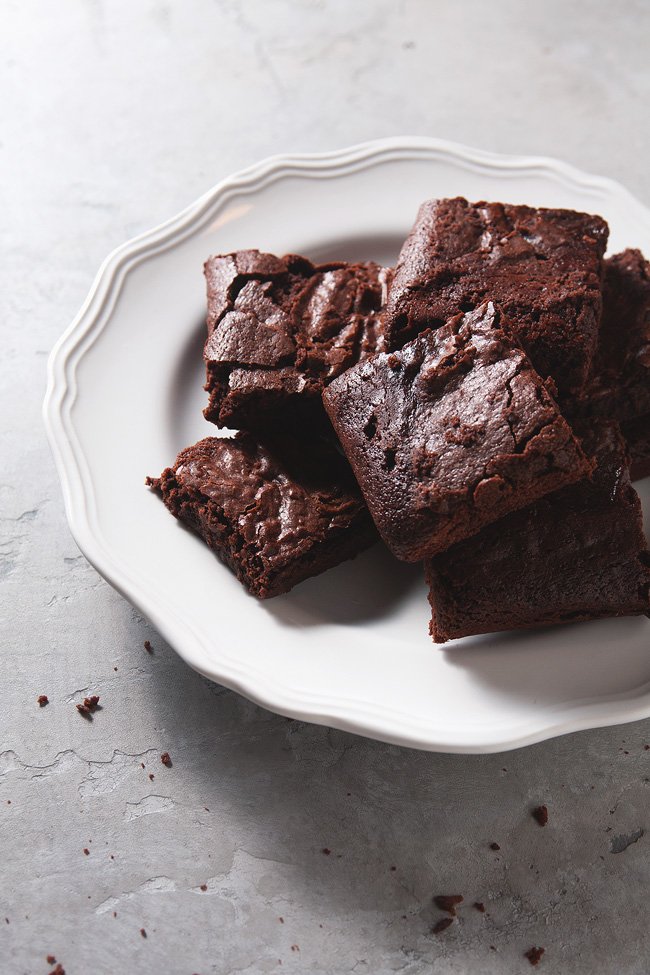
Let’s get things straight here: I am no food stylist. If I were, I would know that trying to cut into a panful of brownies immediately after taking them out of the oven would result in extremely jagged edges, serrated knife and all.
But good-looking brownies be damned. Yesterday was my birthday and I didn’t think I should have to wait. The temptation was just too great: its crackly top gleamed diffusely, its gorgeous smell tickled my nose, and most importantly, there was the knowledge that a truly great brownie—possibly the brownie—was waiting. After all, no Genius Recipe has failed met yet. This one was no exception.
You all probably know Alice Medrich better than I do. I’ve only recently been officially introduced to her and her incredible repertoire of desserts, but long before I became aware of the obsessions of the food world, her kamut pound cake had already collapsed synapses in my brain—in a good way, haha—something that no baked good has done in quite the same way since. I was a fan way before I even knew it.

I think these are probably the best brownies I’ve ever had. Their crackly top is exemplary, and, though I know we all judge our brownies by different metrics so that there is no universally-accepted Best Brownie, these are, conclusively, it. This statement comes from the mouth of someone who has not done all that much perfect-brownie-chasing in her life but recognizes instant chemistry when it happens. It’s like falling in love all over again. I mean, it is falling in love all over again, only with a brownie.

I don’t even know why I felt like brownies yesterday. My birthweekend (a phenomenon which inevitably happens when your birthday falls on a Monday) had already been full of beyond-normal levels of hedonism. I can only offer this, something my mom told me yesterday: it had been snowing when I was born. Do you think this explains my predilection for the gooey, rich, and chocolate-y? Whatever the case, they are definitely the perfect way of easing myself into my XXth (I’m keeping the figure undisclosed) year.
Cheers, y’all! And go make some brownies!


ALICE MEDRICH’S COCOA BROWNIES
Makes 16 to 25 brownies
Adapted from Alice Medrich’s Bittersweet via Food52
Ingredients:
10 Tbsp (1-1/4 sticks) unsalted butter
1-1/4 cups sugar
3/4 cup plus 2 Tbsp unsweetened cocoa powder (natural or Dutch-process)
1/4 tsp salt
1/2 tsp vanilla extract
2 cold large eggs
1/2 cup all-purpose flour (unsifted, measured by stirring briefly, spooning into the measuring cup until it’s heaped above the rim, then leveling it with a straight-edged knife or spatula — it should weigh nearly 2.5 ounces)
2/3 cup walnut or pecan pieces (optional—I didn’t use them)
Directions:
Preheat oven to 325 degrees F. Line an 8″ square pan (I used a 9″, which resulted in slightly flatter brownies) with parchment paper so that there is an overhang on each side.
Let a skilletful of water come to a gentle simmer. In a heatproof bowl, place the butter, sugar, cocoa powder, and salt, and place it in the skillet. Stir while the butter melts. Once the mixture is hot, remove the bowl from the skillet and let it cool until it’s only warm. Using a wooden spoon, stir in the vanilla, then stir in the eggs, one a time, vigorously. Once the batter looks shiny and well-blended, stir in the flour until no streaks remain. Vigorously beat the batter for 40 strokes. Stir in the nuts if using. Spread the batter evenly into the pan, then place it into the oven.
Bake until a toothpick in the middle comes out slightly moist with batter, 20 to 25 minutes (in my 9″ pan, it took about 20 minutes). Remove and let cool completely before lifting out of the pan and transferring to a cutting surface. Cut to your desired size.
Related Posts

Subscribe for New Racipies
Get mental health tips, updates, and resources delivered to your inbox.
Chocolate Peppermint M&M; Fudge

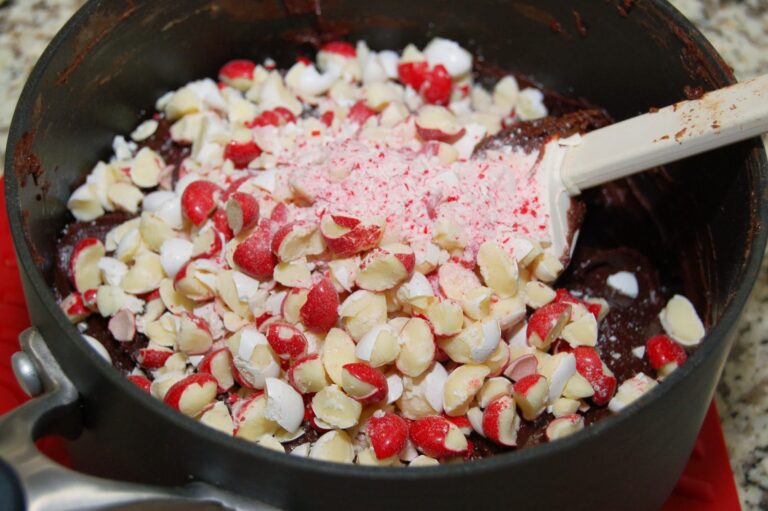

So what do you do when you have a bag of broken M&Ms? You make fudge! I was so excited to find Peppermint M&M’s this year, but then my butter fingers acted up again and I dropped one of the bags. So when I went to open it, I cried a little seeing my pretty M&Ms dented, chipped, and cracked.
I could have just eaten the bag and drowned my sorrows, but I may have ended up with peppermint overload. I do love peppermint, but it needs to be mixed with other flavors. The Peppermint Cheesecake Rice Krispie Treats I made before Thanksgiving are a perfect example of mixing up the flavors. This time, I mixed it up with chocolate. Peppermint and chocolate always go well together.

I hope everyone had a great Thanksgiving. I spent it with my family up north. The kids did very well on the 14 hour drive up. Thank goodness. I got to catch up with friends and family. Had a few date nights with the hubby since mom was available to watch the kids. It was fun, but the cold weather wasn’t. I was glad to come back to my new home down south. I don’t regret the move. I even drove by my old house to see if I missed it and I didn’t. I certainly don’t miss the kitchen, my new one has so much more room to work in.

Even though the M&Ms were a bit broken, I broke them up a little more to make more bit sized pieces.

I love how easy and fast this recipe is to put together. Just melt the chocolate with the condensed milk, then add the M&M’s and Peppermint Pigsy Dust.

Ahh..peppermint…the smell of Christmas. I know not everyone loves peppermint, but those that do will love this fudge.

I dressed up the top of the fudge with additional M&Ms. I think it looks pretty festive. I do like the combination of the white chocolate and peppermint in the M&Ms with the chocolate. This fudge would be great all dolled up in a box and given as a gift to a fellow peppermint lover for the holidays.
Chocolate Peppermint M&M Fudge
by The Sweet Chick
Prep Time: 15 minutes
Cook Time: 5-10 minutes
Keywords: no bake stove top dessert chocolate chips Peppermint M&Ms sweetened condensed milk Christmas fudge American winter
Ingredients (36 pieces)
- 3 cups semi-sweet chocolate chips
- 1 can (14 oz.) sweetened condensed milk
- 1 cup crushed Peppermint M&Ms
- 2 teaspoons Peppermint Pigsy Dust
Additional Toppings
- 36 Peppermint M&Ms
Instructions
In a medium saucepan over low heat, melt the chocolate chips and milk until smooth.
Remove from heat, stir in the M&Ms and Pigsy Dust until completely incorporated.
Then spread the mixture evenly onto a parchment paper lined 8″ x 8″ pan or glass dish.
If you wish, place additional M&M’s evenly across the mixture, pressing gently to make sure they adhere.
Place the container in the fridge and chill until set (about 2 hours).
Remove from fridge and gently lift the parchment paper to remove the fudge from the pan.
If the fudge is too hard to remove, let it sit out a room temperature for about a half hour and then remove it from the pan and slice it into squares.
Note: If you want straight edges, use a sharp knife and clean it after every cut. I also slice off about a quarter inch around the entire perimeter to get better squares. But don’t waste the slivers, keep them in the fridge and add them to your coffee or hot cocoa.
Related Posts

Subscribe for New Racipies
Get mental health tips, updates, and resources delivered to your inbox.