
Are Fuji Apples Acidic? Sweetness and Reflux Risk

Medically reviewed by Jaclyn Weiner, RD, RDN, MEd, MS Updated Date: October 13, 2026
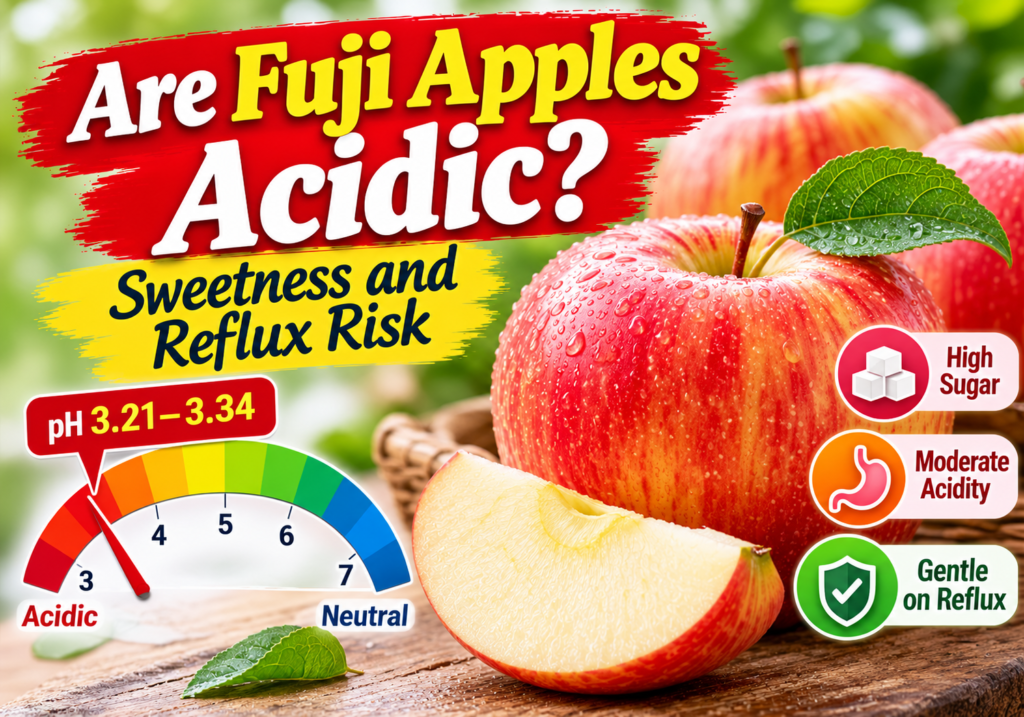
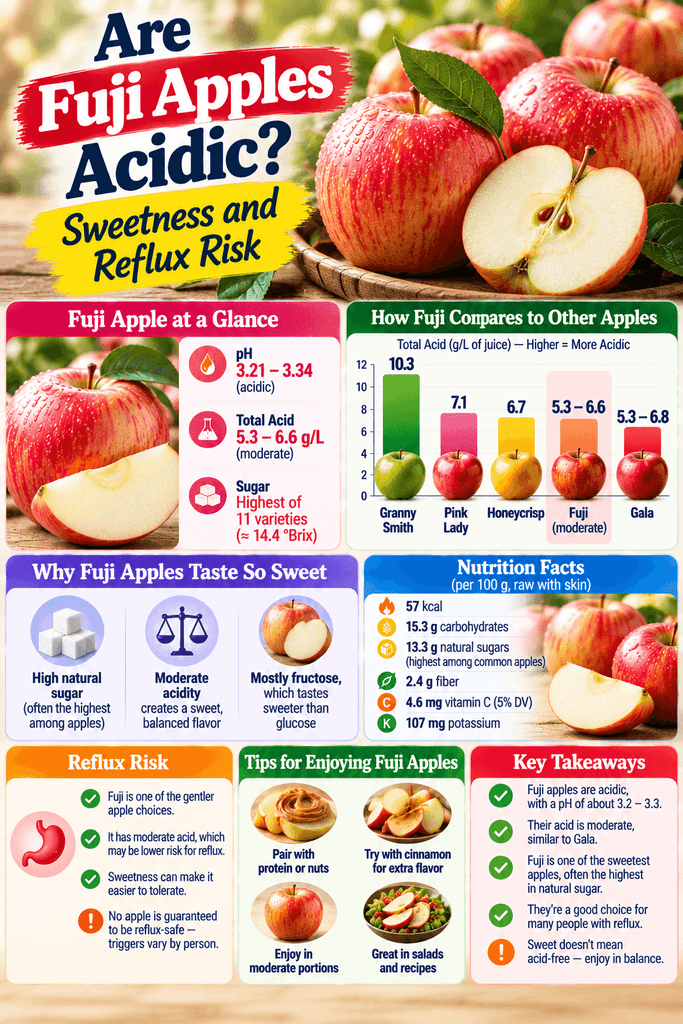
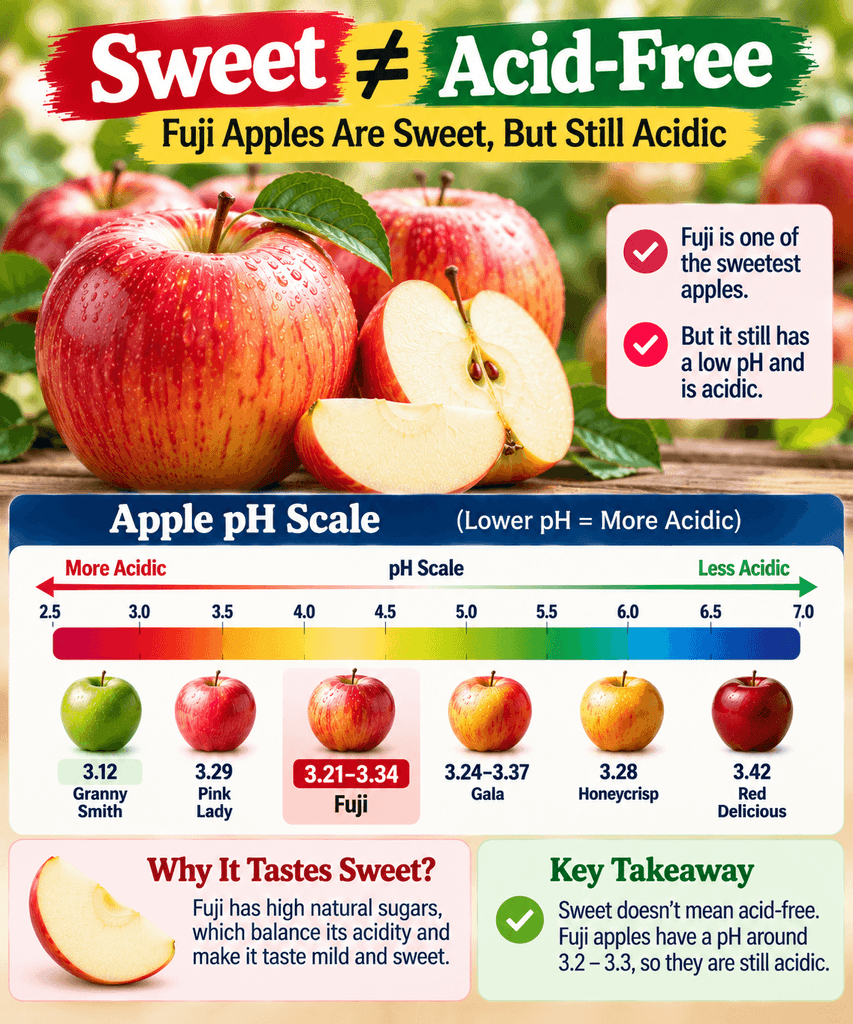
Yes, Fuji apples are acidic, but their sweetness hides it well. In a 2018 study of 11 apple varieties, Fuji measured pH 3.21 to 3.34 with about 5.3 to 6.6 grams of total acid per liter of juice (Mezey and Serralegri, 2018). That’s a moderate acid level, similar to Gala and well below tart apples like Granny Smith. What sets Fuji apart is sugar: it had the highest sugar reading of every apple in that study, about 14.4 °Brix (Mezey and Serralegri, 2018).
So what does that mean for acid reflux? Fuji is one of the lower-risk apple choices, thanks to its moderate acid. But sweet doesn’t mean acid-free, and no apple is guaranteed to be reflux-safe. This guide breaks down Fuji’s pH, why it tastes so sweet, how it compares with other apples, and how to enjoy it if you’re prone to heartburn.
Key Takeaways
- Fuji apples are acidic, with a pH of about 3.2 to 3.3 in one study.
- Their acid is moderate, about the same as Gala, roughly half to two-thirds of Granny Smith’s, and less than Pink Lady’s.
- Fuji is one of the sweetest apples. It had the highest sugar of 11 varieties in one study and the most sugar per 100 grams of the USDA apple entries we compared.
- Sweetness masks acid. Fuji tastes mild, but it still has a pH well below neutral.
- For reflux, Fuji is one of the gentler apple choices, though individual triggers vary.
- Because Fuji is high in natural sugar, it’s smart to pair it with protein if you’re watching blood sugar.
For other varieties, see our guides to Gala, Honeycrisp, Pink Lady, and Granny Smith, or start with Are Apples Acidic?
Are Fuji Apples Acidic or Alkaline?
Fuji apples are acidic. On the pH scale, anything below 7 is acidic, 7 is neutral, and anything above 7 is alkaline. Fuji juice measured pH 3.21 to 3.34 in the 2018 study (Mezey and Serralegri, 2018).
Like all apples, Fuji’s tang comes mainly from malic acid. Fuji just has a lot of sugar to balance it.
What about apples being “alkaline-forming”?
Apples often appear on “alkaline food” lists. That label describes the estimated acid load a food leaves after digestion, not its pH. Most fruits and vegetables are considered alkaline-forming because of their potassium and other minerals (Remer and Manz, 1995). Either way, food doesn’t change your blood pH, which your body keeps at about 7.35 to 7.45 (Hopkins et al., StatPearls).
What Is the pH of Fuji Apples?
Fuji isn’t listed separately in the FDA’s food pH table, but several studies have measured it.
Study 1: The 2018 apple comparison
Researchers measured Fuji apples from both organic and conventional farms (Mezey and Serralegri, 2018):
| Fuji sample | pH | Total acid (g/L) | Sugar (°Brix) |
| Organic | 3.34 | 5.33 | 13.61 |
| Conventional | 3.21 | 6.61 | 14.41 |
Source: Mezey and Serralegri, Athens Journal of Sciences, 2018.
The authors noted that Fuji had the highest soluble solids (14.41 °Brix) and total sugar content of the apples tested.
Study 2: Fuji juice from Brazil
A study of juices from Brazilian Fuji and Gala apples found Fuji’s titratable acidity averaged about 0.25 grams per 100 mL, ranging from roughly 0.14 to 0.43. Fuji also had more reducing sugar than Gala, about 12.75 vs. 11.06 grams per 100 mL (Vieira et al., 2011).
Study 3: Fuji among Chinese apple cultivars
A 2023 study of 15 apple cultivars grown in China found that Shandong Fuji had the second-highest soluble solids, 15.60 °Brix, of all the cultivars tested (Zhang et al., 2023).
What the studies agree on
- Fuji’s pH is about 3.2 to 3.3, typical for apples.
- Its acid is moderate, not especially high or low.
- Its sugar is consistently high, often the highest in the group.
Why Fuji Apples Taste So Sweet
Fuji’s sweetness comes from high sugar combined with moderate acid. USDA FoodData Central lists raw Fuji apples at about 13.3 grams of sugar per 100 grams, the most of the USDA apple entries we compared (USDA FDC 1750340):
| Apple (raw, with skin) | Total sugars per 100 g (USDA) |
| Fuji | 13.3 g |
| Honeycrisp | 12.4 g |
| Gala | 11.8 g |
| Granny Smith | 10.7 g |
Sources: USDA FoodData Central Foundation Foods: Fuji (1750340), Honeycrisp (1750343), Gala (1750341), Granny Smith (1750342).
Most of Fuji’s sugar is fructose (about 8.6 grams per 100 grams), the main sugar in apples.
The sugar-to-acid balance
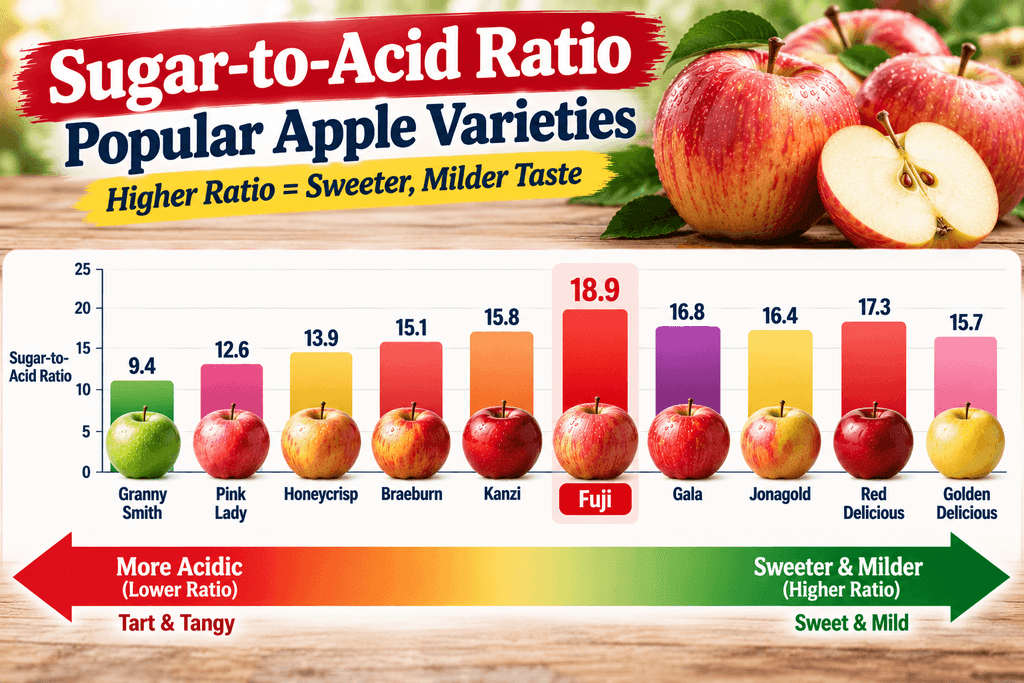
How sweet an apple tastes depends on its balance of sugar and acid. Using the 2018 study’s conventional samples, we divided each apple’s sugar reading (°Brix) by its total acid (g/L) to get a rough sugar-to-acid ratio. A higher number means the apple tastes sweeter relative to its acidity:
| Apple variety | Sugar (°Brix) | Total acid (g/L) | Sugar-to-acid ratio |
| Red Chief | 12.57 | 4.64 | 2.7 |
| Red Delicious | 11.97 | 4.89 | 2.4 |
| Envy | 13.16 | 5.45 | 2.4 |
| Fuji | 14.41 | 6.61 | 2.2 |
| Golden Delicious | 13.23 | 6.31 | 2.1 |
| Gala | 12.83 | 6.84 | 1.9 |
| Kanzi | 13.21 | 7.83 | 1.7 |
| Braeburn | 12.42 | 7.78 | 1.6 |
| Pink Lady | 12.92 | 8.17 | 1.6 |
| Granny Smith | 11.70 | 10.34 | 1.1 |
Calculated from conventional-production data in Mezey and Serralegri, 2018. These ratios are our own simple calculation for comparison, not values reported by the study.
Fuji isn’t the lowest-acid apple. Golden Delicious, Red Delicious, Red Chief, and Envy have less. But Fuji pairs moderate acid with the most sugar, which is why so many people describe it as one of the sweetest apples available.
Where Fuji came from
Fuji was developed in Japan. Researchers at the Tohoku Agricultural Experiment Station in Fujisaki, Aomori Prefecture, crossed Ralls Janet and Delicious (Red Delicious) and introduced the result in 1962. It was named after Fujisaki and Mount Fuji, and by 1990 it made up about half of Japan’s apple production (Sawamura et al., Plant Disease, 1993). Its Red Delicious parent is one of the lowest-acid apples, which may help explain Fuji’s mild, sweet character.
Sweetness Can Hide Acidity
This is the most important point for anyone with heartburn or sensitive teeth: your taste buds read the balance of sugar and acid, not the pH.
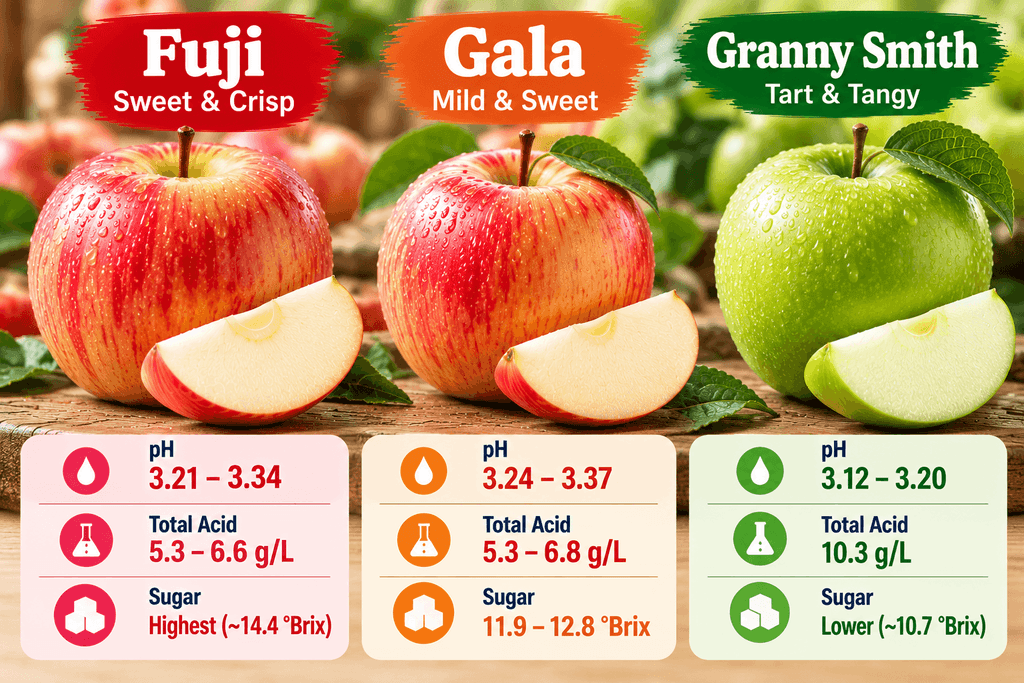
Fuji tastes mild because its sugar overpowers the sour notes. But its pH of about 3.2 to 3.3 is nearly the same as much tarter apples. For example, Granny Smith measured pH 3.12 to 3.20 in the same study (Mezey and Serralegri, 2018). The real difference is total acid: Granny Smith had about 1.6 to 1.9 times as much.
We’ve seen this pattern with other foods too. Sweet cherry tomatoes, for example, can contain plenty of acid despite tasting sweet. The lesson: don’t judge acidity by taste alone.
Fuji vs. Other Apples: Acidity Comparison
Here’s how Fuji compares with nine other varieties in the 2018 study (Mezey and Serralegri, 2018):
| Apple variety | pH (conventional) | Total acid, g/L (conventional) | pH (organic) | Total acid, g/L (organic) |
| Granny Smith | 3.12 | 10.34 | 3.20 | 10.26 |
| Pink Lady | 3.13 | 8.17 | 3.28 | 7.44 |
| Kanzi | 3.20 | 7.83 | 3.19 | 8.71 |
| Braeburn | 3.16 | 7.78 | 3.29 | 6.37 |
| Gala | 3.24 | 6.84 | 3.37 | 5.28 |
| Fuji | 3.21 | 6.61 | 3.34 | 5.33 |
| Golden Delicious | 3.19 | 6.31 | 3.33 | 4.99 |
| Envy | 3.31 | 5.45 | 3.46 | 5.24 |
| Red Delicious | 3.28 | 4.89 | 3.36 | 5.07 |
| Red Chief | 3.26 | 4.64 | 3.33 | 5.38 |
Source: Mezey and Serralegri, Athens Journal of Sciences, 2018, Tables 3 and 4.
Fuji vs. Gala
They’re almost twins on acidity. In the 2018 study, Fuji and Gala had nearly identical pH and total acid, and the Brazilian juice study found similar average acidity for both (Vieira et al., 2011). The difference is sugar: Fuji consistently tested sweeter. See Are Gala Apples Acidic?
Fuji vs. Honeycrisp
Honeycrisp wasn’t in the 2018 study. Other research found Honeycrisp juice at about pH 3.11 at harvest (Gao and Rupasinghe, 2012), with titratable acidity of 0.3% to 0.7% at harvest (Good Fruit Grower). Since the numbers come from different studies, the comparison is approximate, but Fuji is generally in a similar or slightly milder range, and it has more sugar per USDA (13.3 g vs. 12.4 g per 100 g). See Are Honeycrisp Apples Acidic?
Fuji vs. Pink Lady
Pink Lady had about 24% to 40% more total acid than Fuji in the 2018 study. Pink Lady tastes sweet-tart, while Fuji tastes sweet. See Are Pink Lady Apples Acidic?
Fuji vs. Granny Smith
Granny Smith had about 1.6 times (conventional) to 1.9 times (organic) as much total acid as Fuji, and less sugar. That’s why Granny Smith tastes sour and Fuji tastes sweet. See Are Granny Smith Apples Acidic?
Fuji vs. other foods
| Food | Approximate pH |
| Lemon juice | 2.00–2.60 (FDA) |
| Fuji apple | 3.21–3.34 (2018 study) |
| Tomatoes, fresh | 4.30–4.90 (FDA) |
| Bananas | 4.50–5.29 (FDA) |
| Cantaloupe | 6.13–6.58 (FDA) |
Sources: FDA, Approximate pH of Foods and Food Products; Fuji value from Mezey and Serralegri, 2018.
For a complete list, see our guide to acidic foods.
Fuji Apples and Reflux Risk
So how risky are Fuji apples if you have acid reflux or GERD? Here’s a realistic picture.
The good news
- Apples aren’t a common trigger. The National Institute of Diabetes and Digestive and Kidney Diseases (NIDDK) lists citrus fruits, tomatoes, alcohol, chocolate, coffee and caffeine, high-fat foods, mint, and spicy foods as foods that may worsen reflux. Apples aren’t on that list (NIDDK).
- Fuji has moderate acid. It contains less acid than Granny Smith, Pink Lady, Kanzi, and Braeburn, which makes it one of the gentler apple choices.
- Fuji is naturally low in fat, and fat is one of the foods NIDDK lists as a possible trigger.
The caveats
- Sweet doesn’t mean acid-free. Fuji’s pH is still about 3.2 to 3.3.
- Triggers are personal. The American College of Gastroenterology’s 2022 guideline recommends that people with GERD identify their own trigger foods (Katz et al., 2022). Some people react to any acidic fruit.
- No apple treats reflux. There’s no research showing that Fuji, or any apple, prevents or relieves heartburn.
Our take on Fuji’s reflux risk
Among common apples, Fuji sits in the lower-risk group, alongside Gala, Golden Delicious, Red Delicious, and Envy. Tart apples like Granny Smith and Pink Lady are more likely to bother acid-sensitive people. For a full ranking, see our guide to GERD-friendly apple varieties.
Tips for eating Fuji apples with reflux
- Eat them with a meal or snack, such as with oatmeal, yogurt, or cottage cheese.
- Keep portions moderate, like half an apple to start.
- Avoid eating close to bedtime. NIDDK suggests eating meals at least 3 hours before lying down if you have nighttime symptoms (NIDDK).
- Watch apple drinks. Apple juice has a pH of 3.35 to 4.00 (FDA) and is easy to overdo. See Is Apple Cider Safe for Acid Reflux?
- Track your symptoms in a simple food diary.
For more, read foods to avoid with GERD. If you have heartburn more than twice a week, trouble swallowing, or symptoms that don’t improve, see your doctor.
Fuji Apples and Your Teeth
Fuji combines natural sugar with moderate acid, so frequent snacking can expose your teeth to both. The American Dental Association recommends eating acidic foods as part of a meal, not by themselves, rinsing with water or having milk or cheese afterward, and waiting about an hour before brushing (American Dental Association).
A Fuji apple with a piece of cheese is a simple, tooth-friendly snack. Read more in Are Apples Good for Your Teeth?
Fuji Apples and Blood Sugar
Because Fuji is one of the sweetest apples, people managing blood sugar often ask about it. A few practical points:
- Fuji has more sugar per 100 grams than Gala, Honeycrisp, or Granny Smith, according to USDA data. The difference is a couple of grams, so portion size matters more than variety.
- Whole apples include fiber, about 2.1 grams per 100 grams of Fuji with skin (USDA FDC 1750340).
- Pairing apples with protein or fat, like nuts or cheese, is a common way to make a more balanced snack.
For more, see Are Apples Good for Diabetics? If you have diabetes, your doctor or a registered dietitian can help you fit fruit into your meal plan.
Cooking and Baking with Fuji Apples
Fuji’s sweetness makes it a natural choice for snacking, salads, and desserts:
- Raw snacking: Crisp, juicy, and sweet, it’s a favorite fresh-eating apple.
- Salads and slaws: Thin Fuji slices add sweetness without much tang.
- Baking: Because Fuji is so sweet, you may be able to use a little less added sugar in recipes. For more tang, mix it with a tarter apple like Granny Smith.
Cooking doesn’t remove an apple’s acid. The FDA lists applesauce at pH 3.10 to 3.60 (FDA).
Recipes to try with Fuji apples
- Honeycrisp apple salad: Fuji makes a sweet substitute.
- Maple apple muffins: Sweet Fuji pairs well with maple.
- Apple cinnamon raisin pancakes: A cozy weekend breakfast.
- Pumpkin apple scones: A fall favorite.
- Apple cupcakes with apple spice buttercream: A sweet treat for apple lovers.
A sprinkle of cinnamon complements Fuji’s natural sweetness.
Are Fuji Apples Healthy?
Yes. Fuji apples are a low-fat fruit with fiber and natural sugars. Here’s what USDA FoodData Central lists for 100 grams of raw Fuji with skin (USDA FDC 1750340):
| Nutrient | Per 100 g |
| Calories | about 58 |
| Water | 83.6 g |
| Carbohydrates | 15.7 g |
| Fiber | 2.1 g |
| Total sugars | 13.3 g |
| Potassium | 104 mg |
Tip: Keep the skin on for more fiber.
Frequently Asked Questions
Are Fuji apples acidic or alkaline?
Fuji apples are acidic, with a pH of about 3.21 to 3.34 in one study. Like most fruits, apples are considered alkaline-forming after digestion, but that doesn’t change your blood pH.
What is the pH of a Fuji apple?
About 3.2 to 3.3. In a 2018 study, conventional Fuji apples measured pH 3.21 and organic Fuji apples measured pH 3.34.
Are Fuji apples less acidic than other apples?
Fuji has less acid than Granny Smith, Pink Lady, Kanzi, and Braeburn, and about the same as Gala. Golden Delicious, Red Delicious, Red Chief, and Envy contain slightly less.
Are Fuji apples good for acid reflux?
They’re one of the gentler apple choices because of their moderate acid, but no apple treats reflux. Eat them with meals and in moderate portions.
Why are Fuji apples so sweet?
Fuji combines high sugar, about 13.3 grams per 100 grams according to USDA, with only moderate acid. It had the highest sugar of 11 varieties in one study.
Is Fuji or Gala less acidic?
They’re nearly the same. Studies found very similar pH and total acid for Fuji and Gala. Fuji usually tastes sweeter.
Is Fuji or Honeycrisp better for acid reflux?
Both have moderate acid. Fuji is generally in a similar or slightly milder range, but individual apples vary. Try each and see how you feel.
Are Fuji apples healthy?
Yes. They’re low in fat, provide fiber, and make a satisfying snack. Because they’re high in natural sugar, pair them with protein if you’re watching blood sugar.
The Bottom Line
Fuji apples are acidic, with a pH of about 3.2 to 3.3, but their high sugar content makes them taste sweet and mild. Their total acid is moderate, about the same as Gala, roughly half to two-thirds of Granny Smith’s, and less than Pink Lady’s.
For people with acid reflux, Fuji is one of the lower-risk apple choices, but it isn’t acid-free, and triggers vary from person to person. Enjoy Fuji apples with meals, keep portions reasonable, and pay attention to how your body responds.
Want to compare more apples? Read Are Gala Apples Acidic?, Are Honeycrisp Apples Acidic?, Are Pink Lady Apples Acidic?, Are Granny Smith Apples Acidic?, or Are Apples Acidic?
Medical disclaimer: This article is for general information only and isn’t a substitute for professional medical or dental advice. If you have frequent heartburn, GERD, diabetes, or dental sensitivity, talk with your doctor, dentist, or a registered dietitian.
References
- Mezey J, Serralegri D. Selected quantitative parameters comparison of apples from bio- and conventional production. Athens Journal of Sciences. 2018;5(4):343–354. https://doi.org/10.30958/ajs.5-4-3
- Vieira RG, Prestes RA, Denardi F, Nogueira A, Wosiacki G. Chemical pattern of Brazilian apples: a chemometric approach based on the Fuji and Gala varieties. Ciência e Tecnologia de Alimentos. 2011;31(2):418–426. https://www.redalyc.org/pdf/3959/395940105021.pdf
- Zhang M, Yin Y, Li Y, Jiang Y, Hu X, Yi J. Chemometric classification of apple cultivars based on physicochemical properties: raw material selection for processing applications. Foods. 2023;12(16):3095. https://doi.org/10.3390/foods12163095
- Sawamura K, Harada Y, Kikuchi T, Ogawa JM. The apple industry in Japan: a historical sketch and diseases specific to the region. Plant Disease. 1993;77(6):546. https://apsnet.org/publications/PlantDisease/BackIssues/Documents/1993Articles/PlantDisease77n06_546.PDF
- Gao J, Rupasinghe HPV. Characterization of ‘Honeycrisp’ and ‘McIntosh’ apple juice quality in relation to delayed cooling treatments. The Open Food Science Journal. 2012;6:12–15. https://benthamopen.com/contents/pdf/TOFSJ/TOFSJ-6-12.pdf
- Good Fruit Grower. How to measure Honeycrisp qualities (quoting Dr. Jim Mattheis, USDA-ARS). https://goodfruit.com/how-to-measure-honeycrisp-qualities
- USDA FoodData Central. Apples, fuji, with skin, raw (FDC ID 1750340, Foundation Foods). https://fdc.nal.usda.gov/fdc-app.html#/food-details/1750340/nutrients
- USDA FoodData Central. Apples, honeycrisp / gala / granny smith, with skin, raw (FDC IDs 1750343, 1750341, 1750342). https://fdc.nal.usda.gov/fdc-app.html#/food-details/1750343/nutrients
- U.S. Food and Drug Administration, CFSAN. Approximate pH of Foods and Food Products. 2007. Copy used: https://riverstonehealth.org/wp-content/uploads/FDA-Approximate-pH-of-Foods.pdf
- NIDDK. Eating, Diet, & Nutrition for GER & GERD. https://www.niddk.nih.gov/health-information/digestive-diseases/acid-reflux-ger-gerd-adults/eating-diet-nutrition
- Katz PO, Dunbar KB, Schnoll-Sussman FH, et al. ACG Clinical Guideline for the Diagnosis and Management of GERD. Am J Gastroenterol. 2022;117(1):27–56. https://doi.org/10.14309/ajg.0000000000001538
- American Dental Association, MouthHealthy. Dietary Acids and Your Teeth. https://www.mouthhealthy.org/all-topics-a-z/dietary-acids-and-your-teeth
- Remer T, Manz F. Potential renal acid load of foods and its influence on urine pH. J Am Diet Assoc. 1995;95(7):791–797. https://pubmed.ncbi.nlm.nih.gov/7797810/ [VERIFY PMID]
- Hopkins E, Sanvictores T, Sharma S. Physiology, Acid Base Balance. StatPearls. https://www.ncbi.nlm.nih.gov/books/NBK507807/ [VERIFY authors]
Related Posts

Subscribe for New Racipies
Get mental health tips, updates, and resources delivered to your inbox.
Is Kombucha Acidic? Is It Good For Acid Reflux?

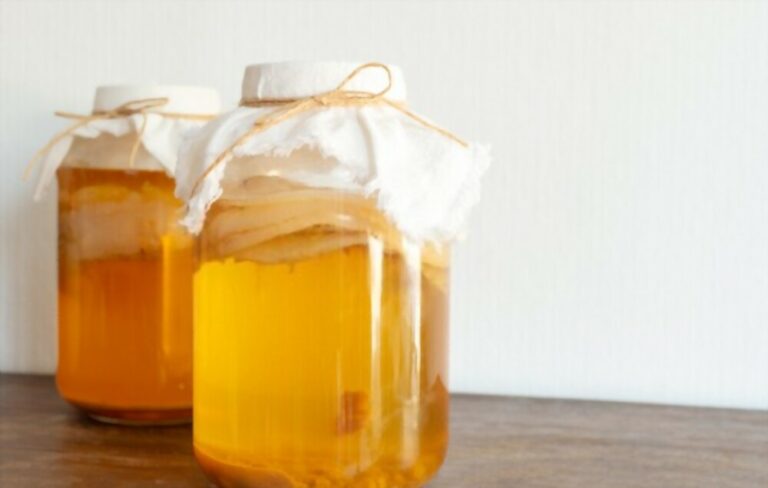
The combination is pretty weird! Black tea, yeast, and sugar, and you got kombucha.
Kombucha lovers say this fermented tea is great for boosting energy, helping in digestion, and removing toxins from your body. But others say they have issues with the versatile taste-sometimes sweet or sometimes tangy.
You must be wondering about the diversity. And trying to figure out if kombucha is acidic or not?
Kombucha is acidic with the pH range between 2.5 to 4.2. When you ferment the kombucha tea, it produces less than 1% acetic acid which has a pH level of 3.0-3.5. This acid is responsible for the tangy nature of kombucha. Surprisingly, moderate amount kombucha is good for reducing acid reflux too.
However, the actual pH level is dependent on the tea types, tea-sugar-yeast ratio, brew time, room temperature, and the length of fermentation.
Keep reading to learn more about the acidic nature of kombucha and its relationship with acid reflux.
Kombucha – Acidic Or Alkaline?
In one line, kombucha is acidic, not alkaline. Let me explain why!
Black tea, green tea, white tea, or oolong tea are used for making kombucha. However, black tea for its oxidized leaves nature is mostly preferable for making a perfect kombucha.
And the pH of black tea is 4.9-5.5 which is a good range to grow yeast perfectly.
With time, the yeast of SCOBY (symbiotic culture of bacteria and yeast) starts eating the sugar content of the kombucha. That results in producing ethanol and it gradually turns acidic.
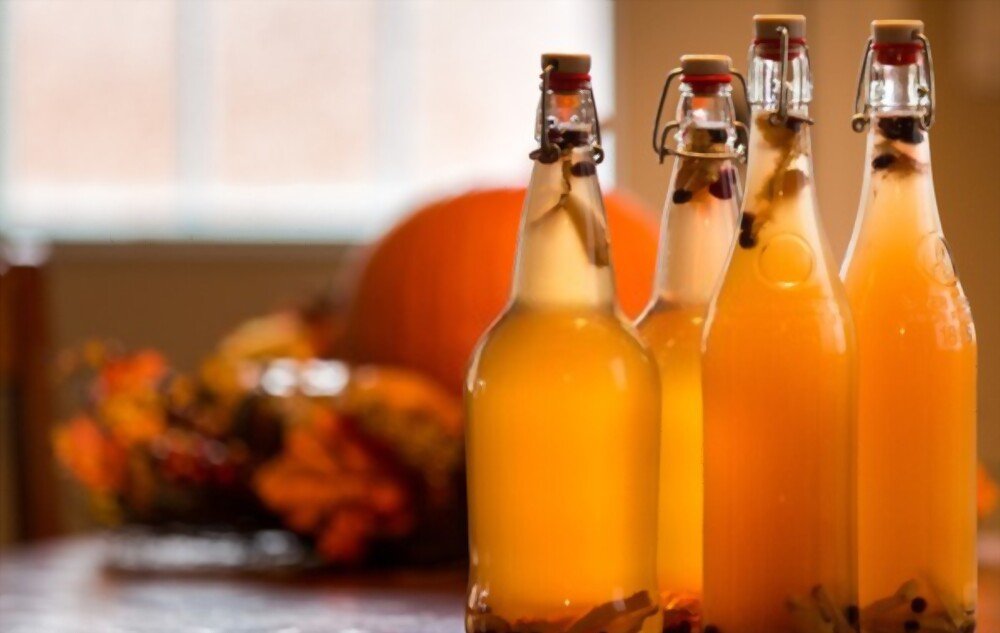
What about green tea or white tea kombucha? Well, they are neutral or basic, but with the fermenting process over time, the alkaline nature will vanish and turn into acidic for the yeast.
pH of Kombucha
The pH of kombucha is directly related to the fermentation time. However, tea types and ratios also take part in the pH level of kombucha.
And the pH value defines whether kombucha will taste sweet or tart. The pH like 3.5 ensures it will taste sweet. The lower pH like 2.5 makes the kombucha tart.
| Type | pH |
| Homemade Kombucha | 2.5 – 3.0 |
| Black Tea Kombucha | 5-5.5 |
| Green Tea Kombucha | 3.05 |
| White Tea Kombucha | 2.5 – 3.5 |
| Kombucha Rosella Tea | 2.86 |
| GT’s Kombucha | 2.5 – 3.5 |
| Kombucha brewed | 2.5 – 4.2 |
| Humm Kombucha | 3.0 |
| Sweet Kombucha | 3.5 |
3 Ways: How To Raise The pH Of Kombucha?
When you ferment kombucha, acetic and gluconic acid start producing by the fermenting bacteria. That results in a lower pH level and makes the taste too tart.
Also, lower pH means the kombucha is highly acidic which is not good for you especially if you are struggling with acid reflux.
Besides, when the taste is too tart, you may want to make it a little sweet. To make kombucha sweet, you have to increase the pH level. Here 3 ways to increase the pH of Kombucha –
1. Less Ferment Time
In general, the fermenting process takes from 7 days to 30 days. The more you ferment, the kombucha will be more acidic and vice versa. To make it less acidic, you can brew after the first fermentation which may take 6 to 10 days.
2. Keep It in Room Temperature
Kombucha brewing temperature affects the pH value directly. More than 85°F speeds up the culturing, which will result in lower pH.
To increase the pH level, you should keep the kombucha vessel at room temperature in between 68-78°F.
3. Maintain The Tea Leaf Ratio
Using more tea leaves can cause lower pH for the tea leaves’ oxidation nature over time. For each one-gallon batch, keep the ratio 6:1 for the tea leaves.
You can use 6 teaspoons of loose tea or 6 tea bags for each batch. So, keep the ratio perfect to get a higher pH kombucha.
How Acidic Is Kombucha For The Body?
Kombucha is acidic, but after drinking, it alkalizes the body. It’s because when you make kombucha using black or green tea, there will be several essential minerals such as manganese, potassium, copper, iron, fluid iron, etc.
The pH of our blood is 7.4 regarded as neutral. When these minerals of kombucha enter our bloodstream, that creates an alkalizing effect and results in a neutral state of our body.
Who Should Not Drink Kombucha? Are You in the 4 Categories?
Kombucha is considered safe and healthy to promote a healthy and smooth digestive system, boost energy and remove body toxins.
However, you are prohibited to drink kombucha under the following health conditions-
1. People With A Weak Immune System
As bacteria and yeast take an active part in kombucha, that may cause infection for people with weak immune systems.
2. Diabetics Patient
Kombucha contains a good amount of sugar. So it may increase blood sugar levels. Also, alcohol production during fermentation can cause complications for diabetic patients.
3. Pregnant, Breastfeeding Women And Kids
For the alcohol and caffeine, pregnant and breastfeeding women should avoid kombucha. Similarly, the bacteria and yeast might be harmful to the developing baby.
Additionally, kids should not drink kombucha. The carbonate effect of kombucha will cause stomach upset.
4. People With Stomach Ulcers
If you have stomach ulcers, kombucha may make it worse. The bacteria and acidic nature of kombucha can potentially aggravate stomach ulcers.
Is Kombucha Good For Acid Reflux?
Acid reflux occurs when you eat or drink high acidic or high-fat content food and drinks. if you have a lower esophageal sphincter (LES), your stomach content leaks up back. That causes acid reflux.
Now the question is what about kombucha? Is it good for acid reflux or promotes acid reflux?
The nature of kombucha is acidic, so you may think it’s not good for acid reflux. But the truth is kombucha is good for people who are suffering from acid reflux.
Kombucha contains lactic acid which has probiotic properties. That can kill harmful bacteria as well as promote smooth digestion. So far, lactic acid is beneficial to reduce the chances of acid reflux.

The tea drink is a great source of vitamin B. vitamin B can improve your gut health by controlling the production of stomach acid.
Several essential minerals of kombucha neutralize the acidic properties and make it alkalizing for your body.
For these activities, kombucha is good for acid reflux. However, you should be concerned about your daily intake. You can drink around 4 ounces per day to avoid health complications. Also, avoid adding high sugar content to it to get the best result.
Is Kombucha Bad For Acid Reflux?
Drinking too much kombucha causes acid reflux. The recommended level is 4 ounces per day for 1 to 3 times.
However, kombucha will be bad for acid reflux under certain health conditions.
First of all, if you already have the symptoms of acid reflux, drinking too much kombucha may make it worse.
Kombucha contains a decent amount of caffeine and alcohol. Both can increase the acid production in your stomach and irritate your digestion which causes heartburn too.
A lengthy fermentation process makes kombucha carbonated. And the carbonated nature feels your stomach fuller and pressurizes your lower esophageal sphincter. As a result, the acid flow starts moving back into the esophagus which leads to acid reflux directly.
In addition, the acetic acid of kombucha may also be responsible for acid reflux or GERD by disturbing your regular digestive system.
Various Forms Of Kombucha And Its Acidity
In the USA, around 14. 1 percent of adults drink kombucha in various forms such as kombucha tea, raw or hard kombucha for several purposes. The pH level and acidity are also different for each type.
Is Kombucha Tea Alkaline Or Acidic?
Kombucha tea is acidic with a pH range of 2.5 to 3.5. However, using tea bags instead of tea leaves makes kombucha tea more acidic for rapid oxidation.
The type of tea affects the acidity of kombucha. If you use pure black tea, it will make kombucha too acidic as black teas are already acidic in nature.
pH wise oolong tea kombucha will be almost the same as the black tea version. Though green tea and white tea kombucha seem alkaline for their higher pH values. But during the fermentation process, the basic nature will be removed.
Whether you use either green or white tea, the resulting kombucha tea will be acidic with a pH below 4.6. However, adding fruits or herbs can reduce the acidity of kombucha tea.
Related Post: Is Tea Acidic? 5 Non-acidic Alkaline Tea for You!
Is Hard Kombucha Acidic?
Hard kombucha is more acidic than kombucha tea. It’s the boozier version of the regular or raw kombucha. As hard kombucha fermented at 28°C/82.4°F or higher for 5 to 14 days, it will taste tangy and slightly vinegary.
Warm temperatures and lengthy fermentation, increases the ABV (alcohol by volume) and decreases the pH level to around 2.5.
Is Raw Kombucha Acidic?
Raw kombucha is not pasteurized though it’s acidic with a pH of less than 4.6. Mostly, the pH level of raw kombucha is 2.5-3.5. During the fermentation period, the yeast starts feeding the sugar content and creates a suitable environment to grow gradually. This process enhances the pH level of the raw kombucha drink.
Fun fact: Do you know when and where the kombucha tea originated? In 220 BC, kombucha originated in China. Then it reaches Russia, USA, Germany and all over the world.
FAQs
Is Kombucha Highly Acidic?
Yes, kombucha is highly acidic. The pH level of kombucha can range from 2.5 to 3.5, making it acidic. However, the acidity of kombucha is not harmful and can actually be beneficial for your health.
Is Kombucha Good For An Acidic Stomach?
Yes, kombucha can be good for an acidic stomach. This is because kombucha is rich in probiotics, which can help to balance the levels of acid in the stomach. At the same time, it can improve digestion, reduce inflammation and promote a healthy immune system.
Is Kombucha Acidic For Teeth?
Drinking too much kombucha is acidic for teeth. The acidity and sugar in kombucha can lead to tooth decay and other dental problems damaging tooth enamel. This is why it’s important to drink kombucha in moderation and to brush your teeth after drinking it.
Is Kombucha Bad For Ulcers?
Mostly, kombucha can be bad for people with ulcers. The fermented tea drink contains acetic acid, which can irritate the already inflamed lining of the stomach and intestines. In addition, the probiotics in kombucha can also increase gastric acid production, further exacerbating the symptoms of ulcers.
Is Kombucha Part Of An Alkaline Diet?
Kombucha is part of an alkaline diet. The fermentation process of kombucha results in a slightly acidic beverage with a pH between 2.5 and 3.5. However, after the drink is consumed, it leaves behind alkaline ash in the body that helps to neutralize acidity.
Does Kombucha Make Your Body Acidic or Alkaline?
Kombucha is acidic but it makes your body alkalize when it enters the bloodstream. The acidic nature neutralizes by the neutral pH of the blood and acts like alkalize to your body.
Bottom Line
Now it’s time to wrap up the discussion on: “is kombucha acidic”. Hopefully, you can understand the acidic nature and its role in acid reflux.
In summary, kombucha is acidic but a moderate amount is good for acid reflux. Also, the probiotics of kombucha are beneficial for sound digestion, weight loss, preventing GERDs as well as keeping your skin healthy.
Eat healthy, live healthy.
Related Posts
Subscribe for New Racipies
Get mental health tips, updates, and resources delivered to your inbox.