
Are Cherry Tomatoes Acidic? pH vs Regular Tomatoes

Medically reviewed by Jaclyn Weiner, RD, RDN, MEd, MS Updated Date: October 10, 2026
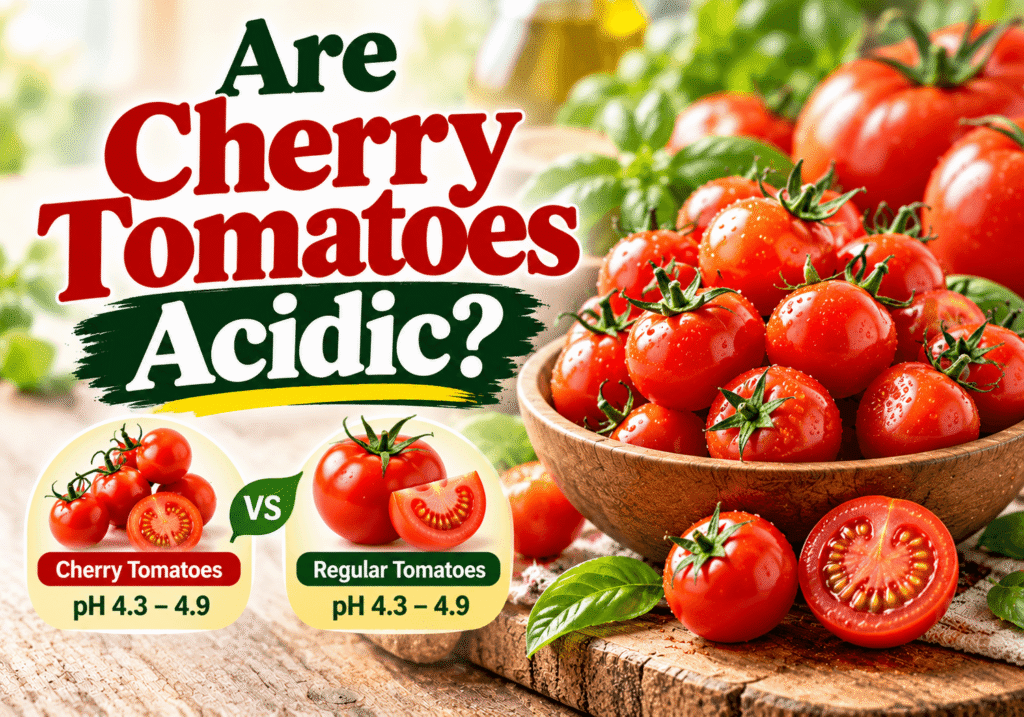
Yes, cherry tomatoes are acidic. Like all fresh tomatoes, they fall in the moderately acidic range. The FDA lists fresh tomatoes at a pH of about 4.3 to 4.9, and there is no official, separate pH value for cherry tomatoes (FDA). Here’s the surprise: even though cherry tomatoes taste sweeter, research suggests they usually contain more sugar and more organic acid than large tomatoes (Pérez-Marín et al., 2021). So they aren’t a low-acid choice. They simply taste milder because the extra sugar balances out the tang.
If you love popping cherry tomatoes like candy but sometimes get heartburn, sore teeth, or a stinging mouth afterward, this guide is for you. You’ll learn what’s known (and not known) about cherry tomato pH, how cherry and grape tomatoes compare with regular slicing tomatoes, what makes one batch tarter than another, and how to keep enjoying these little tomatoes without the burn.
Key Takeaways
- Cherry tomatoes are acidic. They fall within the same general pH range as other fresh tomatoes, roughly 4.3 to 4.9.
- Sweeter doesn’t mean less acidic. Cherry tomatoes tend to have more sugar and more organic acid than large tomatoes, so the sweetness masks the sourness.
- There’s no reliable “low-acid” cherry tomato. Even extension experts haven’t found cherry-specific pH data, and “low-acid” tomatoes generally test about as acidic as others.
- Ripeness, season, and growing conditions matter more than whether a tomato is cherry-sized or full-sized.
- Cherry tomatoes can trigger reflux in sensitive people, but small portions eaten with a meal are often easier to handle.
- Snacking on them all day is harder on teeth than eating them with a meal.
- Nutritionally, they shine. Per 100 grams, USDA data for grape tomatoes show more vitamin C and lycopene than the USDA entry for regular red tomatoes.
For the full story on tomato pH, including the famous Supreme Court “fruit or vegetable” case, see our main guide: Are Tomatoes Acidic?
Are Cherry Tomatoes Acidic? The Short Answer
Cherry tomatoes are acidic because their pH is below 7, the neutral point on the pH scale. Every tomato, from a tiny currant tomato to a giant beefsteak, gets its tang from natural plant acids, mainly citric acid (the acid in lemons) and malic acid (the acid in apples).
But how acidic are they really? On the pH scale, each whole number is a tenfold change in acidity. Lemon juice, at about pH 2.0 to 2.6, is roughly 100 times more acidic than a typical tomato. So cherry tomatoes are not “strongly” acidic like citrus juice or vinegar. They sit in the middle of the scale, alongside most fruits.
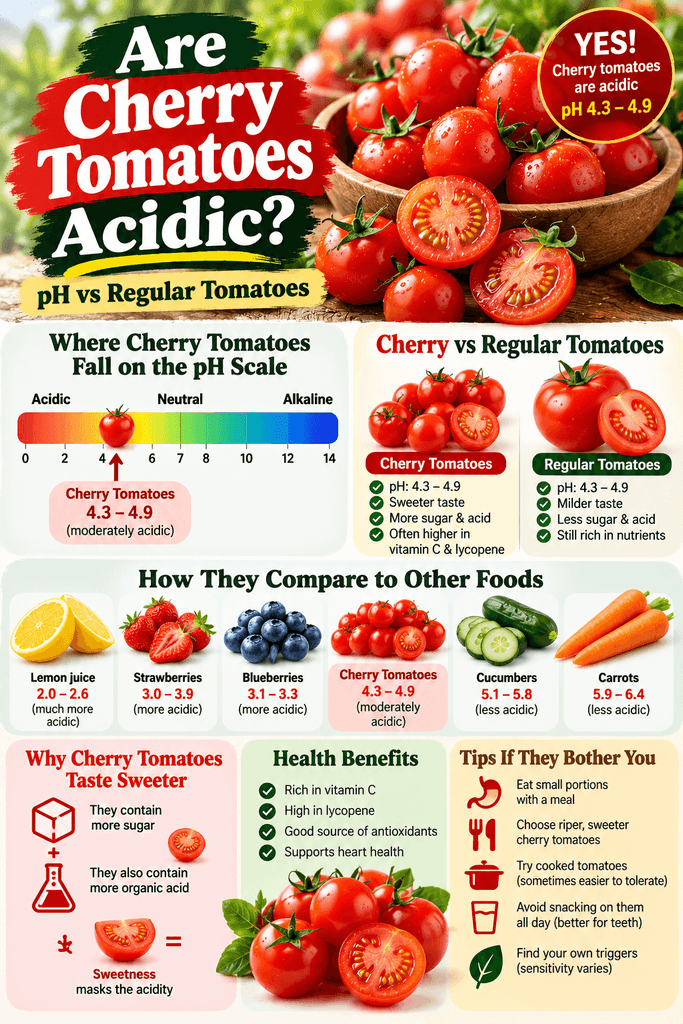
Here’s where cherry tomatoes fit compared with some familiar foods, using FDA pH values:
| Food | Approximate pH (FDA) |
| Lemon juice | 2.00–2.60 |
| Strawberries | 3.00–3.90 |
| Blueberries (Maine) | 3.12–3.33 |
| Ketchup | 3.89–3.92 |
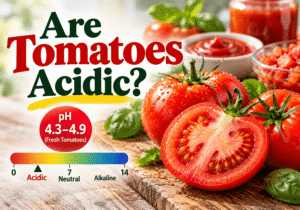
| Fresh tomatoes (including cherry types) | 4.30–4.90 |
| Cucumbers | 5.12–5.78 |
| Carrots | 5.88–6.40 |
Source: FDA, Approximate pH of Foods and Food Products. The FDA doesn’t list cherry tomatoes separately, so the “fresh tomatoes” range is the best available reference.
So, cherry tomatoes are less acidic than berries and citrus but more acidic than most vegetables. For a much bigger list, see our complete guide to acidic foods.
What Is the pH of Cherry Tomatoes?
This is where things get interesting. You might expect a simple answer, like “cherry tomatoes have a pH of 4.4.” But there isn’t one.
The FDA’s widely used pH table lists fresh tomatoes as a group, at 4.30 to 4.90, without splitting them by size or variety (FDA). When a home gardener asked the Cooperative Extension “Ask Extension” service in 2024 which cherry tomatoes are the least acidic, the expert who answered wrote that she “found no specific information about the pH of cherry tomatoes,” and noted that tomato pH varies with soil, time of year, and ripeness (Ask Extension, 2024).
Scientific studies of cherry tomatoes usually measure titratable acidity (how much acid is in the fruit) and soluble solids (mostly sugar) rather than publishing a simple pH figure. Those measurements tell us a lot about flavor, but they don’t translate into one neat pH number for every cherry tomato on the shelf.
The most honest answer is this: cherry tomatoes generally fall within the normal tomato pH range of about 4.3 to 4.9, and individual batches can be a bit higher or lower depending on how they were grown and how ripe they are.
Why a single number would be misleading
Even within one plant, acidity can shift over the season. In a 2024 study of cherry tomatoes grown in soilless culture in Italy, researchers found that fruit pH was highest at the start of the harvest period and lower in later harvests, and that fruit position on the bunch also made a difference (Rivelli et al., 2024). In other words, the cherry tomatoes you pick in early summer may not taste or test the same as those you pick weeks later from the same vine.
Cherry Tomatoes vs Regular Tomatoes: Which Is More Acidic?
Most people assume cherry tomatoes are less acidic because they taste sweeter. The evidence points the other way.
A 2021 study of cherry tomato cultivars, published in the journal Agronomy, notes that cherry tomatoes have “higher contents of both sugars and organic acids” than large-sized tomatoes, citing earlier research (Pérez-Marín et al., 2021). That’s the key to understanding cherry tomatoes. They pack in more of everything that creates flavor: more sweetness and more tartness.
Here’s a side-by-side summary:
| Feature | Cherry / grape tomatoes | Regular slicing tomatoes |
| pH (FDA, all fresh tomatoes) | About 4.3–4.9 (no separate value) | About 4.3–4.9 |
| Organic acids | Tend to be higher | Tend to be lower |
| Sugars | Tend to be higher | Tend to be lower |
| Typical taste | Sweet, intense, “tangy-sweet” | Milder, juicier, sometimes watery |
| Vitamin C per 100 g (USDA) | 27.2 mg (grape tomatoes) | 13.7 mg (red, ripe) |
| Lycopene per 100 g (USDA) | 4,100 mcg (grape tomatoes) | 2,573 mcg (red, ripe) |
| Calories per 100 g (USDA) | 27 (grape tomatoes) | 18 (red, ripe) |
Sources: FDA pH table; Pérez-Marín et al., 2021; USDA FoodData Central for grape tomatoes (FDC 321360) and red ripe tomatoes (FDC 170457). The two USDA entries come from different datasets and samples, so treat the nutrient comparison as a general guide rather than an exact head-to-head.
Why cherry tomatoes taste sweeter
Sweetness in tomatoes is often measured in degrees Brix (°Brix), a measure of dissolved solids in the juice. Sugars make up most of those dissolved solids, which is why Brix is used as a rough sugar test, though organic acids count toward it too (Ohio State University Extension).
In the 2021 Agronomy study, eight cherry tomato cultivars had Brix values between about 7.7 and 9.4 (Pérez-Marín et al., 2021). That’s a lot of sugar packed into a small fruit, and it explains why cherry tomatoes taste so much sweeter than many grocery-store slicing tomatoes.
Ohio State’s extension specialists add an important caution: a high Brix value doesn’t guarantee a sweet taste, because other flavor compounds, including acids, can overpower the sugar (Ohio State University Extension). That’s why some cherry tomatoes taste bright and almost sour, even though they’re full of sugar.
Sweet doesn’t mean low-acid
This is the single most important point in this article. Your tongue measures the balance of sugar and acid, not pH.
Purdue Extension explains this using yellow tomatoes, which are often sold as “low-acid”: they are “not really any lower in acid than red; they contain more sugar and, therefore, have a sweeter taste” (Purdue Extension, 2015). The Ask Extension expert made the same point about so-called low-acid varieties, saying they are “just as acidic as other tomatoes” and simply taste less sour because of their sweetness (Ask Extension, 2024).
Cherry tomatoes work the same way. A super-sweet cherry tomato can still deliver plenty of acid. If your teeth, throat, or stomach are sensitive to acid, don’t use taste as your guide.
Does size matter among cherry tomatoes?
Even within cherry tomatoes, size seems to affect flavor. A 2019 study in AIMS Agriculture and Food sorted cherry tomatoes into small, medium, and large sizes. The smallest fruits had the highest soluble solids (a sign of more sugar), while the largest fruits kept the most titratable acidity and vitamin C during storage (Islam et al., 2019).
This doesn’t mean big cherry tomatoes are a “high-acid” choice or tiny ones are “low-acid.” The differences are modest, and pH wasn’t the main focus. But it’s another reminder that sweetness and acidity don’t simply cancel each other out.
Cherry vs Grape vs Other Small Tomatoes
Walk through any produce section and you’ll see several kinds of small tomatoes. Here’s how they compare when it comes to acidity.
- Round cherry tomatoes: The classic bite-size tomato, often very sweet with a thin skin that “pops.”
- Grape tomatoes: Oblong, slightly firmer, and often a bit less juicy. Despite the name, they have nothing to do with grapes, which are more acidic.
- Pear-shaped tomatoes: Small, teardrop-shaped tomatoes, sometimes yellow or red.
- Yellow, orange, and other colored cherry tomatoes: Often taste milder, mainly because of extra sugar, not lower acid (Purdue Extension, 2015).
Is one shape more acidic than another? The 2021 Agronomy study compared four pear-shaped and four round cherry tomato cultivars. Their titratable acidity values overlapped closely, ranging from about 0.94 to 1.30 in the study’s units, with no clear winner by shape (Pérez-Marín et al., 2021). In practice, the variety, growing conditions, and ripeness matter more than shape.
And don’t confuse cherry tomatoes with actual cherries. Both are small, red, and sweet, but they’re very different fruits with their own acidity profiles.
What Makes Some Cherry Tomatoes More Acidic?
If one carton of cherry tomatoes tastes sharp and the next tastes like candy, several factors could be at play.
1. Ripeness
Unripe, green tomatoes are generally more acidic than ripe red ones (Purdue Extension, 2015). As a cherry tomato ripens on the vine, it builds sugar and color, so it tastes sweeter and mellower. Underripe cherry tomatoes picked early for shipping are more likely to taste tart.
2. Time of the season
As mentioned earlier, the 2024 Italian study found that cherry tomato pH shifted over the harvest season, with lower pH (more acidic) fruit in later harvests (Rivelli et al., 2024). Weather, sunlight, and plant age all play a part.
3. Growing conditions
Colorado State University Extension lists several conditions that can make tomatoes less acidic, including fruit that is damaged, grown in shade, grown during shorter days, ripened off the vine, or harvested from dead vines (Colorado State University Extension). That matters most for home canners, since less acidic tomatoes are harder to can safely.
4. Variety
Variety does make some difference. A two-year Utah State University study that tested 15 tomato varieties found that three heirloom varieties were statistically less acidic than the hybrid used for comparison. However, the researchers still told home canners to follow USDA guidelines and add acid to all tomatoes (Heflebower and Washburn, 2010). There isn’t good published pH data for specific popular cherry varieties, so be skeptical of any list ranking them by pH.
5. Color
As covered above, yellow and orange cherry tomatoes usually taste less acidic because of extra sugar, but they aren’t reliably lower in acid (Purdue Extension, 2015).
Are Cherry Tomatoes Bad for Acid Reflux?
For some people, yes. The National Institute of Diabetes and Digestive and Kidney Diseases (NIDDK) lists tomatoes and tomato products among the foods that may make acid reflux symptoms worse (NIDDK). Cherry tomatoes are still tomatoes, so they belong on that list too.
But tomatoes don’t bother everyone. The American College of Gastroenterology’s 2022 GERD guideline recommends that people identify their own trigger foods rather than cutting out every food that might cause trouble. It also advises avoiding meals in the 2 to 3 hours before bedtime (Katz et al., 2022).
The portion advantage of cherry tomatoes
Cherry tomatoes have one big advantage for people with reflux: they make portion control easy. You can count them. Five cherry tomatoes in a salad is a very different dose of acid than a large bowl of marinara or a glass of tomato juice.
Try this simple experiment if you suspect tomatoes bother you:
- Start small. Eat 3 to 5 cherry tomatoes as part of a meal, not on an empty stomach.
- Note how you feel over the next few hours in a simple food diary.
- Adjust. If you feel fine, try a few more next time. If you get symptoms, cut back or skip them for a while.
- Look at the whole meal. Fat, spice, coffee, alcohol, and large portions can all add to reflux. A few cherry tomatoes may be fine, while a greasy pizza with tomato sauce is not.
For more on what to limit, see our guide to foods to avoid with GERD.
Reflux-friendly ways to eat cherry tomatoes
If cherry tomatoes bother you a little, these pairings may help:
- Pair them with low-acid foods. Toss a few cherry tomatoes with cucumber, avocado, and cooked grains like basmati rice.
- Add something creamy. Cherry tomatoes with cottage cheese or plain Greek yogurt dip make a more balanced snack.
- Go easy on vinegar. Balsamic vinegar and vinaigrettes add more acid. Try a drizzle of olive oil, salt, and herbs instead.
- Skip the late-night snack. Eat them earlier in the day.
- Cook them gently. Some people find roasted cherry tomatoes easier to enjoy than raw ones, though cooking doesn’t remove the acid.
If you have frequent heartburn (more than twice a week), trouble swallowing, or symptoms that don’t improve, talk with your doctor.
What about gastritis?
People with gastritis (an inflamed stomach lining) often find that acidic or spicy foods make them uncomfortable, but this varies a lot from person to person. If cherry tomatoes bother you, try small amounts as part of a meal. For gentle meal ideas, see our 7-day meal plan for gastritis.
Are Cherry Tomatoes Bad for Your Teeth?
Cherry tomatoes are so easy to snack on that people often eat them by the handful throughout the day. That habit matters more for your teeth than the tomatoes themselves.
Acidic foods can soften tooth enamel. The American Dental Association (ADA) explains that how often and how long your teeth are exposed to acid is a big part of the risk, and it suggests eating acidic foods like tomatoes and citrus as part of a meal rather than snacking on them alone (American Dental Association).
Interestingly, the gardener who asked Ask Extension about low-acid cherry tomatoes did so because acidic tomatoes were bothering her teeth (Ask Extension, 2024). Since there’s no proven low-acid cherry tomato, changing how you eat them is the better fix:
- Eat cherry tomatoes with meals instead of grazing on them all afternoon.
- Pair them with cheese, such as mozzarella in a caprese salad.
- Rinse with water after a tomato-heavy snack.
- Wait a while before brushing after eating acidic foods, so you’re not scrubbing softened enamel.
For more about fruit and dental health, see are apples good for your teeth?
Cherry Tomatoes and Mouth Sores
If you have a canker sore, cherry tomatoes can sting. Mayo Clinic lists spicy or acidic foods among the foods that can trigger canker sores in some people (Mayo Clinic). While a sore is healing, it’s a good idea to skip raw tomatoes, salsa, and citrus for a few days and choose soft, mild foods like yogurt, oatmeal, and eggs. See a doctor or dentist if a sore is very large, very painful, or lasts more than two weeks.
Does Cooking Change the Acidity of Cherry Tomatoes?
Cooking doesn’t add acid to cherry tomatoes, but it changes how they taste and how concentrated they are.
- Roasting and blistering bring out sweetness and soften the sharp edge, so cooked cherry tomatoes often taste mellower. Our slow-roasted tomatoes are a great example.
- Simmering into sauce removes water, so the acid becomes more concentrated per spoonful. A thick cherry tomato sauce can taste tangier than a few fresh tomatoes.
- Adding dairy (like ricotta or mozzarella) softens both the taste and the acidity of a dish.
- A tiny pinch of baking soda can neutralize some of the acid in a cherry tomato sauce, because baking soda is alkaline. Use very little, or the sauce will taste soapy.
If you want lots of lycopene, cooking has a bonus. In a small study in the American Journal of Clinical Nutrition, people absorbed about 2.5 times more lycopene from tomato paste than from fresh tomatoes when both meals contained oil (Gärtner et al., 1997). So roasting cherry tomatoes with a little olive oil is both delicious and a smart way to get more of this red pigment.
Can You Can Cherry Tomatoes Safely?
Yes, but cherry tomatoes follow the same safety rules as any other tomato.
The bacterium that causes botulism can’t grow in foods at pH 4.6 or below (UC Master Food Preserver Program). Because tomatoes range from about 4.3 to 4.9, some of them are above that line. Colorado State University Extension states plainly that because of this uncertainty, all home-preserved tomato products must be acidified to pH 4.6 or below (Colorado State University Extension).
Colorado State recommends adding one of the following directly to each jar before filling:
| Jar size | Bottled lemon juice | Citric acid | 5% vinegar |
| Pint | 1 tablespoon | ¼ teaspoon | 2 tablespoons |
| Quart | 2 tablespoons | ½ teaspoon | 4 tablespoons |
Source: Colorado State University Extension. Vinegar may change the flavor more than lemon juice or citric acid.
Don’t skip the acid just because your cherry tomatoes taste tart or sweet. Taste doesn’t tell you the pH. Also avoid canning damaged fruit or fruit from frost-killed or dead vines, and always follow a tested recipe from a university extension service or the USDA (Colorado State University Extension). Our main tomato acidity guide has more on why tomatoes are a borderline canning food.
Cherry Tomato Nutrition
Acidity aside, cherry tomatoes are a nutritious, low-calorie snack. USDA FoodData Central doesn’t have a current entry labeled simply “cherry tomatoes,” but it does have one for grape tomatoes, a close small-fruited cousin. Here’s what 100 grams (roughly 6 to 10 small tomatoes, depending on size) provides:
| Nutrient | Grape tomatoes, raw (per 100 g) |
| Calories | 27 |
| Water | 92.5 g |
| Carbohydrates | 5.5 g |
| Fiber | 2.1 g |
| Protein | 0.8 g |
| Vitamin C | 27.2 mg |
| Potassium | 260 mg |
| Lycopene | 4,100 mcg |
| Beta-carotene | about 440 mcg |
Source: USDA FoodData Central, Tomatoes, grape, raw (FDC ID 321360).
A few highlights:
- Vitamin C: With about 27 mg per 100 grams, grape tomatoes provide roughly 30% of the 90 mg Daily Value for vitamin C (NIH Office of Dietary Supplements). Vitamin C helps your body make collagen and absorb iron from plant foods.
- Lycopene: This red pigment is a carotenoid with antioxidant activity. Per 100 grams, the USDA grape tomato entry lists noticeably more lycopene than its entry for regular red tomatoes (4,100 vs. 2,573 mcg).
- Fiber and potassium: Small but useful amounts, with very few calories.
Cherry tomatoes are an easy way to add color and nutrients to salads, grain bowls, pasta, and snack plates.
Easy Ways to Enjoy Cherry Tomatoes
If cherry tomatoes agree with you, here are some ideas from our kitchen:
- Caprese salad: Swap sliced tomatoes for halved cherry tomatoes and pair them with fresh mozzarella and basil.
- Slow-roasted tomatoes: Roasting concentrates sweetness and mellows the tang.
- Summer Greek-style pasta: Cherry tomatoes are perfect in cold pasta salads.
- Grilled kale with ricotta and tomatoes: Creamy ricotta balances bright tomatoes.
- Kale avocado salad: Add a handful of halved cherry tomatoes for color.
- Roasted corn pico de gallo: Use diced cherry tomatoes for extra sweetness. Go easy on the lime and chili if you’re acid-sensitive.
- Shakshuka and pasta puttanesca: Both work with cherry tomatoes cooked down into a quick sauce. Save these for days your stomach feels fine.
Lower-acid alternatives
If you need a break from tomatoes, try these for color and crunch: cucumbers, bell peppers (which are generally less acidic than tomatoes), shredded carrots, or roasted beets.
Frequently Asked Questions
Are cherry tomatoes more acidic than regular tomatoes?
They can be. Research suggests cherry tomatoes usually contain more organic acid and more sugar than large tomatoes. Both types fall in the same general pH range of about 4.3 to 4.9, so the difference in pH is usually small.
Why do cherry tomatoes taste sweeter if they’re acidic?
Because they’re high in sugar. Cherry tomato cultivars in one study measured about 7.7 to 9.4 °Brix, a sign of plenty of sugar. That sweetness balances the acid, so they taste milder even though the acid is still there.
What is the pH of cherry tomatoes?
There’s no official separate value. The FDA lists fresh tomatoes at pH 4.30 to 4.90, and cherry tomatoes generally fall within that range.
Are yellow cherry tomatoes less acidic?
Not reliably. Purdue Extension says yellow tomatoes aren’t really lower in acid than red ones. They taste milder because they contain more sugar.
Are grape tomatoes less acidic than cherry tomatoes?
There’s no good evidence that one is consistently less acidic. In one study, pear-shaped and round cherry tomato cultivars had very similar acidity. Variety, ripeness, and growing conditions matter more than shape.
Are cherry tomatoes OK for acid reflux?
Some people with reflux tolerate a few cherry tomatoes with a meal, while others need to avoid them. Start with a small portion, eat them earlier in the day, and track how you feel.
Do I need to add lemon juice when canning cherry tomatoes?
Yes. Add 1 tablespoon of bottled lemon juice (or ¼ teaspoon citric acid) per pint, or 2 tablespoons (or ½ teaspoon citric acid) per quart, and follow a tested recipe.
Are cherry tomatoes healthier than regular tomatoes?
Both are healthy. Per 100 grams, USDA data for grape tomatoes show more vitamin C, lycopene, and fiber than the entry for regular red tomatoes, but the entries come from different samples. Eat whichever kind you enjoy.
The Bottom Line
Cherry tomatoes are acidic, with a pH in the same range as other fresh tomatoes, about 4.3 to 4.9. They’re not a low-acid alternative to regular tomatoes. They contain more sugar, which makes them taste sweeter, but they often contain more organic acid too.
For most people, that’s no problem at all. Cherry tomatoes are a colorful, nutrient-rich snack with plenty of vitamin C and lycopene. If you’re sensitive to acid, eat them with meals, keep portions small, pair them with creamy or low-acid foods, and skip them late at night. And if you’re canning, always add acid, no matter how sweet your cherry tomatoes taste.
Want to dig deeper? Read our main guide, Are Tomatoes Acidic?, or browse the complete guide to acidic foods.
Medical disclaimer: This article is for general information only and isn’t a substitute for professional medical or dental advice. If you have frequent heartburn, GERD, stomach pain, mouth sores that don’t heal, or dental sensitivity, talk with your doctor, dentist, or a registered dietitian.
References
- U.S. Food and Drug Administration, CFSAN. Approximate pH of Foods and Food Products. April 2007. Copy used: https://riverstonehealth.org/wp-content/uploads/FDA-Approximate-pH-of-Foods.pdf
- Pérez-Marín J, Issa-Issa H, Clemente-Villalba J, et al. Physicochemical, volatile, and sensory characterization of promising cherry tomato (Solanum lycopersicum L.) cultivars: fresh market aptitudes of pear and round fruits. Agronomy. 2021;11(4):618. https://doi.org/10.3390/agronomy11040618
- Rivelli AR, Castronuovo D, La Gatta B, Liberatore MT, Libutti A. Qualitative characteristics and functional properties of cherry tomato under soilless culture depending on rootstock variety, harvesting time and bunch portion. Foods. 2024;13(10):1450. https://doi.org/10.3390/foods13101450
- Islam MZ, Lee YT, Mele MA, Choi IL, Kang HM. Effect of fruit size on fruit quality, shelf life and microbial activity in cherry tomatoes. AIMS Agriculture and Food. 2019;4(2):340–348. https://doi.org/10.3934/agrfood.2019.2.340
- Heflebower R, Washburn C. The influence of different tomato varieties on acidity as it relates to home canning. Journal of Extension. 2010;48(6). https://doi.org/10.34068/joe.48.06.21
- Ask Extension (Cooperative Extension). Which cherry tomatoes are the lowest in acid? Question #867021, May 2024. https://ask.extension.org/kb/faq.php?id=867021
- Kleinhenz MD, Bumgarner NR. Using °Brix as an Indicator of Vegetable Quality (HYG-1650). Ohio State University Extension, 2013. https://ohioline.osu.edu/factsheet/HYG-1650
- Purdue Extension (adapted from Penn State). Let’s Preserve: Tomatoes (HHS-803-W). 2015. https://www.extension.purdue.edu/extmedia/hhs/hhs-803-w.pdf
- Bunning M, Kendall P, Shackelton E. A Guide to Canning Tomatoes and Tomato Products. Colorado State University Extension (reviewed 2025). https://extension.colostate.edu/resource/a-guide-to-canning-tomatoes-and-tomato-products
- UC Master Food Preserver Program, UC ANR. Understanding pH and Why It’s Important in Food Preservation. https://ucanr.edu/program/uc-master-food-preserver/article/understanding-ph-and-why-its-important-food-preservation
- NIDDK. Eating, Diet, & Nutrition for GER & GERD. https://www.niddk.nih.gov/health-information/digestive-diseases/acid-reflux-ger-gerd-adults/eating-diet-nutrition
- Katz PO, Dunbar KB, Schnoll-Sussman FH, et al. ACG Clinical Guideline for the Diagnosis and Management of GERD. Am J Gastroenterol. 2022;117(1):27–56. https://doi.org/10.14309/ajg.0000000000001538
- American Dental Association, MouthHealthy. Dietary Acids and Your Teeth. https://www.mouthhealthy.org/all-topics-a-z/dietary-acids-and-your-teeth
- Mayo Clinic. Canker sore: Symptoms and causes. https://www.mayoclinic.org/diseases-conditions/canker-sore/symptoms-causes/syc-20370615
- USDA FoodData Central. Tomatoes, grape, raw (FDC ID 321360, Foundation Foods). https://fdc.nal.usda.gov/fdc-app.html#/food-details/321360/nutrients
- USDA FoodData Central. Tomatoes, red, ripe, raw, year round average (FDC ID 170457, SR Legacy). https://fdc.nal.usda.gov/fdc-app.html#/food-details/170457/nutrients
- NIH Office of Dietary Supplements. Vitamin C: Fact Sheet for Health Professionals. https://ods.od.nih.gov/factsheets/VitaminC-HealthProfessional/
- Gärtner C, Stahl W, Sies H. Lycopene is more bioavailable from tomato paste than from fresh tomatoes. Am J Clin Nutr. 1997;66(1):116–122. https://pubmed.ncbi.nlm.nih.gov/9209178/
Related Posts
Subscribe for New Racipies
Get mental health tips, updates, and resources delivered to your inbox.
Chocolate Caramel Cupcakes with Soynut Butter Frosting



Ok, so Thanksgiving is almost here and Christmas is right behind and there is so much to do. Cooking, baking, shopping, decorating, wrapping. Of course relaxing is not one of them. Instead of stressing out, I made cupcakes. Who needs yoga? Have a cupcake.
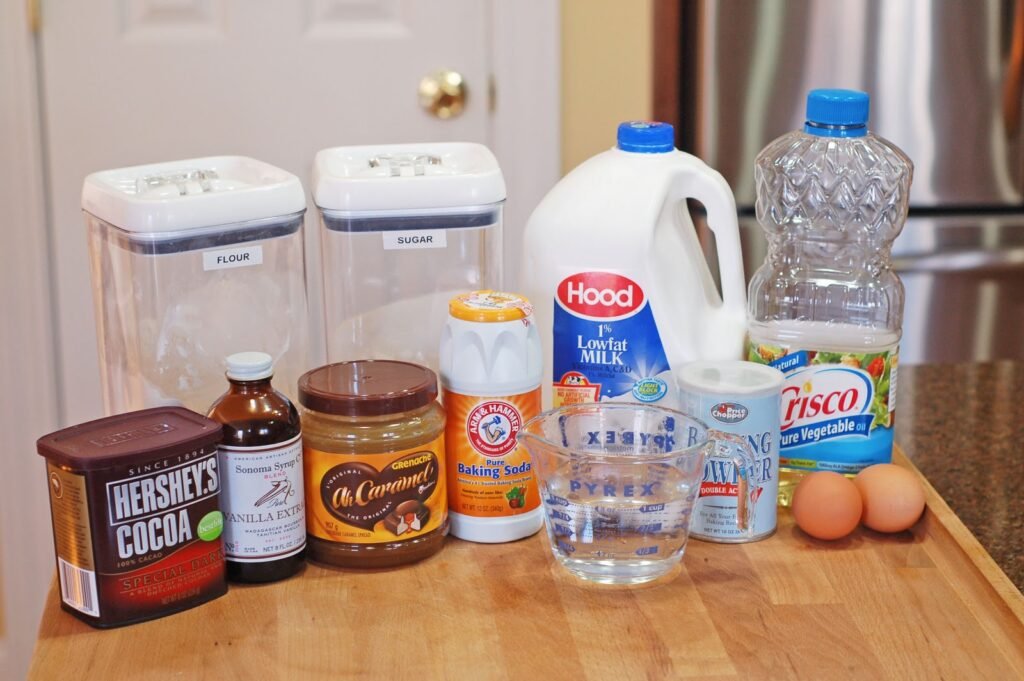
For the cupcakes, I used the recipe on the back of the Hershey’s Cocoa can, except replacing 1 cup of sugar for 1 cup of caramel. The cupcakes were great, but not much caramel flavor. I will have to add some more next time.

For the frosting, I adapted the recipe I used to make my Peanut Butter Fluff Frosting. I used soynut butter instead of peanut butter. The combo of the salty soynut butter and the sweet chocolate cupcakes was just what I was looking for. I even drizzled some extra caramel on top and added dark chocolate sprinkles to finish it off.
Chocolate Caramel Cupcakes with Soynut Butter Frosting
by The Sweet Chick
Prep Time: 15 minutes
Cook Time: 20 minutes
Keywords: bake dessert chocolate caramel soynut butter marshmallow fluff cupcake
Ingredients (32 cupcakes)
For the cupcakes
- 1 cup sugar
- 1 3/4 cups all purpose flour
- 3/4 cup Hershey’s Dark Cocoa
- 1 1/2 teaspoons baking powder
- 1 1/2 teaspoons baking soda
- 1 teaspoon salt
- 2 eggs, beaten
- 1 cup milk
- 1/2 cup vegetable oil
- 2 teaspoons vanilla extract
- 1 cup caramel (or caramel topping)
- 1 cup boiling water
For the frosting
- 1 stick unsalted butter, softened
- 1 cup creamy soynut butter
- 4 cups powdered sugar
- 1/2 cup marshmallow fluff
- 5-6 tablespoons milk
Instructions
For the cupcakes
Heat oven to 350 F. Line muffin tins with cupcake liners.
In a large bowl or stand mixer, stir together sugar, flour, cocoa, baking powder, baking soda, and salt.
Add eggs, milk, oil, vanilla, and caramel. Beat on medium speed for about 2 minutes.
Stir in boiling water (batter will be thin).
Pour batter into prepared muffin tins using a small ladle. If you use a regular scoop like I did, you will make a mess.
Bake at 350º F for 20 minutes or until toothpick inserted in center comes out clean. Cool completely before frosting.
For the frosting
With a mixer, blend butter and soynut butter until smooth.
Sift in confectioners’ sugar and beat on low speed.
Add milk and increase speed to high.
Add fluff. Beat for 1 minute.
Using a small spatula or a cake decorating tip and bag, add frosting to the cupcakes.
Drizzle with extra caramel and sprinkle with dark chocolate bits if you want.
Related Posts





Subscribe for New Racipies
Get mental health tips, updates, and resources delivered to your inbox.