
Are Passion Fruits Acidic? pH, Reflux Risk & Purple vs Yellow

Medically reviewed by Jaclyn Weiner, RD, RDN, MEd, MS Updated Date: October 14, 2026
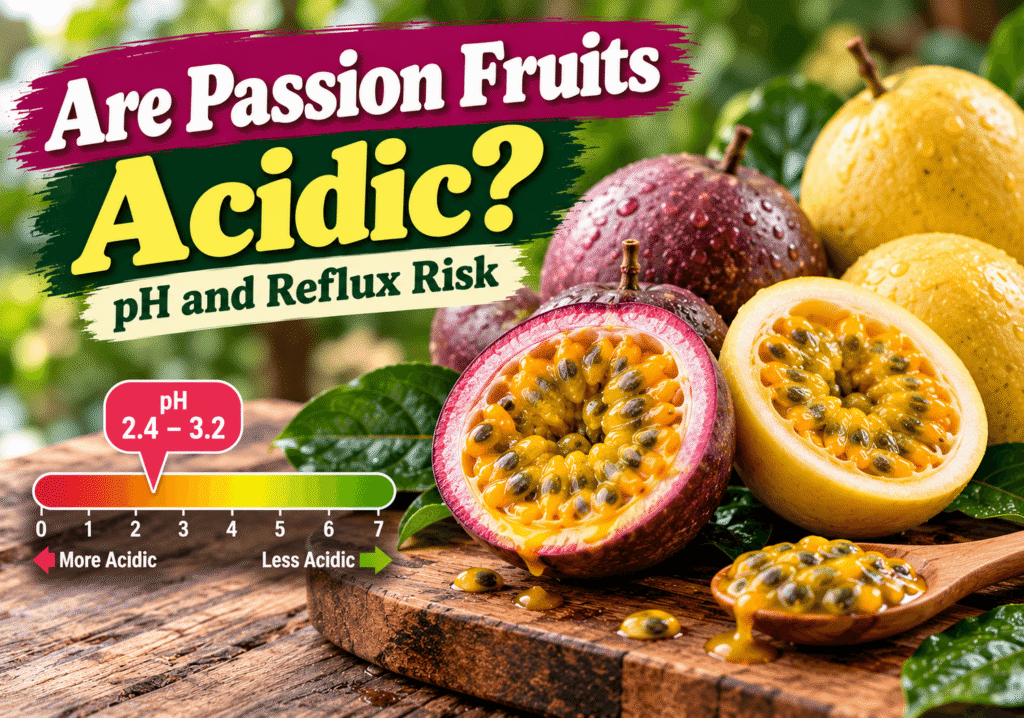
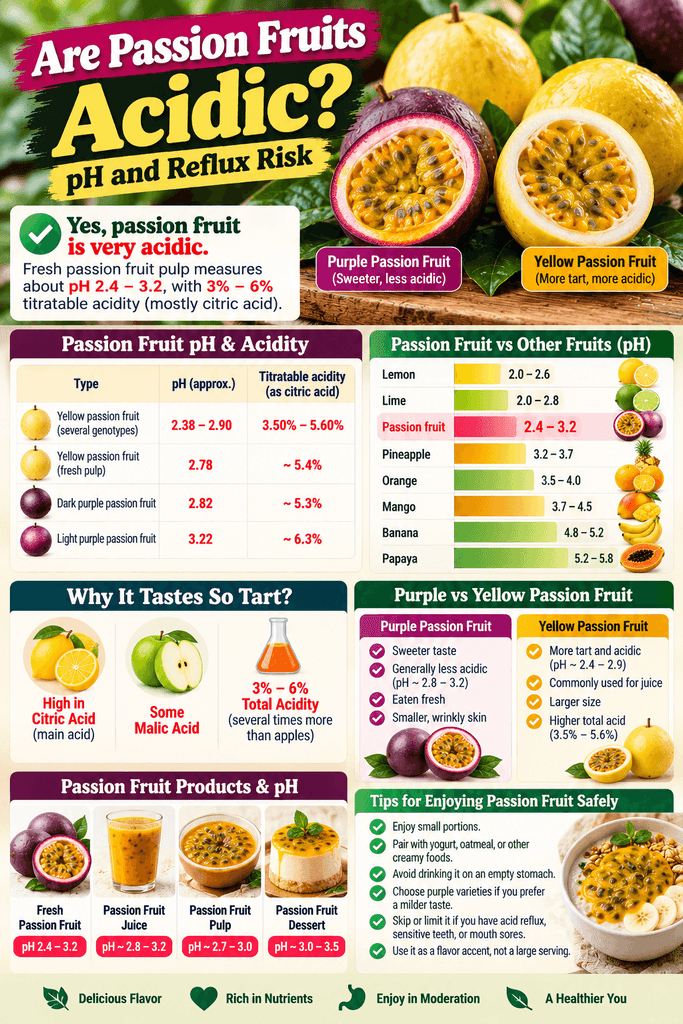
Yes, passion fruit is very acidic. It’s one of the most acidic fruits you can eat. Studies of fresh passion fruit pulp have measured a pH of about 2.4 to 3.2 (Dantas et al., 2018; Araújo et al., 2017). That puts it close to lemon and lime juice. It also carries a lot of acid overall, with titratable acidity of about 3% to 6%, mostly from citric acid. That’s several times more than a tart Granny Smith apple.
So if you have acid reflux, sensitive teeth, or mouth sores, passion fruit deserves some caution. This guide explains passion fruit’s pH, how purple and yellow passion fruit compare, where it ranks among other fruits, and how to enjoy that tropical flavor with less risk.
Key Takeaways
- Passion fruit is highly acidic, with fresh pulp measuring about pH 2.4 to 3.2 in studies. That’s close to lemon and lime juice.
- It’s packed with acid overall, at roughly 3% to 6% titratable acidity, mostly citric acid.
- Yellow passion fruit is usually more acidic than purple. Purple types tend to be sweeter and are more often eaten fresh.
- It’s one of the riskier fruits for acid reflux, especially as juice, on an empty stomach, or in large amounts.
- Small amounts go a long way. Using passion fruit as a topping or flavor accent, paired with creamy foods, is the gentlest approach.
- It’s still nutritious, with about 10 g of fiber per 100 g of pulp and seeds, plus vitamin C and vitamin A.
Are Passion Fruits Acidic? The Short Answer
Yes, and strongly so. The FDA’s widely used pH table doesn’t list passion fruit (FDA), so the best data come from published studies:
| Passion fruit | pH | Titratable acidity (as citric acid) | Source |
| Yellow, several genotypes at different harvest times (Brazil) | 2.38–2.90 | 3.50%–5.60% | Dantas et al., 2018 |
| Yellow, fresh pulp (Brazil) | 2.78 | About 5.4% | Araújo et al., 2017 |
| Dark purple, fresh pulp (Brazil) | 2.82 | About 5.3% | Araújo et al., 2017 |
| Light purple, fresh pulp (Brazil) | 3.22 | About 6.3% | Araújo et al., 2017 |
| Yellow types (India) | Not reported | 3.19%–4.86% | Charan et al., 2018 |
| Purple types (India) | Not reported | 2.87%–3.66% | Charan et al., 2018 |
Values vary with variety, growing region, ripeness, and storage. Araújo et al. acidity values are averages over the storage period.
Brazil’s quality standards for passion fruit pulp, as cited in the Araújo study, expect a pH between 2.70 and 3.80 and titratable acidity above 2.50% (Araújo et al., 2017). In other words, strong acidity is normal for passion fruit, not a sign of an unripe or bad fruit.
pH vs Total Acid: Why Passion Fruit Is So Sharp
Passion fruit is acidic in both ways that matter:
- Low pH. Each step on the pH scale is a tenfold change. A passion fruit at pH 2.8 is about 10 times more acidic than an apple at pH 3.8.
- High titratable acidity. This measures the total amount of acid in the fruit. Passion fruit pulp typically carries 3% to 6% acid. For comparison, tart Granny Smith apples carry about 0.7% to 1.0% at harvest (Good Fruit Grower), and many guavas carry well under 1%.
That combination explains why straight passion fruit pulp makes your mouth pucker even though it also contains a fair amount of sugar. The Indian study measured soluble solids (mostly sugar) of about 12.7 to 17.7 °Brix, but the acid is strong enough to dominate (Charan et al., 2018).
Purple vs Yellow Passion Fruit: Which Is More Acidic?
You’ll usually find two types of passion fruit: purple (Passiflora edulis f. edulis), the smaller, wrinkly fruit common in grocery stores, and yellow (P. edulis f. flavicarpa), a larger fruit grown widely for juice.
| Purple passion fruit | Yellow passion fruit | |
| Taste | Sweeter | More tart |
| Typical use | Eaten fresh | Juice and processing |
| Acidity | Generally lower | Generally higher |
| Titratable acidity (Indian study) | 2.87%–3.66% | 3.19%–4.86% |
| Soluble solids, or sweetness (Indian study) | 15.20–17.73 °Brix | 12.66–16.00 °Brix |
| Vitamin C (Indian study) | 18.6–30.5 mg/100 g | 17.0–23.1 mg/100 g |
Sources: UF/IFAS HS1527; Charan et al., 2018.
University of Florida researchers sum it up: purple types are sweeter and typically eaten fresh, while yellow types are more acidic and preferred for processing because of their higher yields (Habibi et al., UF/IFAS HS1527).
That said, the difference isn’t huge, and it isn’t perfectly consistent. In the Brazilian study, light-purple fruit actually had the highest average acidity, while dark-purple fruit was similar to yellow (Araújo et al., 2017). Both types are strongly acidic. If you’re acid-sensitive, choosing purple may help a little, but portion size matters much more.
How Passion Fruit Compares to Other Fruits
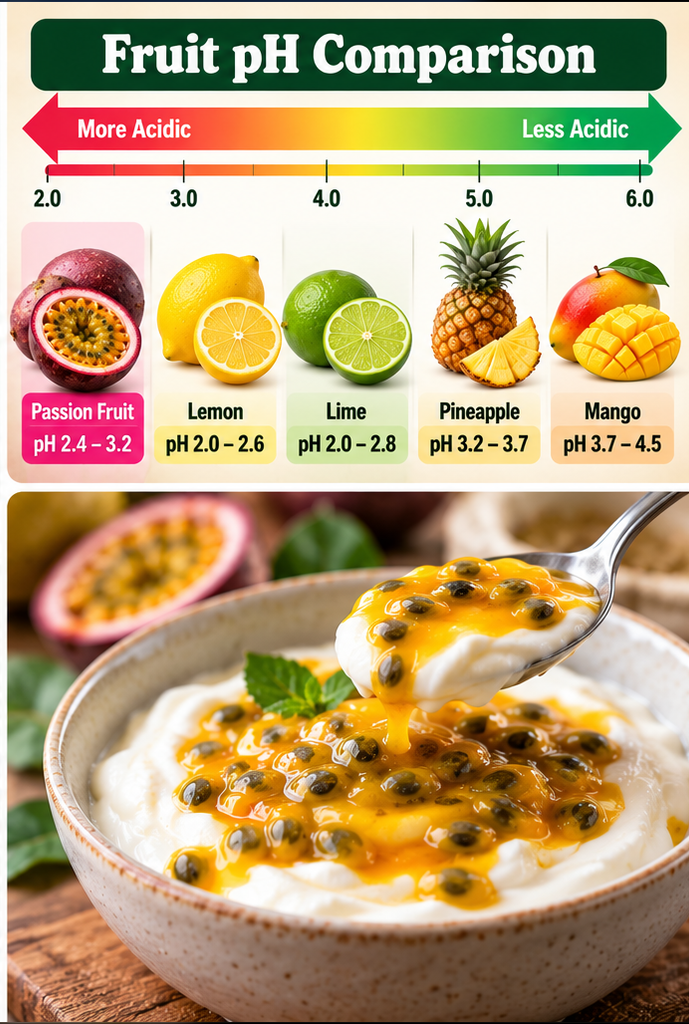
Here’s where passion fruit lands next to other fruits in the FDA’s pH table (FDA):
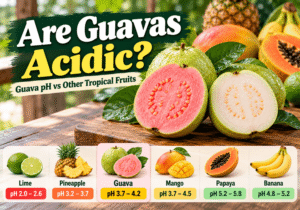
| Fruit | Approximate pH |
| Lemon juice | 2.00–2.60 |
| Lime | 2.00–2.80 |
| Passion fruit pulp (studies) | About 2.4–3.2 |
| Pomegranate | 2.93–3.20 |
| Grapefruit | 3.00–3.75 |
| Pineapple | 3.20–4.00 |
| Orange juice, California | 3.30–4.19 |
| Mangoes, ripe | 3.40–4.80 |
| Guava, fresh (studies) | About 3.7–4.2 |
| Persimmons | 4.42–4.70 |
| Bananas | 4.50–5.20 |
| Papaya | 5.20–6.00 |
Source: FDA, Approximate pH of Foods and Food Products; passion fruit and fresh guava from published studies.
A few takeaways:
- Passion fruit sits right next to citrus. Its pH overlaps with limes and comes close to lemon juice.
- It’s more acidic than most tropical fruits, including pineapple, mangoes, and guavas.
- For gentler tropical choices, try bananas, papaya, or coconut water. Among fall fruits, persimmons are a sweet, low-acid option.
For the full list, see our complete guide to acidic foods.
Is Passion Fruit Bad for Acid Reflux?
For many people with reflux, passion fruit is one of the riskier fruits. The National Institute of Diabetes and Digestive and Kidney Diseases (NIDDK) lists citrus fruits among foods that may make reflux worse, along with tomatoes, alcohol, chocolate, coffee and caffeine, high-fat foods, mint, and spicy foods (NIDDK). Passion fruit isn’t a citrus fruit, but its pH and citric acid content are in the same range as citrus.
Triggers do vary from person to person. The American College of Gastroenterology’s 2022 guideline recommends that people with GERD identify their own triggers instead of cutting out every possible food, and avoid eating within 2 to 3 hours of bedtime (Katz et al., 2022). Some people tolerate a spoonful of passion fruit with yogurt just fine. Others feel it right away.
Why passion fruit juice is riskier than the fruit
- More fruit per serving. A glass of juice concentrates the pulp of several fruits.
- Fast exposure. Drinking acid washes it over your esophagus and teeth quickly.
- Added sugar and acid. Many passion fruit drinks and nectars add sugar, and some add more citric acid. Check the label.
- Cocktails. Passion fruit is a popular cocktail ingredient, and alcohol is another reflux trigger on NIDDK’s list.
Tips for enjoying passion fruit with reflux
- Use it as a topping, not a main food. Start with a teaspoon or two of pulp.
- Pair it with creamy, low-acid foods like Greek yogurt, cottage cheese, or oatmeal.
- Choose purple passion fruit when you can, since it’s usually a bit sweeter and less acidic.
- Skip straight juice, or dilute it well and drink it with food.
- Avoid it on an empty stomach or late at night. NIDDK suggests eating meals at least 3 hours before lying down if you have nighttime symptoms (NIDDK).
- Don’t stack triggers. Passion fruit with chocolate, coffee, or alcohol adds up fast.
- Keep a food diary to see whether passion fruit bothers you and at what amount.
For more guidance, see our list of foods to avoid with GERD. If you have heartburn more than twice a week, trouble swallowing, or symptoms that don’t improve, talk with your doctor.
Passion Fruit, Teeth, and Mouth Sores
Teeth: Foods with a pH this low can soften tooth enamel with frequent exposure. The American Dental Association says how often and how long your teeth are exposed to acid matters. It recommends eating acidic foods as part of a meal, rinsing with water or having milk or cheese afterward, and waiting about an hour before brushing (American Dental Association). Sipping passion fruit juice slowly throughout the day is one of the harder habits on enamel. Our article on whether apples are good for your teeth covers similar fruit-and-enamel questions.
Mouth sores: Mayo Clinic lists spicy or acidic foods among the foods that can trigger canker sores in some people (Mayo Clinic). Passion fruit pulp is likely to sting an open sore, so skip it until it heals.
Gastritis: Highly acidic foods often feel uncomfortable with gastritis. Consider avoiding passion fruit until symptoms settle, and choose mild fruits like banana or papaya instead. Our 7-day meal plan for gastritis has more gentle ideas.
Passion Fruit Nutrition
Acidity aside, passion fruit is surprisingly nutritious. Per 100 grams of raw purple passion fruit pulp and seeds, USDA lists (USDA FDC 169108):
| Nutrient | Per 100 g |
| Calories | 97 |
| Carbohydrates | 23.4 g |
| Fiber | 10.4 g |
| Sugars | 11.2 g |
| Vitamin C | 30 mg |
| Vitamin A | 64 mcg RAE |
| Beta-carotene | 743 mcg |
| Potassium | 348 mg |
| Iron | 1.6 mg |
| Magnesium | 29 mg |
A few highlights:
- Fiber: At 10.4 g per 100 g, passion fruit is very high in fiber for a fruit, largely because you eat the seeds.
- Vitamins: University of Florida researchers describe passion fruit as a rich source of vitamins A, B2, B6, C, and E, along with potassium, fiber, polyphenols, and carotenoids (UF/IFAS HS1527).
- Portion reality: Most people eat passion fruit by the spoonful, so a typical serving is much smaller than 100 g.
Acid-Smart Ways to Enjoy Passion Fruit
Passion fruit’s intense flavor means a little goes a long way. If it agrees with you, try these ideas:
- Yogurt topping: Spoon a little pulp over Greek yogurt with our pumpkin pie spice granola.
- Smoothies: Add a teaspoon of pulp to our fruit yogurt shake with banana to balance the acid.
- Creamy desserts: Drizzle a small amount over our whipped ricotta with mixed berries or a slice of Japanese strawberry shortcake.
- Tropical treats: Swirl a little pulp into our tropical dream rice krispie treats topping.
- Curd and pie (for good stomach days): Passion fruit can stand in for some of the citrus in our blood orange curd or key lime pie. These are still very acidic, so save them for when your stomach feels fine.
The passion fruit swaps haven’t been tested in our kitchen, so adjust to taste.
Kitchen tip: A ripe purple passion fruit usually looks wrinkled and feels heavy for its size. Cut it in half and scoop out the pulp and seeds with a spoon.
Frequently Asked Questions
Are passion fruits acidic or alkaline?
Passion fruits are acidic, and strongly so. Studies of fresh pulp have measured pH values of about 2.4 to 3.2, close to lemon and lime juice. The main acid is citric acid.
Which is more acidic, purple or yellow passion fruit?
Yellow passion fruit is generally more acidic, while purple types are usually sweeter and more often eaten fresh. Results vary by variety, though, and both are very acidic.
Is passion fruit bad for acid reflux?
It can be. Passion fruit has a pH and citric acid content similar to citrus fruits, which NIDDK lists as possible reflux triggers. Small amounts with creamy foods may be tolerated, but juice and large servings are riskier.
Is passion fruit more acidic than lemon?
Usually not quite. The FDA lists lemon juice at pH 2.00 to 2.60, while passion fruit pulp usually measures about 2.4 to 3.2. They overlap, so some passion fruits are nearly as acidic as lemon juice.
Is passion fruit more acidic than pineapple?
Yes. The FDA lists pineapple at pH 3.20 to 4.00, while passion fruit pulp usually measures about 2.4 to 3.2.
Is passion fruit bad for your teeth?
Its acid can soften enamel with frequent exposure. Eat it with meals, rinse with water afterward, and wait about an hour before brushing, following ADA advice.
Can you eat passion fruit seeds?
Yes. The seeds are eaten with the pulp, and they’re a big reason passion fruit is so high in fiber. If you have trouble with seeds, strain the pulp first.
The Bottom Line
Passion fruit is one of the most acidic fruits, with fresh pulp measuring about pH 2.4 to 3.2. It also carries 3% to 6% titratable acidity, mostly from citric acid, which puts it in the same league as citrus. Yellow passion fruit is usually tarter than purple, but both are strongly acidic.
That doesn’t mean you have to avoid it completely. Passion fruit is rich in fiber and vitamins, and its bold flavor works best in small amounts anyway. If you have reflux, sensitive teeth, or mouth sores, use it as a topping, pair it with creamy foods, skip straight juice, and pay attention to how your body responds.
Keep exploring with Are Guavas Acidic?, Are Pineapples Acidic?, Are Limes Acidic?, or our complete guide to acidic foods.
Medical disclaimer: This article is for general information only and isn’t a substitute for professional medical advice. If you have frequent heartburn, GERD, gastritis, or mouth sores that don’t heal, talk with your doctor or a registered dietitian.
References
- Dantas AMT, et al. (2018). Influence of harvest times on yellow passion fruit physicochemical characteristics. Bioscience Journal 34(6). doi:10.14393/BJ-v34n6a2018-39679. DOAJ
- Araújo LS, et al. (2017). Effect of time and storage conditions on the physical and physico-chemical characteristics of the pulp of yellow and purple passion fruit. Food Sci. Technol. (Campinas) 37(3):500–506. PDF
- Charan SM, et al. (2018). Quality characteristics and antioxidant activity of passion fruit accessions. Indian J. Hortic. 75(2):185–190. PDF
- Habibi F, Sarkhosh A, Berry AD, Sargent SA. Passion Fruit: Postharvest Handling Practices and Physiological Disorders (HS1527). UF/IFAS Extension.
- U.S. FDA. Approximate pH of Foods and Food Products.
- USDA FoodData Central. Passion-fruit, (granadilla), purple, raw (FDC 169108).
- Good Fruit Grower. How to measure Honeycrisp qualities.
- NIDDK. Eating, Diet & Nutrition for GER & GERD.
- Katz PO, et al. (2022). ACG Clinical Guideline for GERD. doi:10.14309/ajg.0000000000001538
- American Dental Association. Dietary Acids and Your Teeth.
- Mayo Clinic. Canker sore: Symptoms & causes.
Related Posts
Subscribe for New Racipies
Get mental health tips, updates, and resources delivered to your inbox.
Strawberries and Cream Scones



The end of the school year is fast approaching. Little man is already done with preschool. I only have two weeks left until his sister is out also. I am not sure if I am ready for both of them to be home all day yet. For now I will try to remain calm and enjoy the Memorial Day weekend coming up. We don’t have definite plans, but there will be an ice cream social for our neighborhood that we may attend. To kick it off right, I think I will pour myself a cup of coffee and bite into one of these Strawberries and Cream Scones. They are full of fresh strawberries, sweetened with honey, and drizzled with a creamy glaze.
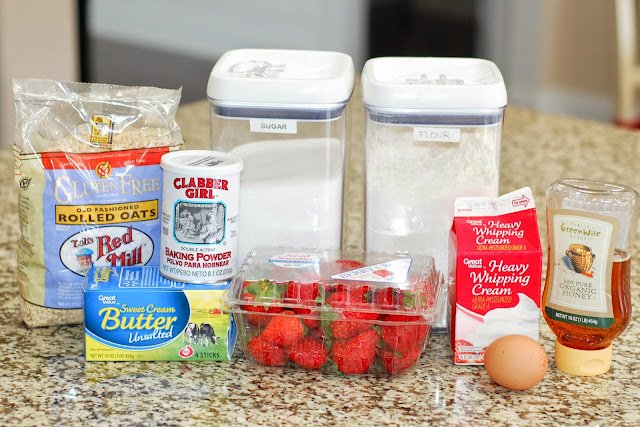
I used heavy cream in the scones as well as for the glaze. I added some honey for an extra bit of sweetness and rolled oats, because I love rolled oats.

I mixed the chopped strawberries by hand so them wouldn’t get all destroyed. There are a lot of strawberries in every bite.

The scones came out a beautiful golden color sprinkled with dots of red. I just drizzled a little glaze on each scone. Just enough to add some sweet creaminess.

I really love the taste of honey in these Strawberries and Cream Scones. It blends well with the heavy cream and the strawberries. These scones are still wonderfully light and fluffy.

They are perfect alone, or paired up with a glass of milk, a mug of coffee, or a cup of tea. I sent some to school with my daughter’s lunch, because she really loved them. I think you should make some to start off your holiday weekend right also.
Strawberries and Cream Scones
by The Sweet Chick
Prep Time: 10-15 minutes
Cook Time: 13-15 minutes
Keywords: bake bread breakfast dessert snack strawberry honey heavy cream rolled oats scones American spring summer
Ingredients (12 scones)
For the scones
- 2 1/3 cups flour
- 1/3 cup sugar
- 2 teaspoons baking powder
- 1 cup rolled oats
- 6 tablespoons cold butter
- 1/2 cup heavy cream
- 1 egg
- 1/3 cup honey
- 1 cup finely chopped fresh strawberries
For the glaze
- 1 cup powdered sugar
- 3 tablespoons heavy cream
- 1 tablespoon milk
- 1/2 teaspoon vanilla extract
Instructions
For the scones
Preheat oven to 425° F.
In a stand mixer, mix flour, sugar, baking powder, and oats.
Cut up butter and add to flour mixture, mixing on low speed for 1 minute.
In a small bowl beat egg, then add it to the flour mixture along with the heavy cream and mix until well combined.
Next add honey and mix on low speed until fully incorporated. The batter will be a dough like consistency.
Lastly, add the strawberries and mix them in by hand until fully incorporated.
With a large scoop, place dough onto a greased/parchment lined cookie sheet. Do not flatten.
Bake at 425°F for 13-15 minutes or until a golden color.
Remove from cookie sheet and place on cooling rack with wax paper underneath and allow to cool before glazing.
For the glaze
In a small bowl whisk together powdered sugar, heavy cream, milk, and vanilla until smooth.
Using the whisk, drizzle the scones with as much or as little glaze as you prefer.
You can wait for the glaze to set or go ahead and eat one!
Related Posts




Subscribe for New Racipies
Get mental health tips, updates, and resources delivered to your inbox.