
Are Apricots Acidic? Fresh vs Dried pH Compared (+ Chart)

Medically reviewed by Jaclyn Weiner, RD, RDN, MEd, MS Updated Date: October 13, 2026
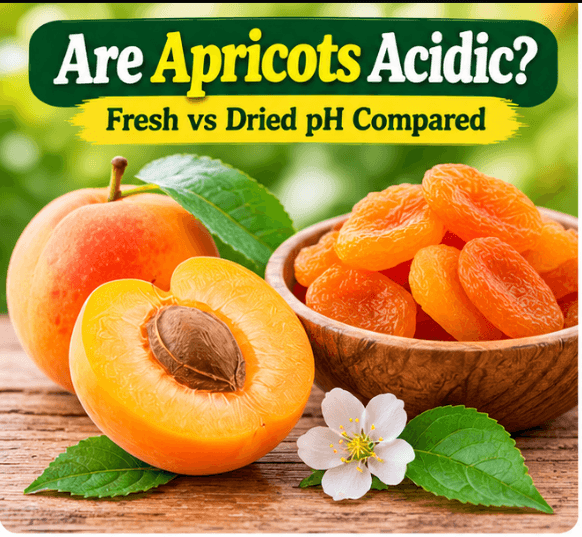
Yes, apricots are acidic. Fresh apricots have a pH of about 3.30 to 4.80, and stewed dried apricots measure about 3.30 to 3.51 (FDA). Their tartness comes mostly from malic acid and citric acid. Dried apricots aren’t dramatically lower in pH, but drying removes most of the water. That leaves about 5 times more apricot packed into every gram, so you get much more acid and sugar per bite.
If you have heartburn, sensitive teeth, or a sulfite sensitivity, the difference between fresh and dried apricots matters more than the pH number alone. This guide compares the two side by side, explains why pH and “total acid” are different things, and shows you how to enjoy apricots with less discomfort.
Key Takeaways
- Fresh apricots are acidic, with an FDA pH range of 3.30 to 4.80. Less ripe fruit sits at the sour end of that range.
- Malic and citric acids make up most of the acid in apricots.
- Dried apricots are about 5 times more concentrated than fresh, based on USDA water and solids data. That means more acid, sugar, and calories in each bite.
- pH doesn’t fall in step with drying. Stewed dried apricots (pH 3.30 to 3.51) fall inside the fresh range.
- Most bright-orange dried apricots are sulfured. Sulfites aren’t an acid issue, but they matter for people who are sulfite-sensitive.
- For reflux, portion size matters most. A few fresh apricots with a meal are usually gentler than a big handful of dried ones.
Are Apricots Acidic? The Short Answer
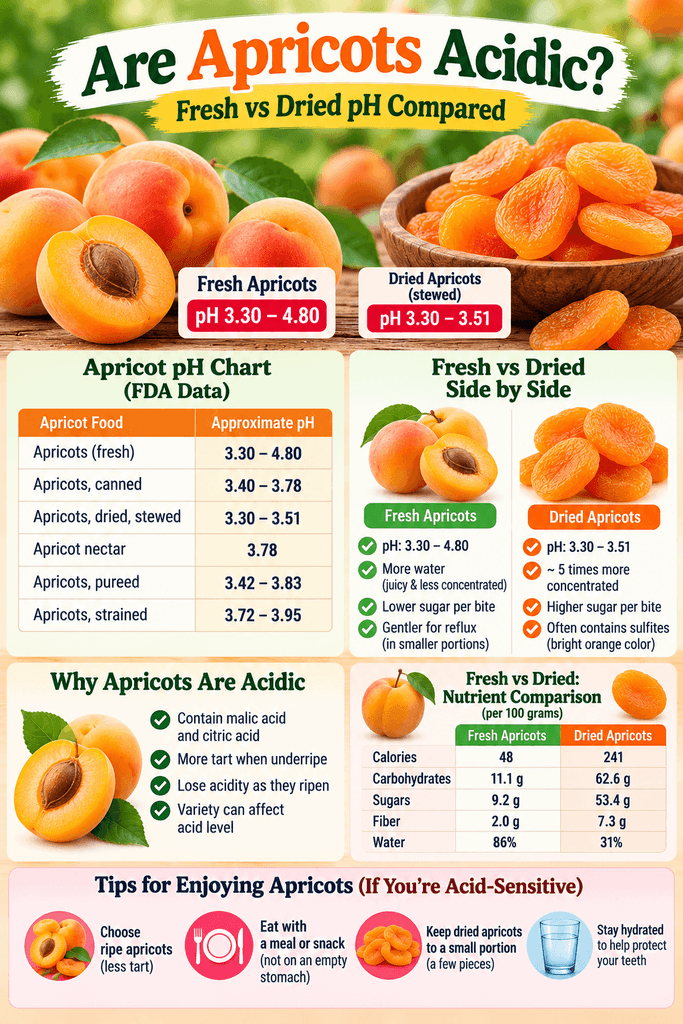
Apricots are acidic, like almost every fruit. Anything with a pH below 7 is acidic, and apricots land between about 3.3 and 4.8. Here’s how the FDA lists different apricot foods (FDA):
| Apricot food | Approximate pH (FDA) |
| Apricots (fresh) | 3.30–4.80 |
| Apricots, canned | 3.40–3.78 |
| Apricots, dried, stewed | 3.30–3.51 |
| Apricot nectar | 3.78 |
| Apricots, pureed | 3.42–3.83 |
| Apricots, strained | 3.72–3.95 |
Source: FDA, Approximate pH of Foods and Food Products.
Two things stand out. First, the fresh range is wide. An apricot at pH 3.3 is roughly 30 times more acidic than one at pH 4.8, because each step on the pH scale is a tenfold change. Ripeness and variety explain most of that spread.
Second, every processed apricot product falls inside the fresh range. Canning, pureeing, and drying don’t push apricots to extreme pH values. They change how much apricot you eat at once, which is a different question.
What Makes Apricots Taste Tart?
Apricots get their tang from natural fruit acids. Research on apricot collections and cultivars agrees on the main ones:
- Citric and malic acids lead. A 2025 study of a large apricot germplasm collection found that citrate and malate were the most abundant organic acids in both the pulp and the skin (Baccichet et al., 2025).
- Quinic acid plays a smaller role. A study of Xinjiang apricots found that malic, quinic, and citric acids made up 94.6% to 98.3% of the total organic acid in ripe fruit (Zheng et al., 2016).
Malic acid is the same acid that makes Granny Smith apples taste sharp. Citric acid is the main acid in limes and lemons. Apricots carry both, which is why a slightly underripe apricot can make your mouth pucker.
Ripeness changes the acid level
Apricots lose acid as they ripen. In a study following five apricot cultivars through fruit development, total acid fell as total sugar rose in every cultivar (Durmaz et al., 2010). The Xinjiang study also found that malic acid dropped sharply during ripening, while citric acid increased (Zheng et al., 2016).
In practical terms:
- Firm, pale apricots with green around the stem are more sour.
- Soft, deep-orange apricots that smell sweet are less tart and taste sweeter.
If you’re acid-sensitive, let apricots ripen on the counter until they give slightly when pressed.
Variety matters too
Not all apricots are equally tart. Across the 2025 germplasm collection, titratable acidity (total acid) ranged from under 5 g/L to over 20 g/L depending on the variety. The same paper notes that apricots with moderate acidity, about 10 to 15 g/L, are often preferred for fresh eating (Baccichet et al., 2025).
For a rough comparison, a lab study of supermarket apples measured about 10.3 g/L of total acid in conventional Granny Smith apples and 6.6 g/L in Fuji (Mezey & Serralegri, 2018). In other words, many apricots carry as much total acid as a tart apple, or more. (These are different studies with different methods, so treat this as a ballpark, not a head-to-head test.)
pH vs Total Acid: Why Dried Apricots Are Confusing
When people hear that dried apricots are “concentrated,” they assume the pH must drop a lot. It doesn’t work quite that way. There are two ways to measure acidity:
- pH measures how strong the acidity is in the fruit’s liquid at a given moment. Lower numbers mean stronger acidity.
- Titratable acidity measures the total amount of acid in the food. Scientists find it by adding a base until all the acid is neutralized.
Fruits also contain natural buffers, compounds that resist pH changes. When you remove water, you concentrate the acids, but you concentrate the buffers too. So the pH shifts much less than you might expect, even though the total amount of acid in each gram rises a lot.
We see the same pattern with tomatoes. Dried tomato slices have higher total acidity than fresh ones, but their pH doesn’t necessarily drop. Our guide to sun-dried tomatoes walks through that research in detail.
The bottom line: Dried apricots contain far more acid per bite than fresh apricots, but their pH is in the same general range. For your stomach and teeth, how much you eat at once usually matters more than the pH number.
Fresh vs Dried Apricots: Side-by-Side
USDA FoodData Central shows exactly how much drying concentrates an apricot. Fresh apricots are about 86% water, while dried, sulfured apricots are about 31% water (USDA FDC 171697; USDA FDC 173941).
| Per 100 g | Fresh apricots | Dried apricots (sulfured) | About how many times more |
| Water | 86.3 g | 30.9 g | — |
| Calories | 48 | 241 | about 5× |
| Total carbohydrates | 11.1 g | 62.6 g | about 5.6× |
| Sugars | 9.24 g | 53.4 g | about 5.8× |
| Fiber | 2.0 g | 7.3 g | about 3.7× |
| Potassium | 259 mg | 1,162 mg | about 4.5× |
| Beta-carotene | 1,094 mcg | 2,163 mcg | about 2× |
| Vitamin C | 10 mg | 1.0 mg | about 10× less |
| pH (FDA) | 3.30–4.80 | 3.30–3.51 (dried, stewed) | similar range |
Sources: USDA FoodData Central, Apricots, raw (FDC 171697) and Apricots, dried, sulfured, uncooked (FDC 173941); pH from the FDA. Multiples are our own rounded calculations.
How we got “about 5 times”
Fresh apricots contain about 13.7 g of solids per 100 g (everything that isn’t water). Dried apricots contain about 69.1 g. That’s roughly 5 times more apricot solids in every gram. Calories rise by almost exactly the same amount (48 to 241), which confirms the math. The natural fruit acids are concentrated in a similar way, so a small handful of dried apricots delivers the acid of a much larger amount of fresh fruit.
What doesn’t survive drying
- Vitamin C drops from 10 mg to about 1 mg per 100 g, even though everything else is concentrated. Vitamin C is easily damaged by heat, air, and long storage.
- Beta-carotene only doubles instead of rising five-fold. Research on dried apricots found that beta-carotene content fell further as storage temperature and time increased (Coşkun et al., 2013).
Is the pH of dried apricots lower?
The FDA table doesn’t list plain, uncooked dried apricots. It only lists dried apricots that have been stewed, at pH 3.30 to 3.51. Stewing adds water back, so this number isn’t a perfect stand-in for a dried apricot straight from the bag [VERIFY: no published pH found for uncooked dried apricots]. It does show that dried apricots stay in the normal acidic-fruit range rather than becoming dramatically more acidic.
For a deeper look at the dried version alone, see our full guide: Are Dried Apricots Acidic?
Sulfites in Dried Apricots
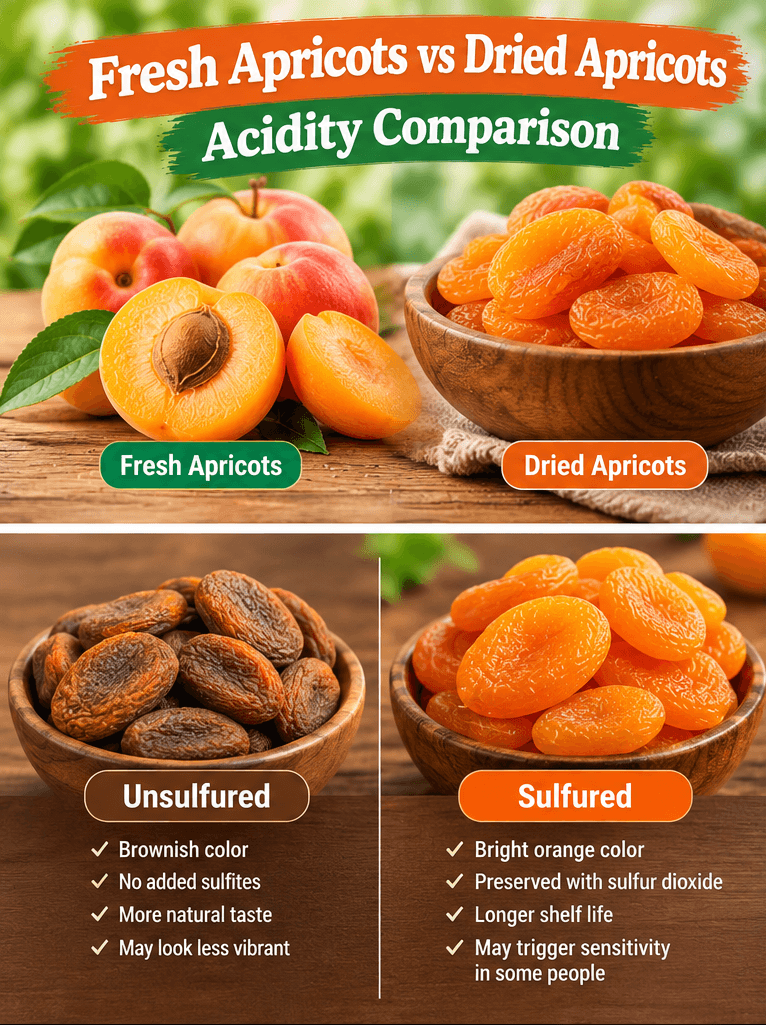
Many dried apricots are bright orange because they’ve been treated with sulfur dioxide or sulfite solutions. In a study of dried apricots, sulfured fruit kept an attractive golden-yellow color in storage, while loss of sulfur dioxide was linked to browning (Coşkun et al., 2013). That’s why unsulfured dried apricots are usually brown.
USDA’s standard dried-apricot entry is specifically “dried, sulfured” (USDA FDC 173941), which tells you how common the treatment is.
Here’s what you need to know:
- Sulfites aren’t an acid problem. They’re preservatives, not the source of an apricot’s tartness.
- They matter if you’re sulfite-sensitive. The FDA restricted sulfite use after reports of sulfite-related asthma reactions, and the FDA requires sulfites to be declared on the label when a food contains 10 parts per million or more (University of Nebraska FARRP, citing 21 CFR 101.100).
- Check the label. Look for “sulfur dioxide,” “sodium bisulfite,” “sodium metabisulfite,” or “unsulfured” on the package.
If you have asthma or a known sulfite sensitivity, unsulfured (brown) dried apricots or fresh apricots are the safer choice. Ask your doctor if you’re unsure.
How Apricots Compare to Other Fruits
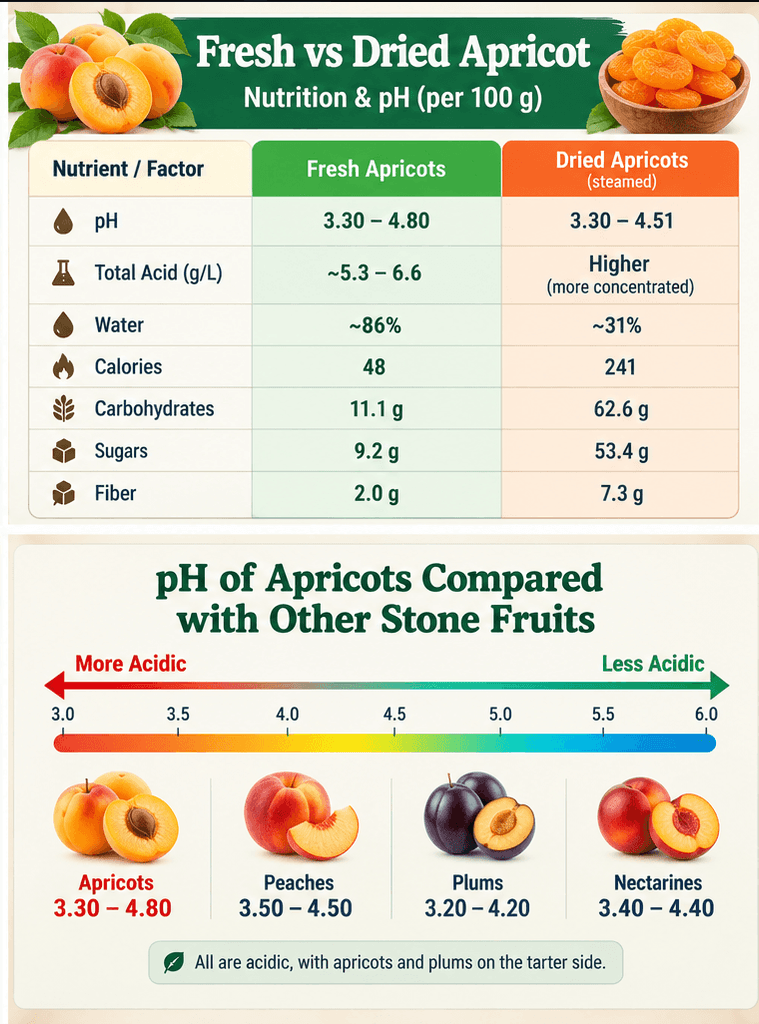
Where do apricots fall among common fruits? Here are FDA pH ranges for apricots and their close relatives (FDA):
| Fruit | Approximate pH (FDA) |
| Lemon juice | 2.00–2.60 |
| Plums, blue | 2.80–3.40 |
| Peaches | 3.30–4.05 |
| Apricots | 3.30–4.80 |
| Apricots, dried, stewed | 3.30–3.51 |
| Apples, Golden Delicious | 3.60 |
| Prunes, dried, stewed | 3.63–3.92 |
| Raisins, seedless | 3.80–4.10 |
| Nectarines | 3.92–4.18 |
| Cherries, California | 4.01–4.54 |
| Dates, Dromedary | 4.14–4.88 |
| Bananas | 4.50–5.20 |
| Figs, Calimyrna | 5.05–5.98 |
| Watermelon | 5.18–5.60 |
| Cantaloupe | 6.13–6.58 |
Source: FDA, Approximate pH of Foods and Food Products.
A few takeaways:
- Apricots sit in the middle of the stone-fruit family. They overlap with peaches, are often a bit more acidic than nectarines, and are usually less acidic than blue plums. Cherries tend to run higher in pH.
- Among dried fruits, apricots are on the tart side. Stewed prunes and raisins measure a little higher in pH, and dates and figs are much less acidic.
- For the least acidic fruits, bananas and melons like cantaloupe are the go-to picks.
Comparing apricots with apples? Our apple acidity guide covers how varieties like Fuji and Gala compare. For the full picture, see our complete guide to acidic foods.
Are Apricots Bad for Acid Reflux?
Apricots aren’t usually named as a classic reflux trigger. The National Institute of Diabetes and Digestive and Kidney Diseases (NIDDK) lists foods such as citrus fruits, tomatoes, chocolate, coffee, alcohol, fatty foods, mint, and spicy foods as possible triggers (NIDDK). Apricots aren’t on that list.
Still, apricots are acidic, and some people with reflux notice that tart fruits bother them. The American College of Gastroenterology’s 2022 guideline recommends that people with GERD identify their own triggers rather than cutting out long lists of foods, and avoid eating within 2 to 3 hours of bedtime (Katz et al., 2022).
Fresh apricots vs. dried apricots for reflux
| Fresh apricots | Dried apricots | |
| Acid per bite | Lower | Much higher (about 5× concentrated) |
| Typical portion | 1 to 3 fruits | Easy to eat a large handful |
| Water content | High (about 86%) | Low (about 31%) |
| Sugar per 100 g | 9.24 g | 53.4 g |
| Best reflux strategy | Choose ripe fruit; eat with a meal | Keep portions small; pair with low-acid foods |
Data from USDA FDC 171697 and 173941. “Acid per bite” is based on concentration, not a lab measurement.
Tips for eating apricots with reflux
- Pick fully ripe fresh apricots. Ripe fruit has less acid than firm, underripe fruit.
- Start with one or two fresh apricots and see how you feel.
- Limit dried apricots to a few pieces. Chop them into foods instead of snacking from the bag.
- Pair apricots with low-acid foods like oatmeal, cottage cheese, or Greek yogurt.
- Avoid stacking triggers. Apricots in a rich, buttery pastry with coffee add up.
- Eat them earlier in the day, not right before lying down.
- Keep a food diary to see whether fresh, dried, or canned apricots affect you differently.
For more ideas, see our list of foods to avoid with GERD. If you have heartburn more than twice a week, trouble swallowing, or symptoms that don’t improve, talk with your doctor.
Apricots, Teeth, and Mouth Sores
Teeth: The American Dental Association says how often and how long your teeth are exposed to acid matters. It suggests eating acidic foods as part of a meal, rinsing with water or having milk or cheese afterward, and waiting before you brush (American Dental Association). Dried apricots deserve extra care, because they’re both acidic and sticky, and they contain about 53 g of sugar per 100 g (USDA FDC 173941). Eat them with a meal rather than grazing on them all afternoon. Our article on whether apples are good for your teeth covers similar fruit-and-enamel questions.
Mouth sores: Mayo Clinic lists spicy or acidic foods among the things that can trigger canker sores in some people (Mayo Clinic). Tart apricots can sting an open sore, so you may want to skip them until it heals.
Gastritis: People with gastritis often do better with mild, low-acid foods. If apricots bother you, try a small amount of very ripe fresh fruit, or skip them until symptoms settle. Our 7-day meal plan for gastritis has gentler ideas.
Apricot Nutrition: Why They’re Still Worth Eating
Acidity aside, apricots bring plenty to the table. Per 100 grams, fresh apricots provide (USDA FDC 171697):
- 48 calories, so they’re a light snack
- 96 mcg RAE of vitamin A, mostly from beta-carotene, the pigment behind their orange color
- 10 mg of vitamin C
- 259 mg of potassium
- 2.0 g of fiber
Dried apricots pack more fiber (7.3 g), potassium (1,162 mg), and iron (2.66 mg) into 100 grams, but also 241 calories and 53.4 g of sugar (USDA FDC 173941). They’re a handy, portable snack, as long as you keep the portion small. If you’re managing blood sugar, fresh apricots are the easier fit.
Acid-Smart Ways to Enjoy Apricots
If apricots agree with you, try them in these ideas and recipes:
- Apricot raspberry galette: A rustic summer dessert. Raspberries add extra tartness, so enjoy a smaller slice if you’re acid-sensitive.
- Mixed berries galette: Swap some of the berries for ripe sliced apricots.
- Pumpkin pie spice granola: Stir in a few chopped dried apricots after baking.
- Apricot oatmeal: Top a bowl of oatmeal with diced fresh apricot and a spoonful of yogurt.
- Fruit yogurt shake: Blend in one ripe apricot with banana to keep it mellow.
Kitchen tip: To make dried apricots gentler, soak them in warm water for 10 to 15 minutes until plump, then drain. They become softer and easier to portion, and you’ll naturally eat fewer.
Frequently Asked Questions
Are apricots acidic or alkaline?
Apricots are acidic. Fresh apricots have a pH of about 3.30 to 4.80, and stewed dried apricots measure about 3.30 to 3.51, according to the FDA. Their main acids are citric and malic acid.
Are dried apricots more acidic than fresh apricots?
They contain more acid per bite because drying removes most of the water, concentrating the fruit about 5 times. But their pH isn’t dramatically lower. Stewed dried apricots fall inside the fresh apricot pH range.
Are apricots good for acid reflux?
They aren’t on NIDDK’s list of common reflux triggers, but they are acidic, so reactions vary. Ripe fresh apricots in small portions, eaten with a meal, are usually the gentlest option. Large handfuls of dried apricots are more likely to bother you.
Which is less acidic, apricots or peaches?
They’re similar. FDA ranges are 3.30 to 4.80 for apricots and 3.30 to 4.05 for peaches. Nectarines (3.92 to 4.18) tend to be a little less acidic than both.
Are canned apricots acidic?
Yes. The FDA lists canned apricots at pH 3.40 to 3.78. Apricots canned in heavy syrup also add extra sugar, so choose fruit packed in juice or water if you can.
Why are some dried apricots brown?
Brown dried apricots are usually unsulfured. Sulfur dioxide treatment helps dried apricots keep their bright golden color, while untreated fruit browns. Brown apricots aren’t spoiled, and they’re the better pick if you’re sulfite-sensitive.
Do apricots make your stomach acidic?
Eating apricots doesn’t change your body’s overall pH, which your body keeps tightly controlled. But acidic foods can irritate an already sensitive esophagus or stomach in some people, so pay attention to how you feel.
The Bottom Line
Apricots are acidic, with a fresh pH of about 3.30 to 4.80. Their tang comes mainly from citric and malic acids, and riper fruit is less sour. Drying doesn’t make apricots dramatically lower in pH, but it concentrates them about 5 times, so dried apricots deliver much more acid, sugar, and calories in every bite. Most bright-orange dried apricots are also sulfured.
For most people, apricots are a healthy, flavorful fruit. If you’re acid-sensitive, choose ripe fresh apricots, keep dried portions small, eat them with meals, and pay attention to your own triggers.
Keep exploring with Are Dried Apricots Acidic?, Are Peaches Acidic?, Are Plums Acidic?, or our complete guide to acidic foods.
Medical disclaimer: This article is for general information only and isn’t a substitute for professional medical advice. If you have frequent heartburn, GERD, asthma, sulfite sensitivity, or mouth sores that don’t heal, talk with your doctor or a registered dietitian.
References
- U.S. FDA. Approximate pH of Foods and Food Products.
- USDA FoodData Central. Apricots, raw (FDC 171697).
- USDA FoodData Central. Apricots, dried, sulfured, uncooked (FDC 173941).
- Baccichet I, et al. (2025). Dissection of acidity-related traits in an apricot germplasm collection. Fruit Research 5: e005. PDF
- Zheng H, et al. (2016). Changes in soluble sugars and organic acids of Xinjiang apricot during fruit development and ripening. Scientia Agricultura Sinica 49(20):3981–3992. Link
- Durmaz G, et al. (2010). Some physical and chemical changes during fruit development of five common apricot cultivars. Food Sci Technol Res 16(1):71–78. J-STAGE
- Coşkun AL, et al. (2013). Effects of various sulphuring methods and storage temperatures on the quality of dried apricots. Food Chemistry. doi:10.1016/j.foodchem.2013.06.033
- Mezey J & Serralegri K (2018). Athens Journal of Sciences 5(4):343–354. doi:10.30958/ajs.5-4-3
- University of Nebraska FARRP. Sulfites (USA), citing 21 CFR 101.100.
- NIDDK. Eating, Diet & Nutrition for GER & GERD.
- Katz PO, et al. (2022). ACG Clinical Guideline for GERD. Am J Gastroenterol. doi:10.14309/ajg.0000000000001538
- American Dental Association. Dietary Acids and Your Teeth.
- Mayo Clinic. Canker sore: Symptoms & causes.
Related Posts
Subscribe for New Racipies
Get mental health tips, updates, and resources delivered to your inbox.
Brioche Hamburger Buns, Or Let’s Get That Grill Fired Up


I don’t know about you, but I’ve always viewed hamburger buns as purely functional things. They’re receptacles, carb-wrappers, so you don’t get your hands dirty while eating the truly desirable bits within. Cheese, for instance, and grilled onions, and sauteed mushrooms. Oh right, and the patty too.
Buns are integral to the entire structure of the burger, yet they’ve done little to niggle my desire, warrant my enthusiasm, or raise lustful thoughts (and shouldn’t they? Given their namesake and all). Until now, that is.
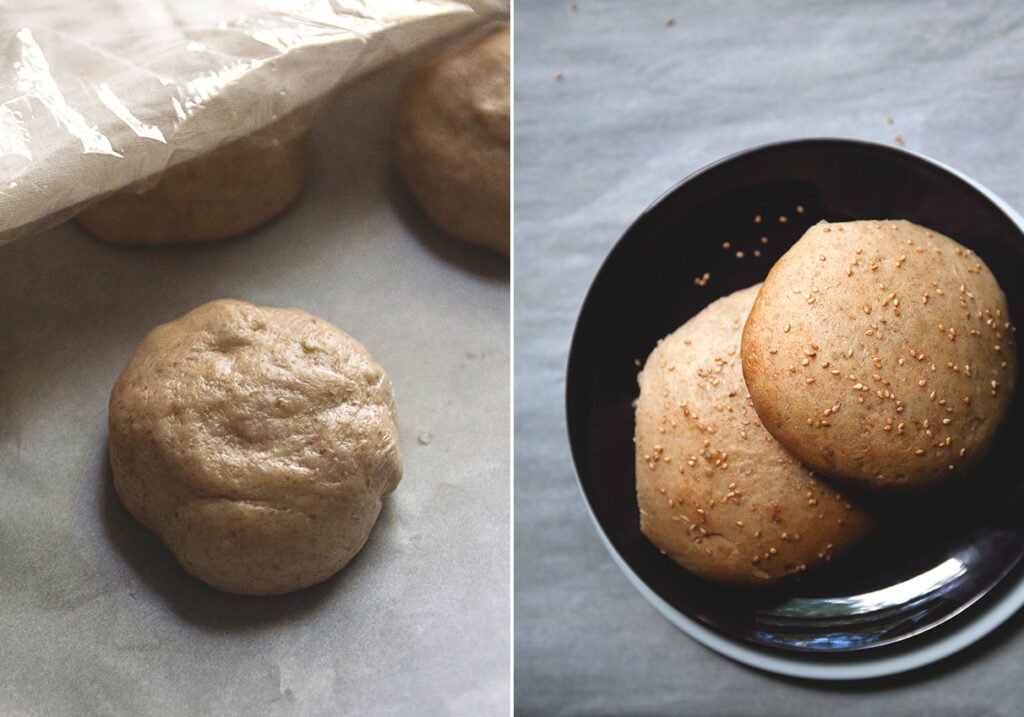
These buns—blogged about by Deb and later Sara—are dreamy: as in, they bake like a dream, come together in a cinch, and their ingredients can be found in most anyone’s pantry. They’re also versatile: I chose all-purpose, whole wheat, and rye flour to go in mine, and they came out hearty but light, soft but complex. But most importantly, they raise the hamburger bun to a higher echelon, one that will no longer be left until the end as an afterthought. And is there anything worse than forcing yourself to eat afterthoughts?
You’ll be ready to fire up your grill after making these.
BRIOCHE HAMBURGER BUNS
Adapted from Smitten Kitchen and Sprouted Kitchen
Makes 8 regular-sized buns
Ingredients:
3 Tbsp warm milk
2 tsp active dry yeast
2-1/2 Tbsp sugar
2 large eggs
1/2 cup whole wheat flour
1/2 cup rye flour
2-1/3 cups all-purpose flour
1-1/2 tsp salt
2-1/2 Tbsp unsalted butter, softened
sesame seeds (if desired)
Directions:
In a glass measuring cup, combine one cup warm water, milk, yeast and sugar. Let stand until foamy, about five minutes. Meanwhile, beat one egg.
In a large bowl, whisk the flours with the salt. Add the butter by rubbing it into the flour between your fingers, making crumbs. Stir in the yeast mixture and beaten egg until a dough forms. Scrape onto a clean, well-floured counter and knead (by scooping it, slapping it onto the counter, and turning) until smooth and elastic (8 to 10 minutes). It should be sticky, so try not to knead in too much flour.
Shape the dough into a ball and return it to the bowl. Cover it with plastic wrap and let it rise until doubled (1 to 2 hours).
Line a baking sheet with parchment paper. Divide the dough into 8 equal balls. Gently roll each ball and arrange them 2 to 3 inches apart. Cover the baking sheet loosely and let the dough rise until doubled (1 to 2 hours).
Set a shallow pan with water in it on your oven floor or lower rack. Preheat the oven to 400 degrees Fahrenheit. Beat the other egg with 1 Tbsp of water and brush the egg wash onto the buns. Sprinkle sesame seeds on top, if using. Put the baking sheet in the oven and bake for about 15 minutes (turning halfway through), until the buns are golden-brown. Transfer to a rack and cool.
Note: I kept them in the fridge for about a week after I baked them and they still tasted good. Just heat them up on the grill or toast them right before eating.
Related Posts





Subscribe for New Racipies
Get mental health tips, updates, and resources delivered to your inbox.