
What to Write on A Wedding Cake – Make Your Wedding Special!

Medically reviewed by Christiana George Updated Date: September 10, 2022

Weddings is one of the most important events in a person’s life. And wedding cake is a significant part of it. A wedding cake symbolizes a lot of things about the wedding. And that’s why the writing on the wedding cake is a big concern.
But what to write on a wedding cake?
A wedding cake can have a short message written on it. It can be a playful phrase or a romantic quote that you like. You may also write your names on the cake. But whatever you write, it should make the cake look classy. Overall, the cake should celebrate the new status of your life.
The above portion gives a vague idea about the writings on a wedding cake. If you want to look deeper into the matter, please read the full article.
Symbol of A Wedding Cake
A wedding cake is usually a white cake with white icing and decorations. Traditionally it’s made in tiered layers.
A wedding cake symbolizes prosperity and good luck. It also symbolizes that the marriage will be long-lasting and happy with the best ingredients available. So, a wedding cake meaning is quite significant.

So, we can see that wedding cake is an art. But with a good cake artist, this thing can be pulled off nicely.
Difference Between Wedding Cake And Regular Cakes
We often celebrate different occasions with a cake. But wedding cakes are a bit different from those regular cakes.
Wedding cakes are not like birthday cakes or other regular cakes. They certainly take more time, effort, and expertise than the cake designer. It takes more ingredients as well to make a wedding cake.
Traditionally, wedding cakes are vanilla flavored with vanilla buttercream frosting. At present, chocolate cakes are also popular as wedding cakes. Wedding cakes are usually two or three-layered cakes.
There’s a wedding cake topper on top of every wedding cake. This topper is usually a small model that represents the bride and the groom. These models are designed as wearing formal wedding clothes.
The topper can be edible or inedible. Sometimes the models aren’t used as the topper. There may be any symbol that resembles the couple’s passion as the topper.
Sometimes words are also used as the topper instead of icing them on the cake. Anything that fits the wedding theme can be used as the topper. You can even skip it if you feel like it’s not necessary with the cake.
So, we can see that wedding cakes are quite different from regular cakes.
Captioning The Wedding Cake
Now comes the important part of what to write on your wedding cake. You can go for small phrases like “Just Married”, “Mr. & Mrs.”, etc. These are some of the most used lines on a wedding cake.

There can be a wedding cake with names written on it. Wedding cake quotes love as well.
However, you can wish to follow a different path. For that, you can add lines from wedding vows or you can add short messages. You can practice cake cutting quotes for weddings as well. Now let’s discuss it in more detail.
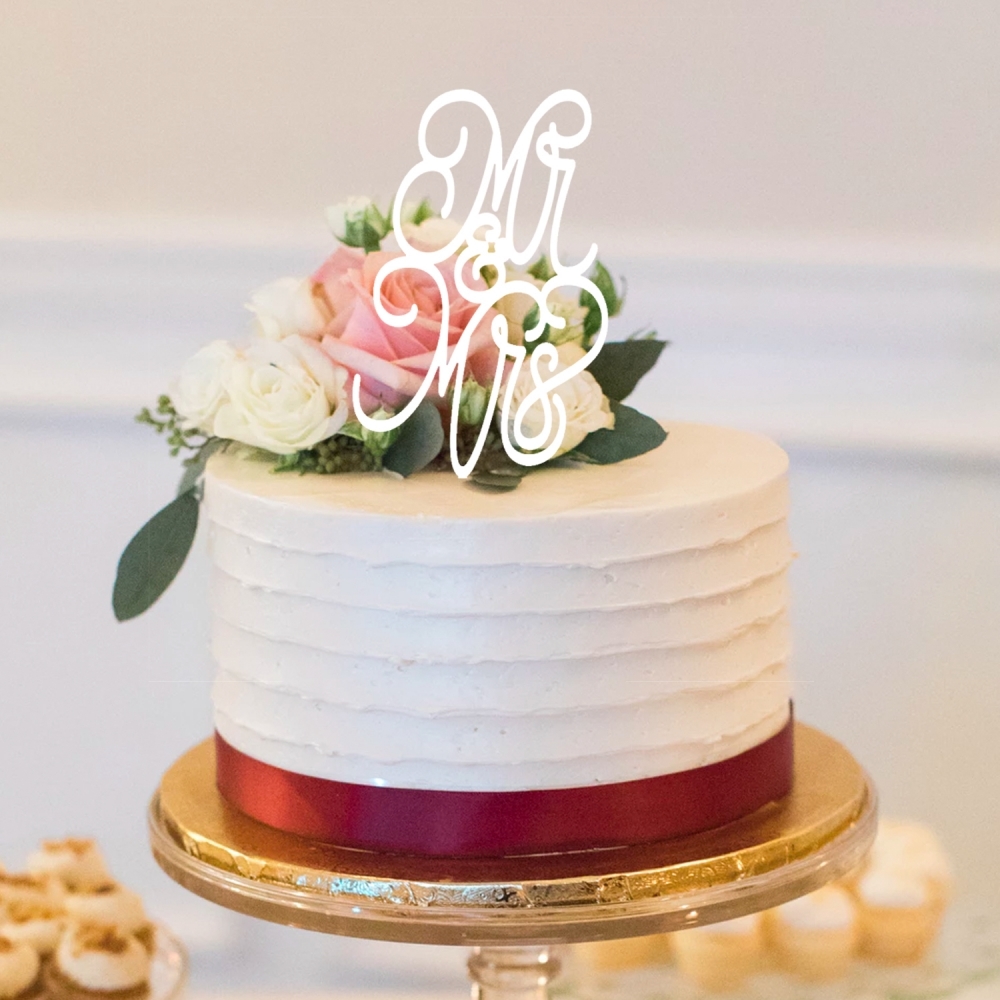
Picking Lines from Vows
There must be a favorite line of yours in your wedding vows. You can pick that line and use it on your wedding cake. You may instruct the cake designer to use short fonts. In that way, it will look like a new design on the cake.
You can add multiple lines to show what to say on the wedding cake. In that case, the top of the cake may not have enough space to fit the words. But the designer can use the side of the cake to write and make it visually appealing.
Also, you can use the multiple tiers of your wedding cake. Instead of writing on only the top tier of the cake, use all the tiers. Thus you can fit in multiple lines from your vows. And the whole cake will get a new look.
However, discuss it thoroughly with your cake designer and finalize it well. Make sure that the cake looks good even after you fit in such lines. Because your wedding cake should look as gorgeous as you on the wedding day.
Using Short Wishes
A short message, a small wish, or even a small joke is captioned on the wedding cake. However, it should fit the context.
This idea of adding a short message or wish is a very classic one. And it looks good if it’s pulled off nicely. Your cake should have an elaborate design so that it doesn’t look messy after adding the message.
You can add short messages from your beautiful moments or memories. You can also add small jokes from any of your funny moments. However, don’t ruin the cake with meaningless words or sentences. There are a lot of funny wedding cake messages, use them.
Here as well, you can utilize the multiple layers and tiers of your cake. Consult with your designer well about what should be written on the wedding cake.
So, these were the ideas about what to write on your wedding cake. You can go forward with any approach you like.
Best Cakes for Wedding
After you’re ready with the caption for the wedding cake, you should choose the cake type. The amount of significance the wedding cake holds, you should choose a good one for that.
In case your wedding cake is the only dessert, it’s good to choose two flavors of it. One of them can be the couple’s favorite whereas the other can be served to the guests. The couple should enjoy the wedding cake first and it should reflect their taste.
Some of the best wedding cakes are-
- Red Velvet
- Strawberry & Cream
- Chocolate Cappuccino
- Chocolate Decadence
- Lemon Berry
- Hazelnut Praline
- Chocolate Mint
- Chocolate Orange
You can choose to select any of the above or any other cake that you like.
Tips to Design A Wedding Cake
Your designer may provide you with all the information, still knowing some basic things can help you. That’s why we’ve some basic tips for you regarding designing a wedding cake. They are as follows-
- The overall concept of the cake should be according to the couple’s liking. The cake should match the wedding theme.
- The number of tiers in the cake should be enough to serve the people attending the wedding.
- The components in the wedding cake should be suitable for the environment.
- The frosting of the cake should be able to deliver the proper color and texture. And it should deliver the flavor that needs to be delivered.
- The fondant should be used accordingly to decorate the cake well.
- Be confirmed what to write on the wedding reception cake and the topper beforehand.
- Be sure about which elements of the cake will be edible and which will be inedible.
So, these are some useful tips while designing a wedding cake.
Fake Layers in Wedding Cakes
Some wedding cakes are decorated with fake layers. In that case, the real tier of the cake is cut by the couple. And the lower tiers of the cake are made using fake elements. This is done to decorate the cake within a low budget.
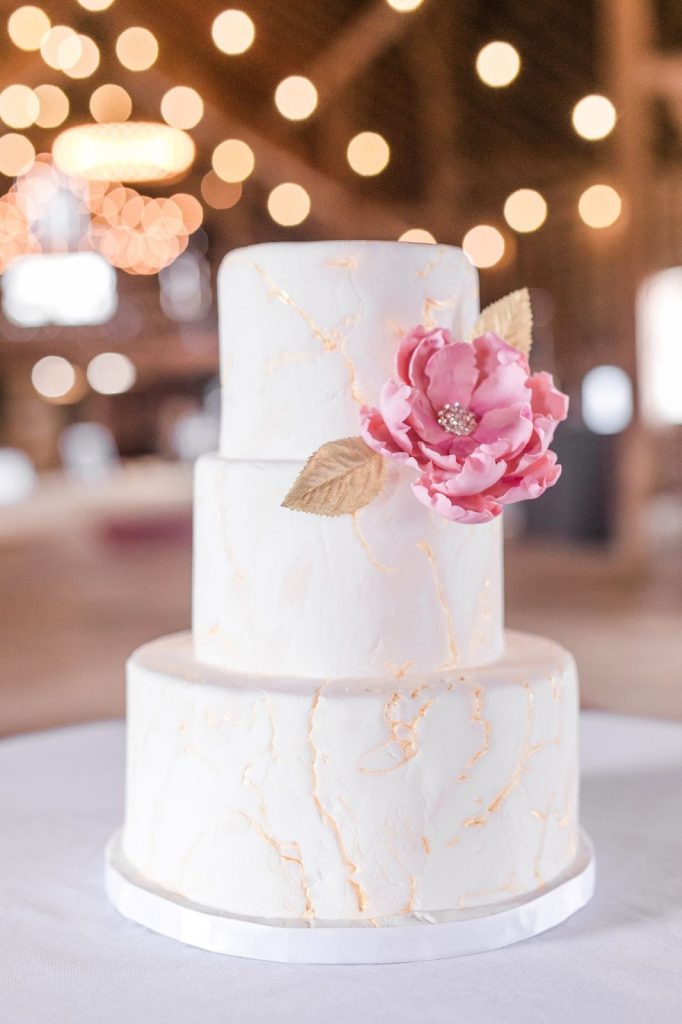
In case you have a shortage of budget, you can go this way. Thus your cake will look fancy, and you won’t have to spend much.
FAQs
What’s the tradition of cutting the wedding cake?
As per tradition, the bride and groom cut the wedding cake and get the first bite. The cake can be served to each other with a fork or something else. It’s a sweet moment and all the guests look forward to it.
Which colors shouldn’t be worn at a wedding as a guest?
White or any shades of white color shouldn’t be worn at a wedding as a guest. Also, all black, all red, bridesmaid dress color, etc. should be avoided. Besides, it’s good not to wear heavily metallic or too sparkling colors.
Cake cutting or toast, which should come first?
Toasts can be before or after cutting the cake. There’s no mandatory rule for that. The toast can be after all courses of the meal as well. Or else, it can be in between two courses of the meal. Depending on the time of cutting the cake, the toast can be at any time.
Why is the wedding cake cut during the ceremony?
The wedding cake is cut during the ceremony and the bride and the groom feed each other. This symbolizes their love and commitment to each other in the years to come. That’s why cake cutting is an important part of the wedding.
Why are there tiers in a wedding cake?
The tiers in a wedding cake depict prosperity and it’s also a status symbol. Because only wealthy ones can afford a multiple-tiered wedding cake. That’s why it represents the bride and groom quite well.
Conclusion
So, this was all we had to discuss what to write on a wedding cake. Hope you enjoyed going through the whole article.
We tried to cover the other aspects of a wedding cake as well for your convenience. Hopefully, it will help you to choose the perfect wedding cake. This was all from us. Have a good time.
Related Posts




Subscribe for New Racipies
Get mental health tips, updates, and resources delivered to your inbox.
Foods To Avoid With Trulicity


If you have Type 2 diabetes, then chances are, you have heard of Trulicity. This medication is increasingly popular among physicians, so it is possible your physician may discuss prescribing it for you.
Starting a new drug can be a cause of worry. You want to ensure that the drug has its maximum effect, and you may wonder how your diet may affect its action. You may ask, “Which foods do I avoid when taking Trulicity?”
The quick answer to that is to avoid foods with high sugar, high fat, and refined carbohydrates. But why must these be avoided? And should they be stopped completely? Read on for the answers to these questions.
Foods to Avoid With Trulicity
Trulicity, or Dulaglutide, has no known food interactions. That means its effects will not be minimized by any food, and will not react with any food items to produce severe adverse effects. That being said, it is recommended to eat smaller portions of food when you are taking Trulicity.
This is related to the way this drug works. Dulaglutide works like GLP-1 (Glucagon-like-peptide 1), and so it is referred to as a GLP-1 agonist. GLP-1 is a chemical that is released from the L-cells in your gut.
This chemical increases insulin secretion and decreases the rate at which food crosses the stomach. It also reduces appetite. This is why consuming excessive sugar may overcome the effects of Dulaglutide.
Dulaglutide may also cause nausea and vomiting at times. So, ingesting foods that cause nausea might add to its effects, making you feel worse.
Let’s take a look at a few foods you should avoid on Dulaglutide.
Foods Containing High Sugar
High-sugar food is a big no-no for any diabetic. Even if you are properly taking your medications, you should still not eat too many sugary foods.
If you are suffering from Type 2 diabetes, then there is insulin resistance in your body, meaning your pancreas has to work extra hard to secrete more insulin. Dulaglutide can help your pancreas release more insulin.
However, too much sugar would overwork your pancreas and, in time, damage the pancreas. A damaged pancreas would make hyperglycemia harder to treat.
Foods With High-Fat Content
Fatty foods interfere with Trulicity in two possible ways. First, research shows that excessive fatty food intake reduces the levels of GLP-1 in your blood. This reduces the effect of Dulaglutide.
Secondly, these foods tend to cause nausea. Since Dulaglutide may also cause nausea, a high-fat meal could compound this discomfort.
Foods Containing Refined Carbohydrates
Refined carbohydrates cause the biggest spike in blood sugar levels. Research shows that excessive refined carbohydrates do not cause a proportionate increase in GLP-1 levels, which means that they are absorbed very quickly.
The pancreas may not be able to keep up with the high blood sugar in the bloodstream. Lower GLP-1 levels compared to the high calories consumed mean that Trulicity may not be able to cause a large enough insulin release. This results in higher glucose levels.
Related Article: Trulicity for weight loss: Side effects, dosages, uses, and more
Drinks to Avoid with Trulicity
What about drinks to avoid with Trulicity? As expected, you should not consume drinks that contain excess sugar. It causes the same reaction as sugary foods, explained above. Soda, energy drinks, sports drinks, and artificial fruit drinks are examples of sugary drinks to avoid. Still, you do not have to give them up completely; small amounts will not do much harm.
Can you Drink Alcohol with Trulicity?
Alcohol should be avoided while taking Trulicity. Alcohol is known to cause hypoglycemia. This is a clinical condition where your blood glucose is too low. It hampers the ability of the liver to produce sugar, lowering glucose levels in the bloodstream.
While Duraglutide is low risk when it comes to hypoglycemia compared to other drugs, it can increase your insulin levels. Insulin ultimately causes hypoglycemia, and Dulaglutide can further lower the already low blood sugar caused by alcohol.
You do not have to completely stop alcohol. This is true if your diabetes is well-controlled and you have been taking Trulicity for quite some time. Mild amounts of alcohol will not cause too much trouble in that case.
Can you Drink Coffee with Trulicity?
The short answer is, yes, you can drink coffee with Trulicity. Caffeine does not interact with Trulicity in any way. But if you add too much sugar and creamer, then that might be a problem.
Excessive caffeine might be harmful, as it has been proven to cause either hyperglycemia or hypoglycemia. Moderate amounts of coffee are harmless, especially where diabetes is well-controlled.
Can You Take Trulicity with Diabetic Medications?
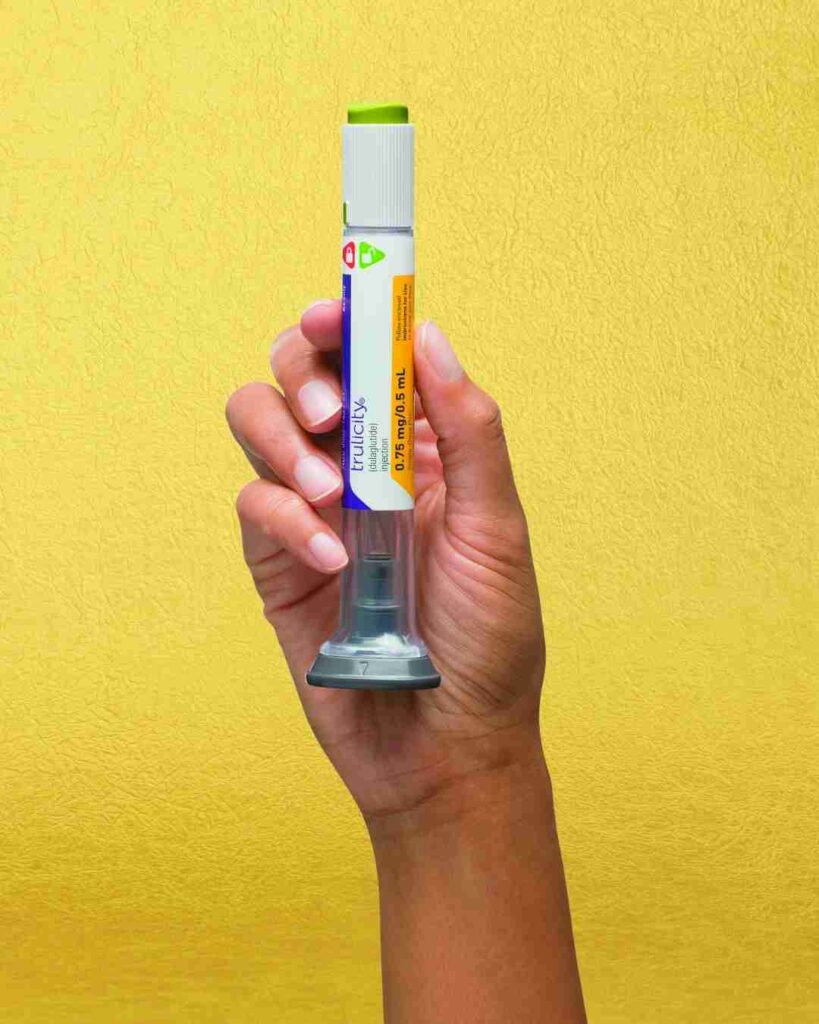
You should always follow your doctor’s orders when taking medication. Your doctor may prescribe Trulicity with other diabetic medications. This drug has no adverse interactions with other diabetic medications.
You should never take antidiabetic drugs on your own without a physician’s prescription. This is because antidiabetic drugs do essentially one thing-decrease your blood glucose.
If you add other drugs on your own, you risk hypoglycemia. This can lead to severe problems in your body, including brain damage.
The only drugs with which Trulicity has severe reactions are bexarotene and gatifloxacin. None of these drugs is are antidiabetic medication.
Let’s look at some common queries about drug combinations with Trulicity.
Can You Take Trulicity with Victoza
The generic name of Victoza is Liraglutide. Liraglutide is also a GLP-1 agonist, just like Dulaglutide. It is unlikely that your doctor will prescribe both at the same time.
Your doctor may tell you to swap one with the other if one is not working. Taking both at the same time is uncommon.
Can You Take Trulicity with Metformin
You can take Trulicity and Metformin together. There are no adverse reactions. However, you should take it only with the doctor’s advice. That is because the doses have to be adjusted together.
Can You Take Trulicity with Insulin
You can take Trulicity with Insulin if your doctor suggests it. Trulicity does not interact directly with insulin. Both of these drugs can lower blood sugar, so the dosage is critically important and should be monitored by your physician.
Can You Take Trulicity with Jardiance
You can take Trulicity with Jardiance per a physician’s advice. Jardiance or empagliflozin is an SGLT-2 inhibitor, which means it lowers blood sugar by increasing its excretion from the body. It may also cause hypoglycemia, so a dosage adjustment by a physician is necessary.
Can You Take Trulicity with Tradjenta
You can take Trulicity with Tradjenta. This drug is an incretin modifier type of drug, which means it increases insulin secretion. Tradjenta may cause hypoglycemia, but it does not directly interact with Trulicity. These medications can be combined if their doses are adjusted by a physician.
What Should You Eat While Taking Trulicity
As mentioned above, Trulicity does not interact with any food directly. But it is best to stick to the diabetic diet. That way, Trulicity can work effectively to check your blood glucose. Below are some foods that you can try incorporating into your diet.
Foods Rich In Vitamins
Vitamins and antioxidants are essential for your body in small amounts. Deficiencies of vitamins can cause harm to your body. Vitamin-rich foods include fresh fruits, vegetables, milk, and liver.
Foods Rich In Fiber and Complex Carbohydrates
Complex carbohydrates and fibers are the best sources of carbohydrates for diabetics. These are broken down and absorbed slowly. They do not cause a spike in blood glucose, which helps Trulicity to work effectively. Fibers and complex carbohydrates include whole grains, apples, beans, cabbage, celery, kale, beans, and broccoli.
Foods Rich in Antioxidants
Antioxidants are compounds that can fight against free radicals. Free radicals are responsible for harm to your body. Diabetic patients often have fewer antioxidants in their bodies. Taking antioxidant-rich foods like carrots, watermelon, squash, papaya, strawberries, etc., is helpful.
Foods With Healthy Fats Like Omega-3 Fatty Acids
Healthy fats help diabetics with their insulin resistance. Healthy fats can be found in avocado, coconut, sea fish oil, nuts, seeds, olive oil, and palm oil.
Should I Take Trulicity with Food
Food does not interfere with Trulicity’s actions, so it does not matter if you take it with or without food.
Can you Take Trulicity On an Empty Stomach?
Yes, you can take Trulicity on an empty stomach. This drug is given as an injection, so it can not cause stomach upset due to an empty stomach.
Can you Take Trulicity after Eating?
Yes, you can take Trulicity after eating. This drug is given as an injection, so food in the stomach will not interfere with its absorption.
How Long Does Trulicity Stay In Your System?
Trulicity may stay in your system for 25-30 days.
Trulicity has a half-life of around 5 days for most individuals. Half-life means the amount of time your body takes to push half of the drug out of the body. It takes 5 to 6 half-lives for your body to eliminate any drug (i.e., 25-30 days for Trulicity).
Side Effects of Trulicity
Like all other drugs, Trulicity has its own share of side effects. Most are not serious. However, in rare cases, a few serious side effects have been noted.
Stomach Problems
Gastrointestinal issues are the most common side effects of Trulicity. Symptoms such as nausea, vomiting, diarrhea, and anorexia may occur, but not severely.
Acute Pancreatitis
This is a rare but serious side effect of Trulicity. Acute pancreatitis presents with severe central abdominal pain. This pain radiates to the back and is relieved by leaning forward.
Low Blood Sugar
Although less than other diabetic drugs, Trulicity can still cause hypoglycemia. Symptoms of hypoglycemia include palpitations, sweating, dizziness, and loss of vision.
Allergic Reactions
Because it is given by subcutaneous injection, there can be dermal and/or systemic allergic reactions as well. Allergic symptoms may include rash, hives, itching, swelling, breathing difficulty, and palpitations.
Acute Kidney Injury
Like other GLP-1 agonists, Dulaglutide may cause kidney injury. This manifests as sudden stoppage of urine, fatigue, and muscle cramps.
Gallbladder Problems
Trulicity increases the risk of cholecystitis. This causes pain in the upper right abdomen and right shoulder that increases with fatty foods.
Cancers
Dulaglutide increases the risk of thyroid gland tumors. If you notice any abnormal neck swellings, inform your doctor immediately.
How To Avoid Trulicity Side Effects
If you notice any new symptoms after starting Trulicity, you should inform your doctor immediately. Your physician may need to adjust your dose or switch up your medications.
You should not take more than the prescribed amount.
Solution: Pancreas Inflammation
Reducing your alcohol intake can decrease the chance of pancreatitis.
Solution: Allergic Reaction
For an allergic reaction, you need to stop the drug and inform your doctor. They can administer the proper medication to treat the reaction.
Solution: Digestive Problems
The proper antiemetic drugs can reduce this problem if it becomes too severe.
Solution: Low Blood Sugar
If you feel the symptoms of low blood sugar, then you can consume anything sweet, like candy.
FAQs
Are There Any Generic Substitutes for Trulicity?
There are no other generic substitutes for Dulaglutide or Trulicity. But there are other cheaper antidiabetic drugs that your doctor may suggest at your request.
Should Trulicity be stored at room temperature?
Trulicity can be stored at room temperature for up to 2 weeks. For longer storage time, refrigeration is recommended. Take care not to freeze it.
What is the best time of day to inject Trulicity?
You can take Trulicity at any time of the day. Additionally, it does not matter whether you take it on an empty stomach.
Conclusion
Trulicity works best when it is taken as prescribed by a physician. Avoiding food and drink that are high in fat and sugar helps control blood glucose levels. This will make it easier for Dulaglutide to exert its effect and help you live a longer, healthier life.
Related Posts






Subscribe for New Racipies
Get mental health tips, updates, and resources delivered to your inbox.