
Tartine Croissant Recipe

Medically reviewed by Christiana George Updated Date: June 8, 2023

Every now and again, I like to tackle big projects. I’m good at big projects. There’s something so reassuring about them, like you know there’s an end in sight, eventually, but it’s so far away that you’re not focused on it. Instead, you get to hunker down, keep your head low, and really sink yourself into the process. Drink some coffee while you’re at it, noodle around with other things while waiting (there’s always a lot of waiting).
BUT. Everything will be going swimmingly, until everything goes awry. That’s when, say, you open the oven to discover a hot tub’s worth of butter oozing around on the floor of your baking pan. It might be kind of like how Alexander Fleming felt when he realized he’d left a Petri dish uncovered in the lab—the horror!, the shame!, the contamination (him)!, the smell of frying croissants (me)!—except he discovered penicillin, and I ended up with rubbery croissants.
It’s in moments like these that your character will come through. You could give up, throw in the towel, decide to start down another path altogether. Knife-sharpening comes to mind, although that’s another one of those projects you could (and will be told to) spend a lifetime mastering. Or attempting the elusive scorpion pose. (I know, scary.) Alternatively, you could also decide to try again. According to my assessment, the latter demonstrates true grit. Or so I have to believe. Fine, mostly, I didn’t want to feel like I’d been defeated by a baked good.

So I took a step back and really tried to figure out where I’d gone wrong. I think it came down to one main reason: the butter hadn’t been soft enough when I’d started the lamination process. It seems that butter that isn’t sufficiently malleable will clump up and tear through the layers, resulting in lots of leakage points. Does that sound about right, seasoned croissant makers? But, a little leaking is normal too, and should not be a cause for concern. Along with a few other small tweaks, I felt ready to give croissants another go.
I’d initially made half a batch of plain croissants and half a batch of ham and cheese, but for my second attempt, I decided to pare down my expectations. If I could successfully make a batch of plain croissants, I could begin thinking about incorporating other ingredients. It’s kind of like how in Japan, sushi apprentices spend years mastering the art of making rice before they’re allowed to move on to even touching the other stuff. (Talk about integrity!)

Of course you’re wondering how my second attempt went? Pretty well, I think. The insides were a bit doughier than I would’ve liked, but they actually tasted like croissants. Buttery, flaky, layers shattering upon contact. I love that initial tenderness of the innards when the croissants are pulled apart. They’re still steaming from their bake and taste incredibly luscious and fresh. I also love the way the tips burn slightly. They’re the crispest parts, all puff pastry-like and caramelized. And the shape, the shape! While svelte and long are generally qualities esteemed by women the world over, I love how cute and round mine came out. They’re like the Volkswagon Beetles of the croissant world.
I don’t know, I think Tartine just might approve.


TARTINE CROISSANTS Recipe
Adapted from Tartine
Makes 10
Ingredients:
- For the preferment:
- 6 Tbsp nonfat milk
- 1/2 T (or 1.5 t) active dry yeast
- 2/3 cup all-purpose flour
And everything else:
- 2 t active dry yeast
- 1 cup minus 2 T (or 14 T) whole milk
- 3 cups all-purpose flour
- 1/6 cup sugar
- 2 t salt
- 1/2 T unsalted butter, melted
- 2-3/4 sticks (or 22 Tbsp) unsalted butter, cool but malleable
- 1 egg & a pinch of salt for the egg wash
Tartine Croissant Recipe Directions:
For the preferment: Heat up the milk so it’s warm but not hot (I mixed whole milk with hot water that had been heated in the kettle earlier in the day to make warm-ish “nonfat” milk.) and pour it in a mixing bowl. Sprinkle the yeast on top, stir to dissolve, and mix in the flour until a smooth batter forms. Cover and let rise until almost doubled in volume, 2 to 3 hours (or overnight if stored in the fridge).
For the rest of the recipe: Make the dough. Transfer the preferment to the bowl of a stand mixer fitted with the dough hook. Sprinkle in the yeast and mix on low speed until incorporated, a minute or two. You can stop the mixer to scrape down the sides if needed. When the mixture is well-mixed, increase the speed to medium and mix for a few minutes. Slowly add in half the milk and continue to mix until the milk is fully incorporated. (This will take awhile. I helped the process along by stopping the mixer and scraping down the sides.) Reduce the speed to low, add the flour, sugar, salt, melted butter, and the rest of the milk, and mix until everything comes together in a loose, shaggy-looking dough, about 3 minutes. Stop the mixer and let the dough rest for about 15 minutes. Once again, turn on the mixer and mix until the dough is smooth and elastic, no more than 4 minutes. (Mixing encourages gluten growth, which is not what you want in this case, so try to keep the mixing time as short as possible.) Once you’ve achived a smooth dough, cover the bowl and let the contents rise in a cool place until the volume increases by about half, 1.5 hours.
Lightly flour a work surface and transfer the dough to the surface. Press it into a rectangle about 2 inches thick, wrap in plastic wrap, and place the dough in the fridge for about 4 to 6 hours.
About an hour before removing the dough, put the butter in the bowl of your stand mixer fitted with the paddle attachment, and mix it on medium-high speed for a few minutes. This part is important, as the consistency of the butter is really important for lamination. What you’re going for is butter that’s malleable, but not melting. It should still be cool but amorphous, not retaining its original shape. I found it helpful to stop and scrape the butter that had built up on the side of the bowl with a spatula and into a bowl. If you do this a few times, poking the butter out of the holes of the paddle, you’ll end up with soft but cool butter. Place the bowl in the fridge to firm up a bit.
Now the lamination begins: Lightly flour a work surface and take dough and butter out of the fridge. Unwrap the dough and set it on the surface. With a rolling pin, roll the dough into a pronounced rectangle 20 inches wide and 8 inches long. Make sure the long side is facing you. Starting from the left, spread the butter over 2/3 of the dough using a combination of your hands and a spatula to apply it evenly (leave a slight margin). Fold the uncovered third over the center third, then fold the left third over that. (It’s like folding a letter.) What you end up with is called a plaque. Seal the seams of the plaque so that the butter is sealed within the dough.
Now onto the second turn: Turn the plaque 90 degrees so that the long side is once again facing you. Again, roll the dough out to a pronounced 20′x8″ rectangle and fold it like you did earlier. All the while, feel free to scatter a little flour over and under the dough to keep it from sticking to the rolling pin/surface, but brush off excess flour as it will affect the final product. Wrap the plaque in plastic wrap and place it in the fridge for about 1.5 hours.
The third and final turn: Repeat rolling out the plaque and folding it. Re-wrap it in plastic wrap and place it back in the fridge for about 1 hour. (At this point, the dough can be frozen, but let it warm up by spending a night in the fridge before rolling it out.)
Shaping: This time, roll the dough out to a pronounced rectangle at least 22.5″ wide and 9″ tall. Using a sharp knife or pizza wheel, cut off the excess margins. You basically want a 22.5″x9″ rectangle with the sides all trimmed off. Using a ruler, slice the dough into five equal rectangles that are 4.5″ wide and 9″ tall. Slice each of these in half so that you have 2 right-angled triangles (with a long side about 10″).
Have a large baking sheet covered with parchment paper ready. To shape, position each triangle so that the base faces you. Take the two points of the base in your fingers and stretch them a bit. Then furl the base upwards into a roll. Continue rolling with your palms, and at the end, grab the last tip, give it a slight stretch, and tuck the point underneath the rolled dough.
Place the croissant on the baking sheet, giving it plenty of space (Please note: in the picture above of the raw croissants, they are way too closely-spaced!). After all the croissants have been placed on the pan, set the croissants in a draft-free, cool place for a final rise, 2 to 3 hours. I placed the baking sheet in a large empty plastic bag. (It keeps a skin from forming, inhibiting the rise.)
Preheat your oven at 400 degrees F. When the croissants are just about ready (they’ll be puffy, and when you push one with your fingertips, the indent will stay), prepare the egg wash by whisking together the egg, a pinach of salt, and a splash of water. Apply the wash with a pastry brush over all the surfaces and edges. Slide the croissants into the oven. After 5 minutes, reduce the temperature to 350 degrees F and bake another 20 minutes until the croissants are golden-brown. And if some butter seeps out, that’s totally okay.

Check More Recipes:
Apricot Raspberry Galette, Or Look What I Made!
Related Posts





Subscribe for New Racipies
Get mental health tips, updates, and resources delivered to your inbox.
Maple Chocolate Chip Zucchini Cookies

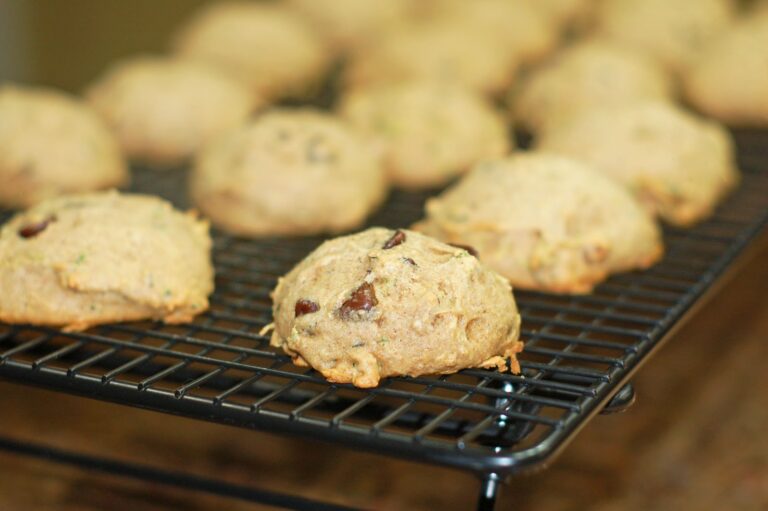
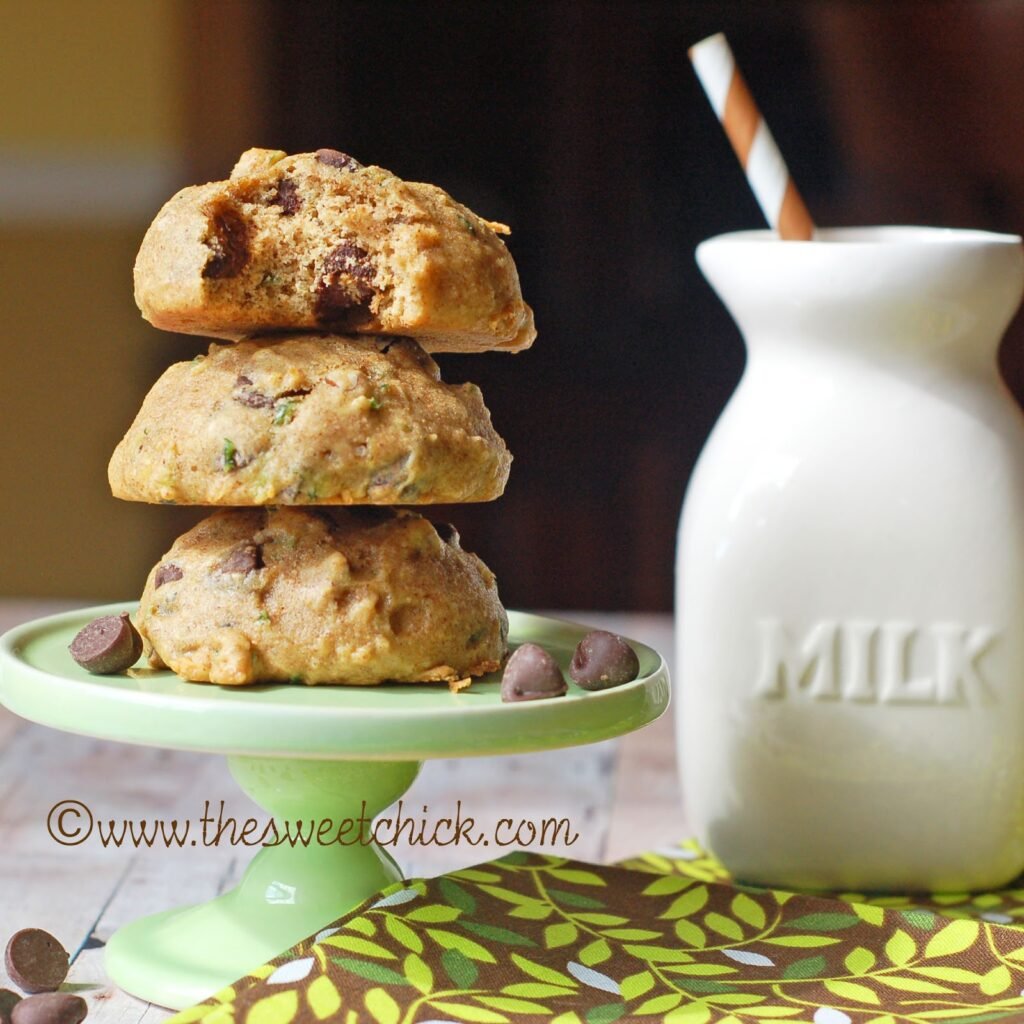
I figured you guys would be sick of pumpkin recipes by now and I was craving zucchini. I have made these zucchini cookies before using a recipe from my mom’s archives. I just adapted it to my taste. I was more in the mood for pecans and chocolate chips than walnuts and raisins.

I didn’t even have any sticks of butter on hand, so I had to make due with a tub of Smart Balance. I really needed cookies and I wasn’t driving to the store for butter.
Never fear, the cookies turned out fine. In fact, they were nice and puffy, just like a chocolate chip zucchini cloud.

When you bite into them, you can taste the zucchini with a hint of cinnamon that really enhances the flavor of the chocolate chips. I like that they are not overly sweet. Although, it does make it harder to stop after eating just one. They go down real easy.
Maple Chocolate Chip Zucchini Cookies
by The Sweet Chick
Prep Time: 15 minutes
Cook Time: 12 minutes
Keywords: bake dessert zucchini maple syrup chocolate chips cookie
Ingredients (30 cookies)
- 1/2 cup butter
- 3/4 cup sugar
- 1/4 cup pure maple syrup
- 1 egg, beaten
- 1 teaspoon pure vanilla extract
- 1 cup all purpose flour
- 1 1/2 cups wheat flour
- 1 teaspoon cinnamon
- 1/4 teaspoon salt
- 1 teaspoon baking powder
- 1 teaspoon baking soda
- 1 cup shredded zucchini
- 1/2 cup semi sweet chocolate chips
- 1/3 cup chopped pecans
Instructions
Preheat oven to 350º F.
In a stand mixer add butter, sugar, syrup, egg, and vanilla. Beat on low until well mixed and texture is smooth.
In a separate bowl combine flours, cinnamon, salt, baking powder and baking soda. Stir until all is well blended.
Then slowly add dry mixture to the wet mixture and beat on low until it becomes a dough like consistency.
Then add zucchini, chocolate chips, and pecans. Mix until all is evenly distributed throughout the dough.
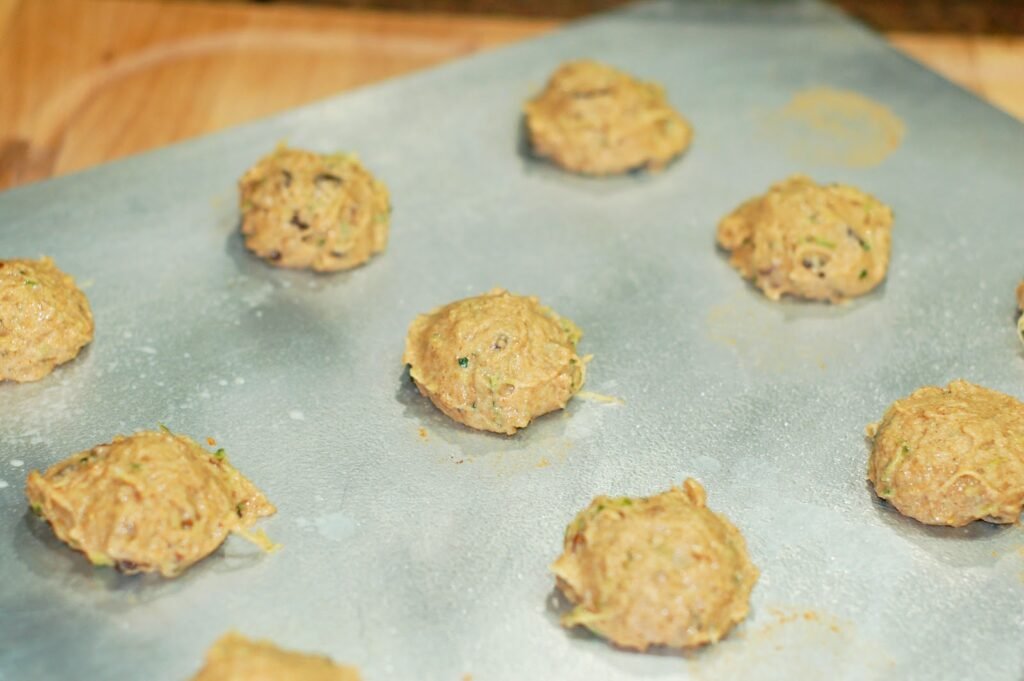
Using a spoon or cookie scoop, drop by tablespoon or so onto a greased cookie sheet leaving 2 inches between each dough ball.
Bake for 12 minutes or until the tops are slightly golden. Remove from the oven and wait 5 minutes, then remove from cookie sheet and place on cooling rack until completely cooled.
Then grab a glass of milk or a cup of coffee and see if you can resist eating more than one.
Related Posts




Subscribe for New Racipies
Get mental health tips, updates, and resources delivered to your inbox.