
Are Roma Tomatoes Acidic? Better for Acid Reflux Than Beefsteak?

Medically reviewed by Jaclyn Weiner, RD, RDN, MEd, MS Updated Date: October 10, 2026
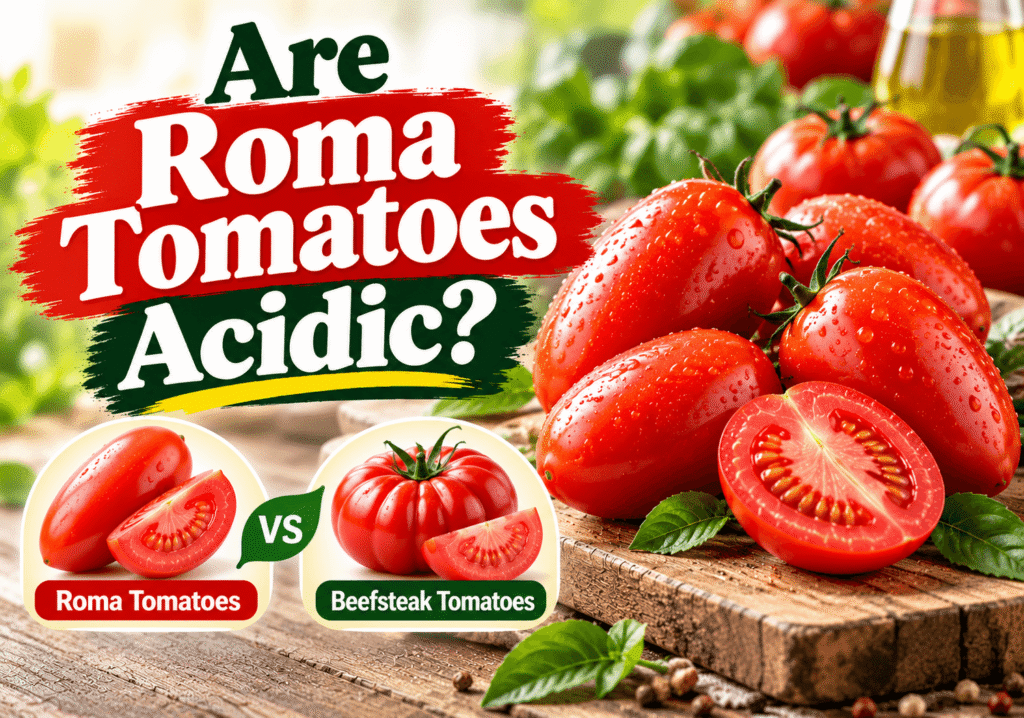
Yes, Roma tomatoes are acidic. Like every tomato, they have a pH below 7. The FDA lists fresh tomatoes at about pH 4.3 to 4.9 and doesn’t give Roma tomatoes a separate value (FDA). In one North Dakota State University test, a Roma-type variety called La Roma measured pH 5.08, which is on the mild side for a tomato (NDSU Extension). But an older study found that plum tomatoes, the group Romas belong to, were the most acidic of five tomato types tested (Mahakun et al., 1979).
So are Romas better for acid reflux than big beefsteak tomatoes? There’s no good evidence that they are. Both are acidic, results vary from study to study, and no research has compared tomato varieties for heartburn. What you make with them, how much you eat, and when you eat it matter far more than the variety.
This guide explains what the research really says about Roma tomato acidity, how Romas compare with beefsteak tomatoes, why sauce made from Romas can still bother your stomach, and practical ways to enjoy them if you have reflux.
Key Takeaways
- Roma tomatoes are acidic, like all tomatoes. Fresh tomatoes generally range from pH 4.3 to 4.9.
- Studies disagree on whether Romas are more or less acidic than other tomatoes. One study found plum types the most acidic; a newer test found a Roma variety on the mild side.
- Growing conditions can matter more than variety. In one North Dakota test, every variety, including slicers, measured above pH 4.9.
- There’s no proof Romas are easier on reflux than beefsteak tomatoes. Portion size, cooking method, fat, and timing matter more.
- Roma tomatoes are usually cooked into sauce, and thick, concentrated sauces are a common heartburn trigger.
- Always add acid when canning Romas, no matter how mild they taste.
For the full background on tomato pH, see our main guide, Are Tomatoes Acidic?, and our companion article, Are Cherry Tomatoes Acidic?
Are Roma Tomatoes Acidic? The Short Answer
Roma tomatoes are acidic because they contain natural plant acids, mainly citric acid and malic acid, which give tomatoes their tangy flavor. Their pH is below 7, the neutral point on the pH scale.
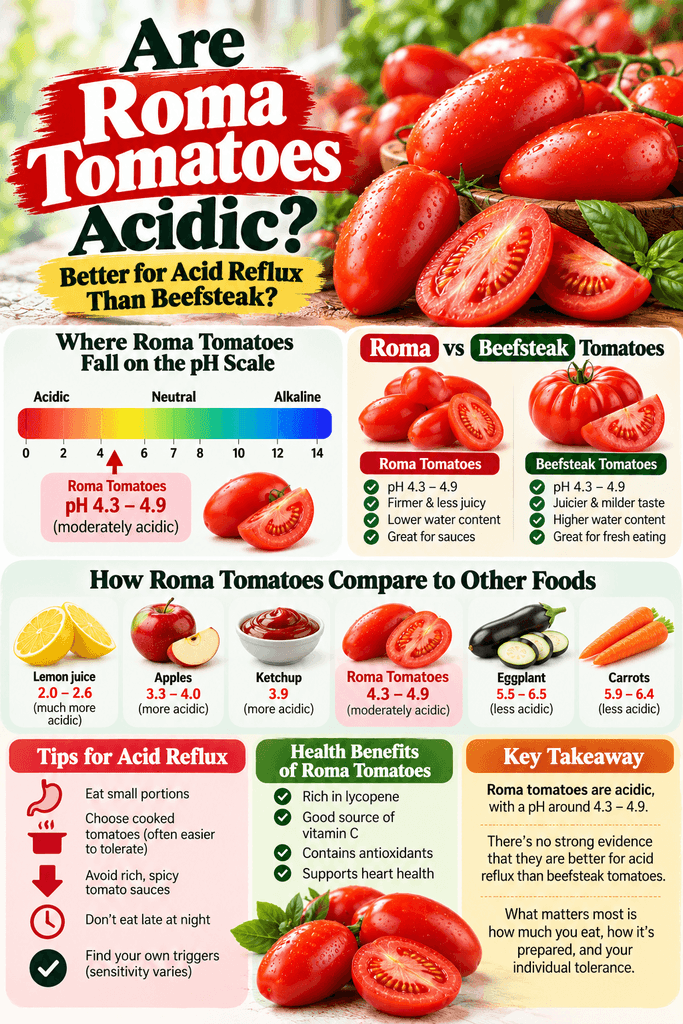
But “acidic” doesn’t mean “very acidic.” Here’s how fresh tomatoes compare with some everyday foods, using FDA pH values:
| Food | Approximate pH (FDA) |
| Lemon juice | 2.00–2.60 |
| Apples (eating) | 3.30–4.00 |
| Tomato paste | 3.50–4.70 |
| Ketchup | 3.89–3.92 |
| Fresh tomatoes (including Roma) | 4.30–4.90 |
| Eggplant | 5.50–6.50 |
| Carrots | 5.88–6.40 |
Source: FDA, Approximate pH of Foods and Food Products. The FDA groups all fresh tomatoes together.
Each step on the pH scale is a tenfold change, so lemon juice is roughly 100 times more acidic than a typical tomato. Roma tomatoes are moderately acidic: tangier than most vegetables but milder than citrus and most fruit. For hundreds more foods, see our complete guide to acidic foods.
What Is the pH of Roma Tomatoes?
There’s no single official pH for Roma tomatoes, but a few studies give us useful clues. The numbers don’t all point the same way, which is exactly why you should be skeptical of any website that gives a precise “Roma pH.”
Study 1: North Dakota’s variety test
North Dakota State University (NDSU) Extension grew 14 tomato varieties in Williston, North Dakota, and measured their pH. Several were paste or Italian-style types similar to Roma (NDSU Extension):
| Variety | pH of raw tomatoes |
| Bush Celebrity (round slicer) | 4.93 |
| HA3510 | 4.95 |
| Dr. Carolyn | 5.01 |
| Classica | 5.05 |
| Super Italian Paste | 5.06 |
| La Roma | 5.08 |
| Opalka | 5.08 |
| Russian | 5.09 |
| Super Marzano | 5.20 |
Selected varieties from Table 1 of NDSU Extension publication FN1396. All 14 varieties tested above pH 4.6.
Two things stand out. First, every variety in this test was above pH 4.9, which is higher (less acidic) than the FDA’s typical range. The researchers’ conclusion was a safety warning: since all the tomatoes were above pH 4.6, they all needed added lemon juice for safe canning. Second, the paste-style varieties, including La Roma and Super Marzano, landed in the same narrow range as the round slicing tomato, Bush Celebrity. In this test, variety type made only a small difference. Where the tomatoes were grown seems to have mattered more.
Study 2: San Marzano tomatoes in Italy
San Marzano tomatoes are a famous Italian plum tomato closely related to Romas. A study in the journal Food Chemistry analyzed many San Marzano lines and found a mean pH of 4.6, with individual samples ranging from about 4.2 to 5.1. The authors noted this was “somewhat higher” than the pH of the hybrid processing tomatoes used by industry, and that San Marzano tomatoes had lower total acidity (about 0.35 g per 100 g, versus 0.44 g in hybrids) (Loiudice et al., 1995).
That suggests some Italian plum tomatoes can be a bit less acidic than standard processing tomatoes. But the range is wide, and some samples were still quite acidic.
Study 3: Plum tomatoes were the most acidic type
An older study in the Journal of Food Science compared the acid content of five different tomato fruit types. The researchers reported that “tissues from plum tomatoes were the most acidic of the 5 types” (Mahakun et al., 1979). Roma tomatoes are plum tomatoes, so this result points the other way from the San Marzano findings.
So which is right?
All three can be true at once. Tomato acidity depends on the specific variety, the soil, the weather, how ripe the fruit is, and even where the samples were grown. Studies done in different places, decades apart, won’t give identical answers.
The fair conclusion is this: Roma tomatoes fall within the normal tomato acidity range. Some Roma and plum varieties may test slightly milder than average, and some may test more acidic. You can’t count on a Roma being low-acid.
Roma vs. Beefsteak Tomatoes: Which Is More Acidic?
Beefsteak tomatoes are the big, juicy slicing tomatoes you put on burgers and sandwiches. Romas are smaller, egg-shaped, and firmer. They look and cook very differently, but how do they compare on acidity?
| Feature | Roma (plum/paste) tomatoes | Beefsteak (slicing) tomatoes |
| Shape and size | Small to medium, oval or egg-shaped | Large, round or flattened |
| Texture | Firm, meaty flesh with fewer seeds and less juicy gel | Very juicy, lots of seeds and gel |
| Best uses | Sauces, paste, roasting, canning | Slicing, sandwiches, salads |
| pH | Within the normal tomato range; studies disagree on whether higher or lower | Within the normal tomato range; little published variety data |
| Better for reflux? | No proven advantage | No proven advantage |
Sources: FDA; NDSU Extension; Mahakun et al., 1979; Purdue Extension.
There’s very little published pH data specifically for beefsteak varieties, so a direct, fair comparison isn’t possible. What we can say is that neither type is reliably low-acid.
Where the acid is inside a tomato
Here’s an interesting detail that helps explain the confusion. Inside a tomato, the acid isn’t spread evenly. The 1979 Journal of Food Science study found that the locular tissue, the jelly-like gel around the seeds, had the highest acidity and the most citric acid, while the pericarp, the firm outer flesh, had the highest pH (the least acidic part) (Mahakun et al., 1979).
Roma tomatoes are known for meaty flesh and less seedy gel, while beefsteak tomatoes are full of juicy gel pockets. You might expect that to make Romas milder. Yet the same study found plum tomatoes were the most acidic type overall. In other words, tomato structure alone doesn’t predict acidity, and you can’t tell how acidic a tomato is by looking at it.
A practical tip: remove the seeds and gel
Although there’s no study on whether it helps reflux, the finding that the gel is the most acidic part of a tomato offers a simple kitchen experiment. If raw tomatoes bother you, try scooping out the seeds and gel before slicing or dicing them. Romas make this easy because they have less gel to begin with. You’ll be eating mostly the outer flesh, which tested as the least acidic part of the fruit in that study.
Do Romas have less water?
Romas feel drier and meatier, which is why cooks prize them for sauce. But USDA data show that raw Roma tomatoes are still about 94.7% water, almost the same as regular red tomatoes at 94.5% (USDA FDC 1999634; USDA FDC 170457). The difference is mostly in structure: more firm flesh and less loose, juicy gel, rather than much less water overall.
Roma vs. San Marzano and Other Paste Tomatoes
Roma is just one of several paste, or plum, tomatoes. You’ll also see San Marzano, Amish Paste, Opalka, and others at farmers’ markets and in seed catalogs. Some are sold as “low-acid.”
Here’s what the evidence supports:
- San Marzano: One study found an average pH of 4.6 and lower total acidity than hybrid processing tomatoes, but with a wide range of 4.2 to 5.1 (Loiudice et al., 1995).
- Opalka, Super Italian Paste, Super Marzano: In NDSU’s test, these paste types measured pH 5.06 to 5.20, very close to La Roma at 5.08 and the round slicer Bush Celebrity at 4.93 (NDSU Extension).
- “Low-acid” labels: When a gardener asked Ask Extension about low-acid tomatoes, the expert listed San Marzano and Amish Paste among varieties marketed that way, but explained that “low-acid tomatoes are just as acidic as other tomatoes” and simply taste less sour because they’re sweeter (Ask Extension, 2024).
Purdue Extension makes the same point about yellow tomatoes: they’re not really lower in acid, they just contain more sugar (Purdue Extension, 2015). Taste is not a pH test. A mellow-tasting paste tomato can still carry plenty of acid.
Fresh vs. Canned Roma Tomatoes
Many cans of whole, crushed, or puréed tomatoes are labeled as Roma, plum, or San Marzano style, so canned tomatoes are worth a look too.
Check the ingredient list and you’ll often see citric acid. Manufacturers add it so every batch stays safely acidic, since fresh tomatoes can test above pH 4.6. That’s one reason the FDA lists canned tomatoes at pH 3.50 to 4.70, a range that reaches lower (more acidic) than fresh tomatoes at 4.30 to 4.90 (FDA).
What does this mean for you?
- If you’re sensitive to acid, fresh Romas may be gentler than some canned tomatoes, especially brands with added citric acid.
- Tomato paste is the most concentrated form. It can range as low as pH 3.5, so use it in small amounts.
- Canned tomatoes without added citric acid do exist, but they’re still tomatoes, and their pH won’t be dramatically higher.
If you make sauce from scratch with fresh, ripe Romas, you have more control over the final dish: you can seed them, skip extra acidic ingredients like wine or vinegar, and balance the sauce with vegetables or dairy.
Are Roma Tomatoes Better for Acid Reflux Than Beefsteak?
This is the question many people really want answered, so let’s be direct: no study has shown that Roma tomatoes cause less heartburn than beefsteak or any other tomato.
The National Institute of Diabetes and Digestive and Kidney Diseases (NIDDK) lists tomatoes and tomato products as foods that may make acid reflux worse, without singling out any variety (NIDDK). And as the studies above show, Roma pH can land anywhere in the normal tomato range.
Why Romas might actually be harder on reflux
Ironically, Roma tomatoes may end up causing more heartburn for some people, not because of the tomato itself but because of how it’s usually eaten. Romas are the classic sauce tomato. Purdue Extension recommends paste varieties for sauce and ketchup (Purdue Extension, 2015). And sauces often come with other reflux triggers:
- Concentration: Simmering cooks off water, so a spoonful of thick sauce carries more tomato acid than a slice of fresh tomato. The FDA lists tomato paste as low as pH 3.5 (FDA).
- Big portions: A plate of pasta with sauce often contains far more tomato than a sandwich slice.
- Fat and cheese: Lasagna, pizza, and meat sauces add fat, which NIDDK also lists as a possible trigger.
- Garlic, onion, and spice: Common in Italian sauces and bothersome for some people.
- Late dinners: Pasta night often means a big meal close to bedtime.
A few slices of beefsteak tomato on a sandwich at lunch may be much easier on your stomach than a large bowl of Roma-based marinara at 9 p.m.
What the experts recommend instead
The American College of Gastroenterology’s 2022 guideline on GERD suggests that people with reflux identify their own trigger foods rather than avoiding every possible one, and avoid eating within 2 to 3 hours of bedtime (Katz et al., 2022).
That means the best way to know whether Romas or beefsteaks suit you better is to test them yourself:
- Eat the same amount of each type, prepared the same way (for example, a few raw slices with lunch), on different days.
- Write down how you feel in a simple food diary.
- Then try cooked versions, such as a small serving of sauce, and compare.
- Look for patterns over a week or two before deciding which tomatoes, if any, to limit.
If you have heartburn more than twice a week, trouble swallowing, or symptoms that don’t improve, talk with your doctor. For more on common triggers, see our guide to foods to avoid with GERD.
How to Make Roma Tomato Sauce Gentler on Your Stomach
If you love cooking with Romas but your stomach sometimes complains, these kitchen strategies can help. None of them make tomatoes acid-free, but they can make a dish easier to tolerate.
- Keep portions modest. Serve sauce as a light coating, not a deep pool, and fill the rest of the plate with vegetables and grains.
- Seed the tomatoes. Scoop out the seeds and gel before cooking. It’s a simple trick with Romas, and the gel was the most acidic part of the fruit in research (Mahakun et al., 1979).
- Add sweet, low-acid vegetables. Blend in grated carrots, roasted red bell peppers, or a scoop of pumpkin puree so each serving has less tomato.
- Add a pinch of baking soda. Baking soda is alkaline and neutralizes some acid. Add a tiny pinch, stir, and taste. Too much makes sauce taste soapy.
- Stir in something creamy. A spoonful of ricotta or a splash of milk softens both taste and acidity.
- Go light on fat and spice. Choose lean protein over sausage, and skip chili flakes if they bother you.
- Eat earlier. Have tomato-based dinners at least 2 to 3 hours before bed, as the ACG guideline suggests (Katz et al., 2022).
- Serve it with gentle sides. Pair sauce with potatoes, basmati rice, or plenty of steamed vegetables.
Adding sugar to sauce is a popular trick too, but it mainly balances the taste of acid without changing the pH much.
Tomato-free sauce ideas
If tomatoes clearly trigger your reflux, you can still enjoy pasta night:
- Pesto or garlic and olive oil (go easy on the garlic if it bothers you)
- A white sauce made with milk and a little cheese
- Roasted vegetable puree made from butternut squash, sweet potatoes, carrots, and herbs
- Eggplant-based dishes, since eggplant is much less acidic than tomato
Roma Tomatoes, Gastritis, and Mouth Sores
Gastritis: People with an inflamed stomach lining often find acidic, spicy, or fatty foods uncomfortable, but reactions vary. If tomato sauce bothers you, try small amounts of fresh, seeded Roma tomatoes as part of a meal instead. For gentle meal ideas, see our 7-day meal plan for gastritis.
Mouth sores: Mayo Clinic lists spicy or acidic foods among the foods that can trigger canker sores in some people (Mayo Clinic). While a sore heals, skip tomato sauce and salsa for a few days.
Teeth: The American Dental Association suggests eating acidic foods like tomatoes as part of a meal rather than on their own, because how often your teeth are exposed to acid matters (American Dental Association).
Canning Roma Tomatoes: Always Add Acid
Roma tomatoes are a favorite for home canning, but their pH is exactly why you need to be careful.
The bacterium that causes botulism can’t grow in foods at pH 4.6 or below (UC Master Food Preserver Program). In NDSU’s test, La Roma (5.08) and Super Marzano (5.20) were both well above 4.6, and so was every other variety tested. After lemon juice was added, the salsa made from them dropped safely below 4.6 (NDSU Extension).
Even the Utah State University variety study, where all the tomatoes tested below 4.6, concluded that home canners should add acid “regardless of the varieties used,” because you can’t know a tomato’s pH by looking at it (Heflebower and Washburn, 2010).
Colorado State University Extension recommends adding the following to each jar (Colorado State University Extension):
| Jar size | Bottled lemon juice | Citric acid | 5% vinegar |
| Pint | 1 tablespoon | ¼ teaspoon | 2 tablespoons |
| Quart | 2 tablespoons | ½ teaspoon | 4 tablespoons |
A few more tips:
- Use bottled lemon juice, not fresh, for a consistent acid level.
- Don’t can tomatoes from dead or frost-killed vines, because their acidity may change (NDSU Extension).
- Follow a tested recipe from a university extension service or the USDA.
Roma Tomato Nutrition
Roma tomatoes are low in calories and offer useful nutrients. Here’s what USDA FoodData Central lists for 100 grams of raw Roma tomato:
| Nutrient | Roma tomato, raw (per 100 g) |
| Calories | 19 |
| Water | 94.7 g |
| Carbohydrates | 3.8 g |
| Fiber | 1.0 g |
| Protein | 0.7 g |
| Vitamin C | 17.8 mg |
| Potassium | 193 mg |
| Lycopene | 2,863 mcg |
| Beta-carotene | 276 mcg |
Source: USDA FoodData Central, Tomato, roma (FDC ID 1999634).
- Vitamin C: 17.8 mg per 100 grams is about 20% of the 90 mg Daily Value (NIH Office of Dietary Supplements).
- Lycopene: The red pigment in tomatoes. Your body absorbs it better from cooked tomato products eaten with a little fat. In one study, people absorbed about 2.5 times more lycopene from tomato paste than from fresh tomatoes (Gärtner et al., 1997). That’s good news for Roma sauce lovers who tolerate it well.
Delicious Ways to Use Roma Tomatoes
If tomatoes agree with you, Romas shine in cooked dishes. Try them in these recipes from our kitchen:
- Tomato soup: Romas make a thick, rich soup. A splash of cream softens the acidity.
- Slow-roasted tomatoes: Halved Romas roast beautifully and turn sweet and jammy.
- Pasta puttanesca: A bold, briny sauce. Save it for good-stomach days.
- Shakshuka: Eggs poached in a Roma tomato sauce. Go easy on the chili if needed.
- My lasagna and petite lasagnas: The petite version makes portion control easier.
- Caponata: Eggplant does most of the work here, so there’s less tomato per bite.
- Roasted corn pico de gallo: Firm Romas dice neatly and don’t get watery. Seed them first if you’re sensitive.
- Caprese salad: Traditionally made with slicing tomatoes like beefsteaks, but sliced Romas work too.
Frequently Asked Questions
Are Roma tomatoes less acidic than regular tomatoes?
Not reliably. One study found a Roma variety on the mild side (pH 5.08), and San Marzano plum tomatoes averaged a slightly higher pH than hybrids. But another study found plum tomatoes the most acidic of five types. Romas fall within the normal tomato range.
What is the pH of a Roma tomato?
There’s no official value. The FDA lists fresh tomatoes at pH 4.30 to 4.90. In one North Dakota test, the La Roma variety measured 5.08.
Are Roma tomatoes good for acid reflux?
Not especially. No research shows Romas cause less heartburn than other tomatoes. Many people find concentrated Roma sauces more troublesome than a few fresh slices, so portion size and preparation matter most.
Are beefsteak tomatoes more acidic than Romas?
There isn’t enough published data to say. Both types fall within the usual tomato pH range, and growing conditions can matter as much as variety.
Are San Marzano tomatoes less acidic?
They may be slightly. One study found San Marzano tomatoes averaged pH 4.6, a bit higher than hybrid processing tomatoes, but individual samples ranged from 4.2 to 5.1.
Does removing the seeds make tomatoes less acidic?
It may help a little. Research found the gel around tomato seeds is the most acidic part of the fruit, and the outer flesh is the least acidic. There’s no study on whether seeding tomatoes reduces heartburn, though.
Do I need to add lemon juice when canning Roma tomatoes?
Yes. In one test, La Roma tomatoes measured pH 5.08, above the 4.6 safety limit. Add 1 tablespoon of bottled lemon juice per pint or 2 tablespoons per quart.
The Bottom Line
Roma tomatoes are acidic, with a pH in the normal tomato range. Some Roma and San Marzano varieties may test a little milder than average, while other research found plum tomatoes the most acidic type. Either way, you can’t count on Romas being a low-acid tomato.
Are they better for reflux than beefsteak tomatoes? There’s no evidence that they are. Romas are usually cooked into thick sauces, which can concentrate acid and often come with fat, garlic, spice, and big portions. If tomatoes bother you, focus on what you can control: smaller servings, seeded tomatoes, gentler sauces, low-acid sides, and earlier dinners. And if you can Romas at home, always add acid.
Want to learn more? Read Are Tomatoes Acidic?, Are Cherry Tomatoes Acidic?, or browse our complete guide to acidic foods.
Medical disclaimer: This article is for general information only and isn’t a substitute for professional medical advice. If you have frequent heartburn, GERD, stomach pain, or mouth sores that don’t heal, talk with your doctor or a registered dietitian.
References
- U.S. Food and Drug Administration, CFSAN. Approximate pH of Foods and Food Products. April 2007. Copy used: https://riverstonehealth.org/wp-content/uploads/FDA-Approximate-pH-of-Foods.pdf
- Garden-Robinson J, Houge K, Smith R. Why Add Lemon Juice to Tomatoes and Salsa Before Canning? (FN1396). NDSU Extension, 2018 (reviewed 2023). https://www.ndsu.edu/agriculture/extension/publications/why-add-lemon-juice-tomatoes-and-salsa-canning
- Mahakun N, Leeper PW, Burns EE. Acidic constituents of various tomato fruit types. Journal of Food Science. 1979;44(4):1241–1244. https://agris.fao.org/search/en/records/65df7afe4c5aef494fe2d0d4
- Loiudice R, Impembo M, Laratta B, et al. Composition of San Marzano tomato varieties. Food Chemistry. 1995;53(1):81–89. https://doi.org/10.1016/0308-8146(95)95791-4
- Heflebower R, Washburn C. The influence of different tomato varieties on acidity as it relates to home canning. Journal of Extension. 2010;48(6). https://doi.org/10.34068/joe.48.06.21
- Ask Extension. Which cherry tomatoes are the lowest in acid? Question #867021, 2024. https://ask.extension.org/kb/faq.php?id=867021
- Purdue Extension. Let’s Preserve: Tomatoes (HHS-803-W). 2015. https://www.extension.purdue.edu/extmedia/hhs/hhs-803-w.pdf
- Bunning M, Kendall P, Shackelton E. A Guide to Canning Tomatoes and Tomato Products. Colorado State University Extension (reviewed 2025). https://extension.colostate.edu/resource/a-guide-to-canning-tomatoes-and-tomato-products
- UC Master Food Preserver Program, UC ANR. Understanding pH and Why It’s Important in Food Preservation. https://ucanr.edu/program/uc-master-food-preserver/article/understanding-ph-and-why-its-important-food-preservation
- NIDDK. Eating, Diet, & Nutrition for GER & GERD. https://www.niddk.nih.gov/health-information/digestive-diseases/acid-reflux-ger-gerd-adults/eating-diet-nutrition
- Katz PO, Dunbar KB, Schnoll-Sussman FH, et al. ACG Clinical Guideline for the Diagnosis and Management of GERD. Am J Gastroenterol. 2022;117(1):27–56. https://doi.org/10.14309/ajg.0000000000001538
- Mayo Clinic. Canker sore: Symptoms and causes. https://www.mayoclinic.org/diseases-conditions/canker-sore/symptoms-causes/syc-20370615
- American Dental Association, MouthHealthy. Dietary Acids and Your Teeth. https://www.mouthhealthy.org/all-topics-a-z/dietary-acids-and-your-teeth
- USDA FoodData Central. Tomato, roma (FDC ID 1999634, Foundation Foods). https://fdc.nal.usda.gov/fdc-app.html#/food-details/1999634/nutrients
- USDA FoodData Central. Tomatoes, red, ripe, raw, year round average (FDC ID 170457). https://fdc.nal.usda.gov/fdc-app.html#/food-details/170457/nutrients
- NIH Office of Dietary Supplements. Vitamin C: Fact Sheet for Health Professionals. https://ods.od.nih.gov/factsheets/VitaminC-HealthProfessional/
- Gärtner C, Stahl W, Sies H. Lycopene is more bioavailable from tomato paste than from fresh tomatoes. Am J Clin Nutr. 1997;66(1):116–122. https://pubmed.ncbi.nlm.nih.gov/9209178/
Related Posts
Subscribe for New Racipies
Get mental health tips, updates, and resources delivered to your inbox.
Chocolate Caramel Cupcakes with Soynut Butter Frosting



Ok, so Thanksgiving is almost here and Christmas is right behind and there is so much to do. Cooking, baking, shopping, decorating, wrapping. Of course relaxing is not one of them. Instead of stressing out, I made cupcakes. Who needs yoga? Have a cupcake.
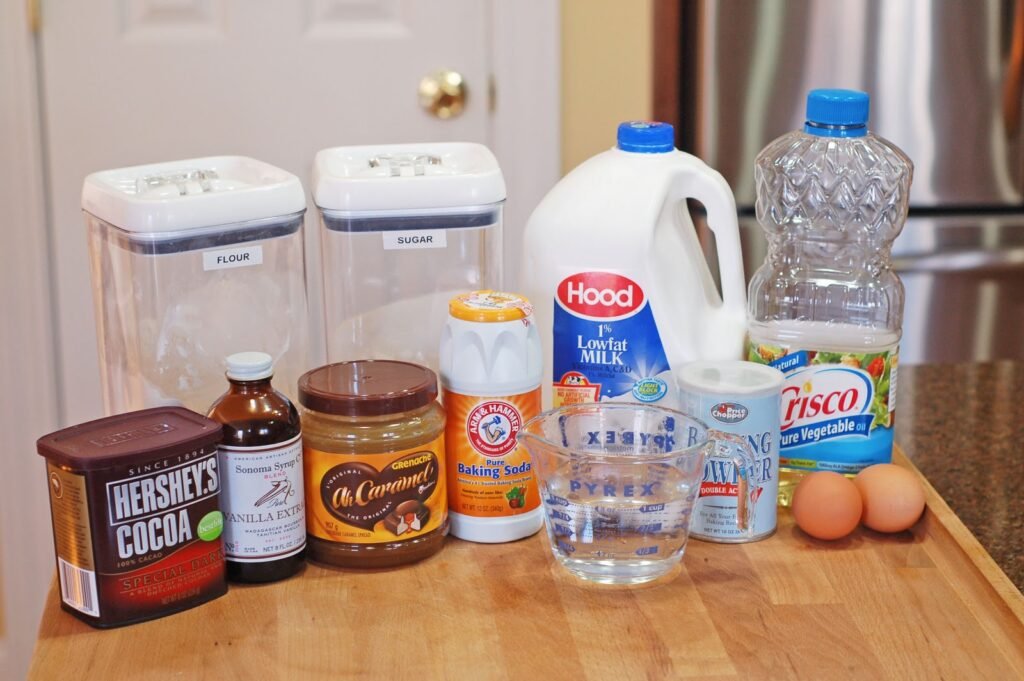
For the cupcakes, I used the recipe on the back of the Hershey’s Cocoa can, except replacing 1 cup of sugar for 1 cup of caramel. The cupcakes were great, but not much caramel flavor. I will have to add some more next time.

For the frosting, I adapted the recipe I used to make my Peanut Butter Fluff Frosting. I used soynut butter instead of peanut butter. The combo of the salty soynut butter and the sweet chocolate cupcakes was just what I was looking for. I even drizzled some extra caramel on top and added dark chocolate sprinkles to finish it off.
Chocolate Caramel Cupcakes with Soynut Butter Frosting
by The Sweet Chick
Prep Time: 15 minutes
Cook Time: 20 minutes
Keywords: bake dessert chocolate caramel soynut butter marshmallow fluff cupcake
Ingredients (32 cupcakes)
For the cupcakes
- 1 cup sugar
- 1 3/4 cups all purpose flour
- 3/4 cup Hershey’s Dark Cocoa
- 1 1/2 teaspoons baking powder
- 1 1/2 teaspoons baking soda
- 1 teaspoon salt
- 2 eggs, beaten
- 1 cup milk
- 1/2 cup vegetable oil
- 2 teaspoons vanilla extract
- 1 cup caramel (or caramel topping)
- 1 cup boiling water
For the frosting
- 1 stick unsalted butter, softened
- 1 cup creamy soynut butter
- 4 cups powdered sugar
- 1/2 cup marshmallow fluff
- 5-6 tablespoons milk
Instructions
For the cupcakes
Heat oven to 350 F. Line muffin tins with cupcake liners.
In a large bowl or stand mixer, stir together sugar, flour, cocoa, baking powder, baking soda, and salt.
Add eggs, milk, oil, vanilla, and caramel. Beat on medium speed for about 2 minutes.
Stir in boiling water (batter will be thin).
Pour batter into prepared muffin tins using a small ladle. If you use a regular scoop like I did, you will make a mess.
Bake at 350º F for 20 minutes or until toothpick inserted in center comes out clean. Cool completely before frosting.
For the frosting
With a mixer, blend butter and soynut butter until smooth.
Sift in confectioners’ sugar and beat on low speed.
Add milk and increase speed to high.
Add fluff. Beat for 1 minute.
Using a small spatula or a cake decorating tip and bag, add frosting to the cupcakes.
Drizzle with extra caramel and sprinkle with dark chocolate bits if you want.
Related Posts




Subscribe for New Racipies
Get mental health tips, updates, and resources delivered to your inbox.