
Are Persimmons Acidic? Hachiya vs Fuyu pH Compared

Medically reviewed by Jaclyn Weiner, RD, RDN, MEd, MS Updated Date: October 13, 2026
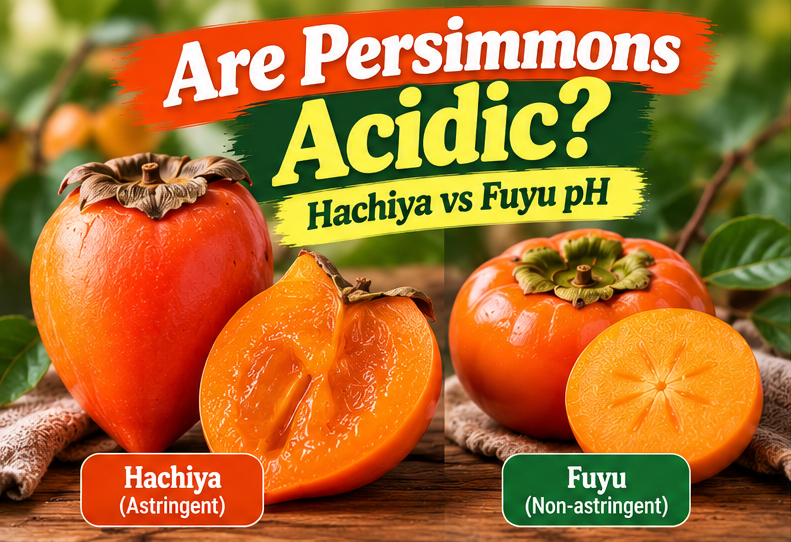
Persimmons are only mildly acidic. They’re one of the least acidic fruits you can buy. The FDA lists persimmons at a pH of about 4.42 to 4.70 (FDA), and lab studies of individual varieties have measured even higher values, around pH 5.3 for Hachiya and 5.5 to 5.9 for Fuyu. If a Hachiya persimmon makes your mouth pucker, acid isn’t the cause. That dry, chalky feeling comes from tannins, which are a completely different thing.
This guide compares Hachiya and Fuyu persimmons side by side. It explains why “astringent” doesn’t mean “acidic,” shows where persimmons rank among other fruits, and covers what people with acid reflux, sensitive teeth, or a history of stomach surgery should know.
Key Takeaways
- Persimmons are mildly acidic, with an FDA pH range of 4.42 to 4.70. That’s less acidic than apples, apricots, plums, and most berries.
- Hachiya and Fuyu have similar, low acidity. Studies found pH around 5.3 for Hachiya and 5.5 to 5.9 for Fuyu, with very little total acid in either one.
- The pucker isn’t acid. Unripe Hachiya persimmons are “astringent” because of soluble tannins, not because they’re sour.
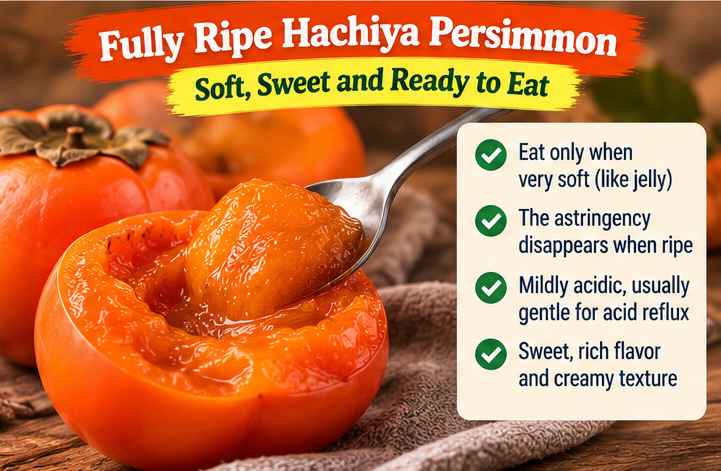
- Fuyu can be eaten firm; Hachiya must be eaten very soft. Ripening turns Hachiya’s tannins insoluble, so the astringency disappears.
- Persimmons are usually a gentle fruit for acid reflux, though portion size and ripeness still matter.
- Never eat unripe astringent persimmons in large amounts. Their tannins are linked to a rare but serious kind of stomach blockage called a bezoar.
Are Persimmons Acidic? The Short Answer
Technically, yes. Anything with a pH below 7 is acidic, and persimmons fall below that line. But compared with other fruits, persimmons sit near the mild end of the scale.
Here’s what the main sources report:
| Persimmon | pH | Total acid (titratable acidity) | Source |
| Persimmons (variety not specified) | 4.42–4.70 | Not given | FDA |
| Fuyu | 5.52–5.58 | 0.12% | Altuntas et al., 2011 |
| Fuyu (with peel / without peel) | 5.71 / 5.86 | 0.13% / 0.12% | Gautam et al., 2020 |
| Fuyu | 5.66 | 0.12% | Bisht et al., 2023 |
| Hachiya (during fruit development, 65 to 215 days after bloom) | 5.30–5.34 | 0.45% falling to 0.37% | Özdemir et al., 2021 |
Lab studies were done on fruit grown in different countries and measured at different stages, so treat these as approximate.
Why is the FDA range lower than the lab studies? The FDA table doesn’t say which variety, growing region, or ripeness it measured. pH can also vary with growing conditions and testing methods. Either way, every source puts persimmons in the mildly acidic zone, well above the sharp, sour fruits.
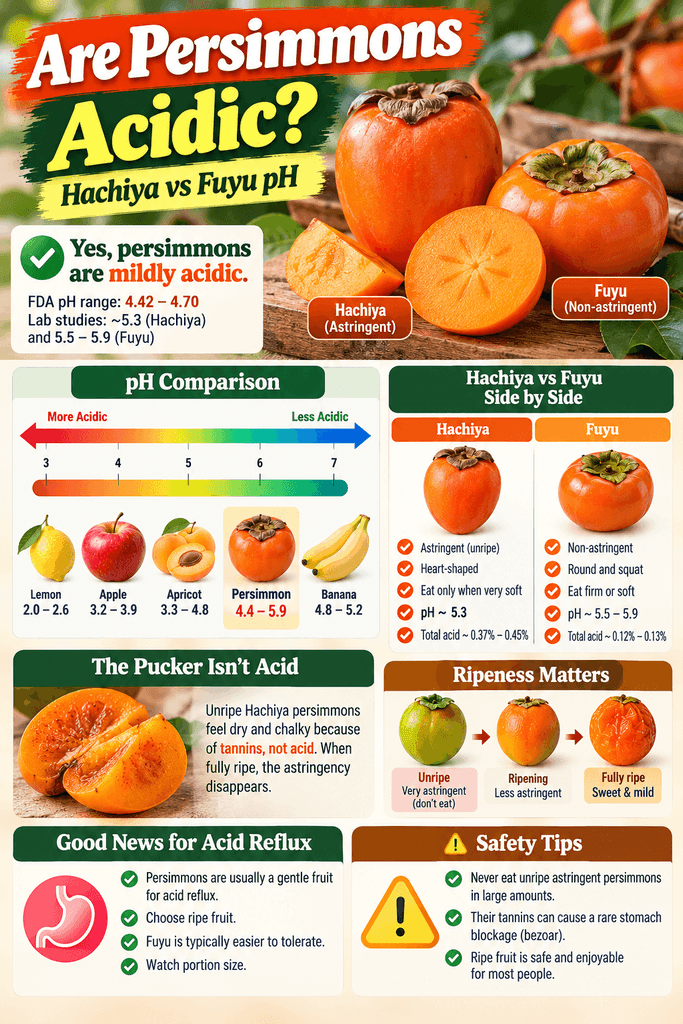
Hachiya vs Fuyu: What’s the Difference?
Most persimmons sold in U.S. stores are one of two Japanese persimmon varieties:
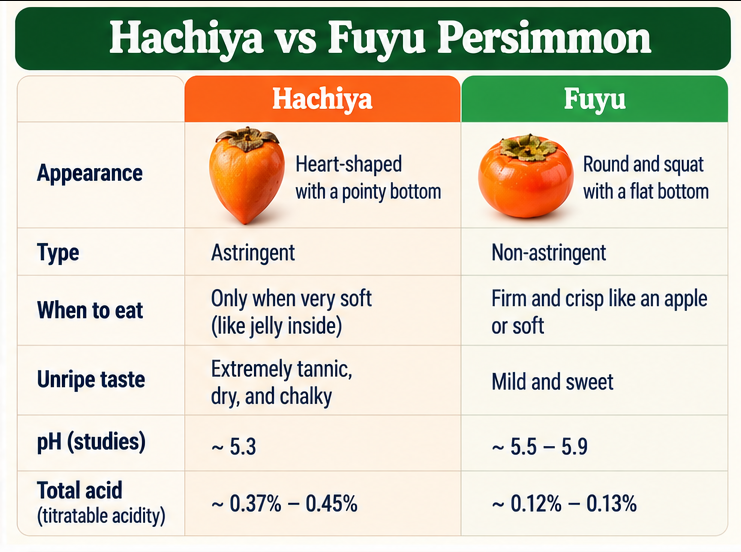
| Hachiya | Fuyu | |
| Type | Astringent | Non-astringent |
| Shape | Heart- or acorn-shaped, with a pointy bottom | Squat and round with a flat bottom, a bit like an orange tomato |
| When to eat | Only when very soft, like jelly inside | Firm and crisp like an apple, or soft |
| Unripe taste | Extremely tannic, dry, and chalky | Mild and sweet |
| pH (studies) | About 5.3 | About 5.5 to 5.9 |
| Total acid (studies) | About 0.37% to 0.45% | About 0.12% to 0.13% |
Sources: shape and eating notes from UC Master Food Preservers and UF/IFAS Extension; pH and acid from the studies in the table above.
Which is more acidic, Hachiya or Fuyu?
Based on the available studies, Hachiya is slightly more acidic than Fuyu, with a slightly lower pH and about three times more total acid. But both are very low compared with most fruits. For comparison:
- Fuyu had about 0.12% to 0.13% titratable acidity in three separate studies.
- Hachiya had about 0.37% to 0.45% in one study that followed the fruit as it grew (Özdemir et al., 2021).
- Granny Smith apples, one of the tartest common apples, carry about 0.7% to 1.0% titratable acidity at harvest (Good Fruit Grower).
So even the “more acidic” persimmon carries roughly half the acid of a Granny Smith apple, and Fuyu carries far less. (These figures come from different studies, so use them as a general comparison.)
One caveat: the Hachiya values were measured during fruit development and at harvest, while the fruit was still firm. Hachiya persimmons are normally eaten after they soften. We couldn’t find a published pH for fully soft-ripe Hachiya fruit.
Astringent Isn’t the Same as Acidic
This is the biggest point of confusion about persimmons. People bite into a firm Hachiya, feel their whole mouth dry up, and assume the fruit must be extremely acidic. It isn’t.
Acidity is the sour, sharp taste you get from lemons, limes, or green apples. It comes from acids such as citric and malic acid, and it’s measured by pH and titratable acidity.
Astringency is a dry, fuzzy, puckering feeling, as if your mouth has been coated in chalk. In persimmons, it comes from tannins. University of Florida researchers explain that persimmon astringency results from tannins building up in the cells of the fruit’s flesh. These are also called condensed tannins or proanthocyanidins (Sarkhosh et al., 2024, UF/IFAS HS1483).
Illinois Extension describes Hachiya as “quite tart” before it’s ripe, but notes that once it’s fully ripe, “the tannins dramatically reduce, creating a sweet and juicy flesh” (Illinois Extension). In everyday language, people often call that unpleasant unripe taste “tart” or “sour,” but it’s the tannins they’re tasting, not acid.
How astringency goes away
As an astringent persimmon ripens, its tannins slowly polymerize (link together into larger molecules). That makes them insoluble, so they no longer cause that dry, mouth-puckering feeling (UF/IFAS HS1483). The same report describes several ways growers and home cooks speed this up:
- Ripening: Letting Hachiya persimmons soften until the inside feels like gel. This is the simplest method at home.
- Freezing: Freezing to about -4°F (-20°C) converts soluble tannins into insoluble forms. UC Master Food Preservers’ freezing instructions allow at least 15 days in the freezer (UC Master Food Preservers).
- Carbon dioxide or ethanol: Commercial treatments that cause the tannins to link together and drop out.
None of these methods is designed to change the fruit’s acidity. They target the tannins.
Where Persimmons Rank Among Other Fruits
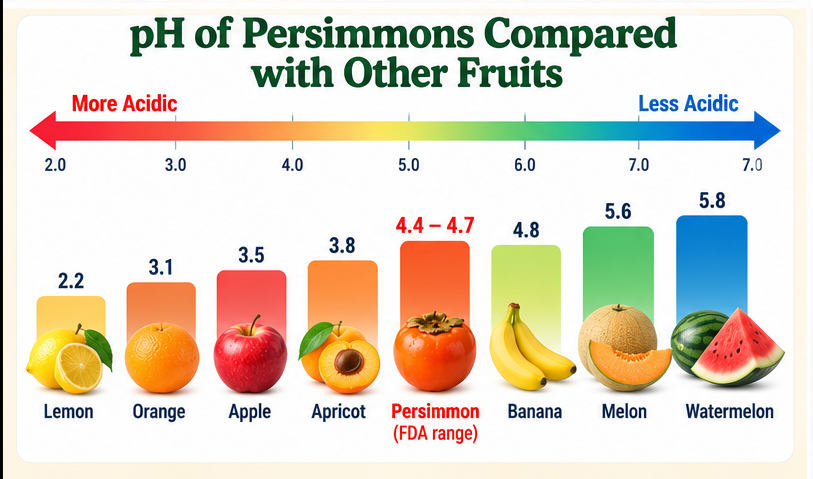
Here’s how persimmons compare with other fruits in the FDA’s pH table (FDA):
| Food | Approximate pH (FDA) |
| Plums, blue | 2.80–3.40 |
| Pomegranate | 2.93–3.20 |
| Strawberries | 3.00–3.90 |
| Apples, eating | 3.30–4.00 |
| Apricots | 3.30–4.80 |
| Mangoes, ripe | 3.40–4.80 |
| Pears, Bartlett | 3.50–4.60 |
| Persimmons | 4.42–4.70 |
| Bananas | 4.50–5.20 |
| Pumpkin | 4.90–5.50 |
| Figs, Calimyrna | 5.05–5.98 |
| Papaya | 5.20–6.00 |
| Sweet potatoes | 5.30–5.60 |
| Cantaloupe | 6.13–6.58 |
Source: FDA, Approximate pH of Foods and Food Products.
A few takeaways:
- Persimmons are less acidic than most common fruits, including apples, apricots, plums, strawberries, and mangoes.
- They’re in the same neighborhood as bananas, a fruit often recommended for people with sensitive stomachs.
- Only a handful of fruits are milder, such as figs, papaya, and melons like cantaloupe.
If you like the soft, sweet, autumn flavor of persimmons, other low-acid fall foods include sweet potatoes and pumpkin puree. For the full list, see our complete guide to acidic foods.
Are Persimmons Good for Acid Reflux?
For most people, persimmons are one of the gentler fruit choices. They aren’t among the foods the National Institute of Diabetes and Digestive and Kidney Diseases (NIDDK) lists as possible reflux triggers, which include citrus fruits, tomatoes, alcohol, chocolate, coffee and caffeine, high-fat foods, mint, and spicy foods (NIDDK). Their low acidity makes them a reasonable swap for sharper fruits like oranges or pineapple.
That said, reflux triggers differ from person to person. The American College of Gastroenterology’s 2022 guideline recommends that people with GERD identify their own triggers and avoid eating within 2 to 3 hours of bedtime (Katz et al., 2022).
Hachiya or Fuyu for reflux?
Both are low in acid, so either can work. A few practical differences:
- Fuyu is easier to eat in a controlled portion. You can slice it like an apple and add a few pieces to a meal.
- Hachiya must be eaten fully soft. Never eat it firm, both because of the unpleasant taste and because of the bezoar risk (see below).
- Both are fairly high in natural sugar and fiber. One medium Japanese persimmon (about 168 g) contains roughly 21 g of sugar and 6 g of fiber, based on USDA data (USDA FDC 169941; our calculation). If large portions leave you feeling overfull, start with half a fruit.
Tips for eating persimmons with reflux
- Choose fully ripe fruit. Soft Hachiya or fully colored Fuyu tastes sweeter and is easier to eat.
- Start with half a persimmon and see how you feel.
- Eat it with a meal or a low-acid snack, like oatmeal, Greek yogurt, or cottage cheese.
- Skip acidic pairings like lemon juice, vinaigrette, or citrus segments if those bother you.
- Eat earlier in the day. NIDDK suggests eating meals at least 3 hours before lying down if you have nighttime symptoms (NIDDK).
For more ideas, see our list of foods to avoid with GERD. If you have heartburn more than twice a week, trouble swallowing, or symptoms that don’t improve, talk with your doctor.
A Safety Note: Unripe Persimmons and Bezoars
This is rare, but it’s the most important health caution about persimmons, and it has nothing to do with acidity.
A bezoar is a hard mass of undigested material that can form in the stomach and cause a blockage. Persimmon bezoars, also called diospyrobezoars, are caused by unripe persimmons and are considered harder than other plant-based bezoars (Kement et al., 2012).
According to the same review:
- Unripe persimmons contain soluble tannin. In the stomach’s acidic environment, that tannin can form “a glue-like coagulum” that sticks to other stomach contents.
- Risk is higher after stomach surgery. Procedures such as vagotomy and partial gastrectomy reduce the stomach’s ability to break up food.
- Other risk factors include chewing problems, diabetic gastroparesis (slow stomach emptying), and antacid use.
- In one earlier study the review cites, 91.2% of 113 people with plant-based bezoars had a history of eating persimmons (Krausz et al., 1986, cited in Kement et al., 2012).
What this means for you:
- Eat astringent persimmons like Hachiya only when they’re fully soft.
- Don’t eat large amounts of persimmons at once, especially unripe or partly ripe fruit.
- If you’ve had stomach surgery, have gastroparesis, or have trouble chewing, ask your doctor whether persimmons are safe for you.
- See a doctor if you develop stomach pain, nausea, vomiting, or a feeling of fullness after eating very little.
Persimmons, Teeth, and Gastritis
Teeth: Persimmons are low in acid, so they’re less of an enamel concern than citrus or sour fruits. But they’re high in natural sugar, and dried persimmons are sticky. The American Dental Association recommends eating acidic foods as part of a meal, rinsing with water or having milk or cheese afterward, and waiting about an hour before brushing (American Dental Association). The same habits help with sugary fruit snacks. Our article on whether apples are good for your teeth covers similar fruit-and-enamel questions.
Gastritis: Because they’re low in acid, ripe persimmons are often easier to tolerate than citrus or berries. Start with a small amount of soft, fully ripe fruit. Our 7-day meal plan for gastritis has more gentle meal ideas.
Fresh vs Dried Persimmons
Dried persimmons are popular in many cuisines, and they’re increasingly easy to find in U.S. stores. Drying removes most of the water, which concentrates everything else.
| Per 100 g | Fresh Japanese persimmon | Dried Japanese persimmon | About how many times more |
| Water | 80.3 g | 23.0 g | — |
| Calories | 70 | 274 | about 3.9× |
| Carbohydrates | 18.6 g | 73.4 g | about 3.9× |
| Fiber | 3.6 g | 14.5 g | about 4× |
| Potassium | 161 mg | 802 mg | about 5× |
| Vitamin C | 7.5 mg | 0 mg | lost in drying |
Sources: USDA FoodData Central, Persimmons, japanese, raw (FDC 169941) and Persimmons, japanese, dried (FDC 169942). Multiples are our own rounded calculations.
University of Florida researchers note that drying concentrates “the sugars, acids, and phytochemicals in the fruit,” and that both dehydration and freeze-drying can reduce astringency (Sarkhosh et al., 2024, UF/IFAS HS1479). They also note that long heat exposure during traditional drying can break down vitamin C, which matches the USDA data above.
What this means: Dried persimmons carry about 4 times more of everything per bite, including their small amount of acid. Because persimmons start out so low in acid, dried persimmons are still a mild choice for most people. The bigger issue is sugar and calories: a few pieces go a long way. We see the same concentration effect with dried apricots and sun-dried tomatoes.
Persimmon Nutrition Highlights
Per 100 grams, fresh Japanese persimmons provide (USDA FDC 169941):
- 70 calories
- 3.6 g of fiber
- 12.5 g of natural sugar
- 81 mcg RAE of vitamin A
- 7.5 mg of vitamin C
- 161 mg of potassium
- 0.35 mg of manganese
Storing and Preserving Persimmons
- Ripening: Leave Hachiya persimmons at room temperature until they feel soft and gel-like inside (UC Master Food Preservers).
- Refrigerating: Once ripe, refrigeration helps them last longer.
- Freezing whole Fuyu: Wash and freeze ripe, firm, whole Fuyu persimmons, and ideally use them within three months.
- Freezing pulp: UC Master Food Preservers suggests freezing persimmon purée, with 1/8 teaspoon of ascorbic acid added per quart to help preserve color. Frozen pulp keeps for up to 6 months.
A note on canning: The FDA’s persimmon pH range goes up to 4.70, which is above the pH 4.6 line that separates acidic foods from low-acid foods for home canning. Clostridium botulinum, the bacterium that causes botulism, can grow in foods above pH 4.6 (UC Master Food Preserver Program). The UC persimmon guide covers freezing and drying, not canning. We weren’t able to find a USDA-tested home canning process for plain persimmon pulp, so freezing is the safer choice.
Acid-Smart Ways to Enjoy Persimmons
If persimmons agree with you, try them in these ideas:
- Breakfast: Dice ripe Fuyu over oatmeal with a sprinkle of cinnamon, or stir it into our pumpkin pie spice granola with yogurt.
- Smoothies: Blend soft Hachiya pulp into a fruit yogurt shake in place of some of the fruit.
- Salads: Slice Fuyu into a fall salad, like our Honeycrisp apple salad, or try it on goat cheese and walnut bruschette.
- Baking: Swap ripe Fuyu slices for pears in our upside-down pear cake or pear and blue cheese tart. (These swaps haven’t been tested in our kitchen, so expect some trial and error.)
Kitchen tip: If you buy Hachiya persimmons that are still firm, don’t cut into them yet. Let them sit on the counter until they’re very soft and gel-like inside.
Frequently Asked Questions
Are persimmons acidic or alkaline?
Persimmons are acidic, but only mildly. The FDA lists them at pH 4.42 to 4.70, and lab studies have measured Fuyu at about 5.5 to 5.9 and Hachiya at about 5.3. They’re less acidic than most common fruits.
Which is less acidic, Hachiya or Fuyu?
Fuyu. Studies found Fuyu has a slightly higher pH and about one-third the total acid of Hachiya. Both are still very low in acid compared with apples, berries, or citrus.
Why do persimmons make my mouth feel dry?
That’s astringency, caused by soluble tannins in unripe astringent varieties like Hachiya. It isn’t acidity. As the fruit ripens, the tannins become insoluble and the dry feeling goes away.
Are persimmons good for acid reflux?
They’re usually a gentle choice because they’re low in acid and aren’t on NIDDK’s list of common reflux triggers. Eat ripe fruit in moderate portions, ideally with a meal, and watch for your own triggers.
Can you eat a Fuyu persimmon when it’s hard?
Yes. Fuyu is non-astringent, so you can eat it firm and crisp, like an apple. Hachiya should only be eaten when it’s very soft.
Are dried persimmons acidic?
They’re still mildly acidic, but drying concentrates everything, including the small amount of acid, sugar, and calories. Per USDA data, dried persimmons have about 4 times more solids per gram than fresh ones.
Is it dangerous to eat unripe persimmons?
Eating a lot of unripe astringent persimmons is linked to persimmon bezoars, hard masses that can block the stomach. The risk is highest in people who’ve had stomach surgery or have slow stomach emptying. Eat Hachiya only when fully soft.
The Bottom Line
Persimmons are only mildly acidic, with an FDA pH of about 4.42 to 4.70, and studies put both Hachiya and Fuyu even higher. Hachiya carries a little more acid than Fuyu, but both rank among the least acidic fruits, closer to bananas than to apples or berries.
The famous persimmon “pucker” isn’t acid at all. It’s tannins in unripe astringent varieties like Hachiya, and it disappears when the fruit is fully soft. For most people, ripe persimmons are a sweet, fiber-rich, reflux-friendly fruit. Just eat Hachiya only when it’s soft, keep portions reasonable, and talk with your doctor if you’ve had stomach surgery.
Keep exploring with Are Apricots Acidic?, Are Pears Acidic?, Are Bananas Acidic?, or our complete guide to acidic foods.
Medical disclaimer: This article is for general information only and isn’t a substitute for professional medical advice. If you have frequent heartburn, GERD, a history of stomach surgery, gastroparesis, or ongoing stomach pain, talk with your doctor or a registered dietitian.
References
- U.S. FDA. Approximate pH of Foods and Food Products.
- Altuntas E, Cangi R, Kaya C (2011). Physical and chemical properties of persimmon fruit. Int. Agrophysics 25:89–92. PDF
- Gautam A, et al. (2020). Nutritional and functional characteristics of ripe persimmon fruit. J Pharmacogn Phytochem 9(4):3364–3367. PDF
- Bisht S, et al. (2023). Quality attributes of Fuyu persimmon fruit. J Pharmacogn Phytochem 12(5):103–107. PDF
- Özdemir AE, et al. (2021). Fruit development and optimum harvest maturity in some astringent persimmon cultivars. Alatarım 20(1):12–21. PDF
- Sarkhosh A, Habibi F, Brecht JK (2024). Alleviating Astringency in Persimmon Fruit (HS1483). UF/IFAS.
- Sarkhosh A, et al. (2024). Dried Persimmon Fruit: A Year-round Available Product (HS1479). UF/IFAS.
- McGuire G (2024). Making Astringent Persimmon Edible. UF/IFAS EDIS blog.
- UC Master Food Preservers. Preserving Persimmons I: Freezing and Drying.
- UC Master Food Preserver Program. Understanding pH and why it’s important in food preservation.
- Smith J (2020). Persistent Persimmons. Illinois Extension.
- USDA FoodData Central. Persimmons, japanese, raw (FDC 169941); Persimmons, japanese, dried (FDC 169942).
- Kement M, et al. (2012). Synergistic effect of multiple predisposing risk factors on the development of bezoars. World J Gastroenterol 18(9):960–964. Link
- Good Fruit Grower. How to measure Honeycrisp qualities (Granny Smith titratable acidity).
- NIDDK. Eating, Diet & Nutrition for GER & GERD.
- Katz PO, et al. (2022). ACG Clinical Guideline for GERD. doi:10.14309/ajg.0000000000001538
- American Dental Association. Dietary Acids and Your Teeth.
Related Posts

Subscribe for New Racipies
Get mental health tips, updates, and resources delivered to your inbox.
Brioche Hamburger Buns, Or Let’s Get That Grill Fired Up


I don’t know about you, but I’ve always viewed hamburger buns as purely functional things. They’re receptacles, carb-wrappers, so you don’t get your hands dirty while eating the truly desirable bits within. Cheese, for instance, and grilled onions, and sauteed mushrooms. Oh right, and the patty too.
Buns are integral to the entire structure of the burger, yet they’ve done little to niggle my desire, warrant my enthusiasm, or raise lustful thoughts (and shouldn’t they? Given their namesake and all). Until now, that is.
These buns—blogged about by Deb and later Sara—are dreamy: as in, they bake like a dream, come together in a cinch, and their ingredients can be found in most anyone’s pantry. They’re also versatile: I chose all-purpose, whole wheat, and rye flour to go in mine, and they came out hearty but light, soft but complex. But most importantly, they raise the hamburger bun to a higher echelon, one that will no longer be left until the end as an afterthought. And is there anything worse than forcing yourself to eat afterthoughts?
You’ll be ready to fire up your grill after making these.
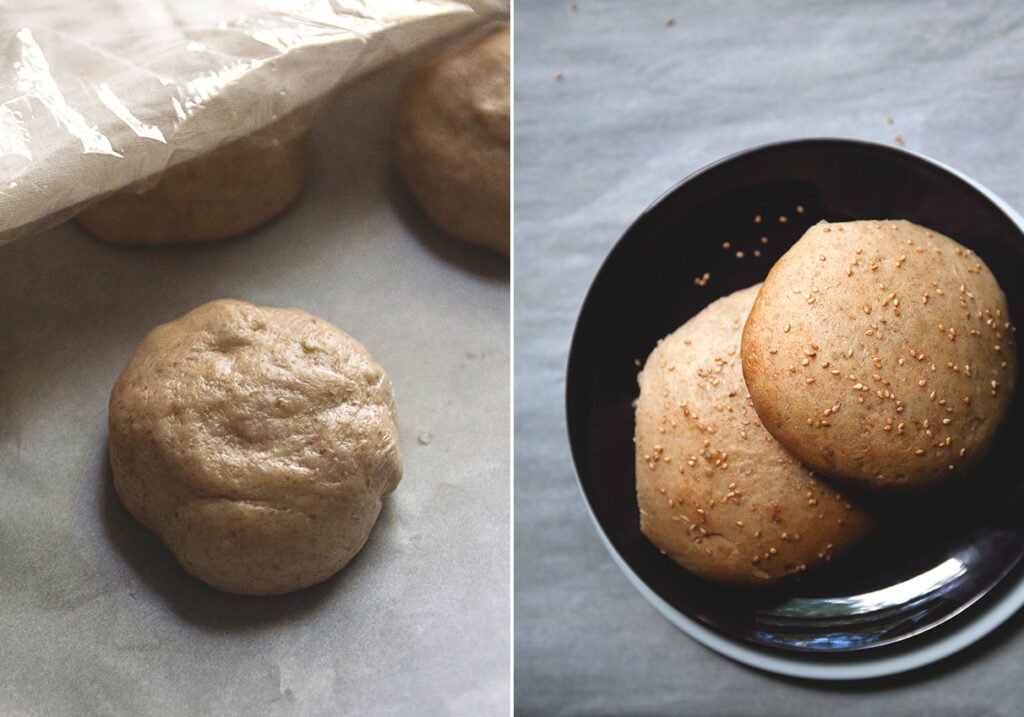
BRIOCHE HAMBURGER BUNS
Adapted from Smitten Kitchen and Sprouted Kitchen
Makes 8 regular-sized buns
Ingredients:
3 Tbsp warm milk
2 tsp active dry yeast
2-1/2 Tbsp sugar
2 large eggs
1/2 cup whole wheat flour
1/2 cup rye flour
2-1/3 cups all-purpose flour
1-1/2 tsp salt
2-1/2 Tbsp unsalted butter, softened
sesame seeds (if desired)
Directions:
In a glass measuring cup, combine one cup warm water, milk, yeast and sugar. Let stand until foamy, about five minutes. Meanwhile, beat one egg.
In a large bowl, whisk the flours with the salt. Add the butter by rubbing it into the flour between your fingers, making crumbs. Stir in the yeast mixture and beaten egg until a dough forms. Scrape onto a clean, well-floured counter and knead (by scooping it, slapping it onto the counter, and turning) until smooth and elastic (8 to 10 minutes). It should be sticky, so try not to knead in too much flour.
Shape the dough into a ball and return it to the bowl. Cover it with plastic wrap and let it rise until doubled (1 to 2 hours).
Line a baking sheet with parchment paper. Divide the dough into 8 equal balls. Gently roll each ball and arrange them 2 to 3 inches apart. Cover the baking sheet loosely and let the dough rise until doubled (1 to 2 hours).
Set a shallow pan with water in it on your oven floor or lower rack. Preheat the oven to 400 degrees Fahrenheit. Beat the other egg with 1 Tbsp of water and brush the egg wash onto the buns. Sprinkle sesame seeds on top, if using. Put the baking sheet in the oven and bake for about 15 minutes (turning halfway through), until the buns are golden-brown. Transfer to a rack and cool.
Note: I kept them in the fridge for about a week after I baked them and they still tasted good. Just heat them up on the grill or toast them right before eating.
Related Posts




Subscribe for New Racipies
Get mental health tips, updates, and resources delivered to your inbox.