
Are Pink Lady Apples Acidic? GERD-Safe Apple Varieties

Medically reviewed by Jaclyn Weiner, RD, RDN, MEd, MS Updated Date: October 10, 2026
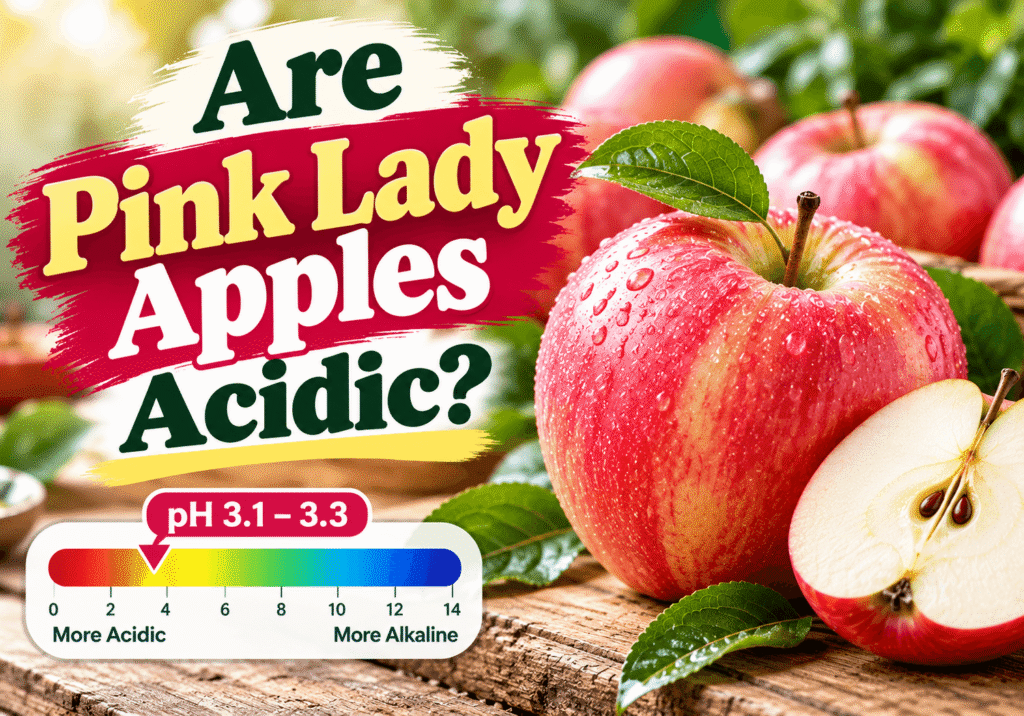
Yes, Pink Lady apples are acidic, and they’re one of the more acidic apples you can buy. When the variety was first described in 1993, its breeders reported an average titratable acidity of 0.73%, more than double that of Golden Delicious (0.32%) (Cripps et al., 1993). A 2018 study measured Pink Lady at pH 3.13 to 3.28, with more total acid than Gala, Fuji, Golden Delicious, or Red Delicious (Mezey and Serralegri, 2018).
That doesn’t make Pink Lady a bad apple. It’s popular precisely because its tartness is balanced by plenty of sugar. But if you have acid reflux or GERD and fruit sometimes bothers you, it helps to know where Pink Lady falls compared with gentler varieties.
In this guide, you’ll learn exactly how acidic Pink Lady apples are, why they taste sweet-tart, how they compare with other popular apples, and which apple varieties are usually the gentlest choices for people with reflux.
Key Takeaways
- Pink Lady apples are acidic, with a pH of about 3.1 to 3.3 and above-average total acid.
- They’re among the tarter apples. Pink Lady has roughly twice the acid of Golden Delicious and more than Gala, Fuji, or Red Delicious, though less than Granny Smith.
- They also have plenty of sugar, which is why they taste sweet-tart instead of sour.
- No apple is proven “GERD-safe.” But lower-acid apples like Red Delicious, Golden Delicious, Envy, Fuji, and Gala may be gentler choices than Pink Lady or Granny Smith.
- Apples aren’t on the NIH’s list of common reflux triggers, and many people with reflux eat them without trouble.
- Eating apples with a meal, in modest portions, is the easiest way to reduce discomfort.
For a broader look at apples, see our main guide, Are Apples Acidic?, and our variety profile, Are Honeycrisp Apples Acidic?
Are Pink Lady Apples Acidic or Alkaline?
Pink Lady apples are acidic, not alkaline or basic. On the pH scale, anything below 7 is acidic. Pink Lady apples measured about pH 3.13 to 3.28 in a 2018 study (Mezey and Serralegri, 2018). That’s well into the acidic range, similar to most apples.
The main acid in Pink Lady, as in all apples, is malic acid. In the 2018 study, malic acid made up most of Pink Lady’s total acid: about 6.9 to 7.3 grams per liter of juice (Mezey and Serralegri, 2018).
Acidic on the plate, alkaline-forming in the body?
You may see apples described as “alkaline” foods. That refers to something different: a food’s estimated effect on the body’s acid load after digestion. Most fruits and vegetables are considered alkaline-forming because they’re rich in potassium and other minerals (Remer and Manz, 1995). Either way, food doesn’t change your blood pH, which your body keeps at about 7.35 to 7.45 (Hopkins et al., StatPearls).
Are Pink Lady apples “acid loving”?
That phrase is about the tree, not the fruit. Apple trees aren’t true acid-loving plants like blueberries. Extension fruit specialists note that apples grow best when soil pH is about 6.0 to 7.0 (apples.extension.org).
How Acidic Are Pink Lady Apples? The Numbers
Two good sources tell us how acidic Pink Lady apples are.
The original variety description (1993)
Pink Lady, also known by its variety name Cripps Pink, was bred by John Cripps at the Stoneville Horticultural Research Station near Perth, Western Australia. It came from a 1973 cross between Lady Williams and Golden Delicious, and was released for commercial testing in 1986 (Cripps et al., 1993).
When the breeders introduced it in HortScience, they compared it with both parent apples:
| Apple | Sugar (soluble solids, %) | Titratable acidity (%) |
| Pink Lady (Cripps Pink) | 13.0 (range 12.5–13.5) | 0.73 (range 0.71–0.9) |
| Lady Williams (parent) | 12.3 | 0.83 |
| Golden Delicious (parent) | 14.0 | 0.32 |
Source: Cripps, Richards, and Mairata, HortScience, 1993.
Pink Lady inherited most of its acid from Lady Williams and some of its sweetness from Golden Delicious. The breeders described the flesh as “sweet, with an acid balance.”
A 2018 apple comparison study
A study published in the Athens Journal of Sciences measured 11 apple varieties grown both organically and conventionally. Here are Pink Lady’s results (Mezey and Serralegri, 2018):
| Pink Lady sample | pH | Total acid (g/L) | Sugar (°Brix) |
| Organic | 3.28 | 7.44 | 12.82 |
| Conventional | 3.13 | 8.17 | 12.92 |
So, are Pink Lady apples “very acidic”?
Compared with other apples, Pink Lady is on the higher end, but it isn’t the most acidic. In the 2018 study, Granny Smith had more total acid, and so did Kanzi in the organic samples. Compared with truly sour foods like lemon juice (pH 2.0 to 2.6), Pink Lady is far milder (FDA).
Are Pink Lady apples more acidic or less acidic than other apples?
- More acidic than: Gala, Fuji, Golden Delicious, Red Delicious, Envy, and Honeycrisp (on average).
- Similar to: Braeburn and Kanzi.
- Less acidic than: Granny Smith.
Why Pink Lady Tastes Sweet-Tart (Not Sour)
If Pink Lady is so acidic, why doesn’t it taste sour? Because it also has plenty of sugar, about 13% soluble solids, according to its breeders (Cripps et al., 1993). Australian agriculture officials describe the variety as having “high sugar with acid balance” (NSW Department of Primary Industries and Regional Development).
Sugar and acid together create Pink Lady’s signature taste: a sweet start with a tangy, refreshing finish. Some people would call it tart, but few would call it sour like a Granny Smith.
This balance is a good reminder that taste isn’t a reliable acid test. We saw the same thing with tomatoes: sweet cherry tomatoes can carry plenty of acid. See Are Cherry Tomatoes Acidic?
Are Pink Lady apples pink inside?
No. The pink-red color is on the skin. The flesh is described as firm, dense, fine, crisp, and juicy, not pink (NSW DPIRD). Apples with pink or red flesh are separate varieties.
Is “Pink Lady” the same as “Cripps Pink”?
Mostly, yes. Cripps Pink is the variety name. Pink Lady is a trademarked brand name used for Cripps Pink apples that meet certain quality standards (NSW DPIRD). So every Pink Lady is a Cripps Pink, but not every Cripps Pink can be sold as a Pink Lady.
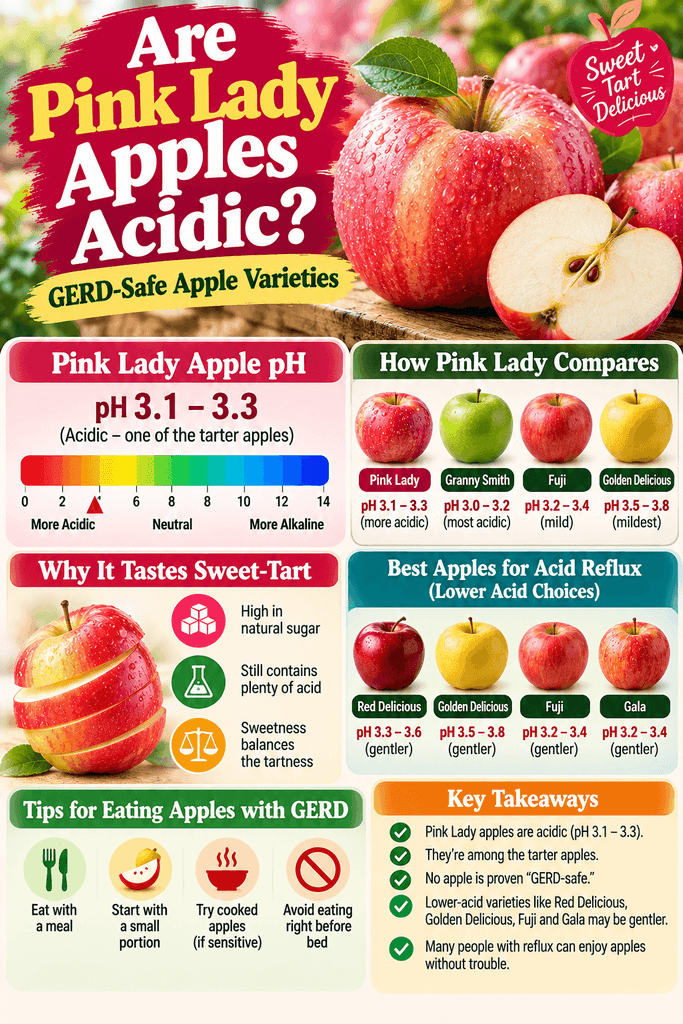
Apple Acidity Chart: Pink Lady vs Other Varieties
The 2018 study is especially useful because it measured many varieties side by side. Here are the results for apples grown conventionally (the kind most people buy), ranked from most to least total acid (Mezey and Serralegri, 2018):
| Apple variety | pH | Total acid (g/L) | Sugar (°Brix) |
| Granny Smith | 3.12 | 10.34 | 11.70 |
| Pink Lady | 3.13 | 8.17 | 12.92 |
| Kanzi | 3.20 | 7.83 | 13.21 |
| Braeburn | 3.16 | 7.78 | 12.42 |
| Gala | 3.24 | 6.84 | 12.83 |
| Fuji | 3.21 | 6.61 | 14.41 |
| Golden Delicious | 3.19 | 6.31 | 13.23 |
| Envy | 3.31 | 5.45 | 13.16 |
| Red Delicious | 3.28 | 4.89 | 11.97 |
| Red Chief | 3.26 | 4.64 | 12.57 |
Source: Mezey and Serralegri, Athens Journal of Sciences, 2018, Table 4 (conventional production).
A few points to keep in mind:
- These are results from one study, so individual apples will vary with orchard, ripeness, and storage time.
- Total acid matters more for taste than pH in apples, because the pH differences are small.
- Apples lose acid in storage. USDA research notes that all apples lose acid during storage (Good Fruit Grower, quoting USDA’s Dr. Jim Mattheis). A Pink Lady bought late in the season may taste milder than one bought soon after harvest.
Pink Lady vs Honeycrisp vs Granny Smith
These three are often compared at the store. Here’s how they stack up on acid:
| Feature | Pink Lady | Honeycrisp | Granny Smith |
| Titratable acidity at harvest | About 0.71%–0.9% (mean 0.73%) | About 0.3%–0.7% | About 0.7%–1.0% |
| Taste | Sweet-tart, tangy finish | Sweet with mild tang | Tart to sour |
| Acid level among apples | Higher | Middle | Highest |
| Gentler for sensitive stomachs? | Moderate choice | Better choice | Least gentle |
Sources: Cripps et al., 1993 (Pink Lady); Good Fruit Grower, quoting USDA’s Dr. Jim Mattheis (Honeycrisp and Granny Smith). Values come from different sources and growing regions, so treat them as general ranges.
If you like a tangy apple but find Granny Smith too sharp, Pink Lady sits in between. If even Pink Lady feels too acidic, Honeycrisp is usually a step milder.
How to Pick a Milder-Tasting Pink Lady
You can’t change an apple’s variety, but you can sometimes choose a gentler Pink Lady:
- Look for full color. Growers in Australia are advised to pick Cripps Pink when its base color shifts from green to yellow, a sign of ripeness (NSW DPIRD). Greener-looking apples may have been picked earlier and may taste sharper.
- Consider the season. Pink Lady is a late-season apple that stores well. Since apples gradually lose acid in storage (Good Fruit Grower), a Pink Lady bought months after harvest may taste a little milder than one bought fresh.
- Pair it with something creamy. Pink Lady slices with yogurt or cheese taste softer and are friendlier to your teeth.
None of these tips turns Pink Lady into a low-acid apple. If you’re very sensitive, choosing a lower-acid variety will make a bigger difference.
GERD-Safe Apple Varieties: Which Apples Are Gentlest?
Let’s be clear about one thing first: no apple variety has been tested and proven “GERD-safe.” There are no clinical studies comparing apple varieties for heartburn. But if acidic foods bother you, it makes sense to start with apples that contain less acid.
Based on the acid measurements above, here’s a practical guide:
Gentler choices (lower acid)
- Red Delicious and Red Chief: The lowest total acid in the 2018 study. USDA physiologist Jim Mattheis also gives Red Delicious just 0.2% to 0.3% titratable acidity at harvest (Good Fruit Grower).
- Envy: Low acid and very sweet in the 2018 study.
- Golden Delicious: Pink Lady’s own parent, with less than half its acid (0.32% vs. 0.73%) (Cripps et al., 1993).
- Fuji and Gala: Moderate acid with lots of sugar.
Middle of the road
- Honeycrisp: Usually 0.3% to 0.7% acid at harvest (Good Fruit Grower). Read more in Are Honeycrisp Apples Acidic?
Tarter choices (higher acid)
- Pink Lady, Braeburn, and Kanzi: Above-average acid.
- Granny Smith: The most acidic common apple.
What about Pink Lady specifically?
If you have mild, occasional reflux and enjoy Pink Lady apples, there’s no reason to give them up automatically. But if you’ve noticed that acidic fruit triggers your symptoms, a lower-acid apple like Golden Delicious, Red Delicious, Fuji, or Gala may be a better everyday pick.
Are Pink Lady Apples Good, OK, or Bad for Acid Reflux?
For most people, Pink Lady apples are OK. Apples aren’t on the National Institute of Diabetes and Digestive and Kidney Diseases’ (NIDDK) list of foods that commonly worsen reflux. That list names citrus fruits and tomatoes, alcohol, chocolate, coffee and caffeine, high-fat foods, mint, and spicy foods (NIDDK).
But reflux triggers vary. The American College of Gastroenterology’s 2022 guideline advises people with GERD to identify their own trigger foods rather than avoiding long lists of foods (Katz et al., 2022).
So here’s the honest answer:
- Good for acid reflux? There’s no evidence that Pink Lady, or any apple, treats reflux.
- OK for acid reflux? Yes, for many people, especially in moderate portions with a meal.
- Bad for acid reflux? Possibly, if you’re sensitive to acidic fruit. Pink Lady’s higher acid makes it more likely to bother you than a low-acid apple.
Tips for enjoying apples with GERD
- Choose a lower-acid variety if tart apples bother you.
- Eat apples with a meal or snack, such as with cottage cheese, yogurt, or a small amount of nut butter.
- Start with half an apple and see how you feel.
- Try cooked apples. Some people find baked apples easier to eat, although cooking doesn’t remove the acid.
- Avoid eating close to bedtime. NIDDK suggests eating meals at least 3 hours before lying down if you have nighttime symptoms (NIDDK).
- Go easy on apple juice and cider. The FDA lists apple juice at pH 3.35 to 4.00 (FDA), and it’s easy to drink a lot quickly. See Is Apple Cider Safe for Acid Reflux?
For more, read our guide to foods to avoid with GERD. If you have heartburn more than twice a week, trouble swallowing, or symptoms that don’t improve, see your doctor.
Lower-acid fruits to mix in
If you want fruit that’s even gentler than apples, these have a higher pH, according to the FDA (FDA):
- Cantaloupe: pH 6.13 to 6.58
- Bananas: pH 4.50 to 5.29
- Figs: pH 5.05 to 5.98
- Pears (Bartlett): pH 3.50 to 4.60
Are Pink Lady Apples Acidic for Digestion?
Some people search whether Pink Lady apples are “acidic for digestion” or “acidic to eat.” Here’s what to know:
- Your stomach is far more acidic than any apple. Apple acid doesn’t add meaningfully to the strong acid your stomach already makes for digestion.
- Apples contain fiber, about 2.4 grams per 100 grams of raw apple with skin (USDA FDC 171688), which supports regular digestion for most people.
- Discomfort usually comes from portion size or sensitivity, not from the apple’s acid “upsetting” digestion. If raw apples bother your stomach, try smaller portions, peeled apples, or cooked apples.
Are Pink Lady Apples Acidic for Cooking and Baking?
Yes, and that’s often a good thing. Acid gives baked apple dishes their bright, balanced flavor, so desserts don’t taste flat or overly sweet. Pink Lady’s firm, dense flesh (NSW DPIRD) and sweet-tart flavor make it a popular choice for baking.
A few things to know:
- Cooking doesn’t remove the acid. Applesauce, for example, has a pH of 3.10 to 3.60 according to the FDA (FDA).
- Sugar and dairy soften the taste. Pairing baked apples with oats, yogurt, or a little cream makes the dish taste milder.
- Mix varieties. Combining Pink Lady with a sweeter, lower-acid apple like Golden Delicious can give you a balanced flavor that’s a little gentler on sensitive stomachs.
Recipes to try with Pink Lady apples
- Mom’s apple cake: A classic, cozy apple cake.
- Little Brown Bettys: A baked apple dessert similar to an apple crisp.
- Apple cupcakes with apple spice buttercream: A fun fall bake.
- Maple apple muffins: Great for breakfast.
- Apple pie donut holes: A bite-size treat.
- Honeycrisp apple salad: Works beautifully with Pink Lady, too.
Warm spices like cinnamon pair well with tart apples.
Pink Lady Apples and Your Teeth
Because Pink Lady is a higher-acid apple, it’s worth protecting your enamel if you snack on apples often. The American Dental Association recommends eating acidic foods as part of a meal, rinsing with water or having milk or cheese afterward, and waiting about an hour before brushing (American Dental Association).
Read more in Are Apples Good for Your Teeth?
Are Pink Lady Apples Healthy?
Yes. Like other apples, Pink Lady is a low-fat, fiber-rich fruit. USDA FoodData Central doesn’t list Pink Lady separately in its standard reference data, but here’s what it lists for 100 grams of raw apple with skin (USDA FDC 171688):
| Nutrient | Per 100 g (raw apple with skin) |
| Calories | about 52 |
| Carbohydrates | 13.8 g |
| Fiber | 2.4 g |
| Sugars | 10.4 g |
| Vitamin C | 4.6 mg |
| Potassium | 107 mg |
Values are for apples in general. Pink Lady’s exact numbers may differ slightly.
A few notes:
- Keep the skin on for more fiber.
- If you’re watching blood sugar, pair apples with protein or fat. See Are Apples Good for Diabetics?
- Pink Lady stores well. Australian officials note the variety keeps for up to about four months in storage (NSW DPIRD).
Frequently Asked Questions
Are Pink Lady apples acidic or alkaline?
Pink Lady apples are acidic, with a pH of about 3.1 to 3.3 in one study. Like most fruits, they’re considered alkaline-forming after digestion, but that doesn’t change your blood pH.
Are Pink Lady apples very acidic?
They’re more acidic than many popular apples, with about 0.73% titratable acidity, but less acidic than Granny Smith and far less acidic than lemon juice.
Are Pink Lady apples more acidic than Honeycrisp?
Usually, yes. Pink Lady averages about 0.73% acid, while Honeycrisp typically ranges from 0.3% to 0.7% at harvest.
Are Pink Lady apples good for acid reflux?
There’s no evidence they help reflux. Many people tolerate them fine, but if acidic fruit bothers you, a lower-acid apple may be a better choice.
Are Pink Lady apples OK for acid reflux?
For many people, yes, especially in moderate portions with a meal. Apples aren’t on NIDDK’s list of common reflux triggers.
What apple is best for GERD?
No apple is proven GERD-safe. Based on acid content, Red Delicious, Golden Delicious, Envy, Fuji, and Gala are generally gentler than Pink Lady or Granny Smith.
Are Pink Lady apples sour?
Not usually. They’re tart, but their high sugar content balances the acid, so most people describe them as sweet-tart.
Are Pink Lady apples good for baking?
Yes. Their firm flesh and sweet-tart flavor make them a popular baking apple. Cooking doesn’t remove their acid, though.
The Bottom Line
Pink Lady apples are acidic, and they’re on the tarter side for apples. Their pH is about 3.1 to 3.3, and their total acid is roughly twice that of Golden Delicious. Their high sugar content is what keeps them tasting sweet-tart instead of sour.
For most people, Pink Lady apples are a healthy, delicious choice. If you have GERD or find that acidic fruit triggers heartburn, you don’t necessarily need to avoid apples. Instead, try lower-acid varieties like Red Delicious, Golden Delicious, Envy, Fuji, or Gala, eat apples with meals, and pay attention to how your body responds.
Want to compare more foods? Explore Are Apples Acidic?, Are Honeycrisp Apples Acidic?, or our complete guide to acidic foods.
Medical disclaimer: This article is for general information only and isn’t a substitute for professional medical or dental advice. If you have frequent heartburn, GERD, or dental sensitivity, talk with your doctor, dentist, or a registered dietitian.
References
- Cripps JEL, Richards LA, Mairata AM. ‘Pink Lady’ apple. HortScience. 1993;28(10):1057. https://journals.ashs.org/downloadpdf/view/journals/hortsci/28/10/article-p1057.pdf
- Mezey J, Serralegri D. Selected quantitative parameters comparison of apples from bio- and conventional production. Athens Journal of Sciences. 2018;5(4):343–354. https://doi.org/10.30958/ajs.5-4-3
- NSW Department of Primary Industries and Regional Development. Cripps Pink (apple variety profile). https://www.dpird.nsw.gov.au/agriculture/horticulture/pomes/apples/varieties/cripps-pink
- Good Fruit Grower. How to measure Honeycrisp qualities (quoting Dr. Jim Mattheis, USDA-ARS). https://goodfruit.com/how-to-measure-honeycrisp-qualities
- U.S. Food and Drug Administration, CFSAN. Approximate pH of Foods and Food Products. 2007. Copy used: https://riverstonehealth.org/wp-content/uploads/FDA-Approximate-pH-of-Foods.pdf
- USDA FoodData Central. Apples, raw, with skin (FDC ID 171688, SR Legacy). https://fdc.nal.usda.gov/fdc-app.html#/food-details/171688/nutrients
- NIDDK. Eating, Diet, & Nutrition for GER & GERD. https://www.niddk.nih.gov/health-information/digestive-diseases/acid-reflux-ger-gerd-adults/eating-diet-nutrition
- Katz PO, Dunbar KB, Schnoll-Sussman FH, et al. ACG Clinical Guideline for the Diagnosis and Management of GERD. Am J Gastroenterol. 2022;117(1):27–56. https://doi.org/10.14309/ajg.0000000000001538
- American Dental Association, MouthHealthy. Dietary Acids and Your Teeth. https://www.mouthhealthy.org/all-topics-a-z/dietary-acids-and-your-teeth
- Miller DD. Select and prepare a site for planting apple trees. apples.extension.org. https://apples.extension.org/select-and-prepare-a-site-for-planting-apple-trees/
- Remer T, Manz F. Potential renal acid load of foods and its influence on urine pH. J Am Diet Assoc. 1995;95(7):791–797. https://pubmed.ncbi.nlm.nih.gov/7797810/ [VERIFY PMID]
- Hopkins E, Sanvictores T, Sharma S. Physiology, Acid Base Balance. StatPearls. https://www.ncbi.nlm.nih.gov/books/NBK507807/ [VERIFY authors]
Related Posts
Subscribe for New Racipies
Get mental health tips, updates, and resources delivered to your inbox.
Does Peace Tea Have Caffeine? (Flavor Breakdown, Ingredients & Safety Guide)


In my daily clinic, patients often bring large, colorful beverage cans while waiting for their routine appointments. Just last Tuesday, a teenage patient sat on the exam table holding a massive 23-ounce can adorned with bright peace signs. Her mother immediately looked at me and asked, does peace tea have caffeine?
She was understandably worried about her daughter’s erratic sleep schedule and rising anxiety levels. Many people simply assume these sweet, fruity drinks are just harmless fruit juices, perhaps enjoying them alongside a sweet afternoon slice of olive oil cake. Consequently, they let their teenagers drink them late into the evening without a second thought.
However, as a medical professional, I always emphasize that we must look strictly past the clever marketing. Therefore, we are going to dive deep into this specific beverage today. We will explore the exact stimulant levels, analyze the core ingredients, and discuss how it impacts your overall metabolic health.
TL;DR: Quick Overview
- Yes, most flavors of this popular iced drink contain a mild neuro-stimulant.
- A standard 23-ounce can delivers roughly 23 to 30 milligrams directly to your system.
- Popular variations like Peach, Razzleberry, and Sno Berry all contain this active compound.
- It is absolutely not classified as a highly caffeinated commercial energy drink.
- The overall stimulant levels remain significantly lower than standard sodas or brewed coffee.
Exact Stimulant Amount in These Cans
Patients frequently ask me for precise chemical measurements when we discuss their daily dietary habits. Therefore, I always break down the exact numbers so people can track their intake accurately.
| Can Size | Approximate Amount |
| 23 oz Tall Can | ~23-30 mg |
| 16 oz Standard Can | ~15-20 mg |
| Per 100 ml Serving | ~6-10 mg |
Consequently, the medical community classifies this specific product as a very low-stimulant beverage. Furthermore, it contains much less of the active compound than a standard cup of green tea.
However, because the cans are exceptionally large, the total volume adds up very quickly. Therefore, you must always account for the massive 23-ounce serving size when calculating your daily limits.
Analyzing the Stimulant Presence in This Beverage
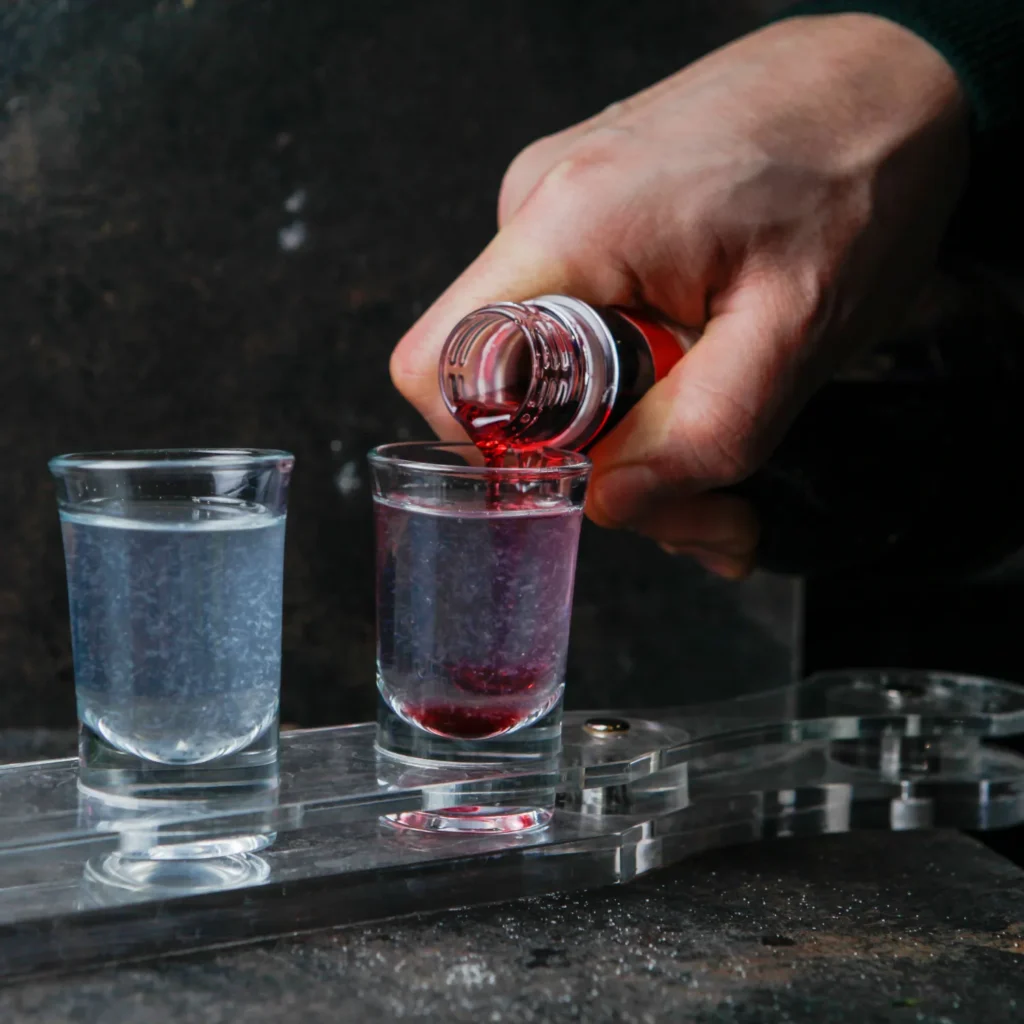
Yes, this sweet beverage absolutely contains a measurable amount of active neuro-stimulants. However, the exact source of this chemical compound is incredibly important for your overall bodily digestion.
The manufacturer does not pump isolated, synthetic chemical powders into the liquid formula. Instead, the compound naturally derives directly from the actual brewed black or green tea leaves used in production.
Consequently, your body metabolizes it slightly differently than the harsh chemicals found in aggressive sports drinks. Furthermore, natural tea provides a much smoother biological uptake without the sudden, violent nervous system spikes.
Comprehensive Flavor Breakdown and Profiles
When evaluating commercial beverages in my medical practice, we must analyze the entire product line. The parent company manufactures several distinct flavor profiles to capture a very wide consumer demographic. Therefore, understanding exactly what constitutes each flavor helps patients make much better nutritional choices. Let us comprehensively explore the primary variations you will typically find on grocery store shelves today.
First of all, the most popular variation is undoubtedly the Razzleberry flavor. This specific formulation utilizes a robust black tea base blended heavily with artificial raspberry flavoring. Consequently, it delivers a very sharp, sweet, and tart experience that heavily appeals to younger teenagers. Furthermore, the dark tea base naturally provides the underlying mild stimulant properties that consumers often fail to notice.
Similarly, the Sno Berry variation represents another massive seller for the beverage brand. This particular drink combines a lighter tea base with a distinct, sugary blueberry and white grape flavor profile. Many of my patients specifically prefer this lighter taste, assuming it is somehow biologically healthier, similar to how they view a homemade bowl of lemon frozen yogurt. However, it still contains the exact same underlying brewed tea extract, thus providing a nearly identical chemical load.
In addition, the Peach variation stands as a classic staple in the modern iced tea market. The manufacturer blends traditional black tea with strong peach aromatics to mimic Southern-style sweet tea. I often warn my diabetic patients that this specific flavor hides its massive sugar content exceptionally well behind the tart peach bite, sometimes packing more sugar than a heavy serving of pumpkin pie spice granola.
Furthermore, we must closely examine the Green Tea variation, which often confuses health-conscious consumers. Because it clearly says “green tea” on the label, shoppers instantly assume it offers profound medical benefits. While green tea leaves do possess natural antioxidants, the commercial brewing and heavy sweetening process significantly degrades these delicate organic compounds. Thus, you are primarily drinking sugar water with a very faint hint of actual green tea extract.
Finally, the Caddy Shack flavor mimics the famous Arnold Palmer half-and-half beverage style. It mixes brewed tea directly with sweet lemonade for a very tart, refreshing summer drink, reminding some of a refreshing glass of gin thyme lemonade. Consequently, the dilution with lemonade slightly alters the overall ratio of the brewed tea base. Nevertheless, it remains a heavily sweetened, mildly stimulating beverage that requires strict portion control in a balanced daily diet.
Stimulant Levels by Specific Variation
Patients often wonder if choosing a different fruit flavor changes their overall daily intake. Therefore, let us break down the exact chemical numbers based on the most popular commercial flavors.
The Razzleberry Profile
This dark berry option consistently delivers approximately 23 to 30 milligrams per massive 23-ounce can. Furthermore, the strong black tea base ensures this number remains relatively stable across different manufacturing batches.
The Sno Berry Profile
Similarly, this lighter blueberry option contains an almost identical range of 20 to 30 milligrams. Consequently, switching from raspberry to blueberry will not noticeably reduce your daily neurological stimulation.
The Peach Profile
This classic Southern-style flavor also utilizes a strong black tea foundation for its core taste. Thus, it predictably provides a moderate dose of roughly 20 to 30 milligrams per large can.
The Sweet Lemon and Caddy Shack Profiles
Because these variations mix tea with heavy lemonade flavoring, the exact ratio shifts very slightly. However, they still consistently contain the active tea-based compound, providing a nearly identical mild energy lift.
Is This Beverage Completely Stimulant-Free?
Many parents specifically look for zero-stimulant options when shopping for their active children. No, the vast majority of these bright, colorful cans are absolutely not stimulant-free.
Because the entire brand relies heavily on real brewed tea extracts, the chemical compound naturally persists. Furthermore, the company rarely manufactures completely decaffeinated versions for the standard consumer market.
Therefore, if you require a strictly zero-chemical beverage for medical reasons, this brand will unfortunately not work. You must carefully seek out herbal alternatives that do not utilize a black or green tea foundation.
Volume Comparison: 16 oz Versus 23 oz Cans
Portion sizes have grown completely out of control in the modern American food industry. Consequently, patients constantly miscalculate their actual liquid intake because they ignore the physical container size.
If you purchase the smaller 16-ounce can, you ingest roughly 15 to 20 milligrams of the active compound. However, the massive 23-ounce tall cans dominate most convenience store refrigerators today.
Therefore, drinking the larger size naturally pushes your total intake closer to 30 milligrams per sitting. You must always read the exact fluid ounces listed at the bottom of the aluminum can.
Analyzing Its Status as an Energy Drink
A concerned mother recently brought a can into my office, genuinely terrified it was a dangerous energy supplement. I immediately reassured her that the medical community absolutely does not classify this as an energy drink.
Traditional commercial energy drinks contain massive doses of synthetic stimulants, often exceeding 200 milligrams per serving. Furthermore, they heavily utilize unregulated chemical additives like taurine, guarana extract, and massive B-vitamin complexes.
This specific tea beverage contains absolutely none of those harsh, synthetic neurological modifiers. Thus, it remains a simple, mildly stimulating sweet tea, far removed from the aggressive energy drink market.
Does This Product Contain Alcohol?
Some of the colorful, psychedelic marketing occasionally confuses older consumers regarding the actual product category. No, this commercially available liquid does not contain any alcohol whatsoever.
It is strictly formulated and legally sold as a standard, non-alcoholic refreshment for general consumers. Furthermore, the brewing process completely halts before any natural fermentation can possibly occur in the vats. Therefore, it is entirely safe for underage consumption regarding strict alcohol laws and biological liver processing.
Examining the Core Ingredient Profile
As a physician, I teach my patients to completely ignore the front label and read the back ingredient list. The primary ingredient in this beverage is simply filtered water mixed directly with brewed tea extract.
However, the second ingredient is almost always a massive dose of standard industrial sugar or high fructose corn syrup. Furthermore, the manufacturer adds heavy citric acid to preserve the liquid and provide a sharp, tart bite.
Consequently, natural fruit juices account for an incredibly tiny, almost negligible percentage of the total volume. You are essentially drinking heavily sweetened, slightly flavored water with a very mild tea base, which is nutritionally very different from treating yourself to homemade apple pie donut holes.
Is This Beverage Bad for Your Health? (MD Review)
When analyzing the safety profile of this specific product, we must focus intensely on the macronutrients. The mild neuro-stimulant content is absolutely not the primary medical danger here.
The real clinical concern lies squarely in the massive, overwhelming sugar content found inside every single can. Many popular flavors contain between 30 and 60 grams of highly processed sugar per 23-ounce serving.
Consequently, drinking just one can forcefully spikes your blood glucose levels and severely taxes your pancreas. Over time, this massive daily sugar load significantly increases your risk for systemic inflammation and metabolic syndrome.
Furthermore, liquid calories bypass your body’s natural physical satiety cues entirely. Thus, you can easily consume hundreds of empty calories without ever feeling biologically full or satisfied, unlike eating a hearty, warm bowl of tomato soup.
While the hydration aspect provides a minor, basic biological benefit, pure water is infinitely superior. Therefore, I strongly advise my patients to treat this beverage as a rare dessert, not a daily hydration source.
Safe Daily Medical Intake Guidelines
Understanding your exact biological limits helps prevent chronic anxiety and severe, frustrating sleep disruptions. The FDA strictly states that healthy adults can safely consume up to 400 milligrams of neuro-stimulants daily.
Therefore, drinking one 30-milligram can barely registers against an adult’s maximum daily medical allowance. However, developing teenagers possess much more sensitive, highly reactive central nervous systems.
Medical guidelines strictly advise that adolescents should never exceed 100 milligrams in a single 24-hour period. Consequently, while one can is technically safe, multiple cans will quickly disrupt a teenager’s delicate natural sleep architecture.
How Tea-Based Stimulants Function Biologically

The specific chemicals found in natural tea interact with your human nervous system in a very unique manner. Unlike the harsh, rapid spike provided by synthetic powders, tea naturally contains a distinct amino acid called L-theanine.
Furthermore, L-theanine biologically binds with the active stimulants during the human digestive process. This specific biological pairing drastically slows the chemical absorption rate across your highly protective blood-brain barrier.
Consequently, you experience a much smoother, sustained mental alertness without the aggressive, shaking jitters. Therefore, tea-based beverages rarely trigger the severe, sudden afternoon energy crashes associated with harsh commercial sodas.
Corporate Ownership Information
Understanding the massive corporate structures behind our daily food helps explain certain marketing and formulation choices. The Coca-Cola Company completely owns and aggressively distributes this specific iced tea brand globally.
Consequently, they leverage their massive global supply chain to place these brightly colored cans in almost every store. Furthermore, this deep corporate backing ensures strict, highly consistent manufacturing standards across all their bottling facilities.
Retail Availability
Because a massive global distributor handles the logistics, you can locate this product almost anywhere. It universally populates the refrigerated sections of major grocery chains and tiny local convenience stores alike.
Furthermore, massive online retailers readily ship heavy, bulk cases directly to residential homes. Therefore, consumers enjoy incredibly easy, uninterrupted access to these heavily sweetened beverages year-round, making it harder to stick to whole foods and healthy snacks like baked sweet potato fries.
Frequently Asked Questions
Does the beverage contain active chemical stimulants?
Yes, most flavors naturally contain roughly 20 to 30 milligrams of the active compound per large can.
Is the product completely stimulant-free for sensitive individuals?
No, the standard commercial formulation relies on real brewed tea, which naturally provides a mild chemical lift.
How much of the compound exists in the popular Razzleberry variation?
The Razzleberry profile specifically delivers approximately 23 to 30 milligrams inside a massive 23-ounce container.
Does this commercial beverage contain any hidden alcohol?
No, it is strictly formulated and legally sold as a completely non-alcoholic, safe consumer refreshment.
Is this biologically considered a traditional, aggressive energy drink?
No, it entirely lacks the massive chemical doses and synthetic additives found in modern commercial energy drinks.
Conclusion
Navigating the modern beverage aisle requires a strong, foundational understanding of basic nutritional science. Companies deliberately use bright colors and wholesome words to mask heavily processed, sugar-laden liquids.
As a healthcare professional, my primary goal is providing you with total, unfiltered transparency regarding your diet. Understanding exactly how these liquids impact your cellular biology empowers you to make drastically better daily choices.
We have thoroughly analyzed the exact chemical profile of this popular, brightly packaged iced tea product. It absolutely provides a very mild, tea-based energy lift that remains well below standard medical danger zones.
Furthermore, its natural L-theanine content ensures this mild stimulation feels smooth rather than harsh or aggressive. However, you must remain incredibly vigilant regarding the massive, dangerous carbohydrate load hiding inside these large aluminum cans.
Consuming 60 grams of liquid sugar in one sitting will inevitably damage your long-term metabolic health. If you regularly struggle with weight management, chronic fatigue, or systemic inflammation, you must audit your liquid intake.
Simply replacing these sweet teas with pure, filtered water often resolves mild metabolic issues entirely. I always advise my clinic patients to prioritize clean hydration above all else. I sincerely hope this detailed medical breakdown clearly answers your pressing question regarding does peace tea have caffeine.
Evidence-Based References:
- Food and Drug Administration (FDA) — Spilling the Beans: How Much Caffeine is Too Much?
- National Center for Biotechnology Information (NCBI) — Adenosine, Adenosine Receptors and the Actions of Caffeine
- World Health Organization (WHO) — Use of Non-Sugar Sweeteners: WHO Guideline
- Mayo Clinic — Caffeine Content for Coffee, Tea, Soda and More
- Harvard T.H. Chan School of Public Health — Caffeine
- World Health Organization — Sugars intake for adults and children
- American Heart Association — Added Sugars
- The American College of Obstetricians and Gynecologists — Moderate Caffeine Consumption During Pregnancy
- Nutrients — Caffeine as a Factor Influencing the Functioning of the Human Body—Friend or Foe?
- Frontiers in Psychiatry — The Safety of Ingested Caffeine: A Comprehensive Review
Related Posts






Subscribe for New Racipies
Get mental health tips, updates, and resources delivered to your inbox.